

Product Overview
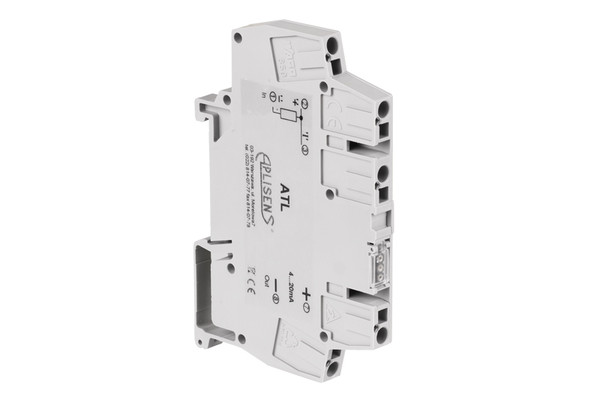
The Aplisens ATL Rail-Mounted Temperature Transmitter converts Pt100 / Ni100 RTD resistance into a standard 4–20 mA output and is programmable for sensor type and measuring range. For accurate selection and pricing, please call 865-900-8844 or email KSmith@CPSCalibrations.com.
The Aplisens ATL is an economical rail-mounted temperature transmitter designed to convert the resistance of a temperature sensor into a standard 4–20 mA current signal. The ATL is programmable (sensor type and measuring range) and supports 3-wire RTD line compensation. Programming is performed using a PC with an RS converter and Aplisens configuration software.
- Input sensors: Pt100, Ni100
- Output: 4–20 mA
- Mounting: DIN rail / rail mounting system
- RTD wiring: thermoresistance line compensation (3-wire)
- Alarm current: 23 mA or 3.8 mA
If you specify sensor type and measuring range when ordering, the transmitter can be factory programmed and labeled accordingly.
| Feature | Details |
|---|---|
| Model | ATL Rail-Mounted Temperature Transmitter |
| Input Signal | Pt100, Ni100 |
| Input Resistance Range | 20 Ω < R < 380 Ω |
| Minimum Measuring Range | 10 Ω |
| Output Signal | 4–20 mA |
| Power Supply | 6…29 V DC |
| Load Resistance | RO [kΩ] < (UZ – 7 V) / 25 mA |
| Alarm Signal | 23 mA or 3.8 mA |
| Accuracy | For ΔR > 20 Ω: ±0.2% |
| Thermal Error | ±0.1% / 10°C |
| Error vs Supply Voltage Changes | ±0.1% |
| Ambient Temperature | -25…+80°C |
ATL pricing depends on sensor type, range, and alarm selection. To quote correctly, we typically confirm:
| What We Need | Examples |
|---|---|
| Sensor Type | Pt100 or Ni100 |
| Measuring Range | Example: 0…100°C (custom ranges available within limits) |
| Alarm Output | 23 mA or 3.8 mA |
| Panel Supply | Available DC supply (6…29 VDC) |
Ordering format: ATL / ___ / __÷__°C / ___
Example: ATL / Pt100 / 0…100°C / 23mA
Call 865-900-8844 or email KSmith@CPSCalibrations.com and we’ll quote the correct configuration.
Need help selecting Pt100 vs Ni100, confirming your range, or load resistance? Reach out and we’ll help.