
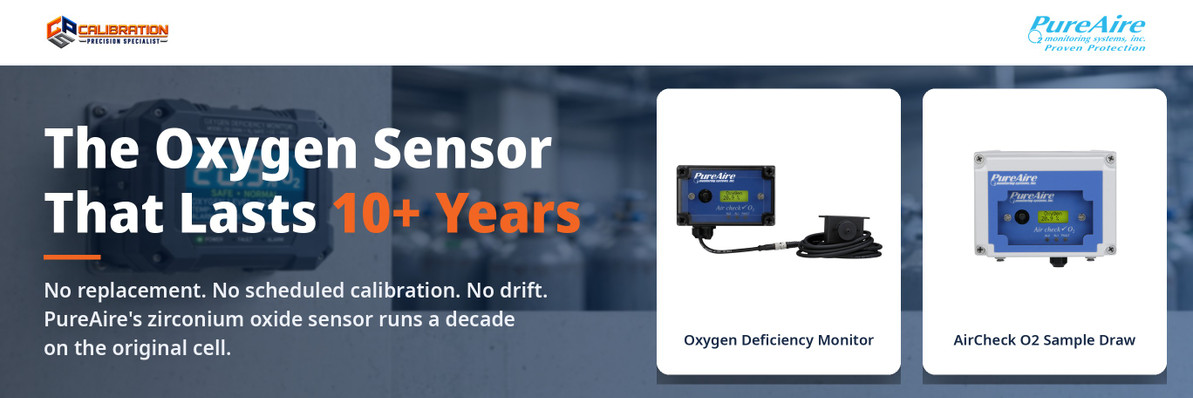
PureAire's Long-Lasting O2 Sensor: Why Their Oxygen Monitor Runs 10+ Years Without a Sensor Swap
If you manage a facility that stores nitrogen, argon, helium, or CO2, you know the weak point in most oxygen deficiency monitors: the sensor itself. Standard electrochemical O2 sensors deplete with use and typically need replacing every 1 to 2 years — plus the calibration, labor, and downtime that come with them. PureAire built their oxygen monitors around a different sensor, and it's the reason their units routinely run a decade or more on the original cell.
Here's how it works, and why it matters for your safety budget.
The Short Answer
- PureAire sensor: non-depleting zirconium oxide cell, rated for 10+ years in a normal environment with no replacement and typically no calibration required
- Standard electrochemical sensor: depleting cell that lasts 1-2 years before it needs replacing, and must be calibrated frequently to stay accurate
- Bottom line: one PureAire sensor can outlast five to ten generations of electrochemical sensors
Why Most Oxygen Sensors Die So Young
An electrochemical oxygen sensor works like a battery: the sensing electrode is consumed as part of the chemical reaction that detects oxygen. Like a battery, it loses power and responsiveness as it depletes. And just like a battery, you can't recharge it — when it's gone, it's gone.
That depletion has three real-world costs:
1. Replacement sensors every 12-24 months — the cell, plus shipping, plus the labor to swap it
2. Frequent calibration — electrochemical sensors drift as they deplete, so you have to calibrate often to trust the readings
3. Unplanned failures — a sensor that dies between calibration cycles can fail quietly, leaving a blind spot in your monitoring
In a nitrogen storage room or freezer, a dead O2 monitor is a serious safety gap. Oxygen depletion is invisible and odorless — by the time a person notices the symptoms, they're already in danger.
How PureAire's Zirconium Oxide Sensor Is Different
PureAire uses a proprietary current-limiting zirconium oxide sensor instead of an electrochemical cell. The key word is non-depleting: the zirconia cell isn't consumed by the sensing reaction, so it doesn't wear out on a 1-2 year clock. PureAire rates the sensor at 10+ years of accurate operation in a normal environment — and they note that some of their earliest customers, who started using the monitors in 1997, still have the original sensors in service today.
A few things that make this sensor design practical in the field:
- No reference gas needed. The cell can operate reliably in atmospheres that are essentially 100% nitrogen — exactly the kind of oxygen-deficient environment you're monitoring.
- No calibration typically required. Per PureAire, the sensors are made of non-depleting zirconium oxide and calibration is typically not required — there are no zero or span pots to adjust.
- No scheduled maintenance. Once installed, the monitor runs continuously on its own.
- Immune to barometric drift. The PureAire sensor doesn't operate on partial pressure, so readings don't drift with barometric pressure changes or thunderstorms, and the monitor needs no adjustment for elevation.
- Extreme temperature range. It performs from -40°C to +55°C, which is why these monitors go into freezers, cryogenic facilities, and frozen-food plants without special accommodations.
What That Means in Dollars
PureAire estimates that the long-life zirconium sensor can save up to $475 per year compared to monitors with disposable sensors — between replacement cells, calibration gas, and service labor. At that rate, the monitor pays for the sensor difference in just over three years, and then you're running years four through ten (and beyond) on the original cell.
Run your own numbers: count the sensor replacements, calibration cylinders, and technician hours your current oxygen monitors consume over a decade, and compare. The 10-year sensor turns a recurring line item into a one-time purchase.
Built for the Jobs That Need It
PureAire's oxygen deficiency monitors are built for anywhere an inert-gas leak could displace oxygen:
- Nitrogen, argon, and helium storage and piping areas
- Cryogenic facilities and freezers
- Confined spaces and gas storage rooms
- Laboratories, semiconductor tools, and glove boxes
- Beverage stations (CO2) in bars and restaurants
- Food processing and hyperbaric chambers
Every unit carries the standard safety package: dual user-adjustable alarm relays (defaults at 19.5% — the OSHA action level — and 18.0%), a built-in 90 dB audible alarm, digital display, 4-20mA analog output, wall-mount brackets, a 24V DC power supply, UL/CUL and CE approvals, and a 3-year warranty. Supervised watchdog software self-checks the monitor's operation and flags inconsistencies.
The remote-sensor versions put the sensor where the hazard is — up to 10 feet away — with the display and alarm where your people can see and hear them.
FAQ
Do PureAire oxygen monitors really need no calibration?
PureAire states that calibration is typically not required for their zirconium oxide sensors, since the cell doesn't deplete or drift like electrochemical sensors. If your written safety program requires periodic verification, a functional bump check is simple to perform — but there's no calibration schedule built into the product.
What happens if the sensor does fail?
Supervised watchdog software continuously checks that the monitor is working properly and notifies you of inconsistencies, so a failed sensor doesn't silently stop protecting the area.
Will the sensor work at my altitude?
Yes. Unlike partial-pressure sensors, PureAire's zirconium oxide sensor doesn't require adjustment for elevation or barometric pressure changes.
How long is the warranty?
Three years on the monitor. The sensor itself is rated for 10+ years in a normal environment.
Where should the monitor be installed?
Mount it where an inert-gas leak would most likely accumulate — low for heavy gases like argon and CO2, or per your ventilation layout. Remote-sensor models let you put the sensor in a confined space or freezer while the alarm stays in a visible location.
The Bottom Line
Most oxygen monitors hide a recurring cost inside a disposable sensor. PureAire's zirconium oxide sensor removes it: a non-depleting cell rated for 10+ years, no scheduled calibration or maintenance, no drift from weather or altitude, and operation down to -40°C. If you run nitrogen, argon, helium, or CO2 anywhere people work, it's one of the few safety upgrades that pays for itself and then keeps paying for years.
Need help picking the right PureAire oxygen monitor for your facility? Call CPS Calibrations at 865-900-8844 or browse our PureAire oxygen monitors. Tell us where your inert gases are stored and we'll match you to the right model.
Recent Posts
-

Electrochemical Toxic Sensors: Cross-Sensitivities That Fool Your Readings
Your carbon monoxide alarm goes off in the battery room. You sweep the area — there's no CO source a …Oct 8th 2026 -

Why Oxygen Sensors Die — and How to Make Them Last
Every 4-gas monitor has an oxygen channel, and it's the only channel with a built-in expiration date …Oct 7th 2026 -
Catalytic Bead vs. Infrared LEL Sensors: When Each Wins
Most gas detectors read %LEL the same way on the display. What's happening behind that number is any …Oct 6th 2026