
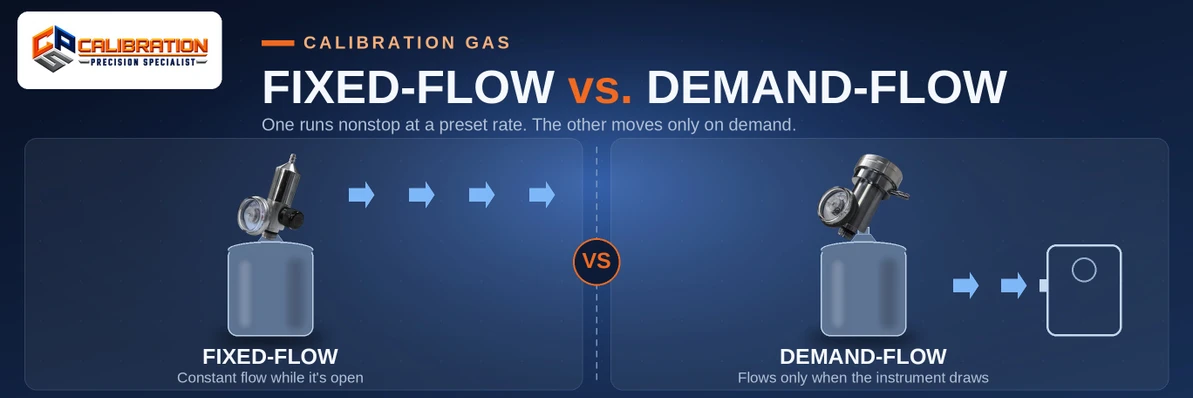
Fixed-Flow vs. Demand-Flow Regulators: Why It Matters
Every calibration and bump test runs through a regulator — the small brass or stainless fitting between the cylinder and the instrument. It's the least glamorous part of the gas detection kit, and it's responsible for an outsized share of calibration headaches: mysterious failed bump tests, cylinders that die months early, and calibrations that look fine on paper but weren't.
The regulator's job is simple — deliver calibration gas from a high-pressure cylinder to the instrument at a usable pressure. But how it delivers that gas splits into two very different designs, and matching the wrong one to your detector causes real problems. Here's the breakdown.
Fixed-Flow Regulators: Steady, Preset, Always On
A fixed-flow regulator delivers gas at one constant, preset rate — 0.5 liters per minute, for example — from the moment you open the valve until you close it. There's no adjustment knob to fiddle with and nothing for the instrument to trigger. You pick the flow rate when you buy the regulator, matched to what your instrument's manufacturer specifies for calibration and bump testing.
This is the right regulator for diffusion instruments — detectors like the RKI GX-3R or SENKO SP-MGT that sample the air around them passively, with no internal pump. During a calibration, gas flows from the regulator through a cal cup or tubing into the sensor chamber at the specified rate (0.5 LPM is the most common spec across portable instruments), and the sensor reads the known concentration. Our C-10 fixed-flow regulator covers the usual range — 0.1 through 6.0 LPM — so you can match whatever your instrument calls for, and the CGA-600 version fits larger cylinders.
The strength of fixed-flow is repeatability: the same flow, every time, for every instrument on the bench. The weakness is that it never stops on its own. Open the valve, run the test, and close the valve — because a fixed-flow regulator left cracked open will quietly drain a cylinder overnight. That's one of the most common ways good calibration gas ends up wasted.
Demand-Flow Regulators: Gas Only When Asked
A demand-flow regulator works the opposite way: it stays shut until the instrument's pump pulls gas through it. The negative pressure from the pump opens the regulator's internal valve, gas flows at exactly the rate the pump draws, and when the pump stops, the flow stops. Nothing to open, nothing to remember to close, and no preset flow rate to choose.
This is the right regulator for pumped (aspirated) instruments — detectors with an internal sample pump, like pumped configurations of RKI instruments or the SENKO SP-MGT-P. The pump does the work; the regulator just keeps up. Our C-10 demand-flow regulators come in nickel-plated brass for standard mixes and stainless steel for reactive gases.
The strength of demand-flow is zero waste and zero setup: no flow rate to match, no valve to forget. The limitation is that it's useless without a pump — put it on a diffusion instrument and nothing flows at all.
Why It Matters: Three Expensive Mistakes
1. The "failed" bump test that isn't. A demand-flow regulator on a diffusion instrument delivers exactly zero gas — there's no pump to open the valve. The sensor reads nothing, the bump test "fails," and the technician starts troubleshooting a perfectly good sensor. We've seen this exact mismatch burn hours of bench time. If your diffusion detectors suddenly won't respond to gas, check the regulator before you blame the sensor.
2. The drained cylinder. A fixed-flow regulator left open after a calibration keeps flowing until the bottle is empty. On a 34L or 58L cylinder, that's real money vented into the shop air — and the next bump test finds a dead bottle. Demand-flow regulators can't do this; they shut off with the pump. If your gas budget keeps coming up short, audit who's closing the valves.
3. The invalid calibration. Gas delivery is part of the calibration. Too much flow on a diffusion instrument can pressurize the cal cup and skew the reading; too little and the sensor never sees the full concentration. Either way, the certificate documents a calibration that didn't happen under the right conditions. Matching the manufacturer-specified flow rate isn't a nicety — it's what makes the calibration valid.
Choosing the Right One
The decision is simpler than the catalog makes it look:
- Diffusion instrument? → Fixed-flow regulator at the manufacturer's specified LPM (usually 0.5). RKI GX-3R, SENKO SP-MGT, and most personal monitors live here.
- Pumped instrument? → Demand-flow regulator. Pumped RKI units, SENKO SP-MGT-P, and anything with an internal sample pump live here.
- Reactive gas (H₂S, Cl₂, NH₃, HCl)? → Stainless steel body, not brass. Reactive gases attack brass internals over time; stainless holds up. This applies to either flow type.
- Which valve? → C-10 for the small portable cylinders (17L–103L); CGA-600 for larger cylinders. Match the regulator to the cylinder, not just the instrument.
One regulator type doesn't win everywhere — most shops end up owning both, because most fleets include both diffusion and pumped instruments. What matters is that the right one is on the right bottle at the right time, and that everyone on the bench knows the difference.
The Calibration Angle
Here's where this connects to our benches: gas delivery is half the calibration. When detectors come through our lab — gas detection and process instruments alike, temperature, flow, pressure, and gas — we challenge every channel with the correct regulator, the manufacturer-specified flow, and fresh, NIST-traceable gas inside its certified life. The certificate shows the gas lot behind the work. We calibrate every channel, and we prove it on paper.
Not sure which regulator your fleet needs? Call us at 865-900-8844 — we'll match regulators to your instruments and your gas before you spend a dollar. Ship your detectors to our lab or have us come to your facility.
The Bottom Line
Fixed-flow regulators deliver a steady, preset flow for diffusion instruments — simple and repeatable, but they'll drain a cylinder if you forget to close the valve. Demand-flow regulators deliver gas only when a pump draws it — zero waste and no setup, but only for pumped instruments. The expensive mistakes are all mismatches: demand-flow on a diffusion detector (no gas flows), fixed-flow left open (cylinder drained), or the wrong flow rate (invalid calibration). Diffusion gets fixed-flow at the spec'd LPM; pumped gets demand-flow; reactive gases get stainless. Get that right and the regulator disappears from your list of problems.
Stocking up? Browse calibration gas — single-gas bottles and multi-gas mixes — plus fixed-flow and demand-flow regulators. Need your fleet verified? Ship your detectors to our lab or have us come to your facility — gas detection and process instruments alike.
Frequently Asked Questions
Can I use a demand-flow regulator on a diffusion gas detector? No — and this is the most common regulator mistake in the field. A demand-flow regulator only opens when an instrument's pump draws gas through it. A diffusion instrument has no pump, so no gas flows, the sensor reads zero, and the bump test or calibration "fails." Use a fixed-flow regulator at the manufacturer's specified flow rate for diffusion instruments.
Can I use a fixed-flow regulator on a pumped instrument? It will work — the pump draws what it needs and excess flow vents off — but it's wasteful, and you still need the preset flow rate to meet or exceed what the pump draws. Demand-flow is the cleaner choice for pumped instruments: no flow to select, no valve to close, no wasted gas.
What flow rate should I choose for a fixed-flow regulator? Whatever your instrument's manufacturer specifies for calibration — 0.5 LPM is the most common across portable gas detectors, but check the manual. Too much flow can pressurize the calibration cup and skew readings; too little and the sensor never sees the full concentration. When in doubt, call us at 865-900-8844.
Do I need stainless steel or is brass fine? For non-reactive gases (methane, CO, pentane, O₂, most 4-gas mixes), nickel-plated brass is fine. For reactive gases — H₂S, Cl₂, NH₃, HCl — use stainless steel; reactive gases attack brass internals over time and the regulator becomes a consumable. We stock the C-10 demand-flow in both brass and stainless.
What's the difference between C-10 and CGA-600? They're valve connections, not flow types. C-10 is the small threaded connection on portable calibration cylinders (17L–103L); CGA-600 fits larger cylinders. Pick the regulator whose inlet matches your cylinder, then pick the flow type (fixed vs. demand) to match your instrument.
How do I make a cylinder last longer? Close the valve. Seriously — a fixed-flow regulator left open is the number-one cause of prematurely empty cylinders. For pumped fleets, switching to demand-flow regulators eliminates the problem entirely. Also size the cylinder to what you'll consume before the gas expires (see our post on calibration gas shelf life).
CPS Calibrations · 109 S. Front Street, Rockwood, TN 37854 · Portable Gas Detection · Calibration Gas · Calibration Services · Contact Us
Recent Posts
-

What Is a Confined Space? OSHA's Definition, the 3 Tests, and When It Becomes Permit-Required
A confined space is a space that passes all three of OSHA's tests at the same time: it is large enou …Oct 21st 2026 -

PID vs. LEL for VOC Detection: Which Sensor Do You Actually Need?
Use a PID to detect VOCs and an LEL sensor to detect explosive atmospheres — they measure different …Oct 21st 2026 -

Semiconductor (MOS) Gas Sensors: Where They Work and Where They Lie
A semiconductor (MOS) gas sensor measures gas with a heated film of metal oxide — usually tin dioxid …Oct 21st 2026