
PID vs. LEL for VOC Detection: Which Sensor Do You Actually Need?
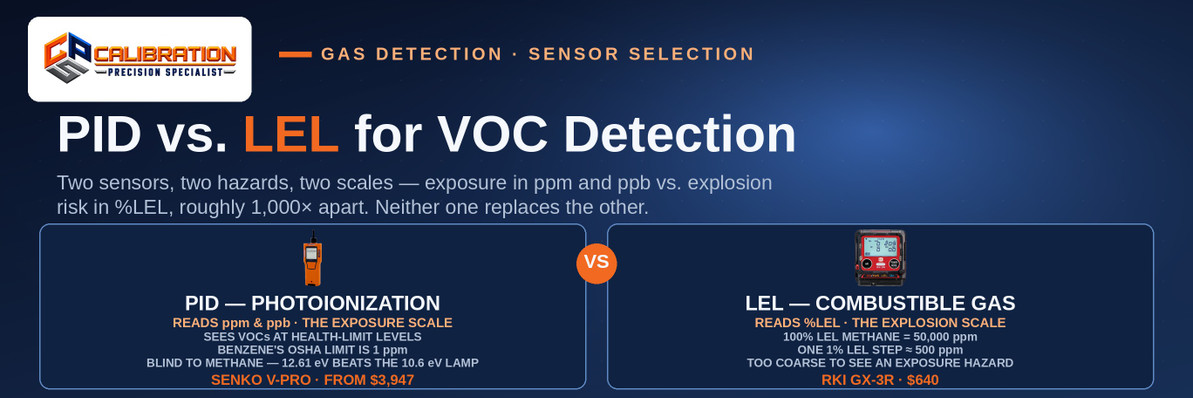
Use a PID to detect VOCs and an LEL sensor to detect explosive atmospheres — they measure different hazards on scales roughly 1,000× apart. A PID reads volatile organic compounds in ppm and ppb (the SENKO V-PRO resolves 0.1 ppm, and 1 ppb on its high-sensitivity range), which is where solvent exposure limits live — benzene's OSHA limit is 1 ppm. An LEL sensor reads combustible gas as a percentage of the lower explosive limit, where 100% LEL for methane is 5% by volume (50,000 ppm) and one 1% LEL step is about 500 ppm — far too coarse to see an exposure hazard. The blind spot runs both ways: a standard 10.6 eV PID cannot detect methane at all, so neither sensor replaces the other.
This is the most common sensor mix-up we run into. A crew checks an area with a 4-gas monitor, the LEL channel reads zero, and everyone relaxes — while solvent vapor sits at a concentration that matters for health but is nowhere near flammable. Or the reverse: someone waves a PID over a natural-gas leak, gets nothing, and concludes the line is clear, when the PID was physically incapable of seeing the gas. Both instruments were working perfectly. They were just answering different questions.
What Does an LEL Sensor Actually Measure?
An LEL sensor — catalytic bead or infrared, the two technologies in our catalytic bead vs. infrared head-to-head — measures combustible gas as a percentage of the lower explosive limit: the lowest concentration in air that can ignite. The scale is set by the gas:
- Methane: LEL is 5% by volume = 50,000 ppm. So 10% LEL (a typical low alarm) is 5,000 ppm, and the sensor's usual 1% LEL resolution step is about 500 ppm.
- Propane: LEL is 2.1% by volume = 21,000 ppm.
- Toluene: LEL is 1.1% by volume = 11,000 ppm.
Everything about the LEL channel — its range, its resolution, its alarms at 10% and 20% LEL — is calibrated to one job: warn you before the atmosphere can burn. It does that job well. What it cannot do is resolve anything at the bottom of its scale. A reading of 0% LEL means "less than roughly 500 ppm of methane-equivalent combustible gas" — it does not mean "no vapor."
What Does a PID Actually Measure?
A photoionization detector shines ultraviolet light — 10.6 eV on the standard lamp — across the sampled air. VOC molecules with an ionization energy below the lamp's energy are ionized, and the resulting current is proportional to concentration. The result is a total-VOC reading in ppm, at sensitivities no LEL sensor approaches:
- The SENKO V-PRO ($3,947) is a pumped, IP68 PID with a standard 0–4,000 ppm range at 0.1 ppm resolution, or a high-sensitivity 0–40 ppm range that resolves 1 ppb ($5,011), running up to 60 hours per charge.
- Because a PID is calibrated on isobutylene, its display reads in isobutylene equivalents — multiply by the compound's correction factor to get the true concentration (benzene ×0.53, toluene ×0.50, n-hexane ×4.3, per Honeywell RAE Technical Note TN-106). Our PID correction factors post works that arithmetic in full.
That sensitivity is the point. Exposure limits for common solvents sit at tens of ppm and below — benzene at 1 ppm (OSHA 8-hour PEL), toluene at 200 ppm PEL with a NIOSH recommended limit of 100 ppm. A PID works on exactly that scale. An LEL sensor cannot see it at all.
The Same Vapor, Read by Both Sensors: A Worked Example
Take 50 ppm of toluene in air — a genuine exposure concern, half of NIOSH's recommended limit:
- On a PID: a clear, mid-scale reading (about 100 ppm displayed in isobutylene equivalents before the ×0.50 correction factor).
- On an LEL sensor: 50 ppm against toluene's 11,000 ppm LEL is roughly 0.45% LEL — below the sensor's 1% LEL resolution. The display reads zero.
Now take the opposite case, a methane leak at 25% LEL (12,500 ppm — a quarter of the way to an ignitable mixture):
- On an LEL sensor: an urgent high alarm, exactly as designed.
- On a 10.6 eV PID: nothing. Methane's ionization energy is 12.61 eV, above the lamp's energy, so methane is invisible to a PID at any concentration. The same is true of most light inorganic gases.
Two hazards, two scales, and each sensor is blind to the other's home ground. That is the whole comparison in one pair of examples.
PID vs. LEL, Side by Side
| PID | LEL sensor (catalytic / infrared) | |
|---|---|---|
| Measures | Total ionizable VOC vapor | Combustible gas |
| Units | ppm / ppb | %LEL (and % volume on some IR) |
| Typical range | 0–4,000 ppm (V-PRO); 0–40 ppm high-sensitivity | 0–100% LEL (50,000 ppm for methane) |
| Finest step | 0.1 ppm; 1 ppb high-sensitivity | 1% LEL ≈ 500 ppm methane |
| Hazard it answers | Exposure — "is this vapor level unhealthy?" | Explosion — "can this atmosphere ignite?" |
| Sees methane? | No — IE 12.61 eV > 10.6 eV lamp | Yes — its primary job |
| Names the gas? | No — total VOC; needs a correction factor | No — reads relative to its calibration gas; needs correction factors for other combustibles |
| Calibration gas | Isobutylene | Typically methane or pentane |
| Weaknesses | Blind above its lamp energy; humidity and lamp fouling shift readings; can't speciate a mixture | Far too coarse for ppm exposure work; catalytic beads need oxygen and can be poisoned |
Note the honest row in the middle: neither sensor names its gas. A PID totals every ionizable vapor into one number; an LEL channel reads every combustible relative to the gas it was calibrated on. Both need correction-factor thinking when the gas in the air isn't the gas in the cylinder.
When Do You Use Which?
Use an LEL sensor when the question is flammability. Confined-space entry, hot work, leak checks on fuel-gas lines, any atmosphere that could reach an ignitable concentration — that is %LEL work, and it belongs on the LEL channel of a portable multi-gas monitor. This is non-negotiable: no PID reading, at any sensitivity, clears an atmosphere for ignition risk, because the PID can't see methane and reads the flammable solvents it can see on the wrong scale.
Use a PID when the question is exposure or trace vapor. Solvent handling, painting and coating, printing, chemical processing, hazmat screening, indoor air investigations, leak hunting at ppm levels — anywhere the concern is "how much vapor are people breathing, or where is it coming from?" long before it's "will it burn?" A 0% LEL reading is not evidence about any of those questions.
Use both when both hazards are real — which is often. Solvent work in a space that also has fuel gas, remediation sites, refineries, wastewater plants: the exposure hazard and the explosion hazard coexist, at concentrations a thousand-fold apart. That is why combination instruments exist — the RKI GX-6100 carries a PID alongside %LEL and toxic channels in one pumped housing, so one sample draw answers both questions. One instrument, two scales, no blind spot traded for the other.
The Mistakes This Comparison Prevents
- "LEL reads zero, so the air is clean." Zero %LEL means "not close to flammable." It says nothing about ppm-level vapor, which is where chronic and acute exposure limits live.
- "The PID reads zero, so there's no gas leak." If the leaking gas is methane, propane from an un-ionizable fraction, or any compound above the lamp energy, the PID is blind to it. Leak-check fuel gas with the LEL channel.
- "The PID number is the solvent concentration." It's isobutylene equivalents until you apply the correction factor — 0.50 for toluene, 4.3 for hexane. Skipping the factor can understate a weak responder like hexane by more than 4×.
- "One sensor is 'better.'" Sensitivity is not superiority. A ppb-capable PID pointed at an explosion hazard and a %LEL sensor pointed at an exposure hazard are both the wrong tool, in opposite directions.
Frequently Asked Questions
Can a PID replace an LEL sensor? No. A standard 10.6 eV PID cannot detect methane at all — methane's ionization energy (12.61 eV) is above the lamp's photon energy — and it reads flammable vapors in ppm rather than as a percentage of the explosive limit. Explosion protection requires an LEL sensor (catalytic or infrared) reading in %LEL. A PID complements the LEL channel; it never substitutes for it.
Can an LEL sensor detect VOCs at exposure levels? No. An LEL sensor's finest step is typically 1% LEL, which for methane is about 500 ppm — and solvent exposure limits sit far below that: benzene's OSHA PEL is 1 ppm, and NIOSH recommends 100 ppm for toluene. Vapor at a hazardous exposure level routinely reads 0% LEL. VOC exposure measurement requires a PID, which resolves 0.1 ppm (1 ppb on high-sensitivity instruments like the SENKO V-PRO's 0–40 ppm range).
What is the difference between ppm and %LEL? They are different scales for different hazards. ppm counts vapor molecules per million parts of air; %LEL expresses combustible gas as a percentage of the concentration that can ignite. For methane, 100% LEL = 5% by volume = 50,000 ppm, so 1% LEL ≈ 500 ppm. A hazard can be serious in one scale and invisible in the other: 50 ppm of toluene is a real exposure and only about 0.45% LEL.
Why can't a PID detect methane? Because photoionization only works when the lamp's photon energy exceeds the molecule's ionization energy. A standard PID lamp emits 10.6 eV; methane needs 12.61 eV. Even an 11.7 eV lamp cannot ionize methane. Methane detection belongs to catalytic and infrared LEL sensors.
What gases can a PID detect that an LEL sensor reads poorly? Aromatics and solvents at exposure-level concentrations: benzene, toluene, xylene, styrene, MEK, acetone, and hundreds of other VOCs whose ionization energies sit below 10.6 eV. An LEL sensor responds to these gases only as they approach thousands of ppm near their explosive limits; a PID reads them accurately (after the correction factor) at the ppm levels where exposure limits apply.
Do I need both a PID and an LEL sensor? If your work involves both flammable atmospheres and solvent vapor — chemical plants, remediation, coating and printing operations, wastewater treatment — yes. The explosion hazard is measured in %LEL and the exposure hazard in ppm, roughly a thousand-fold apart, and each sensor is blind on the other's scale. Combination instruments such as the RKI GX-6100 carry PID, %LEL, and toxic channels together for exactly this reason.
What does a PID reading mean if I don't know which vapor is present? It means "total ionizable vapor, in isobutylene equivalents." A PID cannot separate a mixture into its components. If the vapor is known, apply its correction factor (TN-106: benzene 0.53, toluene 0.50, n-hexane 4.3 at a 10.6 eV lamp). If the mixture is unknown, treat the reading as a screening total and investigate — don't assign it to one compound.
Which sensor is better for finding leaks? It depends on the leaking gas and the leak size you care about. For fuel-gas leaks (natural gas, propane lines), use the LEL channel — a PID can't see methane. For solvent and refrigerant-adjacent VOC leaks, a PID's ppm–ppb sensitivity finds traces an LEL sensor walks straight past, because a small solvent leak never gets near 1% LEL (≈500 ppm methane-equivalent). Match the sensor to the gas first, then to the concentration.
How are PIDs and LEL sensors calibrated? A PID is span-calibrated with isobutylene; an LEL channel is span-calibrated with its target combustible, typically methane or pentane, and both need a fresh-air zero first. CPS calibrates every channel on the instruments it services — see our calibration services and calibration gas categories for the gases involved.
How much does a PID cost compared to a regular 4-gas monitor? More — PID sensing is the premium channel. At CPS, a standard 4-gas monitor like the RKI GX-3R is $640, while a dedicated PID instrument like the SENKO V-PRO starts at $3,947 (high-sensitivity version $5,011). The middle path is a combination monitor: RKI GX-6100 builds start at $1,597, and a 4-gas + PID configuration runs $3,455 — one housing carrying both the %LEL and the ppm scales.
The Bottom Line
PID and LEL are not competing versions of the same measurement — they are two measurements, of two hazards, on scales about a thousand times apart. The LEL sensor guards the line between "flammable" and "not yet," in %LEL, and cannot see down to exposure levels. The PID guards the line between "acceptable to breathe" and "not," in ppm and ppb, and cannot see methane at all. Read a zero on either one as an answer only to its own question — and where both questions are live, carry both sensors.
Not sure which hazard your application actually presents? Call 865-900-8844 or reach us through Contact Us. Browse portable gas detection, the SENKO V-PRO PID, or the RKI GX-6100 if you need both channels in one instrument.
CPS Calibrations · 109 S. Front Street, Rockwood, TN 37854 · Calibration Gas · Calibration Services · Contact Us
Recent Posts
-

Why Does Gas Detector Data Logging Matter? The Paper Trail Your Incidents Need
Gas detector data logging matters because it is the only objective record of an incident: a data-log …Oct 22nd 2026 -

What Is a Confined Space? OSHA's Definition, the 3 Tests, and When It Becomes Permit-Required
A confined space is a space that passes all three of OSHA's tests at the same time: it is large enou …Oct 21st 2026 -

PID vs. LEL for VOC Detection: Which Sensor Do You Actually Need?
Use a PID to detect VOCs and an LEL sensor to detect explosive atmospheres — they measure different …Oct 21st 2026