
What Is a Confined Space? OSHA's Definition, the 3 Tests, and When It Becomes Permit-Required
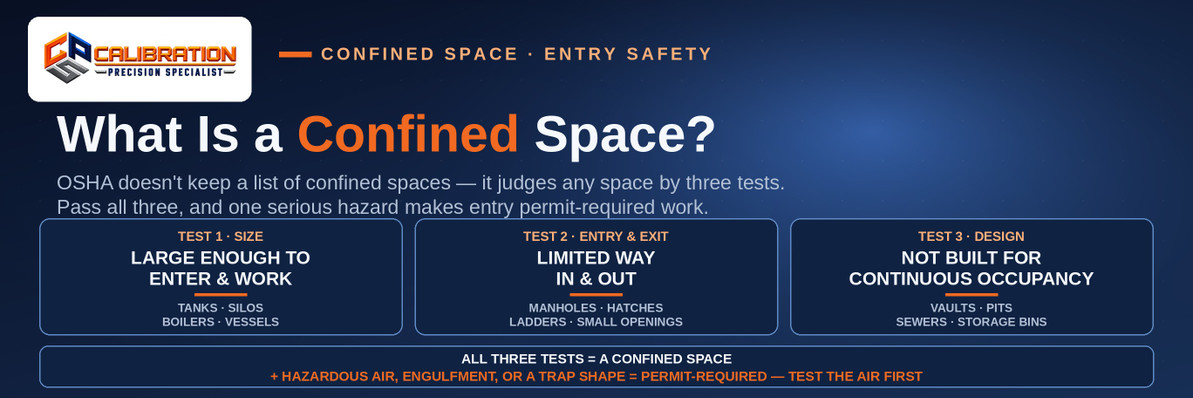
A confined space is a space that passes all three of OSHA's tests at the same time: it is large enough and so configured that an employee can bodily enter and perform assigned work, it has limited or restricted means for entry or exit, and it is not designed for continuous employee occupancy (29 CFR 1910.146). Tanks, vessels, silos, storage bins, hoppers, vaults, and pits are OSHA's own examples. If that space also contains — or could contain — a hazardous atmosphere, engulfing material, a trap-shaped interior, or another serious hazard, it becomes a permit-required confined space, and the air inside must be tested with a gas detector before anyone enters.
Notice what the definition is not: it is not a list. OSHA never published a catalog of confined spaces, because the same structure can be a confined space in one plant and an ordinary room in another. What OSHA published is a test — three questions you ask about any space your people might climb into. This post walks the three tests, judges the spaces people ask about most, explains the four triggers that turn a confined space into a permit-required one, and covers why the classification always ends at the same place: a gas detector, run before entry.
What Is OSHA's Definition of a Confined Space?
The definition lives in OSHA's Permit-Required Confined Spaces standard, 29 CFR 1910.146, and it is worth reading in OSHA's own words, because every word does work:
"Confined space means a space that: (1) Is large enough and so configured that an employee can bodily enter and perform assigned work; and (2) Has limited or restricted means for entry or exit (for example, tanks, vessels, silos, storage bins, hoppers, vaults, and pits are spaces that may have limited means of entry.); and (3) Is not designed for continuous employee occupancy."
Three tests, joined by "and." A space must pass all three to be a confined space. Fail any one of them and — under this standard — it is not a confined space, whatever it looks like. (Construction work runs under a parallel rule, 29 CFR 1926 Subpart AA, with essentially the same three-part definition.) Pass all three, and a second question decides how serious the entry rules get: does the space carry one of the four permit triggers covered below?
The Three Tests, One by One
Test 1: Large Enough to Bodily Enter and Perform Work
The worker's whole body has to fit, and the space has to be configured so they can actually do the job inside — inspect, clean, repair, unclog. A tank entered through a manhole passes. A pipe too small to enter fails this test: nobody can bodily enter it, so it sits outside the standard (which is not the same as calling it safe — it just isn't regulated as a confined space). Size alone doesn't pass the test, either: a warehouse-sized room is large enough to enter, but it usually fails Tests 2 and 3.
Test 2: Limited or Restricted Means of Entry or Exit
This is the test that surprises people. "Limited or restricted" doesn't mean locked or blocked — it means getting in and out is constrained by the space's design: a manhole you lower yourself through, a hatch and a ladder, a small doorway you have to duck and twist through, an opening at height. The practical question is the emergency one: if the entrant collapses inside, can they get out fast, and can anyone get them out? A space you exit through a full-size door at floor level, the way you walk out of an office, generally fails this test. A space you exit by climbing a fixed ladder to a 24-inch hatch passes it — and that slow, awkward exit is exactly what the rule is worried about.
Test 3: Not Designed for Continuous Employee Occupancy
Confined spaces were built to hold something else — product, water, steam, grain, sewage — not people. They typically lack the ventilation, lighting, and room to move that a designed workspace has, and bad air can accumulate in them undisturbed for months. A control room, office, or staffed pump room is designed for people to occupy all shift, so it fails this test even if it's small. A storage tank is occupied by its contents; a worker inside it is a guest in a space that was never meant to keep them alive.
Common Spaces, Judged Against the Three Tests
| Space | Confined space? | Why |
|---|---|---|
| Water storage tank | Yes | Entered through a manhole to inspect or clean; holds water, not people |
| Grain silo or bin | Yes | Limited entry, holds product — and grain adds an engulfment hazard (permit trigger) |
| Sewer or utility manhole | Yes | Ladder entry through a small opening; never designed for occupancy |
| Boiler or furnace | Yes | Entered through a small access door for inspection and repair |
| Tanker truck or rail car | Yes | Hatch entry, product space — a confined space that travels |
| Utility vault | Yes | Ladder or hatch entry; built for equipment, visited briefly |
| Crawl space | Often | Depends on entry size and configuration: a low crawl entered through a small hatch usually passes all three tests |
| Attic | Depends | A floored attic with stair access may fail Tests 2 and 3; a hatch-and-ladder attic not designed for occupancy usually passes |
| Equipment room with full-size doors | Usually no | Walk-in, walk-out access and designed ventilation fail Tests 2 and 3 |
| Open excavation or trench | Usually no | Open top means entry and exit aren't restricted — trenches are regulated under the excavation rules instead |
"Often" and "depends" are honest answers, not evasions: the tests judge the actual space, not the label on the door. When a space sits on the line, the safe move is to evaluate it in writing against all three tests — and to treat it as confined until that evaluation says otherwise.
When Does a Confined Space Become Permit-Required?
A confined space becomes a permit-required confined space when it has one or more of these four characteristics, again in 1910.146's words:
- It contains or has the potential to contain a hazardous atmosphere.
- It contains a material that has the potential for engulfing an entrant — grain, sand, catalyst, liquid, or any material that can flow around and trap a person.
- It has an internal configuration that could trap or asphyxiate an entrant — inwardly converging walls, or a floor that slopes downward and tapers to a smaller cross-section.
- It contains any other recognized serious safety or health hazard — exposed energized parts, moving machinery, extreme heat, and the like.
Most industrial confined spaces are permit-required because of the first trigger, and note its wording: contains or has the potential to contain. A tank that tests clean today can generate a hazardous atmosphere tomorrow — rust consuming oxygen, residue fermenting into hydrogen sulfide, sludge releasing trapped gas when it's disturbed. Potential counts.
A confined space with none of the four triggers is a non-permit confined space, and it can be entered without the permit program. But the classification isn't permanent: if hazards arise — hot work starts, product is introduced, conditions change — the space must be re-evaluated, and a space whose hazards are genuinely eliminated can be reclassified as non-permit under 1910.146(c)(7), with the basis documented in writing.
What Counts as a Hazardous Atmosphere?
OSHA defines it precisely, and the numbers are the ones your gas detector's alarms are built around. An atmosphere is hazardous if it may expose an entrant to death, incapacitation, impaired self-rescue, injury, or acute illness from any of these:
- Flammable gas, vapor, or mist above 10% of its lower flammable limit (LEL).
- Airborne combustible dust at or above its LEL — roughly, dust dense enough to obscure vision at 5 feet or less.
- Oxygen below 19.5% or above 23.5%.
- Any toxic substance above its OSHA permissible exposure limit (PEL) — hydrogen sulfide, carbon monoxide, and others listed in Subpart Z.
- Any other condition that is immediately dangerous to life or health (IDLH).
Read those against the standard four gases on a confined-space monitor and the match is exact: oxygen for the 19.5/23.5 lines, %LEL for the 10% flammability trigger, CO and H₂S for the toxic limits. The detector isn't an accessory to the definition — its alarm setpoints are the definition, in instrument form. (Why you can never trust your nose for hydrogen sulfide is its own story — the gas paralyzes your sense of smell at about 100 ppm, exactly where it turns lethal.)
Why the Atmosphere Is the Hazard That Kills Quietly
The Bureau of Labor Statistics counted 1,030 confined-space deaths from 2011 through 2018. The pattern inside those numbers is the one every safety trainer repeats: NIOSH has found that roughly 60% of confined-space fatalities are would-be rescuers — coworkers who saw someone down, climbed in to help, and met the same invisible atmosphere. The first entrant and the rescuer are usually killed by the same gas, minutes apart.
That is what makes the confined-space rules different from most safety rules. The hazard is frequently undetectable by the person entering: carbon monoxide has no odor at all, hydrogen sulfide deadens the sense of smell that warns you about it, and oxygen deficiency gives no warning sensation — judgment fails before the victim notices anything is wrong. The defenses are all procedural and instrumental: classify the space honestly, test the air from outside before entry, keep testing while the space is occupied, ventilate, station an attendant, and plan retrieval so nobody has to climb in to attempt a rescue. We walk the testing sequence itself in How Do You Test a Confined Space Before Entry? and cover how it differs from non-permit entries in Permit-Required vs. Non-Permit Confined Spaces.
Why Entry Starts With a Gas Detector
For a permit-required space, OSHA's program requirements (1910.146(d)) include testing and monitoring the atmosphere — and the standard's own guidance fixes the order: test oxygen first, then flammables, then toxics. Oxygen comes first because the other readings depend on it (a catalytic LEL sensor needs oxygen to work at all), and because oxygen deficiency is the fastest killer on the list.
In practice that means three habits:
- Test before entry, from outside. A pumped monitor draws air through a probe and hose while the operator stays at the opening — an instrument like the RKI GX-Force ($794) pulls a sample from up to 100 feet away. Nobody leans into the space to take the first reading. A diffusion monitor clipped to the entrant's collar can't do this job — it only samples the air that reaches it, after the entrant is already inside.
- Test at every level. Gases stratify: methane rises, hydrogen sulfide and solvent vapors settle, carbon monoxide mixes evenly. A reading at the top of the space says nothing about the bottom, which is why testing runs top, middle, and bottom — the physics is in Where Does Gas Go When It Leaks? And give each level time: hose transit plus sensor response means a proper pre-entry test takes longer than most people allow, as the math in How Long Do You Test a Confined Space Before Entry? shows.
- Keep testing while the space is occupied. Conditions change — sludge gets stirred, a line leaks, ventilation shifts the atmosphere. Permit spaces are monitored continuously or periodically for as long as anyone is inside, and ventilation is never a substitute for testing: it is the reason readings can change mid-entry.
None of it works if the instrument itself is unproven that day. Bump-test before use and calibrate on schedule — CPS calibrates every channel on the monitors it services, because a detector with a drifted oxygen cell will pass a space that should have failed.
Frequently Asked Questions
What is a confined space in simple terms? A space that meets all three of OSHA's tests at once: big enough for a worker to bodily enter and do work, hard to get into and out of (limited or restricted entry and exit), and not designed for people to occupy continuously. Tanks, silos, manholes, vaults, boilers, and pits are the standard examples. If it also carries a serious hazard — bad air, engulfing material, a trap shape — it is a permit-required confined space with stricter entry rules.
What are the 3 criteria for a confined space? Under 29 CFR 1910.146: (1) the space is large enough and so configured that an employee can bodily enter and perform assigned work; (2) it has limited or restricted means for entry or exit; and (3) it is not designed for continuous employee occupancy. All three must be true at the same time — a space that fails any one test is not a confined space under the standard.
When does a confined space become permit-required? When it has any one of four characteristics: it contains or could contain a hazardous atmosphere; it contains material that could engulf an entrant (grain, sand, liquid); its internal shape could trap or asphyxiate an entrant (inwardly converging walls or a floor sloping down to a smaller cross-section); or it contains any other recognized serious safety or health hazard, such as exposed energized equipment.
What are examples of confined spaces? OSHA's own examples are tanks, vessels, silos, storage bins, hoppers, vaults, and pits. In practice the list also includes boilers, furnaces, sewers and manholes, utility vaults, tanker trucks and rail cars, digesters, and many crawl spaces. The three tests decide, not the name — the same structure can qualify at one facility and not at another.
Is a crawl space a confined space? Often, yes. A low crawl space entered through a small hatch usually passes all three tests: a worker can bodily enter and work, entry and exit are restricted, and it was never designed for continuous occupancy. If it also has a potential atmospheric or other serious hazard, it is permit-required. A crawl space with walk-in access and designed ventilation may fail the tests — evaluate the actual space.
Is an attic a confined space? It depends on configuration. An attic reached by a ladder through a small hatch, with no designed ventilation or lighting for occupancy, generally meets all three tests. A floored attic with permanent stair access and workspace design may not. Attics also bring heat stress and, in older buildings, insulation hazards that can make a qualifying attic permit-required.
Do you need a gas detector to enter a confined space? For a permit-required space, atmospheric testing is a core part of OSHA's required entry program: the air is tested before entry and monitored while the space is occupied. The instrument is a calibrated, bump-tested multi-gas detector — oxygen, %LEL, carbon monoxide, and hydrogen sulfide — and pre-entry testing is done from outside with a pumped monitor and sample hose so nobody enters to take the first reading.
What gases do you test for before entering a confined space? The standard four: oxygen (alarm below 19.5% and above 23.5%), combustible gas as %LEL (hazardous above 10% LEL), carbon monoxide, and hydrogen sulfide (both judged against their OSHA exposure limits). OSHA's testing order is oxygen first, then flammables, then toxics — and spaces with known or suspected additional hazards (ammonia, chlorine, VOCs) need the matching additional sensors.
What makes an atmosphere hazardous in a confined space? OSHA's definition: flammable gas, vapor, or mist above 10% of its lower flammable limit; combustible dust at or above its LEL (about enough to obscure vision at 5 feet); oxygen below 19.5% or above 23.5%; any toxic substance above its OSHA permissible exposure limit; or any other immediately-dangerous-to-life-or-health (IDLH) condition.
Can a permit-required confined space be reclassified as non-permit? Yes, under 1910.146(c)(7): if the space poses no actual or potential atmospheric hazard and every other hazard is eliminated without anyone entering, the employer can reclassify it as a non-permit space — but the basis must be documented in writing, and if conditions change or hazards arise, entrants must exit and the space is re-evaluated. A space with a hazardous atmosphere that can only be controlled by ventilation follows the alternate procedures of (c)(5) instead, which still require testing and monitoring.
The Bottom Line
"Confined space" is a verdict, not a place: any space that is big enough to enter and work in, hard to get out of, and not built for people to stay in meets OSHA's definition — and one serious hazard on top of that makes it permit-required. The classification work is cheap: three questions and an honest look at what the space holds. The expensive mistake is skipping it, because the hazard that defines most permit spaces can't be seen, smelled, or outrun. Classify the space, test the air from outside with a proven detector, and keep testing while anyone is inside.
Not sure whether a space on your site qualifies — or whether your monitors are entry-ready? Call 865-900-8844 or reach us through Contact Us. Browse pumped monitors, portable multi-gas monitors, or our calibration services if your instruments need attention before the next entry.
CPS Calibrations · 109 S. Front Street, Rockwood, TN 37854 · Calibration Gas · Calibration Services · Contact Us
Recent Posts
-

What Is a Confined Space? OSHA's Definition, the 3 Tests, and When It Becomes Permit-Required
A confined space is a space that passes all three of OSHA's tests at the same time: it is large enou …Oct 21st 2026 -

PID vs. LEL for VOC Detection: Which Sensor Do You Actually Need?
Use a PID to detect VOCs and an LEL sensor to detect explosive atmospheres — they measure different …Oct 21st 2026 -

Semiconductor (MOS) Gas Sensors: Where They Work and Where They Lie
A semiconductor (MOS) gas sensor measures gas with a heated film of metal oxide — usually tin dioxid …Oct 21st 2026