
Where Does Gas Go When It Leaks? Does It Rise, Sink, or Mix?
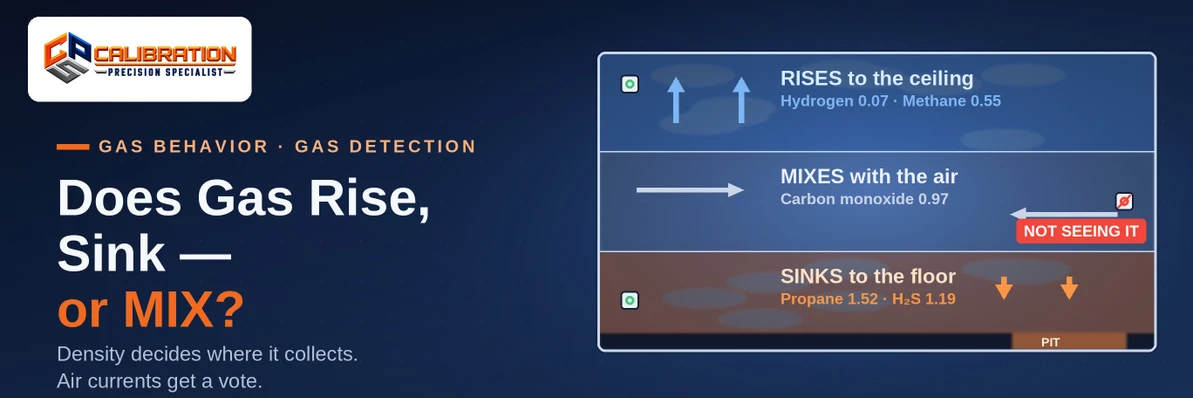
Where a leaked gas goes is set first by its vapor density against air, with air = 1.0: hydrogen at 0.07 and methane at 0.55 rise and collect at the ceiling, carbon monoxide at 0.97 is nearly neutral and mixes through the room with the moving air, and hydrogen sulfide at 1.19, propane at 1.52, and chlorine at 2.49 sink and pool at floor level. Density is only the starting tendency, though — a gas released hot, under pressure, or into moving air can be carried anywhere the air goes, which is why detectors belong where the gas ends up collecting, not just where the leak starts.
Every fixed detector ever mounted at the wrong height was installed by someone who skipped this question. Gas does not fill a room evenly like water filling a tank — at least not at first. It rises, sinks, or drifts depending on one number, and a detector a few feet too high or too low can sit in clean air for the entire leak. This post works through that number, the gases that break the simple version of the rule, and what it all means for where detection actually has to happen. The applied version — the placement rules themselves — is our post on where fixed gas detectors should be placed; this is the physics underneath it.
What Is Vapor Density? The Air = 1.0 Scale
Vapor density (also called relative density or specific gravity for gases) compares a gas to air at the same temperature and pressure. Air is the reference at 1.0. A gas below 1.0 is lighter than air and buoyant — it rises. A gas near 1.0 has almost no buoyancy of its own and goes wherever the air goes. A gas above 1.0 is heavier and sinks. The number is not exotic: it is essentially the gas's molecular weight divided by air's average molecular weight of about 29, which is why light molecules (hydrogen, MW 2) sit at the top of the scale and heavy ones (chlorine, MW 71) sit at the bottom. Every value in the table below comes from the NOAA CAMEO Chemicals datasheets, which compile NIOSH and EPA physical-property data for each gas.
| Gas | Vapor density (air = 1.0) | Behavior | Where it collects |
|---|---|---|---|
| Hydrogen (H₂) | 0.07 | Rises — fastest of all | Ceiling, high pockets |
| Methane / natural gas (CH₄) | 0.55 | Rises | Ceiling |
| Ammonia (NH₃) | 0.60 | Rises (warm gas) — see the cold-release caveat below | Ceiling, once warmed |
| Carbon monoxide (CO) | 0.97 | Mixes — nearly neutral | Throughout the room; breathing zone is what matters |
| Hydrogen sulfide (H₂S) | 1.19 | Sinks — modestly heavier | Low spots, pits, sewers, sumps |
| Propane / LPG (C₃H₈) | 1.52 | Sinks | Floor level, drains, low ground |
| Carbon dioxide (CO₂) | 1.53 | Sinks | Floor level, pits, cellars, tanks |
| Chlorine (Cl₂) | 2.49 | Sinks — strongly | Floor level and low areas |
| Gasoline vapor | 3.4–4.0 | Sinks — strongly | Floor level, pits, trenches |
Read the table as a map of a room. The top rows live at your ceiling, the middle row lives at your face, and the bottom rows live at your ankles and in every hole in the floor. Detection has to be installed on that same map.
Which Gases Rise?
Hydrogen is the extreme case: at 0.07 it is roughly fourteen times lighter than air, escapes upward fast, and accumulates against ceilings and in the high pockets of enclosed spaces. That is why hydrogen detection belongs at the ceiling — the entire subject of our post on why battery rooms need hydrogen detection, where charging batteries vent hydrogen into a room whose other equipment sits far below where the gas collects.
Methane — natural gas — at 0.55 rises steadily and layers at the ceiling of still rooms. A methane detector at head height under a high ceiling can be standing in clean air below a flammable layer.
Ammonia at 0.60 is lighter than air and rises once it is at room temperature — with one well-documented exception. Ammonia is stored as a refrigerated or pressurized liquid, and NOAA's CAMEO datasheet for anhydrous ammonia states plainly that although the gas is lighter than air, "vapors from a leak initially hug the ground": a cold release comes out dense, slumps low, and only rises as it warms and dilutes. Both halves of that sentence matter for detector placement in refrigeration plants.
Which Gases Mix Instead of Rising or Sinking?
Carbon monoxide, at 0.97, is the textbook mixer. Three percent lighter than air is not enough buoyancy to carry it anywhere against ordinary air movement, so CO distributes through a space with the ventilation, the thermal currents, and the traffic of people and doors. Engine exhaust leaves hot and initially rises with its own heat, then cools and mixes to a roughly even concentration through the space.
That is why CO detection is a breathing-zone problem rather than a ceiling or floor problem: the gas will be at head height because it is everywhere at once. Our post on gas monitoring in parking garages works through the CO case in a space designed around moving air. The practical difference from the risers and sinkers is that a CO detector's exact height matters far less than its position relative to sources and air flow — anywhere in the occupied zone samples roughly what people breathe.
Which Gases Sink and Pool?
Hydrogen sulfide at 1.19 is only modestly heavier than air, so it mixes more readily than the gases below it on the table — but in still air it still settles, and it notoriously accumulates in the low, undisturbed places: pits, sumps, sewers, wet wells, and the bottoms of tanks, exactly the confined spaces where it kills. Modest density plus no air movement is enough.
Propane and LPG at 1.52 sink decisively. Propane's own safety data sheets warn that the vapors are heavier than air, may travel a considerable distance along the ground to a source of ignition, and flash back — the leak and the ignition source do not have to be in the same part of the building, because the floor is the road between them. Cold LPG vapor leaving a pressurized tank is denser still until it warms.
Carbon dioxide at 1.53 pours downward like a liquid for the same reason dry ice fog hugs the floor: it fills pits, cellars, fermentation spaces, and tanks from the bottom up, displacing breathable air as it goes, with no color or odor warning at the concentrations that matter.
Chlorine at 2.49 — about two and a half times air's density — is the strong sinker of the common toxics, which is why our post on chlorine gas detection in water treatment puts detection low: a chlorine release slumps to the floor and spreads outward at ankle height. Gasoline and most solvent vapors, at roughly 3.4–4.0, behave the same way, filling trenches and pits with a flammable layer at floor level.
Why Doesn't Gas Always Follow Its Density?
Because the density number carries a condition that is printed right on the NOAA datasheets and usually skipped: the comparison is only valid when the escaping gas is at the same temperature as the surrounding air. Change the temperature, the pressure, or the air movement, and four things can override the table.
- Heat beats density. A hot gas is less dense than the same gas cold. Combustion exhaust, process gas off hot equipment, and any release warmed by the process will rise first — even gases from the heavy half of the table — and only settle toward their density layer as they cool and mix.
- Cold beats density, the other way. NOAA's note continues: a chemical escaping from a pressurized or refrigerated container "may first escape and behave as a heavy gas and sink in the air, even if it has a vapor density value less than 1." Refrigerated hydrogen is the extreme documented case — its datasheet notes that hydrogen gas at normal temperatures is lighter than air, but vapor boiling off the cryogenic liquid is heavier than air until it warms up. Cold ammonia slumping at floor level is the everyday version.
- A pressurized leak goes where it is pointed, first. A jetting release has momentum: it can cross a room, fill a corner, or pile gas against a wall regardless of buoyancy. Density takes over after the jet's energy is spent — which means the worst concentration during an active leak may be where the jet lands, not where the table says.
- Air movement beats everything, continuously. Ventilation, HVAC supply and return, open doors, vehicle traffic, and outdoor wind all carry gas with them. A mixing gas like CO goes exactly where the air goes; even risers and sinkers get dragged along, diluted, or pushed into unexpected pockets by a strong current. This is also the good news built into the physics: gases diffuse and mix over time rather than holding perfect permanent layers. Stratification is real in still air and enclosed pockets — a ceiling layer, a flooded pit — and partial and temporary in a ventilated room. Density tells you where gas collects and lingers, not that it forms a tidy layer cake and stays there.
The practical summary: in a still, enclosed space, trust the table. In a moving, hot, pressurized, or outdoor release, treat the table as the starting tendency and the air as the delivery system.
What Does This Mean for Detector Placement?
Three rules fall straight out of the physics, and they are the short version of our full fixed detector placement guide:
- Risers: detect high. Hydrogen and methane sensors belong near the ceiling, above likely leak sources, where the gas arrives and accumulates.
- Sinkers: detect low. Propane, chlorine, CO₂, and heavy vapor sensors belong near the floor — and near the pits, trenches, and sumps those gases pour into.
- Mixers and toxics people breathe: detect at the breathing zone. CO is the model case — head height, in the occupied space, where the exposure actually happens.
The failure mode for getting it wrong is the one in the graphic that circulates around LinkedIn: hydrogen pooling against a ceiling while the detectors on the wall at mid-height read clean air — not broken, not miscalibrated, simply installed in a layer the gas never visits. A detector measures only the air that reaches it. Height is not an installation detail; it is half the measurement.
Confined spaces make the same point vertically: because a space can hold a riser at the top, breathable air in the middle, and a sinker at the bottom at the same time, pre-entry testing samples at multiple levels — the top/middle/bottom pattern in our post on how to test a confined space before entry. One reading at the hatch tells you about the air at the hatch.
What About a Portable Detector on Your Belt?
A portable instrument samples the air where you hold it — almost always your breathing zone, which is the right answer for your personal exposure and a genuinely incomplete answer about the space. A belt-worn detector will not warn you about the methane layer at the ceiling above you, and it reads the H₂S in a pit only after you have climbed down into it. That is what pumped instruments and remote sampling are for: draw the sample from the level the gas lives at — probe the pit from above, the ceiling pocket from below — before anyone's breathing zone goes there to check. What the reading means once you have it is covered in our post on what LEL means; where you take the sample decides whether the number describes the space or just your shirt pocket.
Three Myths Worth Retiring
- "Gas always rises." Only the light half of the table does. Propane, chlorine, CO₂, gasoline vapor, and H₂S all go down — and several of the most common industrial gases are on that side of the list.
- "Heavy gas stays on the floor forever." In still air it pools; with time and air movement it diffuses and mixes, and ventilation clears it. The danger window is the still, enclosed, undisturbed case — which is unfortunately exactly what pits and idle rooms are.
- "One detector height fits every gas." A mid-wall mounting height is the compromise that misses both ends: above the sinkers pooling at the floor, below the risers collecting at the ceiling. Match the height to the gas, or accept that the detector is decorative for the gases it cannot reach.
Frequently Asked Questions
Does natural gas rise or sink? It rises. Natural gas is mostly methane, with a vapor density of 0.55 against air at 1.0 — a little over half air's density — so leaked natural gas climbs and collects at the ceiling and in high pockets of a room. That is why methane and natural gas detectors are mounted high, near the ceiling: a detector at head height can sit in clean air underneath a flammable layer at the ceiling.
Does propane gas rise or sink? It sinks. Propane's vapor density is 1.52 — about one and a half times air — so propane vapor falls to floor level, spreads along the ground, and pools in low spots, drains, and pits. Propane safety data sheets warn that the vapor can travel a considerable distance along the ground to an ignition source and flash back, so propane detection belongs low, near the floor and near likely leak points.
Where should a hydrogen detector be mounted? At or near the ceiling. Hydrogen's vapor density is 0.07, making it the lightest common industrial gas — it rises faster and collects higher than any other gas on the density table, accumulating against ceilings and in enclosed high pockets. A hydrogen detector at normal wall height can read clean air while hydrogen collects overhead, which is why battery rooms and hydrogen systems put detection at the top of the space.
Is carbon monoxide heavier or lighter than air? Essentially the same weight: carbon monoxide's vapor density is 0.97 against air at 1.0, about 3% lighter — not enough buoyancy to rise meaningfully or sink at all. CO therefore mixes through a room with its air movement instead of layering at the ceiling or floor, and CO detectors are placed in the breathing zone, at the height where people actually inhale it.
Does hydrogen sulfide sink or rise? It sinks. Hydrogen sulfide's vapor density is 1.19, so it is modestly heavier than air: it mixes more readily than strongly heavy gases like chlorine, but in still air it settles and accumulates in low, undisturbed places — pits, sumps, sewers, wet wells, and the bottoms of tanks. That pooling behavior is a large part of why H₂S is such a confined-space hazard, and why low points get sampled before entry.
Why is my gas detector not alarming when there is a leak? One of the most common reasons is height: the detector is mounted in a layer the gas never reaches. A detector at mid-wall reads clean air while hydrogen or methane collects at the ceiling above it, or while propane or chlorine pools at the floor below it — the detector is working correctly and measuring air that genuinely has no gas in it. Detector placement has to match the gas's vapor density: high for gases below 1.0, low for gases above it, breathing zone for near-neutral toxics like carbon monoxide.
What is the vapor density of a gas? Vapor density is a gas's density compared with air at the same temperature and pressure, with air set to 1.0. Below 1.0 the gas is lighter than air and rises (hydrogen 0.07, methane 0.55); near 1.0 it mixes with the air (carbon monoxide 0.97); above 1.0 it is heavier and sinks (propane 1.52, chlorine 2.49). The published values come from the gas's safety data — the NOAA CAMEO Chemicals datasheets compile them from NIOSH and EPA data — and the comparison holds when the gas and the air are at the same temperature.
Does carbon dioxide rise or sink? It sinks. Carbon dioxide's vapor density is 1.53, about one and a half times air, so CO₂ released in a room falls and fills the space from the floor up — pits, cellars, fermentation rooms, beverage plants, and tanks can hold a deep layer of CO₂ at the bottom with breathable air above it. Because CO₂ is colorless and odorless, that invisible low layer is the hazard, and detection and sampling for it belong at low level.
What gases collect in pits and sumps? The heavy half of the density table: any gas with a vapor density above 1.0 can drain into and pool in a pit, sump, trench, or basement. The common industrial cases are hydrogen sulfide (1.19) in sewers and wet wells, propane (1.52) in low ground and drains, carbon dioxide (1.53) in pits and cellars, chlorine (2.49), and gasoline and solvent vapors (about 3.4–4.0). Pits are never assumed safe from a reading taken at ground level above them — they are sampled at depth, from outside, before entry.
Can a gas that is lighter than air still sink? Yes — when it is cold. Vapor density comparisons hold when the gas is at the same temperature as the air around it; a gas escaping from a pressurized or refrigerated container comes out cold and dense, and NOAA's datasheets warn it can behave as a heavy gas and sink even when its vapor density is below 1.0. Ammonia from a liquid leak initially hugs the ground before warming and rising, and vapor off liquid hydrogen is heavier than air until it warms. Temperature can override the table until the gas warms up and dilutes.
The Bottom Line
Where gas goes is not a mystery and not a coin flip: read the vapor density. Below 1.0 it rises and collects high, near 1.0 it mixes and follows the air, above 1.0 it sinks and pools low — and temperature, pressure, and air movement then argue with that tendency, strongest exactly when a release is cold, hot, pressurized, or in a ventilated space. Put detection where the gas ends up, at the height of its layer, and sample confined spaces at every level. The detector was never the weak link in most missed leaks. The mounting height was.
Not sure your detectors are at the height your gases actually collect? That is a question we can walk through with you — call 865-900-8844 or reach us through Contact Us. And whatever height they are mounted at, CPS calibrates every channel — see Calibration Services, with the calibration gas to keep them honest.
CPS Calibrations · 109 S. Front Street, Rockwood, TN 37854 · Calibration Gas · Calibration Services · Contact Us
Recent Posts
-

Flame Detector vs. Gas Detector: What's the Difference — and Do You Need Both?
A gas detector and a flame detector guard opposite ends of the same incident: a gas detector reads l …Oct 21st 2026 -

How Do You Test a Flame Detector? Self-Tests, Test Lamps, and NFPA 72
You test a flame detector with light, not gas — there is no span gas, no zero gas, and never an open …Oct 21st 2026 -

Why Does a Flame Detector False Alarm — and Which Type Won't?
A flame detector false alarms because something that is not a fire is producing the signal it watche …Oct 21st 2026