
Chlorine Gas Detection in Water Treatment: Where Chlorine Hides and How It's Monitored
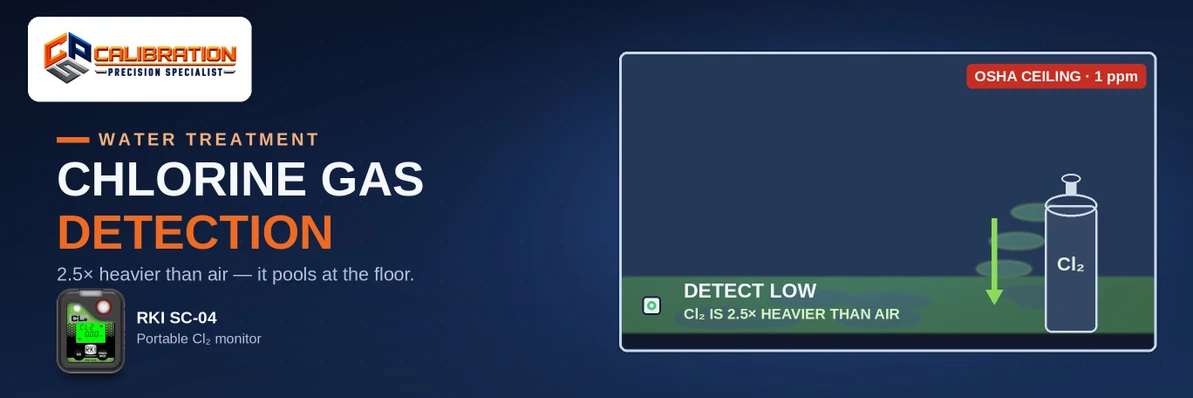
Chlorine gas is about 2.5 times as dense as air, so a leak sinks and pools at floor level — and the exposure limits leave almost no room above the alarm point: OSHA's ceiling is 1 ppm, never to be exceeded at any time; NIOSH's recommended ceiling is 0.5 ppm over 15 minutes; and 10 ppm is immediately dangerous to life or health (IDLH). That is why chlorine storage rooms, chlorinator rooms and scrubber spaces get low-mounted fixed detectors wired to ventilation and alarms outside the room — and why the operator changing a cylinder carries a portable chlorine monitor as well.
Chlorine gas remains the disinfectant a large share of water and wastewater plants run on, delivered as a liquefied gas in 150-lb cylinders and one-ton containers. It is an excellent disinfectant and a genuinely unforgiving gas: the distance between "normal room air" and "over the legal ceiling" is a single part per million. This guide covers where chlorine actually hides in a treatment plant, the limits that set the alarm points, how high — rather, how low — the detectors mount, and how the fixed, sample-draw and portable layers divide the work.
Where Does Chlorine Hide in a Treatment Plant?
Chlorine incidents rarely start in the middle of a room. They start at connections, and the map of a plant's chlorine risk is a map of its fittings:
- Cylinder and ton-container storage. The inventory itself: full and empty containers on scales and in reserve, each with a valve, a fusible plug and a connection waiting to be made. Storage rooms are normally unoccupied — a slow valve-stem leak can run for hours with nobody present to smell it.
- The chlorinator room. Where containers are on line: the vacuum regulator mounted on the container valve, the rotameter and feed piping, the ejector. This room holds the highest density of chlorine joints in the plant, and it is where routine work — container changeouts — breaks and remakes those joints every few days.
- Feed lines and the point of application. Chlorine solution lines and the injector at the contact basin; mostly a water-side concern, but the gas-side piping between container and chlorinator is pressurized chlorine and belongs on the monitored map.
- The scrubber room. The emergency caustic scrubber sits idle until the worst day of the plant's year — and on that day it must start automatically, on a detector signal, with the building already leaking.
- The unloading point. Where containers arrive and are moved; a dropped or rolled container is a mechanical incident, but the detection question — is anything leaking now? — is the same.
The Limits That Set the Alarm Points
| Benchmark | Value | What it means for detection |
|---|---|---|
| OSHA PEL (ceiling) | 1 ppm | The legal ceiling: a worker's exposure may never exceed 1 ppm at any time. |
| NIOSH REL (ceiling, 15-min) | 0.5 ppm | NIOSH's recommended ceiling — the natural first-alarm level for a chlorine room. |
| NIOSH IDLH | 10 ppm | Immediately dangerous to life or health: the room is an entry-by-SCBA problem well before this. |
| Odor threshold | ~0.3 ppm | Most people can smell chlorine below the ceiling — but olfactory fatigue sets in, and storage rooms have nobody in them to smell anything. |
The table explains the design: with a legal ceiling of 1 ppm, a chlorine detector is not an early-warning instrument in the usual sense — its first alarm, sensibly set at or below NIOSH's 0.5 ppm ceiling, is already at half the legal limit. Ranges are chosen accordingly: a 0–20 ppm sensor spends its whole working life in its bottom few percent, and low-end resolution and calibration accuracy matter more than span.
Why Do Chlorine Detectors Mount Low?
Because chlorine goes down. At a vapor density of 2.49 relative to air (NOAA's CAMEO data), released chlorine falls, spreads along the floor, and pools in pits, trenches and low corners — the opposite journey from hydrogen or methane. The placement rules in our guide to where fixed gas detectors should be placed reduce to this for chlorine: sensors mount low — near floor level, beside the credible leak points (container valves, the chlorinator, the regulator), close enough to catch a leak while it is still a leak and not a room. Two practical corollaries: keep the sensor out of standing water and direct washdown, which are hard on any electrochemical cell; and remember a low sensor reads its own layer — a detector by the door does not prove the far corner is clear.
Fixed, Sample-Draw, or Portable? All Three, Doing Different Jobs
| Layer | Instrument | Range | Price at CPS | The job it does |
|---|---|---|---|---|
| Fixed diffusion head | SENKO SI-200E (Cl₂ build) | 0–5, 0–10 or 0–20 ppm | From $950; configured builds $1,092.50–$2,300 | Watches the room continuously; relays start ventilation/scrubber and alarm outside |
| Fixed sample-draw | RKI GD-70D | 0–3 ppm | $1,595 | Pulls a sample from a duct, scrubber inlet or hard-to-reach point to a sensor mounted where staff can service it |
| Portable personal monitor | RKI SC-04 (Cl₂) | 0–20 ppm | $520 | Rides on the operator making and breaking container connections — the highest-risk minutes in the plant |
The layers are not interchangeable. The fixed head protects the room around the clock, including the nights and weekends when leaks actually have time to grow. The GD-70D's pump (0.5 L/min through sample tubing) solves the geometry problem — the point that needs watching is inside a scrubber duct or a cabinet, but the sensor belongs outside it where it can be calibrated; RKI recommends a six-month calibration interval for the GD-70D, and its plug-in replacement sensor units run $525. The portable covers the person, during the one task where the person is the leak point: breaking a container connection. Our spotlights on the GD-70D and the 04 Series cover each instrument in full.
What Should a Chlorine Alarm Do?
More than make noise in an empty room. A chlorine room detector earns its installation in its relay outputs:
- Start the response equipment. First alarm brings up the room's exhaust ventilation; in a scrubber-equipped plant, the detector signal is what starts the emergency scrubber. The SI-200E's three relay contacts (1st alarm, 2nd alarm, fault — 2.0 A @ 30 VDC) exist for exactly this.
- Alarm where the people are. A sounder and beacon outside the door, plus a signal to a staffed point or the plant SCADA via the head's 4–20 mA or RS-485 output. Nobody should learn about a chlorine alarm by opening the chlorine room door.
- Keep people out, not send them in. A chlorine alarm is a stay-out signal: entries into a leaking chlorine room are respirator work under the plant's emergency plan, not an operator with a wrench. The detector's job is to make sure nobody walks in uninformed.
What Are the Honest Limits?
- Chlorine sensors are consumables with a short leash. On both platforms here, the chlorine sensor carries a 1-year warranty where the instruments around it carry more — SENKO warranties the SI-200E's sensor for 1 year against the device's 2 years, and RKI likewise gives the SC-04's chlorine sensor 1 year against the series' 3. Chlorine is hard on electrochemical cells. Budget the replacement cycle when you buy.
- One head, one gas, one point. A fixed chlorine head reads the air that reaches it, in its layer of the room. Cylinder storage and the chlorinator room are separate points; a plant with both needs coverage in both.
- Hypochlorite changes the hazard, it doesn't erase chemistry. Plants that convert from gas chlorine to bulk sodium hypochlorite retire the gas-detection requirement for the rooms they convert — there is no chlorine gas to detect. But hypochlorite mixed with acid releases chlorine gas (it is why the two are stored apart), so chemical storage discipline still matters; and any room that still holds gas cylinders still needs its detector.
How Are Chlorine Detectors Calibrated?
With chlorine gas — there is no surrogate. A fixed head is calibrated in place by applying certified Cl₂ span gas at the sensor through its calibration cap (a sample-draw unit is fed through its sample path), using the right calibration gas at the range the sensor carries: a 0–5 ppm head wants a span gas inside its working range, not a cylinder borrowed from a 0–100 ppm H₂S program. Chlorine's reactivity also means the cylinder and regulator get checked like the reactive gases they are — in date, correct, and actually delivering gas to the sensor. Log every calibration with the room's ventilation and scrubber checks, so the detection record and the response record stay in one file. If your plant's heads are overdue and nobody on staff owns the job, a head can be removed and shipped to us or calibrated in place with gas and phone guidance — we calibrate every channel. Questions about a chlorine room — call 865-900-8844.
Frequently Asked Questions
Why is chlorine monitored at such low concentrations? Because its exposure limits are among the tightest of any industrial gas. OSHA's ceiling is 1 ppm — a level that may never be exceeded at any time — and NIOSH sets 10 ppm as immediately dangerous to life or health. A gas whose legal ceiling and danger zone sit inside 10 ppm has to be detected in tenths of a part per million, which is why chlorine detectors carry ranges like 0–5 and 0–10 ppm instead of hundreds.
What is OSHA's exposure limit for chlorine gas? 1 ppm as a ceiling limit (3 mg/m³): a worker's exposure must never exceed it at any time, not as an average. NIOSH's recommended limit is stricter — a 0.5 ppm ceiling over 15 minutes — and NIOSH's IDLH value is 10 ppm. Most chlorine detection is therefore alarmed at or below 0.5 ppm on the first stage, so the alarm sounds before the legal ceiling is reached.
Where should chlorine gas detectors be mounted? Low — near floor level, close to the credible leak points. Chlorine's vapor density is about 2.49 times air, so released gas sinks, spreads along the floor and pools in pits and low corners. Sensors belong beside container valves, the chlorinator and regulator connections, positioned to catch a leak in its own layer — and out of standing water and direct washdown, which shorten sensor life.
What alarm level should a chlorine detector use? A first alarm at or below 0.5 ppm — NIOSH's recommended ceiling — is the common design, so the response (ventilation or scrubber start, alarm outside the room) happens before OSHA's 1 ppm ceiling is reached, with a second stage above it. The exact setpoints come from the plant's design and emergency plan; what is not defensible is a first alarm set above the legal ceiling.
Do water plants need fixed detectors, portable monitors, or both? Both, doing different jobs. Fixed heads watch the chlorine rooms continuously — including unoccupied hours — and their relays start ventilation or the scrubber and alarm outside the room. A portable like the RKI SC-04 chlorine monitor ($520, 0–20 ppm) protects the operator during container changeouts, the task that breaks and remakes the connections leaks come from. Neither layer covers the other's risk.
What is the difference between the SI-200E and the GD-70D for chlorine? The SENKO SI-200E is a diffusion head (chlorine builds at 0–5, 0–10 or 0–20 ppm, from $950) that mounts in the room where the gas will be. The RKI GD-70D ($1,595) is a sample-draw transmitter with a 0–3 ppm chlorine sensor: its pump pulls air from a duct, scrubber inlet or awkward point through tubing to a unit mounted where staff can reach and calibrate it. Diffusion for rooms, sample-draw for points a head can't occupy.
Does a plant that switched to liquid hypochlorite still need chlorine gas detectors? Not for the converted process — with no chlorine gas stored or fed, there is no chlorine gas hazard to monitor in those rooms. Two cautions survive the conversion: hypochlorite releases chlorine gas on contact with acid, so chemical separation still matters, and any space that still stores gas chlorine — even a backup cylinder — keeps its detection requirement.
How long does a chlorine sensor last? Plan on chlorine being the shortest-lived sensor in the building. Both platforms here warranty the chlorine sensor for 1 year — the SI-200E's sensor against a 2-year device warranty, the SC-04's chlorine sensor against the 04 Series' 3 years — which tells you how SENKO and RKI expect chlorine service to treat an electrochemical cell. A GD-70D replacement sensor unit runs $525; treat sensor replacement as scheduled maintenance, not a failure.
Can a chlorine detector start the emergency scrubber automatically? Yes — that is what its relays are for. The SI-200E provides three relay contacts (1st alarm, 2nd alarm and fault) sized for control circuits, so a first-stage alarm can start exhaust ventilation or the scrubber and light the beacon outside the door, while the 4–20 mA and RS-485 outputs report the concentration to the plant system. The detector is the scrubber's trigger on the day the scrubber matters.
How do you calibrate a chlorine gas detector? In place, with certified chlorine span gas matched to the sensor's range, applied through the head's calibration cap — or through the sample path on a sample-draw unit like the GD-70D, which RKI recommends calibrating every six months. There is no substitute gas for chlorine; the cylinder must be the right gas, in date, and actually reach the sensor. Every calibration goes in the room's log alongside its ventilation checks.
CPS Calibrations · 109 S. Front Street, Rockwood, TN 37854 · SI-200E · GD-70D · SC-04 Chlorine · Fixed Detector Placement · Calibration Gas · Contact Us
Recent Posts
-

Flame Detector vs. Gas Detector: What's the Difference — and Do You Need Both?
A gas detector and a flame detector guard opposite ends of the same incident: a gas detector reads l …Oct 21st 2026 -

How Do You Test a Flame Detector? Self-Tests, Test Lamps, and NFPA 72
You test a flame detector with light, not gas — there is no span gas, no zero gas, and never an open …Oct 21st 2026 -

Why Does a Flame Detector False Alarm — and Which Type Won't?
A flame detector false alarms because something that is not a fire is producing the signal it watche …Oct 21st 2026