
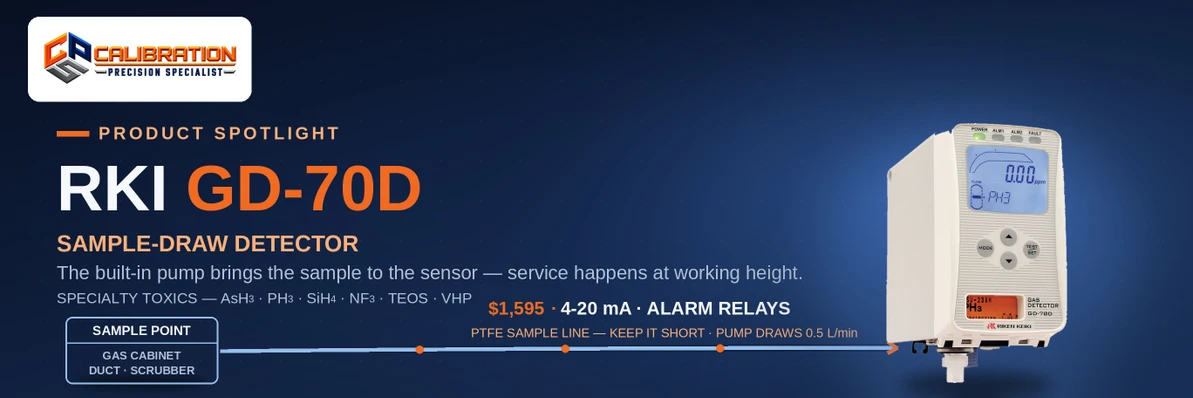
What Is the RKI GD-70D? A Sample-Draw Detector for Specialty Toxic Gases
The RKI GD-70D is a fixed, wall-mounted sample-draw sensor/transmitter ($1,595) whose built-in pump draws air at 0.5 L/min through tubing from the point being monitored to a plug-in sensor inside the unit, so a single accessible transmitter continuously watches one gas at a hard-to-reach point — a gas cabinet, duct, or scrubber — including specialty semiconductor toxics such as arsine (0–0.2 ppm), phosphine (0–1 ppm), silane (0–15 ppm), and vaporized hydrogen peroxide (0–3 ppm). It runs stand-alone with its own LCD display and alarm relays, or sends a 4-20 mA signal to an RKI Beacon controller or a plant PLC.
That is the short version. The longer one explains why this instrument looks nothing like the portable detectors and diffusion fixed heads that fill the rest of our catalog — because it was designed for a different problem: gases so specific, and sample points so awkward, that the standard fixed head was never an option.
What Is the GD-70D, and Who Is It For?
The RKI GD-70D is a fixed gas detection transmitter, 2.8 × 4.7 × 5.9 in. (70 × 120 × 150 mm) and about 2.0 lb (0.9 kg) including its sensor unit, that wall-mounts on a base plate and monitors one gas at one point, continuously. It is not a portable, and it is not a diffusion head that waits for gas to wander over to it. A long-life, high-capacity pump inside the unit pulls the sample to the sensor through 4 × 6 mm PTFE tubing, the flow rate self-adjusts to hold 0.5 L/min, and the reading shows on a large integral LCD with a tri-color bar graph for alarm status.
Per RKI's own positioning, the GD-70D serves the places specialty toxics live:
- Semiconductor fabrication — gas cabinets, valve manifold boxes, and scrubbers handling arsine, phosphine, silane, disilane, diborane, germane, NF₃, and TEOS, many of them toxic at parts-per-billion levels.
- Chemical plants and gas storage — chlorine, hydrogen chloride, hydrogen fluoride, ammonia, and other acid and hydride gases at the equipment, not just in the room.
- Vaporized hydrogen peroxide (VHP) monitoring — RKI specifically positions the GD-70D for VHP in fumigation disinfection of medical facilities, pharmaceutical cleanrooms and production filling lines, and chemical fogging in the food industry.
- Ducts and enclosed equipment — any point where the gas is, but a person with a calibration cylinder cannot conveniently be.
If your hazard list is the standard four — LEL, O₂, CO, H₂S in ordinary industrial spaces — this is more instrument than you need, and a conventional fixed head costs less. The GD-70D earns its price when the gas on your list is one the standard heads simply don't offer.
Why Sample-Draw? The Sensor Stays Where People Can Reach It
A diffusion fixed detector has to be mounted where the gas will be — which is frequently where nobody can safely or conveniently service it: inside a cabinet, up a duct, over a scrubber. Every calibration then becomes a shutdown, a lift, or a confined-space conversation. Our post on where fixed gas detectors should be placed covers that tension; sample-draw is the engineered answer to it.
The GD-70D splits the system in two. The sample point goes where the gas is — the end of the tubing run inside the cabinet, duct, or equipment enclosure. The transmitter mounts on a wall at working height, where its display can be read, its alarms seen, and its sensor swapped and calibrated without opening the equipment being monitored. One point is monitored continuously, around the clock, and the part that needs hands stays reachable.
The trade is the one every pumped system makes, and we covered its physics in our post on how far a pumped gas detector can draw a sample: the sample has to travel the tubing before it is measured, so response includes line travel time, and the line itself becomes a maintenance item. RKI's manual is blunt about it — keep the inlet line as short as possible to minimize absorption of gas by the tubing, avoid loops and kinks, watch for condensation with water-soluble gases, and contact RKI for help determining an inlet tubing length for your layout. There is no honest "maximum feet" number to print here; RKI doesn't publish one, because the right length depends on the gas and the application.
One Transmitter, Four Plug-In Sensor Families
Every GD-70D base unit is identical. What changes is the sensor unit plugged into the front of it — and this is the design decision the whole product turns on:
- Sensors swap in seconds, with no tools, from the front of the unit.
- Each smart sensor stores its own calibration and sensor-specific data in non-volatile memory, so a sensor can be hot-swapped in the field with no programming — the transmitter recognizes it and reads its data.
- A sensor can be calibrated away from the transmitter, because the calibration information travels with the sensor. Calibration gas doesn't have to be hauled to the installed location.
- The firmware automatically corrects for long-term zero and span drift, which stretches the honest interval between adjustments.
- Changing gases is a sensor swap, not a new transmitter — the same base unit accepts any family below.
| Sensor unit | Principle | What it covers |
|---|---|---|
| ESU | Electrochemical cell | The long specialty-toxic list: NH₃, AsH₃, Cl₂, CO, H₂S, HCl, HF, HCN, NF₃, PH₃, SiH₄, SO₂, O₃, H₂O₂, O₂ (0–25% vol.), and more |
| SGU | Semiconductor (MOS) | Hydrogen-specific and ppm-level combustibles and solvents: H₂, CH₄, R-32 and others at 0–2,000 ppm class ranges |
| SSU | Pyrolysis-particle | TEOS 0–15 ppm, with the PLU-70 pyrolyzer unit (also used for NF₃/TEOS service) |
| NCU | Catalytic combustion | 0–100% LEL — H₂, CH₄, isobutane, and other combustibles |
Our listing is the toxic-gas configuration of the GD-70D. The platform's other sensor families are manufacturer configurations of the same base unit — if your application is a MOS, catalytic/LEL, oxygen, or TEOS build rather than an electrochemical toxic, call us at 865-900-8844 and we will spec the configuration with RKI rather than guess at it.
What Gases Can the GD-70D Detect?
The electrochemical (ESU) list is the reason this transmitter exists — gases that most fixed catalogs carry in one or two ranges, if at all. Detection ranges below are RKI's published datasheet figures:
| Gas | Detection range | Gas | Detection range |
|---|---|---|---|
| Ammonia (NH₃) | 0–75 ppm | Hydrogen peroxide (H₂O₂) | 0–3 ppm |
| Arsine (AsH₃) | 0–0.2 ppm | Hydrogen selenide (H₂Se) | 0–0.2 ppm |
| Bromine (Br₂) | 0–1 ppm | Hydrogen sulfide (H₂S) | 0–1 / 0–30 ppm |
| Carbon monoxide (CO) | 0–75 / 150 / 300 ppm | Nitrogen dioxide (NO₂) | 0–9 / 0–15 ppm |
| Chlorine (Cl₂) | 0–3 ppm | Nitrogen trifluoride (NF₃) | 0–30 ppm |
| Chlorine trifluoride (ClF₃) | 0–0.6 ppm | Nitric oxide (NO) | 0–100 ppm |
| Diborane (B₂H₆) | 0–0.3 ppm | Oxygen (O₂) | 0–25% vol. |
| Fluorine (F₂) | 0–3 ppm | Ozone (O₃) | 0–0.6 ppm |
| Germane (GeH₄) | 0–0.8 ppm | Phosphine (PH₃) | 0–1 ppm |
| Hydrogen bromide (HBr) | 0–6 / 0–9 ppm | Silane (SiH₄) | 0–15 ppm |
| Hydrogen chloride (HCl) | 0–6 / 0–15 ppm | Sulfur dioxide (SO₂) | 0–6 ppm |
| Hydrogen cyanide (HCN) | 0–15 ppm | TEOS | 0–15 ppm |
| Hydrogen fluoride (HF) | 0–9 ppm |
Read the arsine and phosphine rows carefully, because they frame the whole product: these are gases with exposure limits in the parts per billion — arsine's ACGIH TLV-TWA is 5 ppb — monitored at ranges like 0–0.2 ppm. That is dedicated, single-purpose detection, and it is why the wastewater and water-treatment world also meets this platform: our post on why hydrogen sulfide is so dangerous in wastewater covers the fixed-point layer of that problem, and the GD-70D's 0–30 ppm H₂S version is one of the sample-draw ways to build it.
Outputs and Integration: Stand-Alone or System Component?
Both, and the buyer chooses. As delivered, the GD-70D is a complete stand-alone detector: integral LCD showing concentration, flow rate, and the gas detected; two programmable alarm levels with a tri-color bar graph and bright alarm LEDs; relay contact output for the first alarm, second alarm, and trouble/fault; and self-diagnostics covering system, sensor, flow, and communication failures, with event, alarm, and calibration history logged on board.
For integration, the standard unit outputs 4-20 mA DC. RKI's datasheet also lists a GD-70D-EA version adding Power over Ethernet (PoE) alongside 4-20 mA, and LonWorks among the platform's communication methods — tell us which protocol your plant standardizes on when you order, because it is a configuration decision, not a field toggle. The transmitter runs on 24V DC ±10% (about 1.5W, max 4W including the sensor unit), is approved to UL 61010-1, operates at 0–40°C and 30–70% RH (non-condensing), and can feed RKI's Beacon series of single- and multi-channel controllers like the rest of our fixed systems range. All operating settings are adjusted from the front panel.
The Honest Limits
- One unit, one gas, one point. Each GD-70D monitors a single gas at a single sample point. A cabinet row with four gases is four transmitters. There is no multi-gas version, and pretending otherwise in a design is how points get left unmonitored.
- The sample line is part of the instrument. Readings wait on line travel time; reactive gases can absorb into long tubing runs; condensation in the line attacks water-soluble gas readings and can corrode internals. Short, clean, correctly routed 4 × 6 mm PTFE tubing is not an installation detail — it is the measurement.
- The environment window is indoor-instrument, not field-rugged. 0–40°C and 30–70% RH non-condensing is a fab, plant-room, and equipment enclosure specification, not a washdown or outdoor one.
- Sensors are consumables with a real price — see the upkeep section below. A specialty toxic point is a commitment to a specialty sensor budget, forever, for as long as the point matters.
- It does not replace personal monitoring. A fixed point watches a location. Workers moving through the area still need their own instruments for the air they actually breathe.
Upkeep: Sensor Swaps, Six-Month Calibration, and What Sensors Cost
RKI recommends regular maintenance and gas calibration every six months for the GD-70D, and the plug-in design is built to make that painless: pull the sensor unit from the front — seconds, no tools — and snap in the replacement. Because each sensor carries its calibration data with it, a fresh sensor can be calibrated separately from the installed transmitter, which is what makes a swap-and-go service visit (or a shipped-in sensor) practical instead of theoretical. The pump unit is likewise front-access and replaceable, and flow is self-tuning, so there is no manual flow adjustment in the routine.
Replacement sensor prices are published on our store, and they are the honest running cost of the platform:
- Electrochemical toxic sensors: $525 for most gases — for example the CO 0–150 ppm sensor, the ammonia (NH₃) 0–75 ppm sensor, and the H₂S 0–30 ppm sensor.
- Catalytic LEL sensor: $415 — the 0–100% LEL combustible sensor.
- Oxygen sensor: $625 — the GD-70D oxygen replacement sensor.
- Ultra-low arsine: $945 — the AsH₃ 0–50 ppb sensor, the premium end of the range, priced like the ppb measurement it is.
Buy genuine RKI sensor units for a life-safety point — our post on OEM vs. aftermarket gas detector sensors works through why the smart-sensor calibration data alone settles that argument on this platform. Keep calibration gas on hand matched to the gas and range you run; a specialty channel can only be spanned with gas that contains it.
On service: fixed wall-mounted transmitters like this one typically aren't a reason for a dedicated site visit. The practical routes are the ones the design invites — swap the plug-in sensor and ship the unit or sensor to our Rockwood lab through in-house calibrations, or calibrate in place with your own gas and equipment with phone guidance from us at 865-900-8844. Either way, the six-month interval is the schedule to hold.
Use the GD-70D When… / A Diffusion Fixed Head Is Enough When…
Use the GD-70D when:
- The gas is a specialty toxic — a hydride, an acid gas, NF₃, TEOS, VHP — that standard fixed heads don't offer, especially at ppm and ppb ranges.
- The sample point is somewhere a sensor shouldn't live or can't be serviced: inside a gas cabinet, in a duct, at a scrubber, in an enclosure that would have to be opened for every calibration.
- The point needs continuous monitoring with a signal back to a controller or PLC (4-20 mA), or stand-alone alarming with relays at the point itself.
- The monitored gas may change over the equipment's life — the plug-in sensor system turns a gas change into a sensor swap on the same $1,595 base platform.
A diffusion fixed head is enough when:
- The gases are the standard industrial set (LEL, O₂, CO, H₂S) and the head can be mounted where the gas will reach it and a technician can reach the head — simpler, cheaper, and no sample line to maintain.
- The point is outdoors, in washdown, or outside a 0–40°C indoor envelope.
- You need several gases at one location in one device class — a multi-point diffusion layout or a controller with several heads will usually pencil out better than stacking single-gas sample-draw units.
Browse the wider fixed systems lineup and the RKI brand page for the diffusion heads, controllers, and portables this transmitter sits alongside.
The Bottom Line
The RKI GD-70D ($1,595) is a fixed sample-draw transmitter for the gases and the sample points that defeat ordinary fixed detectors: a 0.5 L/min self-adjusting pump pulls the sample from a cabinet, duct, or enclosure to a wall-mounted unit at working height; plug-in smart sensors — electrochemical, semiconductor, pyrolyzer, or catalytic — swap in seconds with no tools and carry their own calibration data; and the unit runs stand-alone on its own display and relays or integrates by 4-20 mA with Beacon controllers and plant PLCs. Its limits are just as clear: one gas and one point per unit, a sample line that must stay short and clean, and specialty sensors at $415–$945 when their life runs out, on a six-month calibration rhythm. For a semiconductor hydride, an acid gas, or VHP at a point nobody can stand next to, that trade is the whole point of the instrument.
Spec'ing a specialty-gas point? Start with the RKI GD-70D listing, tell us the gas, the range, and where the sample point sits, and we will confirm the sensor configuration before you order — call 865-900-8844 or reach us through Contact Us. For other GD-70D sensor families (MOS, catalytic/LEL, oxygen, TEOS) on the same platform, the call is the ordering path — those configurations aren't listed as separate store products.
Frequently Asked Questions
What gases does the RKI GD-70D detect? One gas per unit, chosen from one of the widest lists in fixed detection. The electrochemical sensor family covers ammonia (0–75 ppm), arsine (0–0.2 ppm), phosphine (0–1 ppm), silane (0–15 ppm), diborane (0–0.3 ppm), germane (0–0.8 ppm), chlorine (0–3 ppm), hydrogen chloride (0–6/15 ppm), hydrogen fluoride (0–9 ppm), hydrogen cyanide (0–15 ppm), nitrogen trifluoride (0–30 ppm), hydrogen peroxide vapor (0–3 ppm), ozone (0–0.6 ppm), carbon monoxide, hydrogen sulfide (0–30 ppm), sulfur dioxide, nitric oxide, nitrogen dioxide, and oxygen (0–25% vol.). Other plug-in families add semiconductor sensors for hydrogen and ppm combustibles, a catalytic sensor for 0–100% LEL, and a pyrolyzer sensor for TEOS (0–15 ppm).
How much does the RKI GD-70D cost? The GD-70D sample-draw sensor/transmitter is $1,595 at CPS Calibrations. The ongoing cost is the plug-in sensor: replacement sensor units run $415 for the catalytic LEL sensor, $525 for most electrochemical toxic sensors, $625 for oxygen, and $945 for the ultra-low arsine (0–50 ppb) sensor.
How does sample draw work on the GD-70D? A built-in, long-life pump inside the wall-mounted transmitter pulls air continuously at 0.5 L/min (the flow rate self-adjusts) through 4 × 6 mm PTFE tubing from the sample point — inside a gas cabinet, duct, or enclosure — to the plug-in sensor in the transmitter. The sensor measures the drawn sample, and the concentration shows on the unit's LCD. Because the gas travels through tubing first, the reading follows the sample point by the line's travel time, which is why RKI directs installers to keep the inlet line as short as possible.
How far can the GD-70D draw a sample? RKI does not publish a fixed maximum tubing length for the GD-70D. The operator's manual instructs installers to keep the inlet line as short as possible to minimize gas absorption by the tubing, to avoid loops, kinks, and condensation, and to contact RKI for help determining the inlet tubing length for a specific application. In practice: mount the transmitter as close to the sample point as the layout allows, and treat the tubing run as part of the measurement, not as free distance.
Does the GD-70D need a controller? No. The GD-70D is a complete stand-alone detector with its own LCD display, two programmable alarm levels, a tri-color alarm bar graph, and relay contacts for first alarm, second alarm, and fault. It can also be integrated: the standard unit outputs 4-20 mA DC to a PLC or to RKI's Beacon series of single- and multi-channel controllers, and RKI's datasheet lists a GD-70D-EA version with Power over Ethernet (PoE) alongside 4-20 mA, plus LonWorks among the platform's communication methods.
What output signal does the GD-70D have? The standard GD-70D outputs 4-20 mA DC, and every unit — stand-alone or integrated — provides relay contact outputs for its first alarm, second alarm, and trouble/fault alarm. The unit runs on 24V DC ±10% power. A GD-70D-EA variant adds Power over Ethernet (PoE) per RKI's datasheet; specify your plant's protocol when ordering, because communications are a configuration choice.
How often does the GD-70D need calibration? RKI recommends regular maintenance and gas calibration every six months. The plug-in smart sensors store their own calibration data in non-volatile memory, so a replacement sensor can be calibrated separately from the installed transmitter and then hot-swapped in with no programming — the calibration travels with the sensor. The firmware also automatically corrects for long-term zero and span drift between calibrations.
How long does a GD-70D sensor last, and what does a replacement cost? The sensor unit is a consumable: RKI specifies replacement when the sensor deteriorates or will no longer hold calibration, rather than promising a fixed service life. Replacement sensor units are listed on our store at $415 for the catalytic LEL sensor, $525 for most electrochemical toxic sensors (CO, NH₃, H₂S, PH₃, SiH₄, Cl₂, HF, HCN, and others), $625 for the oxygen sensor, and $945 for the ultra-low arsine 0–50 ppb sensor. Swapping one takes seconds from the front of the unit, with no tools.
GD-70D sample-draw vs. a diffusion fixed detector — which do I need? Choose sample-draw (the GD-70D) when the point being monitored is inside a cabinet, duct, or enclosure, or somewhere a sensor cannot be mounted and serviced — the transmitter stays at working height and the tubing brings the gas to it. Choose a diffusion fixed head when the detector can be mounted directly where the gas will reach it and a technician can reach the head for calibration; diffusion is simpler and cheaper for standard gases. Sample-draw adds a tubing run to maintain and a travel-time delay on every reading; diffusion has neither, but only ever measures the air at the head itself.
What warranty does the RKI GD-70D have? One year. RKI Instruments warrants the GD-70D to be free from defects in materials, workmanship, and performance for one (1) year from the date of shipment, with defective parts repaired or replaced at RKI's option at no charge when returned to RKI within that period. Consumable sensor elements are subject to deterioration by their nature and are handled under that warranty policy's terms.
CPS Calibrations · 109 S. Front Street, Rockwood, TN 37854 · Fixed Systems · Calibration Gas · Calibration Services · Contact Us
Recent Posts
-
Flame Detector vs. Gas Detector: What's the Difference — and Do You Need Both?
A gas detector and a flame detector guard opposite ends of the same incident: a gas detector reads l …Oct 21st 2026 -

How Do You Test a Flame Detector? Self-Tests, Test Lamps, and NFPA 72
You test a flame detector with light, not gas — there is no span gas, no zero gas, and never an open …Oct 21st 2026 -

Why Does a Flame Detector False Alarm — and Which Type Won't?
A flame detector false alarms because something that is not a fire is producing the signal it watche …Oct 21st 2026