
OEM vs. Aftermarket Gas Detector Sensors: What Are You Really Buying?
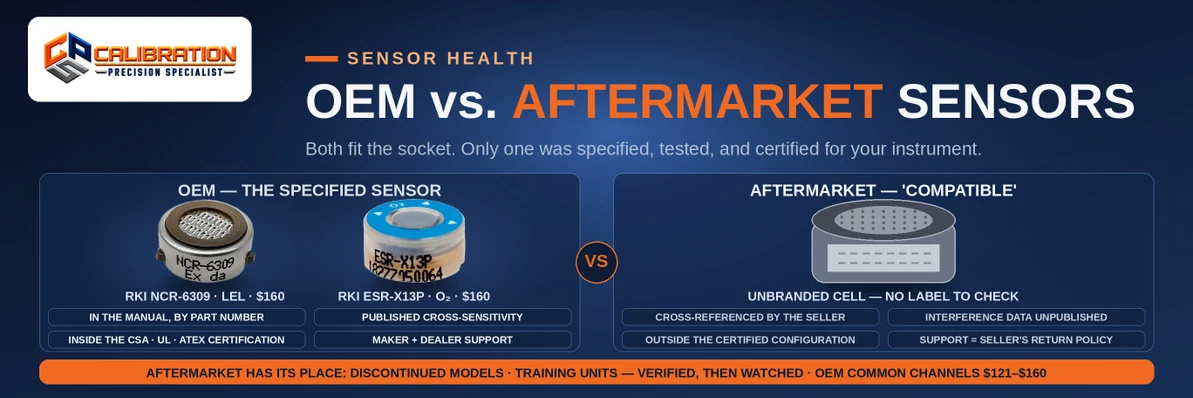
An OEM gas detector sensor is the exact sensor the instrument manufacturer specified, tested, and certified for that model — such as RKI's NCR-6309 catalytic LEL sensor ($160) and ESR-X13P-OXY oxygen sensor ($160) for the GX-3R family, or SENKO's electrochemical replacement sensors ($121) for the SGT-P and MGT lines. An aftermarket "compatible" sensor may fit the socket and pass a calibration on day one, but calibration cannot correct a different cross-sensitivity profile, response time, or temperature compensation — and those differences are what show up in the field.
That is the short answer. The rest of this post is what the OEM part number actually guarantees, where compatible sensors quietly differ, why a passed calibration is not proof of equivalence, and how to run the real cost math before you save $40 on the component your crew's safety depends on.
What Does "OEM Sensor" Actually Mean?
OEM stands for original equipment manufacturer. An OEM replacement sensor is the sensor the detector's manufacturer designed the instrument around, sells under its own part number, and lists in the manual for that model. When you order the RKI NCR-6309 catalytic LEL sensor for a GX-3R, GX-3R Pro, GX-Force, or GX-6100, or the RKI ESR-X13P-OXY oxygen sensor for the same family, you are not buying "a sensor that fits." You are buying the specific sensing element the instrument's firmware, alarm logic, and certification were built around.
An aftermarket or "compatible" sensor is made by a third party to fit the same socket and produce a similar output. Some are built by reputable sensor manufacturers and sold honestly as alternatives. Some are unbranded copies with a part-number cross-reference and nothing behind it. The word "compatible" only promises the first part of that sentence: it fits. Everything else is on you to verify.
Here is the head-to-head:
| OEM sensor | Aftermarket "compatible" sensor | |
|---|---|---|
| Specified for your model | Yes — listed by part number in the instrument manual | Cross-referenced by the seller; not listed by the instrument maker |
| Fit and connector | Exact — housing, pins, and orientation as designed | Usually fits; tolerances and pin plating vary by maker |
| Output the firmware expects | The signal curve, baseline, and temperature compensation the instrument was programmed for | Similar at room temperature; behavior at temperature extremes is unverified for your instrument |
| Cross-sensitivity | Published profile — the maker documents what else the sensor responds to, and any built-in filters (for example, hydrogen filtering on CO sensors) | Often unpublished or copied from the OEM data sheet rather than measured |
| Response time (T90) | Tested to the instrument's specification | May be slower, especially after months in service |
| Date code and traceability | Manufacturer label, lot and date code, traceable supply chain | Varies — old stock and relabeled sensors are a real problem in this market |
| Certification | The sensor the detector's CSA / UL / ATEX / IECEx approval was granted with | Not part of the certified configuration (see below) |
| Support if it misbehaves | The instrument maker and your dealer stand behind it | The seller's return policy is usually the whole story |
Why Does a Sensor That "Calibrates Fine" Still Read Wrong?
This is the point that decides the argument, so it is worth being precise. A span calibration applies one known gas concentration and adjusts the instrument's reading to match. It proves the sensor responds to that gas, at that concentration, at that temperature, on that day. It does not — and cannot — change the sensor's underlying behavior:
- Cross-sensitivity. Electrochemical sensors respond to gases other than their target. A carbon monoxide sensor, for example, also responds to hydrogen; OEM CO sensors for many models include filtering or a compensating element to manage that, and the instrument maker publishes the interference data. A compatible sensor with a different (or missing) filter can read CO that is not there — or read high in a hydrogen-rich area — and it will still calibrate perfectly on CO span gas, because calibration never exposes it to the interfering gas.
- Response time. Alarm timing assumes the sensor reaches its reading within the specified T90. A slower sensor delays the alarm by exactly that difference. Calibration is a steady-state test; it never measures speed.
- Temperature compensation. Electrochemical output shifts with temperature, and the instrument corrects for it using the known behavior of the specified sensor. Fit a sensor with a different temperature curve and the correction is wrong at the extremes — January confined-space entries and August rooftop work are where that bill comes due.
- Drift between calibrations. Two sensors can agree on calibration day and disagree three weeks later. OEM sensors are life-tested in the instrument; a compatible sensor's drift rate in your model is an experiment you run on your own crew.
None of this means every aftermarket sensor reads wrong. It means a passed calibration is not evidence that one reads right — it only proves the one thing calibration tests.
What About Certification and Warranty?
Portable gas detectors carry hazardous-location approvals — CSA, UL, ATEX, IECEx — granted to the instrument as a tested configuration, with specified sensors. Substituting a sensor that is not part of that configuration takes the instrument outside what was actually approved. How much that matters to your facility depends on your safety program, your insurer, and your regulator, but "we fitted an uncertified sensor to a certified life-safety instrument" is not a sentence anyone wants to explain after an incident. The detector's manual lists the approved replacement part numbers for a reason.
Warranty is simpler: instrument manufacturers warrant their instruments with their specified parts in them. A failure traced to a non-OEM sensor is an easy warranty denial, and the sensor itself is usually the most failure-prone part of the instrument. Check the terms for your model before assuming coverage survives the swap — and remember the sensor warranty and support chain disappears along with it.
What Does an OEM Sensor Actually Cost? Run the Real Math
The savings case for aftermarket sensors sounds strongest until you look at what OEM sensors actually sell for. Verified from our own store:
- RKI catalytic LEL sensor (NCR-6309) for the GX-3R family — $160
- RKI oxygen sensor (ESR-X13P-OXY), 0–25% volume — $160
- SENKO oxygen sensor for the SGT-P / MGT / SP-MGTP — $121, with SENKO's CO and H₂S sensors for the same lines at the same $121
- SENKO infrared LEL sensor for the MGT / SP-MGTP — $380 (infrared costs more in any brand — there is no catalyst to poison and nothing to burn out)
Now price the failure, not the part. One sensor that dies early or drifts out between calibrations costs you a second sensor, a second calibration (gas, regulator time, and a technician's hands), a monitor out of service while it happens, and — if it is discovered at a failed bump test at the start of a shift — a worker without a detector or a job delayed. Even a $50 per-sensor saving disappears inside that single event, several times over. Multiply a small saving across a fleet and you have also multiplied the number of experiments running in the field.
Browse the full ranges before you decide: RKI portable replacement sensors, SENKO replacement sensors and parts, and all replacement parts — every sensor we list is the manufacturer's own part for the instrument named.
Is Aftermarket Ever a Defensible Choice?
Honestly, yes — in narrow cases, with your eyes open:
- Discontinued instruments. When the manufacturer no longer supplies the sensor, a quality third-party sensor from a named, reputable sensor maker — with a real data sheet — beats scrapping a working instrument or, worse, running a dead channel.
- Non-life-safety use. Training units and demonstration instruments that never enter a hazardous area are a reasonable place to economize.
- Verified, then watched. If you do fit a third-party sensor, treat it as unproven: calibrate it, bump it before each use without exception, shorten the calibration interval, and document as-found readings so drift shows up in your records instead of in the field.
What is not defensible is fitting the cheapest unbranded compatible you can find to a certified instrument that people rely on to enter confined spaces — to save less than the cost of one calibration.
How Do You Make Sure the Sensor You Bought Is Really OEM?
- Match the part number in the manual, not a cross-reference chart. NCR-6309, ESR-X13P-OXY, SENKO's ACC/ACA-series numbers — the exact part number is the specification.
- Read the label on the sensor itself. OEM sensors carry the manufacturer's name, part number, and a lot or date code printed on the cell — you can see all three in the photos at the top of this post.
- Check the date code. Electrochemical and galvanic oxygen sensors age whether they are working or sitting in a warehouse. Fresh, traceable stock matters more than a small discount on a sensor that has already spent part of its life on a shelf.
- Buy through the manufacturer's dealer channel. An authorized dealer buys from the manufacturer, which is what makes the part number on the box and the sensor inside it the same thing.
The Bottom Line
You are not really choosing between two prices for the same part. You are choosing between a sensor whose behavior in your instrument is specified, tested, certified, and supported — and one whose behavior you will discover yourself, one bump test at a time. On the instruments we sell and service, the OEM part is $121 to $160 for the common channels. That is inexpensive insurance, priced like a consumable, for the component that does the actual detecting.
Need a sensor, or not sure which part number your instrument takes? Shop replacement parts or call us at 865-900-8844 with the model and the channel you are replacing — we will match the exact OEM sensor. Want the new sensor verified in place? Ship the instrument to our lab or book on-site calibration — we calibrate every channel and report as-found and as-left readings on the certificate, whichever instruments your facility runs.
Frequently Asked Questions
Will an aftermarket sensor void my gas detector's warranty? It can. Manufacturers warrant their instruments with their specified parts fitted; a failure traced to a non-OEM sensor is grounds for denial, and the replacement sensor itself carries no support from the instrument maker. Check your model's terms before fitting one.
If an aftermarket sensor calibrates and passes a bump test, is it equivalent to OEM? No. Calibration and bump tests prove the sensor responds to the test gas at that moment. They do not test cross-sensitivity to other gases, response time, temperature behavior, or drift between calibrations — the properties where compatible sensors most often differ.
How much do OEM replacement sensors cost? For the fleets we support, the common channels are consumable-priced: RKI's catalytic LEL (NCR-6309) and oxygen (ESR-X13P-OXY) sensors for the GX-3R family are $160 each, SENKO electrochemical sensors for the SGT-P and MGT lines are $121, and SENKO's infrared LEL sensor is $380.
Can I mix OEM and aftermarket sensors in the same instrument? Physically, usually yes — each channel is independent. But every channel fitted with a non-specified sensor takes that channel outside the instrument's certified configuration and its published interference data, so mixing does not limit the risk to a paperwork issue.
Are all third-party sensors junk? No. Reputable sensor manufacturers sell quality cells with real data sheets, and for discontinued instruments they may be the only option. The risk is unbranded "compatible" sensors with no published cross-sensitivity, response, or life data — and no one standing behind them.
How can I tell if a sensor is genuine OEM? Match the exact part number from the instrument manual, confirm the manufacturer's label and a fresh lot/date code are printed on the sensor cell itself, and buy through an authorized dealer so the supply chain is traceable.
CPS Calibrations · 109 S. Front Street, Rockwood, TN 37854 · Replacement Parts · Calibration Gas · Calibration Services · Contact Us
Recent Posts
-
Flame Detector vs. Gas Detector: What's the Difference — and Do You Need Both?
A gas detector and a flame detector guard opposite ends of the same incident: a gas detector reads l …Oct 21st 2026 -

How Do You Test a Flame Detector? Self-Tests, Test Lamps, and NFPA 72
You test a flame detector with light, not gas — there is no span gas, no zero gas, and never an open …Oct 21st 2026 -
Why Does a Flame Detector False Alarm — and Which Type Won't?
A flame detector false alarms because something that is not a fire is producing the signal it watche …Oct 21st 2026