
How Do You Test a Flame Detector? Self-Tests, Test Lamps, and NFPA 72
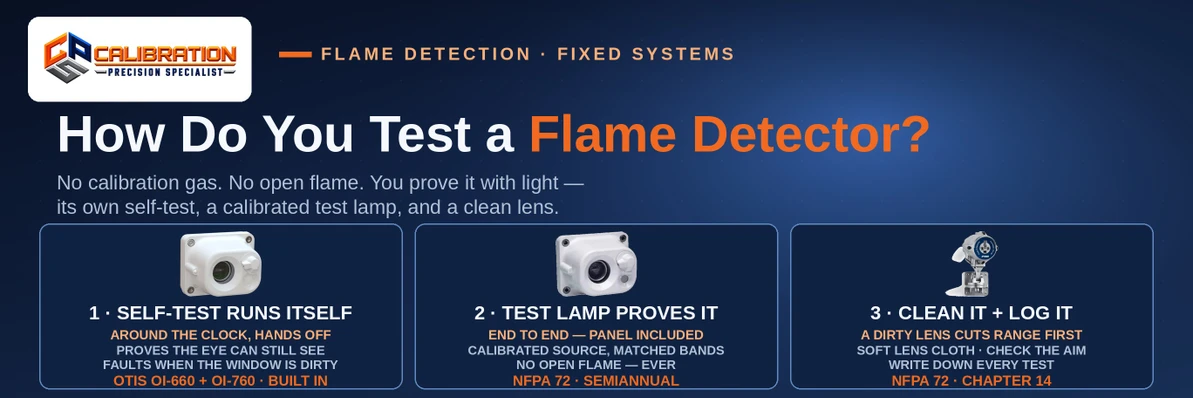
You test a flame detector with light, not gas — there is no span gas, no zero gas, and never an open flame. Verification runs in three layers: a built-in automatic self-test that proves around the clock that the detector's eye can still see and reports a fault when its window is obscured; a hands-on functional test with the manufacturer's calibrated test source, which NFPA 72 requires semiannually for flame detectors; and inspection and lens cleaning in between, because a dirty window silently shortens a flame detector's range long before it blinds it.
Every gas detector on your wall has a calibration routine: zero it, span it with a known gas, write down the numbers. Flame detectors break that habit. They don't measure a concentration, so there is nothing to span — and the technicians who maintain them don't calibrate them, they prove them. This post walks through what proving a flame detector actually involves: the self-test built into the detector, the test lamp that stands in for a fire, the cleaning that keeps the listed range honest, and what NFPA 72 requires of all of it. If you're still choosing a detector, start with our comparison of UV vs. IR vs. UV/IR vs. IR3 flame detectors — the technology you picked decides how it gets tested.
Do Flame Detectors Need Calibration Gas? No — You Prove Them, You Don't Calibrate Them
A gas detector answers a quantitative question — how much gas is in the air — so it drifts, and calibration with a known concentration is how you pull it back to the truth. A flame detector answers a yes/no question — is that a flame? — by watching the light in its cone, the way we covered in how a fixed gas detection system works. There is no concentration to set and no adjustment to make. CPS's own FlameSpec listings say it flatly in their product FAQs: a flame detector "is not calibrated with calibration gas."
So nothing about testing a flame detector involves a gas cylinder. What has to be proven is a chain: the sensing eye still responds to flame radiation, the signal path still works, and the panel on the other end still gets — and acts on — the alarm. The three layers below each prove a different link of that chain, which is why no one of them replaces the others.
Layer 1: What Does a Flame Detector's Self-Test Actually Check?
Better flame detectors test themselves, continuously, without anyone touching them. The OTIS OI-660 runs an automatic through-the-lens self-test that — in the listing's words — "continuously verifies fire-sensing ability, reports fault when impaired": an internal source flashes the sensing path through the same window the detector watches the world through, so the test covers the lens itself, not just the electronics behind it. The OTIS OI-760 carries a built-in automatic self-test too, and its staged 0–20 mA output carries a distinct self-test fault state alongside relay-coil, calibration, and loop faults — so the panel doesn't just know something is wrong, it knows what is wrong.
Not every detector has one, and it's worth knowing which of yours do. The OTIS OI-860 listing makes no self-test claim — its specification table instead names a portable test unit among its accessories, which is the OI-860's verification path. RKI's FlameSpec listings likewise claim no built-in self-test; what a FlameSpec IR3 gives you is supervision — a dedicated fault relay and a tri-colour LED on the head, so trouble is announced locally and at the panel rather than discovered later.
Either way, understand the self-test's limit, because it's the most common misunderstanding in flame detector maintenance: a self-test proves the detector, not the system. It confirms the eye and the electronics can respond and that the window is clear enough to see through. It does not prove that the alarm relay pulled in at the panel, that the right zone annunciated, that notification appliances fired, or that the detector can still catch a real flame at its rated distance. That end-to-end proof is Layer 2 — and it's the layer the code actually asks for.
Layer 2: What Is a Flame Detector Test Lamp — and Why Not a Real Fire?
The functional test replaces the fire with a test source: a calibrated lamp, built by the detector's manufacturer, that puts out energy in the same bands the detector judges — flicker pattern included — at a measured output, so it can be presented to the detector from a defined distance and produce a repeatable, honest alarm. Facilities that test to NFPA 72 use an approved flame simulator of exactly this kind, and the code's test-method requirements for radiant energy detectors turn on the light source having a measured energy output and a defined test distance — a random UV flashlight proves nothing, because nobody knows what it actually emits.
Two consequences follow:
- The source has to match the detector's bands. A UV test lamp stimulates a UV channel and nothing else: it cannot prove an IR3, whose three infrared bands it never touches, and an IR source can't prove a UV detector. UV/IR detectors need a source that speaks to both channels. This is why test units are manufacturer accessories matched to a model family — OTIS, for example, lists a "portable test unit" in the Accessories row of the OI-660, OI-760, and OI-860 specification tables. One honest store note: CPS doesn't list a test lamp on the store today. They're manufacturer accessories, ordered with the detector — if you're setting up a test program, that's a line item to get on the original order, and we're glad to help you match the right unit to your heads.
- Never light a real fire to test a flame detector. It sounds obvious until someone suggests a pan of diesel as a shortcut. A test fire defeats the purpose on every level: it's an uncontrolled ignition in exactly the classified area the detector exists to protect, its size and distance are unmeasured so the "test" proves nothing repeatable, and no AHJ or insurer accepts it as a functional test. The test source exists precisely so the detector can be proven with zero flame in the building.
What the functional test itself looks like is simple to describe: the facility puts the system into its test/impairment procedure (monitoring notified, outputs managed), the technician presents the test source to each detector in turn, and for each one records that the detector alarmed, how long it took, and that the panel received and acknowledged the right point — then confirms the detector returns to normal and any fault clears. A detector that alarms at the head but never shows at the panel has failed the test that matters, no matter how healthy its self-test says it is.
Layer 3: Why Is Cleaning the Lens Half the Test Program?
Ask what actually degrades a flame detector in service and it isn't the electronics — it's the window. Dust, oil film, process grime, frost, and paint overspray all do the same thing: they absorb part of the flame's radiation before it reaches the sensor. The detector doesn't go blind all at once; it goes short-sighted, losing range a little at a time, still passing its self-test's basic sanity check in some designs and looking perfectly normal on a walk-by. That's why inspection and cleaning are a layer of the test program and not housekeeping: the facilities procedure for NFPA 72 testing of these detectors reads — inspect the detector's physical condition, clean all viewing windows with a microfiber cloth, verify the detector is firmly mounted, and verify its line of sight to the hazard is uncompromised.
The practice is unglamorous and specific: a soft lens or microfiber cloth, the cleaning agents the manufacturer approves and no others, and while you're at the head, a check that the aim hasn't shifted and nothing new — a tank, a rack, stored material — has grown into the cone since the last visit. (A detector can pass every test and still be watching the wrong patch of floor; our post on how far a flame detector can see covers cones, range, and aiming.) Cleaning is also the fix behind most "mystery" faults: a detector reporting an impaired view is very often a detector asking for a cloth.
What Does NFPA 72 Require for Flame Detector Testing?
Flame detectors connected to a fire alarm system fall under NFPA 72, the National Fire Alarm and Signaling Code, and its Chapter 14 regime for inspection, testing, and maintenance — the responsibility for which sits with the property owner or their designated representative. The code calls flame detectors radiant energy fire detectors, and under that name they're treated more strictly than most initiating devices:
- Functional testing — semiannual. Table 14.4.3.2 sets the test method and frequency by device type, and radiant energy fire detectors sit on a twice-a-year functional test — twice the frequency of the annual functional test most initiating devices get. The test is performed with a light source acceptable to the manufacturer, with a measured energy output at a defined distance.
- Visual inspection — quarterly. The companion inspection table, Table 14.3.1, puts radiant energy detectors on a quarterly visual inspection — condition, cleanliness, obstruction, orientation — again more often than the semiannual inspection most initiating devices get.
- Records. Chapter 14 expects the testing to be documented and the records retained — detector by detector, not a single line that says "system tested."
Two honest caveats. First, editions change and the edition your local authority having jurisdiction (AHJ) has adopted is the one that governs your building — along with anything your insurer layers on top. Second, the manufacturer's instructions govern the method: the code points back to the listed test source and published procedure for your specific detector. The shape of the obligation, though, is consistent: look at them quarterly, prove them twice a year, write it down.
What Should a Flame Detector Test Record Show?
Proof is the product. A gas calibration leaves behind a certificate whose whole job is to prove the instrument read truthfully — the standard we laid out in what a calibration certificate actually proves — and a flame detector test deserves the same documentary discipline. For each detector, the record should show:
- Which detector: ID or tag, location, and serial number
- When and by whom: date and the technician's name
- What proved it: the test source used (manufacturer and model), and the distance it was presented from
- What happened: alarm — yes or no — and the response time if you measured it
- What the panel saw: the point or zone that annunciated, confirming the whole chain, not just the head
- What you found: lens condition and cleaning performed, faults present, anything obstructing the cone — and what was corrected
- What's next: deficiencies carried forward and the next due date
Six months later — or in front of an inspector, an insurer, or an incident review — that record is the difference between "we test them" and "here is each detector, proved, on these dates."
Frequently Asked Questions
How do you test a flame detector? In three layers. A built-in automatic self-test — where the detector has one, like the OTIS OI-660 and OI-760 — runs continuously and proves the detector's eye can still see, faulting if the window is obscured. On top of that, a technician performs a functional test with the manufacturer's calibrated test source, presented from a defined distance, and confirms the detector alarms and the fire panel receives it. Between functional tests, the detector gets inspected and its lens cleaned, because a dirty window silently cuts range.
Do flame detectors need calibration gas? No. A flame detector doesn't sample air or measure a concentration — it watches for the optical signature of a flame — so there is no zero gas and no span gas, and nothing to adjust. CPS's RKI FlameSpec listings state it directly: a flame detector "is not calibrated with calibration gas." Flame detectors are verified optically and functionally instead, and they normally sit alongside fixed gas detection: gas detectors warn about the leak, flame detectors confirm the fire.
What is a flame detector test lamp? It's a calibrated test source built by the detector's manufacturer: a lamp that emits energy in the same bands the detector judges — flicker included — at a measured output, so a technician can trigger a genuine alarm response from a defined distance without any open flame. OTIS lists a "portable test unit" as an accessory for its OI-660, OI-760, and OI-860 flame detectors. CPS doesn't list a test lamp on the store today; they're manufacturer accessories, ordered with the detector.
How often should a flame detector be tested? Under NFPA 72, twice a year for the functional test. The code's Table 14.4.3.2 covers flame detectors under the name "radiant energy fire detectors" and puts them on a semiannual functional test — more often than the annual test most fire alarm devices get — and its inspection table calls for a quarterly visual inspection. Your AHJ's adopted edition and your insurer can adjust the details, and the detector manufacturer's instructions govern the test method.
Can I test a flame detector with a real fire? No — never light a fire to test a flame detector. A real test fire is an uncontrolled ignition in the classified area the detector protects, its size and distance are unmeasured so the result proves nothing repeatable, and it isn't an accepted functional test for an AHJ or insurer. The calibrated test source exists to do the same job with zero flame: measured output, defined distance, an alarm you can log.
What does a flame detector self-test check — and what doesn't it check? It checks the detector itself: the sensing path — in a through-the-lens design like the OTIS OI-660's, the window is part of that path — and the electronics, and it reports a fault when the view is impaired. The OI-760 even reports a distinct "self-test fault" on its analog output. What it doesn't check is everything downstream: relay action at the panel, correct zone annunciation, notification appliances, and alarm response at rated distance. That's why a periodic functional test is still required even on detectors with excellent self-tests.
Why is my flame detector showing a fault? Work the short list first: a dirty, frosted, or obstructed window is the most common cause — detectors with through-the-lens self-tests fault precisely because their view is impaired, and a cleaning is often the whole fix. After that: wiring and loop faults, and on the OTIS OI-760 the output distinguishes relay-coil, self-test, and loop faults so the panel can tell you which. On detectors without a self-test, supervision is a fault relay — RKI FlameSpec heads carry a dedicated fault relay and a tri-colour status LED on the unit.
How do you clean a flame detector lens? Gently, and on schedule — it's maintenance task number one. Wipe the viewing window with a soft lens or microfiber cloth and only the cleaning agents the manufacturer approves; facility procedures for NFPA 72 testing of flame detectors pair the cleaning with an inspection of the detector's physical condition, its mounting, and its line of sight. Don't use abrasives or unapproved solvents on an optical window, and re-check the aim afterward — a freshly cleaned detector aimed at the wrong spot still isn't protecting anything.
Will any test lamp work on any flame detector? No. The test source has to emit in the bands the detector actually judges: a UV lamp can't prove an IR3's three infrared bands, an IR source can't prove a UV detector, and a UV/IR detector needs both channels stimulated. Test sources are built and calibrated per detector family — that's why they're manufacturer accessories with a measured output and a defined test distance, not generic flashlights.
Do all flame detectors have a built-in self-test? No, and the listings say which is which. The OTIS OI-660 and OI-760 list a built-in automatic self-test; the OI-860 listing doesn't claim one — it names a portable test unit among its accessories instead. RKI's FlameSpec listings claim no built-in self-test either; they supervise through a fault relay and a tri-colour LED. Self-test or not, every flame detector still needs the periodic hands-on functional test — the self-test only changes how much the detector monitors itself in between.
The Bottom Line
Testing a flame detector means proving it, in layers, with light: a self-test that watches the detector's own health around the clock where the model has one, a semiannual functional test with a calibrated, band-matched test source that proves the whole chain to the panel, and quarterly eyes on the window — because the most common flame detector failure isn't electronic at all, it's a dirty lens quietly shortening the detector's reach. No gas, no fire, and a written record for every head. Do those three things and the detector you bought is the detector you actually have.
Setting up a flame detector test program, or not sure your detectors are being proved — not just powered? CPS installs and services fixed detection systems and can walk the whole chain with you — call 865-900-8844 or reach us through Contact Us. The detectors themselves are in the RKI flame detector and OTIS flame detector categories, and the service side lives at Calibration Services.
CPS Calibrations · 109 S. Front Street, Rockwood, TN 37854 · Calibration Gas · Calibration Services · Contact Us
Recent Posts
-
Flame Detector vs. Gas Detector: What's the Difference — and Do You Need Both?
A gas detector and a flame detector guard opposite ends of the same incident: a gas detector reads l …Oct 21st 2026 -

How Do You Test a Flame Detector? Self-Tests, Test Lamps, and NFPA 72
You test a flame detector with light, not gas — there is no span gas, no zero gas, and never an open …Oct 21st 2026 -

Why Does a Flame Detector False Alarm — and Which Type Won't?
A flame detector false alarms because something that is not a fire is producing the signal it watche …Oct 21st 2026