
How Does a Fixed Gas Detection System Work? Sensors, Controllers, and Alarms
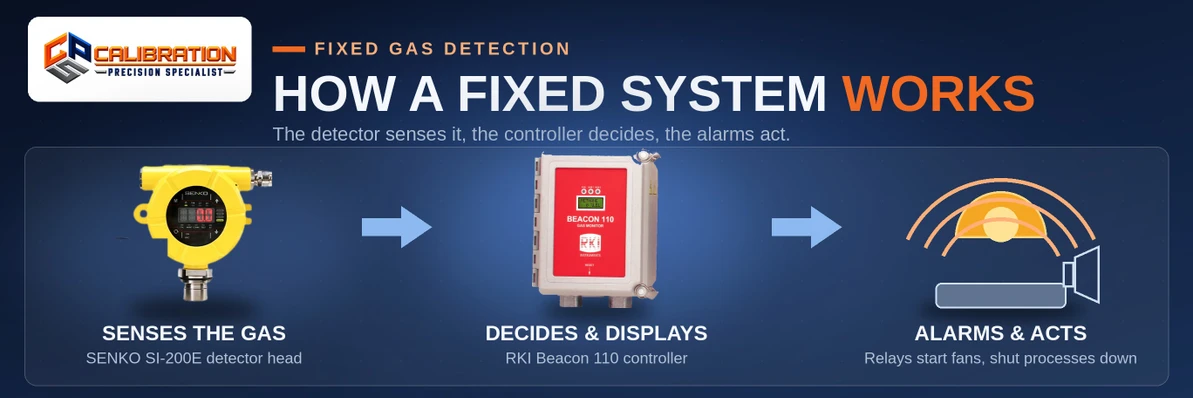
A fixed gas detection system works as a chain: a sensor head mounted at the hazard converts gas concentration into an electrical signal — usually 4-20 mA or RS-485 Modbus — a controller reads every head against its alarm setpoints, and relay contacts act on the result, sounding horns and strobes, starting ventilation, or handing the alarm to a PLC. At CPS that chain starts as small as a single RKI Beacon 110 controller ($1,275) watching one point and scales to an OTIS OI-7432 ($1,930) polling 32 detector heads on one Modbus daisy chain.
Portable detectors protect the person carrying them. A fixed system protects a place — continuously, at 3 a.m., with nobody around — and it can only do that because it is a system, not a sensor in a box. This post walks the chain link by link, with the actual hardware on our shelf at each step.
The Chain at a Glance
- Sense — a detector head at the hazard measures one gas, continuously.
- Signal — the head reports its reading as 4-20 mA, digitally over RS-485 Modbus, or wirelessly.
- Decide — a controller compares every reading with its alarm setpoints and displays the plant's gas status in one place.
- Act — controller relays switch horns, strobes, ventilation, or process equipment, and outputs pass the data to a PLC or building system.
- Sustain — every sensor in the chain is calibrated on its manufacturer's rhythm, or the chain's readings quietly stop meaning anything.
Step 1: The Sensor Head Senses
The head is the only part of the system that ever touches the gas. It mounts where the gas will be — the placement rules are their own subject, covered in our post on where fixed gas detectors should be placed — and it works one of three ways:
- Diffusion heads wait for gas to reach them. The SENKO SI-200E (from $950) is the pattern: an explosion-proof, IP66 diffusion head with its own display, sensing oxygen, toxics, combustibles, or VOCs depending on the sensor fitted. Most fixed points in most plants are diffusion points.
- Sample-draw heads pull the gas to the sensor through tubing, for points a sensor can't be mounted at or serviced in — inside cabinets, ducts, and enclosures. The RKI GD-70D ($1,595) and the SENKO SI-H100 are the two on our shelf, and each has its own spotlight post.
- Transmitters are heads whose whole job is the signal: sensor in front, 4-20 mA out the back, no local alarm ambitions. They run from the RKI M-Series low-cost transmitter ($334) through the RKI T2A 2-wire transmitter (from $1,826) — the part you standardize on when a PLC, not a gas controller, is the brain.
Inside the head, the sensing element itself — electrochemical cell, catalytic bead, infrared, or PID — is chosen for the gas, which is why our comparison of the SENKO fixed range is organized gas-first. One head, one gas is the rule almost everywhere: four gases at one location is four heads, or one of the few multi-gas heads, wired as separate channels.
Step 2: The Signal Travels
A head that can't report is an ornament, so the second decision is how readings move. There are three production answers — analog 4-20 mA loops, digital RS-485 Modbus, and wireless — and most real systems mix them. The short version: 4-20 mA gives each head its own pair of wires and a signal any PLC on earth can read; Modbus lets many heads share one cable and carries alarm and fault status along with the reading; wireless removes the cable run where trenching or conduit is the expensive part (OTIS WireFree heads and RKI's AirLink line exist for exactly that, and our post on wireless gas detection weighs the trade honestly). The full signal explainer — loop math, fault currents, relay logic — is our companion post on 4-20 mA and Modbus.
Step 3: The Controller Decides
The controller is where readings become decisions. It powers and polls the heads (or reads their loops), shows every channel's gas and status on one display, compares each channel against its alarm setpoints, and owns the relay outputs. Controllers are sized by channel count, and the spread on our shelf is wide:
| Controller | Channels | Heads / inputs it accepts | Price |
|---|---|---|---|
| RKI Beacon 110 | 1 | Direct RKI sensors (LEL, O₂, H₂S, CO) or any 4-20 mA transmitter | $1,275 |
| RKI Beacon 200 | 2 | RKI transmitters and sensors | $2,500 |
| RKI Beacon 410A | 4 | RKI transmitters and sensors | $2,825 |
| RKI Beacon 800 | 8 | RKI transmitters and sensors | $2,835 |
| OTIS OI-7480-12 | 12 | Any 4-20 mA transmitter, OTIS or third-party | $3,365 |
| OTIS OI-7432 | 32 | OI-6000-series heads on one RS-485 Modbus daisy chain | $1,930 |
| PureAire 8-Channel Touch Screen | 8 | PureAire monitors, touch-screen programmable | $4,135 |
Two lessons hide in that table. First, per-channel cost collapses as systems grow — the 32-channel Modbus controller costs less than the 12-channel analog one, because digital heads share one cable instead of home-running twelve loops. Second, the controller is not where systems get expensive; heads, cable, installation, and calibration labor are. Choose the controller for the architecture and the head count, including the expansion you already know is coming.
Step 4: Relays Act
A reading that stays on a screen protects nobody at 3 a.m. The controller's relays are the system's hands — dry contacts that switch whatever they're wired to when a channel crosses its setpoint:
- Notification: horns and strobes at the area, so the alarm is local and immediate, not just a line on a display in an empty control room.
- Ventilation: exhaust fans and dampers started (or sped up) to clear the gas the head is reporting — the response that turns a leak from an accumulation into a dilution.
- Process action: a contact to the PLC or equipment controls to shut a feed, close a valve, or stop a process, where the hazard analysis calls for it.
- Escalation: outputs upstream — 4-20 mA re-transmission, Modbus to the plant system, or a fault contact — so a head failure itself is reported, not silent.
The details are engineered per site: relays are configurable latching or non-latching (a latched alarm stays until a person acknowledges it), the Beacon 110's relays are rated 10 amps — strong enough to drive external horns and alarms directly — and the OI-7480-12 includes a relay-disable option so maintenance and calibration don't trigger a plant response every time a technician applies span gas.
Wired, Wireless, or Stand-Alone?
Not every fixed point needs the full chain. The three architectures:
- Full system (heads + controller): many points, one status display, coordinated relays. The default for plants.
- Wireless system: WireFree or AirLink heads report to a wireless controller — OTIS's OI-7032 touchscreen controller ($4,010) or RKI's AirLink 7032 ($5,270) — where cable runs are impractical. Same chain, radio instead of copper for step 2.
- Stand-alone monitors: one unit that senses, displays, alarms, and relays by itself — RKI's indoor OX-600 oxygen monitor ($785), EC-600 carbon monoxide monitor ($945), or PS 2 combustible monitor ($450). Right answer for a single room with a single gas; wrong answer when a second and third point are already on next year's plan.
The Link Everyone Under-Budgets: Calibration
Every sensor technology in a fixed head drifts — electrochemical cells consume themselves, catalytic beads get poisoned and tired, optics foul. A fixed system does not escape the calibration discipline that portables live under; it just performs it in place, at the head, with bottled gas. Makers publish their rhythms (RKI's guidance for the GD-70D is calibration every six months), the work is done channel by channel, and the controller's maintenance modes exist so the plant doesn't alarm while it's done.
This is the service CPS performs on the systems it sells: we calibrate every channel, on the bench or at your site, and the full scope is on our calibration services page. Budget the upkeep when you budget the system — a fixed installation that is never calibrated degrades from a detector into a display, quietly and completely.
The Bottom Line
A fixed gas detection system is five decisions wearing one name: which heads, sensing which gases, placed where; which signal architecture carries their readings; which controller reads them and against what setpoints; which relays act, and on what; and whose calendar the calibration lives on. The hardware on our shelf spans a $450 stand-alone monitor to a 32-channel Modbus system, and the fixed systems category holds all of it.
Designing a system, or inheriting one that needs its chain audited? Call us at 865-900-8844 with the gases, the points, and what the system has to do when it alarms — that last answer designs the rest — or reach us through Contact Us.
Frequently Asked Questions
What are the main parts of a fixed gas detection system? Five: detector heads (a sensor and transmitter at each hazard point), the signal wiring or radio link that carries their readings, a controller that displays every channel and compares readings against alarm setpoints, the alarm and response devices the controller's relays drive (horns, strobes, ventilation, process shutdowns), and power — controllers typically supply the heads. Add the unglamorous sixth part that decides whether the other five mean anything: a calibration program that keeps every channel honest.
Does a fixed gas detector need a controller? A transmitter does — it outputs 4-20 mA or Modbus and needs something (a gas controller, PLC, or DCS) to read it, alarm on it, and act. But not every fixed point is a transmitter: stand-alone monitors like RKI's OX-600 oxygen monitor ($785) or PS 2 combustible monitor ($450) sense, display, alarm, and switch their own relays in one unit, and full-featured heads like the SENKO SI-200E carry their own display and alarm relays. Controllers earn their place when several points need one status display and coordinated responses.
How many detectors can one gas controller run? From one to dozens, by model. On our shelf: the RKI Beacon 110 runs 1 point ($1,275), the Beacon 200 runs 2 ($2,500), the Beacon 410A 4 ($2,825), and the Beacon 800 8 ($2,835); OTIS's OI-7480-12 takes 12 analog 4-20 mA channels ($3,365), and the OI-7432 polls up to 32 heads on a single RS-485 Modbus daisy chain ($1,930). Digital architectures scale cheaper per channel because the heads share one cable instead of each home-running its own loop.
What happens when a fixed gas detection system alarms? Whatever it was wired and programmed to do. The controller channel crosses its setpoint, and its relays switch: horns and strobes sound in the area, ventilation starts or speeds up, a contact tells the PLC or process equipment to act, and the event shows on the controller display. Alarms can be latching — staying active until a person acknowledges and resets them — or non-latching, clearing when the gas does. There is no universal alarm behavior; it is configured per channel, per site, from the hazard analysis.
Can a fixed gas detection system start ventilation automatically? Yes — that is one of the standard jobs of a controller's relay outputs. A relay wired to a fan starter or damper actuator starts exhaust ventilation the moment a channel crosses its setpoint, diluting the leak while the alarm brings people. On smaller systems the relays can carry real loads directly (the RKI Beacon 110's relays are rated 10 amps, enough to drive external horns and alarms); on larger ones the relay typically signals the motor control or building system, which does the heavy switching.
Is wired or wireless fixed gas detection better? Neither, universally — they solve different installation problems. Wired systems (4-20 mA or Modbus) are powered from the loop or controller, never need batteries, and are the default wherever conduit is practical. Wireless heads — OTIS WireFree and RKI AirLink — remove the cable run, which is the expensive part across large outdoor areas, existing structures, and temporary installations, at the cost of battery maintenance and radio planning. Many plants run both: wired indoors, wireless where trenching would cost more than the detectors.
How often do fixed gas detectors need to be calibrated? On the manufacturer's published rhythm for the specific head and sensor — there is no single interval for all fixed systems. As one concrete example, RKI recommends calibrating the GD-70D sample-draw transmitter every six months. What is universal is the need: fixed sensors drift and age exactly as portable sensors do, so every channel needs periodic zero and span calibration with bottled gas, done in place at the head. A system without a calibration schedule is displaying numbers, not detecting gas.
How much does a fixed gas detection system cost? Build it per point. Transmitter heads at CPS run from $334 (RKI M-Series) through $950 (SENKO SI-200E) to $1,826 and up for specialty transmitters; controllers run $1,275 (single-point Beacon 110) to $3,365 (12-channel OTIS OI-7480-12), with 32-channel Modbus controllers at $1,930. A one-point stand-alone monitor is $450–$980 complete. On top of hardware sit the real project costs: cable or conduit installation, commissioning, and the standing calibration program — which is why per-point hardware price alone never describes a system.
Can a fixed gas detection system connect to a PLC or building management system? Yes — that integration is designed in, not bolted on. Heads and transmitters speak the plant-standard 4-20 mA analog loop, controllers like OTIS's OI-7432 and OI-7480-12 provide RS-485 Modbus output for digital integration, and relay contacts give any system a hardwired alarm handshake. Specifying the connection is a step-2 decision (the signal architecture), and our companion post on 4-20 mA and Modbus explains how each option carries readings, alarms, and fault status.
Does a fixed gas detection system replace portable detectors? No — they protect different things. A fixed system watches locations: the room, the process area, the cabinet, continuously and whether or not anyone is there. A portable detector watches a person, including the walk between fixed points and the confined space no fixed head covers. Plants run both layers because the hazards are both place-shaped and person-shaped; neither layer's existence argues the other away.
CPS Calibrations · 109 S. Front Street, Rockwood, TN 37854 · Fixed Systems · Calibration Gas · Calibration Services · Contact Us
Recent Posts
-
Flame Detector vs. Gas Detector: What's the Difference — and Do You Need Both?
A gas detector and a flame detector guard opposite ends of the same incident: a gas detector reads l …Oct 21st 2026 -

How Do You Test a Flame Detector? Self-Tests, Test Lamps, and NFPA 72
You test a flame detector with light, not gas — there is no span gas, no zero gas, and never an open …Oct 21st 2026 -

Why Does a Flame Detector False Alarm — and Which Type Won't?
A flame detector false alarms because something that is not a fire is producing the signal it watche …Oct 21st 2026