
Wireless Gas Detection: Benefits, Limits, and When to Use It
Ask a plant engineer what a fixed gas detector costs and they'll quote the instrument. Ask the electrician who installed it and you'll get the real number: conduit, cable, trenching, junction boxes, seals, labor, and — in a classified area — permits and shutdown windows. On a long run, the wire costs more than the detector. Sometimes several times more.
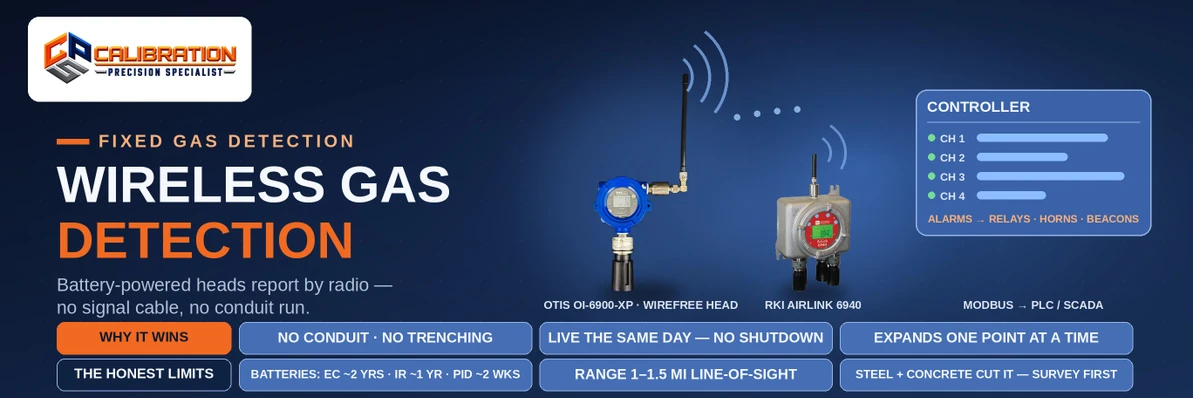
Wireless gas detection exists to delete that line item. Battery-powered sensor heads report to a central controller by radio — no signal cable, no conduit run, no trenching. Both OTIS Instruments (their WireFree line) and RKI Instruments (their AirLink line) build full wireless systems, and we sell and service both. Here's what wireless actually buys you, where its limits are, and how to decide when it's the right call.
How Wireless Fixed Detection Works
A wireless system has the same anatomy as a wired one, minus the cable:
- Sensor heads at each monitoring point — electrochemical, catalytic bead, infrared, or PID sensors in an explosion-proof or weatherproof enclosure — powered by an internal battery pack instead of plant power.
- A radio link — typically 900 MHz or 2.4 GHz — carrying readings, alarms, and fault status to the controller. Both OTIS WireFree and RKI AirLink offer both bands, support dozens of separate networks so neighboring systems don't collide, and address up to 255 heads per network.
- A controller or gateway that displays every channel, sounds alarms, drives relays for horns, beacons, and shutdowns, and passes data on to your PLC or SCADA system by Modbus. The OTIS OI-7010 is a good example: a 32-channel hybrid panel that takes WireFree heads and wired 4–20 mA inputs on the same controller, so wireless points and existing wired points live together.
Nothing about the sensing changes. The sensor still has to be calibrated, still drifts, still fails the same ways. What changes is everything between the sensor and the control room.
The Benefits — Why Wireless Wins Jobs
1. Installation cost collapses. No conduit, no cable, no trenching, no concrete cutting. A head mounts, gets addressed to the network, and it's reporting. Points that would have taken an electrician days of conduit work go live the same day. On remote or spread-out points, this isn't a small saving — it's most of the project cost.
2. No hot work, no shutdown. Running conduit in a classified area can mean hot-work permits, gas checks, and waiting for a turnaround. Mounting a battery head doesn't. Wireless points routinely go into live plants without taking anything down.
3. Coverage where wire can't go. Tank farms, well pads, lift stations, loading racks, cooling towers, remote fence lines — anywhere power and signal cable don't already exist, wired detection is a construction project and wireless is an afternoon. If the point is a quarter-mile from the nearest junction box, wireless is usually the only economical answer.
4. Expansion is trivial. Adding a wired point means new conduit tied into an existing run. Adding a wireless point means mounting another head and giving it an address. Systems grow one point at a time, as budget allows, instead of in one giant capital project.
5. It's movable. Processes change. A head that monitors a temporary tank, a turnaround, or a construction phase can be unbolted and redeployed somewhere else. Wired points are forever — or they're abandoned in place.
6. Temporary and rental-style monitoring works. Turnarounds, remediation projects, leak investigations, insurance-driven short-term coverage — wireless systems install fast and come back out clean when the job ends.
The Honest Limits
Wireless is not magic, and three limits decide whether a given point should be wireless:
Batteries are a maintenance item. Battery life depends heavily on sensor type. Electrochemical sensors are frugal — RKI rates AirLink heads at up to 2 years on electrochemical sensors and about a year on low-power infrared. PID sensors are power-hungry by comparison — think weeks, not years (about 2 weeks on the AirLink 6940-XP). Every wireless point you install is a battery you'll eventually change, so the maintenance plan has to include it. Budget the battery swap into the same visit as a calibration and it's a non-issue; ignore it and the point goes dark quietly.
Radio range is real, and buildings eat it. Both systems are rated around 1 to 1.5 miles line-of-sight. Steel structures, concrete walls, and dense equipment cut that down — sometimes dramatically. Serious wireless projects start with a site survey (RKI and OTIS both offer handheld signal-strength meters for exactly this), and dense plants may need repeaters or a gateway positioned to see around obstructions. If a vendor quotes you a big wireless system without asking about your building layout, be suspicious.
Some points should stay wired. If the point sits ten feet from existing conduit and plant power, wired is simpler, powered forever, and one less battery to track. Wireless earns its keep on distance, difficulty, and change — not on points that were already easy.
When to Use Wireless — The Short Version
Reach for wireless when:
- The point is far from power and signal cable (remote sites, tank farms, well pads, lift stations)
- The run would require trenching, concrete work, or conduit through a classified area
- You need coverage temporarily — turnarounds, construction, investigations
- The plant can't shut down for installation
- You're adding points over time and want to grow the system gradually
- The monitoring point may move as the process changes
Stay wired when the point is close to existing infrastructure, when the application runs power-hungry sensors like PID continuously, or when plant standards require hardwired loops end to end. Plenty of the best systems are hybrids — wired where it's easy, wireless where it isn't — and hybrid controllers like the OTIS OI-7010 exist precisely for that mix.
The Two Systems We Work With
OTIS Instruments WireFree. OTIS built their line around oil, gas, and water/wastewater work. The OI-6900-XP is a dual-battery, explosion-proof WireFree head; the OI-6940-XP puts up to four gases in one WireFree enclosure; and the wired-powered OI-6000 series can add a WireFree radio where plant power exists but signal cable doesn't. Controllers scale from the 32-channel OI-7010 hybrid and OI-7032 touchscreen with data logging up to the OI-9850 gateway at 255 channels. Browse the full line under Fixed Systems → Controllers → OTIS Instruments.
RKI Instruments AirLink. RKI's AirLink family covers the same ground: battery-powered AirLink 6900 and 6940-XP transmitters for classified areas, the lighter AirLink Alert for non-hazardous locations, and AirLink 7010/7032 controllers tying it together — with the sensor range RKI is known for, including PID and low-power IR. We stock the AirLink replacement sensors and accessories, and we can spec a complete AirLink system around your site.
Both systems use non-intrusive magnetic calibration — you calibrate through the enclosure window without opening an explosion-proof housing in the field, which keeps the XP rating intact and the job fast.
The Calibration Angle
Wireless changes the wiring. It does not change the calibration. A WireFree or AirLink head drifts like any other sensor and needs bump testing and calibration on the same schedule as a wired point — the radio just reports the reading, it doesn't vouch for it. We calibrate every channel — fixed fleets included. Fixed systems can be serviced at your facility, or heads can be pulled and shipped to our lab — whatever fits the job and the distance. Call us at 865-900-8844 and we'll help you decide — and if you're planning a wireless system, involving us at the survey stage is how you avoid the range surprises.
The Bottom Line
Wireless gas detection trades conduit for batteries. Where distance, classified-area rules, shutdown windows, or changing processes make wiring expensive or impossible, that trade is a bargain — installation drops from weeks to hours and coverage goes where wire never would. Where a point sits next to existing power and conduit, wired is still the simple answer. The winning move is knowing which points are which — and that's a survey, not a guess.
Planning a system? Browse OTIS Instruments controllers and the OTIS OI-6900-XP WireFree head, or call 865-900-8844 to spec a wireless or hybrid system for your site. Already running fixed detection? Have us come to your facility or ship your instruments to our lab — gas detection and process instruments alike.
Frequently Asked Questions
How long do wireless gas detector batteries last? It depends on the sensor. Electrochemical sensors are the most efficient — up to about 2 years on RKI AirLink heads. Low-power infrared runs about a year. PID sensors draw far more power and run roughly 2 weeks per battery pack on explosion-proof heads. Treat battery changes as scheduled maintenance, ideally paired with calibration visits.
How far will the radio signal reach? Both OTIS WireFree and RKI AirLink are rated around 1 to 1.5 miles in open line-of-sight. Inside plants, steel and concrete reduce that substantially, which is why a site survey with a signal-strength meter comes before any serious installation. Repeaters and gateway placement close most gaps.
Are wireless gas detectors safe for hazardous (classified) areas? Yes — both lines offer explosion-proof, Class I Division 1 certified heads (OTIS OI-6900-XP, RKI AirLink 6940-XP). Non-hazardous-area models like the RKI AirLink Alert cost less and suit unclassified locations. Match the head's certification to the area classification, same as wired.
Can wireless detectors trigger alarms and shutdowns like wired ones? Yes. The controller receives the alarm and drives its relays — horns, beacons, ventilation, shutdown outputs — and passes readings to PLCs and SCADA over Modbus. The head-to-controller hop is radio; everything downstream behaves like a conventional system.
Do wireless gas detectors still need calibration? Absolutely. The radio reports the reading; the sensor still drifts. Wireless heads need bump testing and calibration on the same schedule as wired detectors. Both OTIS and RKI heads support non-intrusive magnetic calibration, so the enclosure never has to be opened in the field.
Can I mix wireless and wired detectors on one system? Yes — that's what hybrid controllers are for. The OTIS OI-7010, for example, accepts WireFree heads and wired 4–20 mA inputs on one panel, so existing wired points stay put and new points go wireless where wiring is painful.
CPS Calibrations · 109 S. Front Street, Rockwood, TN 37854 · Fixed Gas Detection · Calibration Gas · Calibration Services · Contact Us
Recent Posts
-

Open-Path vs. Point Gas Detectors: What's the Difference?
The difference between an open-path and a point gas detector is what each one measures: an open-path …Oct 21st 2026 -

What Does IDLH Mean?
IDLH stands for Immediately Dangerous to Life or Health, and it is NIOSH's escape line: the maximum …Oct 21st 2026 -

Carbon Dioxide vs. Carbon Monoxide: What's the Difference?
Carbon dioxide (CO2) and carbon monoxide (CO) differ by one oxygen atom — and by almost everything t …Oct 21st 2026