
Open-Path vs. Point Gas Detectors: What's the Difference?
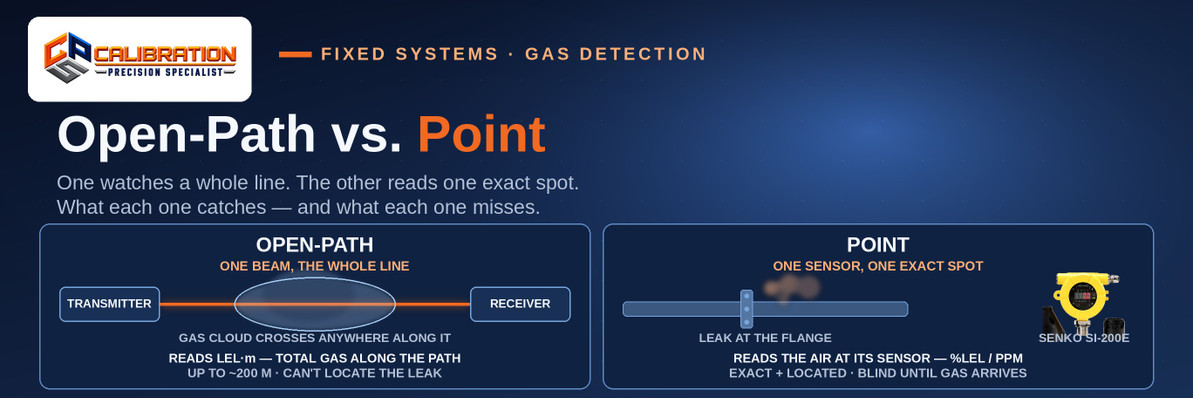
The difference between an open-path and a point gas detector is what each one measures: an open-path detector runs an infrared beam between a transmitter and a receiver — typically 5 to 200 meters apart — and reports the total gas along the whole line in LEL·meters, which is concentration multiplied by cloud length, while a point detector samples the air at its own sensor and reports the exact concentration right there, in %LEL for combustibles or ppm for toxics. So an open-path detector alarms on a cloud crossing its beam anywhere along the line, but cannot say where the gas is or how strong it is at any one spot — and a point detector tells you exactly what is happening at its location and nothing at all about the cloud drifting past ten feet away.
Both are "fixed gas detectors," both wear explosion-proof housings, both wire into the same controllers — and buyers regularly treat them as competing versions of one instrument. They aren't. They are two different measurement philosophies aimed at two different geometries of leak: the point detector guards places (this flange, this seal, this room), and the open-path detector guards lines (this fence line, this pipe rack, this tank farm edge). This post works through how each measurement actually works — including the LEL·meter math that makes open-path readings so different from the %LEL numbers most people know — puts the two head to head, and ends with where each one wins and where each one is blind. For the system both of them plug into, see our guide to how a fixed gas detection system works.
What Does a Point Gas Detector Measure? The Air at One Spot
A point detector measures concentration at a location. A catalytic-bead or infrared sensor in a wall-mounted housing continuously samples the air that reaches it and reports how much gas is in that air: percent of the lower explosive limit (%LEL) for combustibles, parts per million (ppm) for toxics like H₂S and CO. Low alarms are typically set at 10–20% LEL — a call to act while the atmosphere at the sensor is still a tenth to a fifth of what could burn. (If %LEL is new territory, our post on what LEL means works through the scale.) The reading is exact, it trends over time, and because the sensor genuinely samples gas, the detector is bump tested and calibrated with calibration gas on a schedule — the maintenance rhythm the rest of this blog is built on.
Everything else about point detection follows from that one fact: the gas has to arrive. A point detector knows nothing about the cloud that forms across the room, pools in a pit it isn't watching, or drifts past outdoors on the wind. Its coverage is exactly as good as its placement — which is why placement is a discipline: gases rise, sink, or mix according to vapor density, and detectors belong at the credible leak sources and where the gas will actually go, the subjects of our guides to where fixed gas detectors should be placed and where gas goes when it leaks.
This is the technology CPS sells, installs, and calibrates. A representative fixed point detector — SENKO's explosion-proof SI-200E — runs $1,092.50 to $2,300 depending on the gas and configuration, in the SENKO SI-200E listing. Keep that scale in mind; it matters when we get to what covering a long line with points alone would take.
What Does an Open-Path Gas Detector Measure? Everything Along a Line
An open-path detector stretches the measurement out into a line. A transmitter at one end projects an infrared beam to a receiver at the other — or a single transceiver bounces the beam off a retroreflector — across an open path that typically runs 5 to 200 meters. Gas anywhere along that path absorbs the beam at hydrocarbon wavelengths, and the receiver measures the total absorption. The detector never learns the concentration at any point along the line, because that isn't what it measured: it measured the sum of all the gas the beam passed through.
That sum is reported in LEL·meters (LEL·m): concentration, as a fraction of the LEL, multiplied by the length of cloud the beam crosses. The arithmetic is the whole concept:
- 1 meter of cloud at 100% LEL = 1 LEL·m
- 10 meters of cloud at 10% LEL = 1 LEL·m
- 20 meters of cloud at 5% LEL = 1 LEL·m
Those three clouds are completely different events — one small and dangerous, one large and dilute — and an open-path detector cannot tell them apart, because to the beam they are the same total. Typical open-path instruments read 0–5 LEL·m full scale, with alarm settings commonly at 1 LEL·m (low) and 3 LEL·m (high), and they respond to a cloud crossing the beam within a few seconds. Toxic versions of the same idea report ppm·meters, and the performance standard written specifically for these instruments is IEC 60079-29-4. Open-path detection is, overwhelmingly, a hydrocarbon technology: the beam watches infrared absorption bands that combustible gases have and most toxic gases, at ppm levels, effectively don't.
Two consequences define the technology. First, the beam is a tripwire: it needs no gas to travel to a sensor, so a cloud drifting across a fence line on the wind is caught the moment it crosses, wherever along the line that happens — one instrument watching a line that would otherwise take a row of point detectors. Second, the alarm carries no address: the gas is somewhere along up to 200 meters of beam, and somebody still has to go find it — usually with a point instrument, portable or fixed.
Open-Path vs. Point, Head to Head
| Point detector | Open-path detector | |
|---|---|---|
| Measures | Concentration of gas in the air at its sensor | Total gas along the whole beam path |
| Reading unit | %LEL (combustibles), ppm (toxics) | LEL·meters (combustibles), ppm·meters (toxics) |
| Coverage | One spot — the air that reaches the sensor | One line — typically 5–200 m between transmitter and receiver |
| Location information | Exact: the reading is true at the sensor | None along the beam: the gas is somewhere on the line |
| What it needs | The gas itself: leaked fuel must physically reach the sensor | A clear line of sight: an unobstructed beam, kept aligned |
| Its blind spot | Clouds that never reach it — across the room, outdoors on the wind, above or below its mounting height | Small leaks: a short, weak cloud may not total enough LEL·m to alarm; and it can't say where or how strong |
| Calibration | Bump tested and span-calibrated with calibration gas — the sensor samples real gas | No sensor sampling air to span; commissioned by alignment and verified optically per the manufacturer |
| Typical home | At the equipment: flanges, seals, valves, enclosed rooms, toxic-gas points | Along the line: fence lines, tank farms, pipe racks, loading areas |
| CPS note | What CPS sells, installs, and calibrates — e.g. SENKO SI-200E, $1,092.50–$2,300 by configuration | A technology CPS does not stock — a refinery-scale layer, covered here so you can spec the whole system honestly |
Where Open-Path Wins: Fence Lines, Tank Farms, and Long Open Runs
Run a point detector's logic along a 200-meter fence line and the problem is arithmetic: a cloud crossing that line can do it anywhere, and a point detector only speaks for the few meters around itself. Covering the line with points means a row of detectors, each with power, signal cable, and a calibration schedule — and even then, the coverage is a string of dots, not a line; a cloud can slip between two heads, dilute below each one's alarm as it spreads, and cross unannounced. Industry write-ups on the technology often frame the tipping point this way: once an area is running eight to ten point sensors along a boundary, a beam starts to be the cheaper and more honest way to watch it.
The beam also wins the outdoor dilution problem. Outdoors, wind takes a leak and spreads it: concentration at any single point may never reach a 10–20% LEL point alarm, yet the total gas crossing the fence line is large. The integral is exactly what the open-path detector reads — 20 meters of cloud at 5% LEL is a full 1 LEL·m alarm even though no point inside that cloud reads above 5%. Tank farms, perimeter and fence-line monitoring, pipe racks, compressor-station boundaries, and loading jetties are the technology's home ground for the same reason: big open geometry, credible large releases, and a boundary the gas has to cross.
Where Point Wins: At the Equipment, Indoors, and for Toxics
Now shrink the stage. Most leaks in most facilities start small, at known hardware: a pump seal, a flange face, a valve stem, a compressor packing. That is point detection's home ground, and the beam is the blind one here. Run the integral in the other direction: a young leak making a half-meter wisp at 40% LEL totals 0.2 LEL·m — a fifth of a typical beam alarm, invisible to the open-path detector watching the area. The point detector mounted at that flange reads the 40% LEL directly and alarms at 10–20%. For finding leaks early and at the source — which is most of what gas detection is for — the exact local reading is the instrument that matters, and it also hands you the trend: a point reading creeping from 0% to 8% LEL across a shift is a gasket announcing itself days early, a kind of information an integrated beam total can't give you.
Point detection also owns two whole territories the beam barely enters. Toxics: H₂S, CO, chlorine, and ammonia are monitored in ppm, at breathing-zone and leak-source locations, with electrochemical point sensors — open-path is a combustible-gas technology in practice, and ppm-level toxic protection is point work. Indoors and small scale: enclosed rooms, boiler and battery rooms, water-treatment spaces, and the great majority of industrial and municipal facilities have defined leak sources and short distances, where a handful of point detectors give exact, located, trendable readings for a fraction of a beam installation. And where the fire side of the incident matters, both of these gas technologies pair with a third layer entirely — the subject of our post on flame detector vs. gas detector.
The Honest Limits of Each
The beam's limits are the weather and the math. An open-path detector needs its beam: fog, heavy rain, and snow attenuate it, physical obstructions block it, and a transmitter or receiver knocked out of alignment blinds it — the instruments report these as beam-blocked or obscured faults rather than gas readings, which is honest, but a faulted beam is a line unwatched until someone clears it. And the math cuts both ways, as the examples above show: the integral that catches the huge dilute cloud is the same integral that shrugs at the small concentrated one.
The point's limits are geography and the wind. A point detector's world ends where its sampled air ends. Outdoors, wind decides whether a cloud ever visits a sensor; indoors, mounting height decides whether it tastes a rising gas or a sinking one. Coverage is bought one sensor at a time, and every gap between sensors is a gap, full stop. Neither limit is a defect — they're the price of each measurement, and they're why the two technologies are complements rather than rivals.
One more honest note, because this is our blog: CPS sells point detectors. We install them, wire them into controllers, and calibrate them, and the post you're reading argues for them in the places they genuinely win. We don't stock open-path detectors, and nothing above is a sales pitch for one — it's the spec-level picture we'd want a customer to have before designing a system, including the cases where the right answer for part of your site is a technology you'd buy from somebody else.
Do You Need Both? How to Decide
- Where would a leak start, and how big is the stage? Known hardware in defined spaces — flanges, seals, rooms — is point work. Long open boundaries and large outdoor areas where a cloud can form and travel are beam work.
- What size of release are you protecting against? Small, early, at-the-source leaks argue for points at the equipment. Large catastrophic releases crossing a perimeter argue for a beam watching the crossing.
- Which gases? Combustibles across an area suit either, by geometry. Toxics in ppm — H₂S, CO, Cl₂, NH₃ — are point detection, at the source and the breathing zone.
- What does the alarm need to tell you? An exact concentration, a location, and a trend point to point detectors. A fast "gas is crossing this line, send someone with a portable" points to the beam.
In practice, large hydrocarbon sites layer them: beams on the fence line and across the pipe racks, points at the equipment — each covering the other's blind spot, both reporting to the same controller. Most facilities CPS serves are point-only, and at their scale that's not a compromise; it's the right design. The mistake to avoid is assuming one instrument type covers the other's geometry: a point detector is not area coverage, and a beam is not leak detection at the flange.
Frequently Asked Questions
What is the difference between an open-path and a point gas detector? A point detector samples the air at its own sensor and reports the exact concentration there, in %LEL or ppm. An open-path detector runs an infrared beam between a transmitter and a receiver — typically 5 to 200 meters apart — and reports the total gas along the whole line in LEL·meters. The point detector gives an exact, located reading but only for gas that reaches it; the open-path detector catches any cloud crossing its beam but can't say where along the beam the gas is or how strong it is at any spot.
What does LEL·m (LEL-meters) mean? LEL·meters is concentration multiplied by cloud length: the fraction of the lower explosive limit, times the number of meters of cloud the beam passes through. One LEL·m can be 1 meter of cloud at 100% LEL, 10 meters at 10% LEL, or 20 meters at 5% LEL — an open-path detector reads all three as the same total, which is why it reports the size of the whole cloud crossing rather than the strength at any point. Typical instruments read 0–5 LEL·m, with alarms commonly set at 1 and 3 LEL·m.
How far can an open-path gas detector see? Open-path detectors are sold in path-length bands, and a single beam typically covers 5 to 200 meters between transmitter and receiver, depending on the model. That one line replaces what would otherwise be a row of point detectors along a fence line, pipe rack, or tank-farm edge — with the trade-off that the beam reports the gas total for the whole line, not a reading at any position along it.
Can an open-path gas detector tell you where the leak is? No. The detector knows gas crossed its beam somewhere along a path that can run up to roughly 200 meters — it cannot locate the leak along the line, and it can't separate one cloud from another crossing at the same time. Locating the leak still takes point instruments: fixed point detectors alarm at their own positions, and portable detectors do the final hunt. Open-path is an early-warning tripwire, not a locator.
Can an open-path gas detector miss a small leak? Yes — that's the integral working against it. A small leak near a flange might make a half-meter wisp at 40% LEL, which totals only 0.2 LEL·m — well under a typical 1 LEL·m beam alarm. A point detector mounted at that flange reads the 40% LEL directly and alarms at its 10–20% LEL setpoint. Open-path catches big, spread-out clouds; point detectors catch small leaks at the source. It's the main reason equipment-level protection stays point-based even on sites that run beams.
Which is better, open-path or point gas detection? Neither — they answer different geometries. Point detection is better at the equipment: exact readings, exact locations, trends, toxic gases in ppm, and early warning on small leaks. Open-path is better along a line: fence lines, tank farms, and pipe racks, where one beam watches up to ~200 meters and catches dilute clouds that no single point would alarm on. Large hydrocarbon sites typically run both, layered; most smaller facilities run point detection alone, correctly.
Do open-path gas detectors need calibration? Not the way point detectors do. A point detector's sensor samples real gas and drifts, so it's bump tested and span-calibrated with calibration gas on a schedule. An open-path detector has no air-sampling sensor to span — it's commissioned by aligning the beam and verified optically, with the manufacturer's test filters and checks, and its job is keeping the beam aligned and the optics clean. The maintenance burden moves from gas cylinders to alignment and housekeeping.
Can an open-path gas detector detect toxic gases like H2S? In practice, open-path is a combustible-gas technology: the beam reads infrared absorption in LEL·meters, which suits hydrocarbons. Toxic gases like H₂S and CO are monitored in parts per million — concentrations far too small for that measurement — at specific points: leak sources and breathing zones, with electrochemical point sensors. A few specialized laser open-path models exist for individual gases, but standard toxic protection is point detection.
What happens to an open-path detector in fog or when the beam is blocked? The beam weakens or disappears, and the detector reports it as a fault — beam blocked or obscured — rather than inventing a gas reading. Fog, heavy rain, snow, a parked vehicle, scaffolding, or a knocked-out-of-alignment head can all do it. That's fail-safe behavior, but the line is unwatched until the path clears or the head is realigned, which is one reason beams complement point detectors instead of replacing them.
How many point detectors does it take to replace one open-path beam? There's no one-for-one conversion, because they don't cover the same shape: the beam covers a continuous line up to ~200 meters long, while each point detector covers only the air around itself. Industry discussions of the technology often use eight to ten point sensors along one boundary as the point where a beam becomes the practical answer — and even a full row of points still leaves gaps between heads that the beam doesn't have. Most sites don't replace one with the other; they put beams on the lines and points at the equipment.
The Bottom Line
A point detector reads the air at one spot, exactly — and is blind to everything that never reaches it. An open-path detector reads the total gas along a whole line, up to a couple of hundred meters of it — and can't tell you where the gas is, how strong it is anywhere, or notice the small leak smoldering under its beam. Guard places with points; guard lines with beams; and on any site big enough for the question to matter, expect the honest answer to be both, layered. If your facility is the far more common case — defined equipment, defined rooms, defined leak sources — point detection is the system, and it's the system CPS designs, installs, and calibrates.
Working out the fixed detection layout for a facility — points, lines, or both? That is a conversation worth having before the purchase order — call 865-900-8844 or reach us through Contact Us. The architecture both technologies report into is covered in our fixed system overview, placement in where fixed gas detectors should be placed, and the fire layer in flame detector vs. gas detector.
CPS Calibrations · 109 S. Front Street, Rockwood, TN 37854 · Calibration Gas · Calibration Services · Contact Us
Recent Posts
-

PID vs. LEL for VOC Detection: Which Sensor Do You Actually Need?
Use a PID to detect VOCs and an LEL sensor to detect explosive atmospheres — they measure different …Oct 21st 2026 -

Semiconductor (MOS) Gas Sensors: Where They Work and Where They Lie
A semiconductor (MOS) gas sensor measures gas with a heated film of metal oxide — usually tin dioxid …Oct 21st 2026 -

What Do Firefighters Use a Gas Meter For?
Firefighters use a gas meter — usually a 4-gas monitor reading oxygen (O₂), combustible gas as a per …Oct 21st 2026