
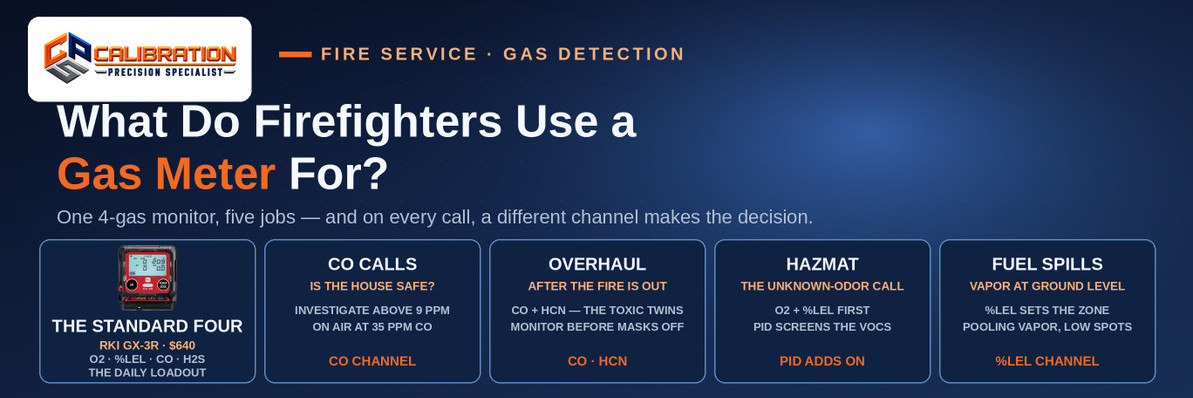
What Do Firefighters Use a Gas Meter For?
Firefighters use a gas meter — usually a 4-gas monitor reading oxygen (O₂), combustible gas as a percentage of the lower explosive limit (%LEL), carbon monoxide (CO), and hydrogen sulfide (H₂S) — to make decisions they can't make by eye or by nose: whether a home with a sounding CO alarm is safe to stand in, whether the air after a fire is clear enough to work without an air pack, whether spilled fuel is in its flammable range, and whether a confined space can be entered for a rescue. The numbers drive the calls — the pattern written into many department procedures is to investigate any CO reading above 9 ppm, put firefighters on air at 35 ppm, and evacuate at readings around 100 ppm.
The meter is the instrument that turns "something smells off" into a number somebody can act on. It rides along on five recurring jobs — carbon monoxide calls, structure-fire overhaul, hazmat screening, fuel spills, and confined-space rescue support — and on every one of them, a different channel of the same instrument is doing the deciding. This post walks through each job, which channel matters and why, where the action levels come from, and when four channels stop being enough. If you want the channel-by-channel fundamentals first, our post on what a 4-gas monitor detects covers each sensor in depth.
CO Calls: The Meter's Day Job
The most common gas-meter run in the fire service starts with a residential CO alarm sounding — or a caller reporting headaches, nausea, or a "gas smell" with no fire in sight. The home alarm on the wall has already done its one job, which is to make noise. What it cannot tell the crew is how much CO is in the house right now, and that number is the whole call. A residential alarm built to UL 2034 is not even required to sound until CO holds at 70 ppm for 60 to 240 minutes — so an alarm can be reporting a real event that has since ventilated away, or the front end of a problem that is still building.
So the crew works the meter, not the alarm. Standard practice is to start and zero the instrument in fresh air outside, take a baseline reading at the door, and then read room by room, working toward the likely sources: the furnace, water heater, gas fireplace, stove, and the attached garage. The readings map onto a decision ladder that many department procedures share:
| CO reading | What it usually means | Typical response |
|---|---|---|
| 0–9 ppm | No elevated CO found above background | Document the readings; the event may have cleared, or the alarm itself may be failing or at end of life |
| Above 9 ppm | Something in the building is producing CO | Find the source, shut it off, ventilate, then re-read to confirm it stays down |
| 35 ppm | NIOSH's recommended exposure limit for CO (8-hour TWA) | Many departments require SCBA from this level up — nobody works in it unprotected |
| Around 100 ppm and up | A dangerous level, not a wait-and-see level | Evacuate the occupants; crews work on air until the source is controlled and readings clear |
The same meter that clears the house also protects the crew clearing it: firefighters walking a CO-filled home without a reading are dosing themselves with the gas they're investigating. And when the readings won't come down after ventilation, the meter has told the crew there is a second source they haven't found yet — a cracked heat exchanger or a vehicle that was run in the garage — which is a finding, not a nuisance. For the exposure-limit math behind the 35 ppm figure, see our breakdown of carbon monoxide exposure limits: OSHA vs. NIOSH vs. ACGIH.
Overhaul: The Fire Is Out, the Gas Isn't
Ask where meters earn their keep at a structure fire and the answer is after knockdown, in overhaul — the phase where crews open walls and pull ceilings hunting hidden fire, surrounded by smoldering contents. The flames are gone; the chemistry isn't. Smoldering material keeps generating carbon monoxide, and modern furnishings and building materials — foams, plastics, and other synthetics — generate hydrogen cyanide (HCN) as they burn and smolder. Fire smoke's two asphyxiants travel together so reliably that the fire service calls CO and HCN the toxic twins: CO binds hemoglobin and starves the blood of oxygen, HCN blocks the cells from using the oxygen that arrives, and each makes the other worse.
That is why the meter comes out before the masks come off. Department air-monitoring procedures commonly set the doffing decision on numbers — CO below 35 ppm and HCN below its NIOSH short-term exposure limit of 4.7 ppm (about 5 ppm) are typical written action levels — and air monitoring continues until the scene is cleared, because debris piles off-gas and readings climb again as overhaul disturbs them. A standard 4-gas meter covers the CO half of that decision; covering the HCN half takes a meter that carries an HCN sensor, which is one of the reasons bigger multi-gas instruments exist (more on that below). The overhaul lesson is the one this whole post hangs on: at a fire, "no visible smoke" and "safe to breathe" are different statements, and only the meter can make the second one. Our hot-work post covers the same monitor-before-and-during logic from the fire-watch side: gas detection for hot work.
Hazmat: Screening the Unknown
The third job is the call nobody can describe: an unknown odor, a person down near chemicals, a leaking container, a chemical smell in a commercial building. The meter is the first screening tool off the truck because it answers the two questions that decide everything else — is there enough oxygen, and is this atmosphere in its flammable range? The O₂ and %LEL channels come first; the CO and H₂S channels cover two of the most common toxic gases a crew can meet, from sewer gas and manure pits to industrial processes.
This is also where the fifth channel earns its place. A photoionization detector (PID) doesn't identify a chemical — it reports total volatile organic compounds in ppm — but as a screening tool it tells the crew whether an organic vapor is present, roughly how much, and where it's strongest, which is how a hazmat team narrows an unknown down before committing people in higher levels of protective clothing. Meter readings also feed the incident commander's zone decisions: where the hot zone boundary sits is a measurement, not a guess. The honest limit belongs in the same breath — a 4-gas meter plus a PID screens the common hazards; it does not clear an atmosphere of every possible chemical, and specialty detection (tubes, papers, and dedicated instruments) takes over from there.
Fuel Spills: The LEL Channel Draws the Zone
At a fuel spill — a ruptured saddle tank, a leaking tanker, a vehicle fire's runoff — the deciding channel is %LEL. Gasoline vapor's flammable range runs from about 1.4% to 7.6% by volume, and the %LEL channel is simply that range rescaled to 0–100: the meter tells the crew, at each spot they sample, how close the vapor at ground level is to ignitable. Gasoline vapor is heavier than air, so it pools in low spots, drains, and basements rather than dispersing — the sampling pattern follows the vapor, low and downwind, as our post on where gas goes when it leaks works through. Crews monitor while the spill is diked, absorbed, and cleaned up, and the readings — not the smell, and not the size of the puddle — decide when the area can be handed back. The same %LEL check covers natural gas and propane leak calls, where the meter confirms whether a building's atmosphere is approaching the range where one spark finishes the call badly.
Confined-Space Rescue: Testing From Outside
The fifth job is the one with the least margin. When a worker is down in a tank, vault, silo, or manhole, would-be rescuers are historically the second and third victims — which is why the meter goes in before any person does. A pumped monitor draws the sample through a hose from outside the space, testing at multiple depths, because gases stratify: some pool at the bottom, some ride at the top. The test order is fixed — oxygen first, then flammables, then toxics — for the practical reason that a combustible-gas sensor needs oxygen present to read honestly. Our walkthrough of how to test a confined space before entry covers the full sequence, and how long you test a confined space before entry covers the part crews rush: the sample has to travel the hose and the sensors have to finish responding before the number means anything. On rescue calls, the meter keeps running during the entry — continuous monitoring is what tells the attendant the atmosphere is changing while the rescuer is still inside.
Why the Standard Four?
The four channels in a fire-service meter aren't tradition; each maps to a way an atmosphere hurts people. Oxygen covers displacement and enrichment — too little and people suffocate without warning symptoms, too much and everything burns faster. %LEL covers the explosion that hasn't happened yet. CO covers the combustion byproduct the fire service meets more than any other toxic gas — every furnace, engine, and fire produces it. H₂S covers the decay gas of sewers, septic systems, and manure pits — the one whose warning sign fails, because H₂S deadens the sense of smell at high concentrations, which our post on why you can't smell hydrogen sulfide explains. Four channels, four failure modes, one instrument a firefighter can clip on and read at a glance.
Four stops being enough in known places:
- PID (VOCs) — for hazmat screening and overhaul atmospheres, where the question is "what organics are in this air, and how much?"
- HCN — for departments that monitor overhaul air against both toxic twins instead of CO alone.
- Specialty toxics — ammonia, chlorine, sulfur dioxide, and others, when a department's local industry makes them a realistic call.
Instruments like the RKI GX-6100 are built for exactly that step up: up to six gases at once, adding a PID, an infrared channel, or a specialty toxic (HCN among them) to the standard four, with a built-in pump for remote sampling.
What Departments Actually Carry
On many departments the meter lives on the engine, the rescue, or with the duty officer — one shared instrument rather than one per firefighter — which makes its readiness a department-level concern, not a personal one. The CPS portable lines that map onto fire-service work:
- RKI GX-3R — $640. The standard four in a diffusion monitor small enough to clip to a strap and forget until it alarms: LEL, O₂, CO, and H₂S, IP66/68, roughly a 25-hour battery, and a 3-year warranty. The CO-call and general-duty default.
- RKI GX-Force — $794. The same four channels with the sample pump built in (0.5 L/min draw, up to 100 ft of hose) — the confined-space and remote-sampling version, no separate pump to charge or remember.
- SENKO SP-MGT — $485. A 4-gas alternative in the same standard configuration, for departments equipping more than one rig on a budget.
- RKI GX-6100 — from $1,597. The step-up instrument: up to six gases, with the 4-gas + PID build at $3,455 and smart-sensor channels that can carry HCN or other specialty toxics — one meter for the hazmat and overhaul jobs as well as the daily four.
The full range sits in our portable multi-gas monitors category, with the pumped models grouped under pumped monitors.
The Meter Only Works If It's Ready
A gas meter that fails silently is worse than no meter, because the crew trusts it. The discipline is short and non-negotiable: a bump test — a brief exposure to known gas to prove every sensor responds and the alarms fire — before each day's use, and a full calibration on the manufacturer's schedule and after any failed bump. Our guide to how to bump test a gas detector walks the procedure, and our gas detector calibration cost post lays out what keeping a meter honest costs — CPS calibrates a 4- or 5-gas monitor in-house for $90. The other half of readiness is the human one: readings only protect a crew that has been trained to interpret them — when to go on air, when a number means evacuate, when a rising trend means get out now. CPS provides instrument training for fire departments, built around the meters the department actually carries; reach us through Contact Us to talk through what your department needs.
Frequently Asked Questions
What gas meter do firefighters use? Most firefighters use a portable 4-gas monitor — one instrument reading oxygen (O₂), combustible gas (%LEL), carbon monoxide (CO), and hydrogen sulfide (H₂S) at the same time. Common examples at CPS are the RKI GX-3R ($640, diffusion) and the pumped RKI GX-Force ($794); departments that also need VOC or hydrogen cyanide coverage step up to a configurable multi-gas instrument like the RKI GX-6100 (from $1,597).
What do firefighters check on a carbon monoxide call? They measure the actual CO concentration, room by room, with a meter that was zeroed in fresh air outside — starting at the door and working toward likely sources like the furnace, water heater, and attached garage. A home CO alarm only says CO was present long enough to trip it (a UL 2034 alarm isn't required to sound until 70 ppm sustained for 60–240 minutes); the meter says how much is there now, which is what decides ventilation, source shutdown, SCBA, and evacuation.
At what CO level do firefighters wear SCBA? A common action level in department procedures is 35 ppm — NIOSH's recommended exposure limit for carbon monoxide as an 8-hour time-weighted average. The usual ladder runs: investigate any reading above 9 ppm, require SCBA at 35 ppm, and evacuate occupants at readings around 100 ppm. Exact thresholds are set by each department's own procedures, but 35 ppm is the widely used line between working unprotected and going on air.
Why do firefighters monitor the air during overhaul? Because the end of the flames is not the end of the gas. Smoldering contents keep producing carbon monoxide, and burning synthetics produce hydrogen cyanide — CO and HCN together are the fire service's "toxic twins." Crews monitor overhaul air so the decision to remove SCBA is based on readings (commonly CO below 35 ppm and HCN below about 5 ppm) rather than on the smoke looking thinner.
What are the toxic twins in firefighting? Carbon monoxide (CO) and hydrogen cyanide (HCN). Both are chemical asphyxiants produced by structure fires — CO from incomplete combustion generally, HCN from burning nitrogen-containing synthetics like foams and plastics. CO starves the blood of oxygen; HCN stops cells from using it. Together they are more dangerous than either alone, which is why departments that monitor overhaul air track both.
Can a standard 4-gas meter detect hydrogen cyanide? No. The standard four channels — O₂, %LEL, CO, and H₂S — do not include hydrogen cyanide, and no setting changes that; HCN needs its own sensor. Instruments with swappable smart sensors, like the RKI GX-6100, can carry an HCN channel alongside the standard four (and a PID), which is how departments add toxic-twin coverage for overhaul and hazmat work.
What gases does a firefighter's 4-gas meter measure? Oxygen (O₂) as a percentage of air, combustible gas as a percentage of the lower explosive limit (%LEL), carbon monoxide (CO) in parts per million, and hydrogen sulfide (H₂S) in parts per million. Those four cover oxygen displacement, explosion risk, and the two toxic gases firefighters encounter most often — CO from combustion and H₂S from sewers, septic systems, and decay.
Do firefighters use gas meters at fuel spills? Yes — mainly the %LEL channel. It tells the crew how close the vapor at ground level is to its flammable range (gasoline vapor ignites from about 1.4% to 7.6% by volume, which the meter reports as 0–100% LEL). Because gasoline vapor is heavier than air and pools in low spots and drains, crews sample low and downwind, and the readings set the working zone and decide when the area can be released.
Why do firefighters test a confined space before a rescue? Because the atmosphere is usually what put the first person down, and rescuers entering untested air become the next victims. A pumped meter tests the space from outside — at several depths, in the fixed order of oxygen, then flammables, then toxics — and keeps monitoring during the entry, so the first warning of a changing atmosphere reaches the attendant while the rescuer can still be pulled out.
How often should a fire department bump test and calibrate its meters? Bump test before each day's use — a quick exposure to known gas proving every sensor responds and every alarm fires — and calibrate fully on the manufacturer's schedule, after any failed bump test, and whenever readings look suspect. CPS calibrates a 4- or 5-gas monitor in-house for $90. A shared department meter that skips the bump test is a guess riding on the truck.
The Bottom Line
A firefighter's gas meter is a decision instrument. On a CO call it replaces "the alarm went off" with a number and a ladder: investigate above 9 ppm, on air at 35, evacuate around 100. At a fire it stands guard over overhaul, when CO and hydrogen cyanide — the toxic twins — outlast the flames. On hazmat calls it screens the unknown, at fuel spills its LEL channel draws the zone, and at a confined-space rescue it goes in first so the rescuers don't become victims. The standard four channels — oxygen, %LEL, CO, and H₂S — cover the jobs that recur; PID and HCN channels cover the jobs that escalate. All of it only works if the meter is bump tested, calibrated, and in the hands of a crew trained to read it.
Outfitting a department, replacing a meter, or setting up training for your crew? Call 865-900-8844 or reach us through Contact Us — we'll match the instrument to the calls your department actually runs. Browse the lines in portable multi-gas monitors, and see the service side at Calibration Services.
CPS Calibrations · 109 S. Front Street, Rockwood, TN 37854 · Calibration Gas · Calibration Services · Contact Us
Recent Posts
-

PID vs. LEL for VOC Detection: Which Sensor Do You Actually Need?
Use a PID to detect VOCs and an LEL sensor to detect explosive atmospheres — they measure different …Oct 21st 2026 -

Semiconductor (MOS) Gas Sensors: Where They Work and Where They Lie
A semiconductor (MOS) gas sensor measures gas with a heated film of metal oxide — usually tin dioxid …Oct 21st 2026 -

What Do Firefighters Use a Gas Meter For?
Firefighters use a gas meter — usually a 4-gas monitor reading oxygen (O₂), combustible gas as a per …Oct 21st 2026