
How Long Do You Test a Confined Space Before Entry?
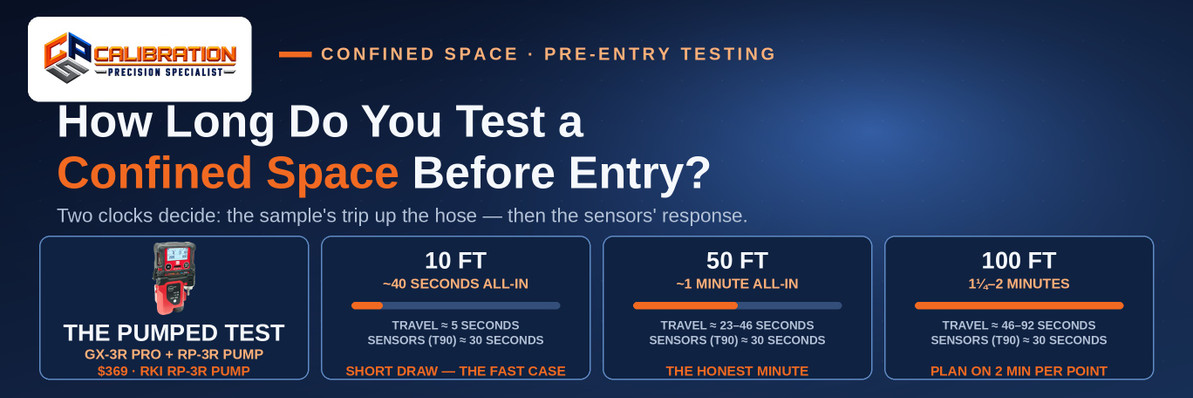
You test a confined space until the sample has physically traveled the sample hose and the sensors have finished responding to it — the total wait is hose travel time plus sensor response time, and the two never overlap. On typical pumped instruments that works out to about 40 seconds all-in at 10 feet of hose, about a minute at 50 feet, and 1¼ to 2 minutes at the 100-foot maximum — per sampling point, and again every time the probe moves to a new level. A reading taken sooner is not a reading of the space; it is a reading of the air that was already sitting in the hose.
Of every question confined space trainers get asked, the most common one is some version of "do we really have to wait that long?" The wait feels like dead time — the probe is in the space, the instrument is running, numbers are on the screen. But those first numbers describe the inside of your hose, not the bottom of the vessel, and entering on them means entering on a measurement of clean yard air. This post works through where the wait comes from, the actual numbers at the hose lengths crews really use, and why the clock restarts at every level. It is the timing companion to our post on the OSHA testing sequence — the order you test in — and to our post on how far a pumped detector can draw a sample, which covers the reach side of the same instruments.
Why Isn't the First Reading Real? The Two Clocks
A pumped pre-entry test runs on two clocks wired in series:
- Travel time. The pump has to pull the entire volume of air already sitting in the hose out of the way and replace it with air from the sampling point. Until that exchange finishes, the sensors are measuring the hose's old air — which is whatever the hose last held, usually the clean air at the opening.
- Response time. Only when the space's air actually reaches the sensors does their response clock start. Sensors do not snap to the final value; they climb toward it, and the industry measure of that climb is T90 — the time to reach 90% of the final reading.
Total wait = travel time + response time. Neither half can be shortened by confidence, experience, or schedule pressure, and a reading taken at second five of a 76-second process is not an early estimate — it is a measurement of the wrong air, displayed on a screen that cannot tell you so.
Clock One: How Long Does the Sample Take to Travel the Hose?
Travel time is hose volume divided by pump flow. Typical detector sample hose is about 4 mm inside diameter and holds roughly 3.8 cc of air per foot, so each foot of hose costs:
- About ½ second per foot at 0.5 L/min — the flow of the RKI GX-Force's built-in pump and the RP-3R clip-on pump on high flow.
- About ⅔ of a second per foot at 0.35 L/min — the RP-3R's ECO flow.
- About ¾ to 1 second per foot at 250–300 cc/min — the SENKO SP-MGTP's pump range.
These are not theoretical numbers. RKI's own documentation for the RP-3R pump ($369) lists a sample draw time of approximately 46 seconds at its 0.5 L/min flow over its maximum 100 ft of hose, and about 65 seconds in ECO mode — and the volume math above lands on 46 and 66 seconds for the same run. Manufacturer and arithmetic agree: at maximum hose length, the sample spends the better part of a minute just getting to the instrument. As a field rule of thumb, budget about 1 second per foot of hose — it covers the slower pumps and the flow sag every real line has — then add the response time on top.
One warning that belongs in this section, because it silently breaks the math: hose diameter matters more than hose length. Volume grows with the square of the bore, so a fatter hose from the shop shelf multiplies the travel time — the same pump that clears 100 ft of specified hose in 46 seconds needs over 6 minutes to clear 100 ft of 8 mm hose. The specified hose is part of the instrument's timing, not an accessory detail.
Clock Two: How Long Do the Sensors Take to Respond?
Once the space's air arrives, the sensors still need their own time to climb to the reading. RKI specifies T90 within 30 seconds for the GX-3R ($640) — the diffusion 4-gas monitor that also rides on the entrant's chest — and the same roughly-30-second class applies across the pumped instruments in this post, the GX-Force and the SP-MGTP included. Electrochemical toxic and oxygen cells and catalytic LEL sensors all live in that neighborhood; a PID channel, where one is fitted, answers faster, but the entry decision is made on the slowest channel that matters, which is the standard four.
Two practical consequences follow. First, the response clock starts last: it cannot begin until clock one finishes delivering the new air, which is why the two times add instead of overlapping. Second, a reading that is "still climbing" at the end of your wait is information, not an inconvenience — a sensor mid-climb is telling you the concentration at the probe is higher than the number currently shown. The wait ends when the reading settles, and the math in the next section is the minimum, not a timer to argue with.
So How Long Do You Wait at 10, 50, and 100 Feet?
Putting both clocks together for typical ~4 mm ID hose, at the pump flows the instruments above actually run:
| Hose length | Sample travel time | Plus sensor response (T90) | Total wait before the reading is the space |
|---|---|---|---|
| 10 ft | ~5 s at 0.5 L/min · ~8–9 s at 250–300 cc/min | ~30 s | About 40 seconds |
| 50 ft | ~23 s at 0.5 L/min · ~38–46 s at 250–300 cc/min | ~30 s | About 1 minute |
| 100 ft | ~46 s at 0.5 L/min · ~77–92 s at 250–300 cc/min | ~30 s | 1¼ to 2 minutes |
Read the table the way a crew experiences it. Short draws feel responsive: at 10 ft, the sample arrives in seconds and the whole test is the sensors' half-minute. Mid-length runs are an honest minute. And at maximum hose length — the deep vessel, the far end of the vault — a trustworthy reading takes one-and-a-quarter to two minutes, which is why the field rule for long lines is simply plan on 2 minutes per sampling point. These are best-case numbers, too: they assume the specified hose, clean filters, and a healthy pump. Cold weather slows the sensor chemistry, a loaded filter starves the flow, and a tired pump stretches every figure in the travel column.
Does the Clock Restart at Every Level? Yes — and It Has To
A confined space is rarely one atmosphere. Gases stratify: methane and other light gases collect at the top, hydrogen sulfide and most solvent vapors settle to the bottom, and oxygen can be deficient at one level and normal at another in the same vessel — the physics our post on where gas goes when it leaks works through in detail, and the reason detector height matters in our fixed detector placement guide as well. So the pre-entry test samples top, middle, and bottom, and — following OSHA's Appendix B method for descent into a possibly stratified space — tests the envelope about every 4 feet in the direction of travel, slowing the entrant to the speed of the sampling.
Every one of those stops restarts both clocks. Move the probe from the top of the vessel to the middle and the hose now holds the top's air; the middle's sample has to displace it foot by foot, and the sensors then have to respond to the new air, all over again. A 12-foot-deep space tested properly at three or four levels on a long hose run is a several-minute test, not a several-second one. Crews that "test the space" in thirty seconds total have measured one level — usually the cleanest one, at the opening — and assumed the rest. The stratification that makes level testing necessary is exactly what makes the assumption dangerous: the reading at the opening describes air the entrant occupies for two seconds on the way to where the hazard actually pooled.
What About Once Someone Is Inside? The Pre-Entry Test Is a Snapshot
However long and however carefully it is run, a pre-entry test certifies a moment. Then the job starts changing the air: sludge gets stirred and releases hydrogen sulfide, cutting and welding consume oxygen and generate carbon monoxide, product migrates through connected lines. That is why OSHA 1910.146 requires the space to be monitored as necessary during entry, and why the standard pattern pairs the two instrument types:
- Before entry: the pumped instrument outside the space — a built-in-pump monitor like the RKI GX-Force ($794), or a diffusion monitor converted with a clip-on pump like the RP-3R — testing every level on the full two-clock wait.
- During entry: a diffusion monitor on the entrant's chest, reading the breathing zone continuously, with no travel clock at all — the air is already at the sensor, so the only delay is the ~30-second response. That immediacy is the point: the entrant's warning has to arrive while there is still time to climb out.
Our post on the OSHA testing sequence covers the during-entry rules in full — continuous monitoring, the attendant's role, and why any interruption resets the entry. The timing lesson of this post is the one-line version: the pumped test buys certainty about a space nobody is in yet, at the price of one to two minutes per point; the diffusion monitor buys immediacy for the person inside, at the price of only knowing the air at that person's chest. A complete program runs both, in that order.
"I'll Be Quick — Can't I Just Hold My Breath?"
This is the version of the wait question that gets people killed, and it deserves a straight answer rather than a procedure.
No — because the hazards do not give you a working interval to be quick inside of. Oxygen deficiency impairs judgment and coordination before it produces any sensation of suffocation; the first symptom is making bad decisions, including the decision to keep going. Hydrogen sulfide is worse: at around 100 ppm it paralyzes the sense of smell, and at high concentrations a small number of breaths can collapse a worker where he stands — there is no breath to hold your way out with afterward. Carbon monoxide has no smell at all. In each case the gas takes away exactly the capability the plan depends on: noticing trouble and self-rescuing.
And the pattern compounds. NIOSH has long reported that roughly 60% of confined space fatalities are would-be rescuers — people who watched a coworker go down and went in after them, quickly, holding nothing but good intentions. The wait at the opening is not bureaucratic caution standing between you and the work. It is the entire mechanism by which the crew finds out whether the space is survivable before the space gets to demonstrate it. One to two minutes per level is the cheapest information in the whole entry program.
Field Rules for an Honest Pre-Entry Test
- Budget the wait before the entry, not during it. 1 second per foot of hose plus ~30 seconds of response — and 2 full minutes per point on maximum-length runs. Put it in the procedure so nobody has to negotiate it at the opening.
- Watch the reading settle, not the clock alone. The table gives minimums. A number still climbing when the timer ends is a number that has not finished telling you the concentration.
- Re-wait at every level. New probe position, new hose-full of the previous level's air, new full wait. The probe leads the entrant by about 4 feet and never faster than the sampling.
- Use the specified hose. Diameter changes volume with the square; a substitute hose silently rewrites every wait in this post.
- Distrust a fast reading — especially a fast all-clear. Gas at the far end of 100 ft of hose cannot arrive in 10 seconds. An instant response means hose air, opening air, or clean air leaking in at a fitting and diluting the sample — the failure that reports a bad space as a good one.
- Bump test first, zero in clean air. The wait only produces a trustworthy number if the instrument was verified that day and zeroed away from the opening, exhausts, and running equipment.
Frequently Asked Questions
How long do you test a confined space before entry? Until the sample has traveled the full hose and the sensors have finished responding — travel time plus T90. At 10 ft of hose that is about 40 seconds all-in; at 50 ft, about a minute; at 100 ft, 1¼ to 2 minutes — per sampling point, and repeated at every level you test. The reading is valid only after both clocks have run.
Why can't I take the reading as soon as the probe goes in? Because the sensors are not yet seeing the space. The hose arrives full of the air that was in it — usually clean air from the opening — and the pump must pull that entire volume out and replace it with air from the probe tip before any space air reaches the sensors. A reading taken in the first seconds is a measurement of the hose's old air, not of the confined space.
How long does a reading take at the end of a 100 ft hose? About 1¼ to 2 minutes. The sample travel alone takes ~46 seconds at a 0.5 L/min pump flow (RKI publishes ~46 seconds of draw time for the RP-3R at 100 ft, ~65 seconds in its 0.35 L/min ECO mode) and ~77–92 seconds at the 250–300 cc/min flows of a SENKO SP-MGTP — then the sensors need roughly another 30 seconds (T90) to settle. Plan on 2 minutes per point at maximum hose length.
Do I have to wait the full time again at every level? Yes. Confined spaces stratify, so the test samples top, middle, and bottom and about every 4 feet of descent — and each time the probe moves, the hose refills with the previous level's air, which the new sample must displace before the sensors respond. The full travel-plus-response wait applies at every stop.
What is T90, and why does it add time to the test? T90 is the time a sensor takes to reach 90% of its final reading after the gas reaches it. RKI specifies T90 within 30 seconds for the GX-3R. It adds to the test because it starts only after the sample finishes traveling the hose — the two delays run in series, so total wait is travel time plus T90, never one or the other.
Does a diffusion monitor have the same wait? No travel wait — the air is already at its sensors — but it still has the ~30-second sensor response, and it can only measure where it physically is. That is why diffusion monitors are not used for pre-entry testing from outside: the standard pattern is a pumped instrument to clear the space level by level before entry, and a diffusion monitor on the entrant's chest for continuous warning during it.
How far ahead of the entrant should the probe stay during descent? About 4 feet — roughly a body's length — following the method in OSHA's Appendix B to 1910.146: test the envelope approximately 4 feet in the direction of travel and to each side, and slow the entrant's progress to match the sampling and the detector's response. The probe leads, the readings settle, then the entrant follows into air that has actually been measured.
Can I shorten the wait with a shorter or wider hose? Shorter, yes — travel time scales with length, which is why a 10 ft check settles in about 40 seconds. Wider, no — the opposite. Hose volume grows with the square of the inside diameter, so a wider hose holds far more air per foot and takes much longer to clear. Use the hose diameter the instrument manufacturer specifies.
Is the pre-entry test enough for the whole entry? No. It is a snapshot of the space at that moment, before work starts disturbing it — sludge releases H₂S when stirred, hot work consumes oxygen and generates CO, and connected lines can migrate product in. OSHA requires monitoring during entry as necessary to confirm conditions are maintained, and the standard practice is continuous monitoring on the entrant for as long as anyone is inside.
Can't I just hold my breath and be quick? No. Oxygen deficiency impairs judgment before it causes any sensation of suffocation, hydrogen sulfide paralyzes the sense of smell at around 100 ppm and can collapse a worker in a few breaths at high concentrations, and carbon monoxide gives no warning at all — each hazard removes the ability to notice trouble and self-rescue that the plan depends on. NIOSH has long reported that roughly 60% of confined space deaths are would-be rescuers who went in quickly after someone else. The one-to-two-minute wait is how the crew learns the space is survivable before entering it.
The Bottom Line
The pre-entry wait is not dead time in front of the real test — it is the test. A pumped reading is only a measurement of the confined space after two clocks have run: the sample's trip up the hose (about ½ to 1 second per foot — 46 seconds at 100 ft on a 0.5 L/min pump, per RKI's own RP-3R figures) and the sensors' response (~30 seconds T90). Together they set the honest numbers: about 40 seconds at 10 ft, a minute at 50 ft, 1¼ to 2 minutes at 100 ft, repeated at every level of a stratified test, with the probe leading the entrant by about 4 feet. Build the wait into the procedure, watch each reading settle, and let continuous diffusion monitoring take over the moment someone goes in. The crews that get confined space testing right are not slower than everyone else — they are the ones whose numbers were real.
Setting up or re-equipping a confined space program? Start with the pumped monitors range — the GX-Force for a built-in pump, the RP-3R to convert the GX-3Rs your crew already wears — and keep every channel calibrated and verified: CPS calibrates every channel and reports as-found and as-left data, through our calibration services. Not sure how your spaces should be tested? Call us at 865-900-8844 and describe the space.
CPS Calibrations · 109 S. Front Street, Rockwood, TN 37854 · Portable Gas Detection · Calibration Gas · Calibration Services · Contact Us
Recent Posts
-

What Is a Confined Space? OSHA's Definition, the 3 Tests, and When It Becomes Permit-Required
A confined space is a space that passes all three of OSHA's tests at the same time: it is large enou …Oct 21st 2026 -

PID vs. LEL for VOC Detection: Which Sensor Do You Actually Need?
Use a PID to detect VOCs and an LEL sensor to detect explosive atmospheres — they measure different …Oct 21st 2026 -

Semiconductor (MOS) Gas Sensors: Where They Work and Where They Lie
A semiconductor (MOS) gas sensor measures gas with a heated film of metal oxide — usually tin dioxid …Oct 21st 2026