
How Do You Test a Confined Space Before Entry? The OSHA Testing Sequence
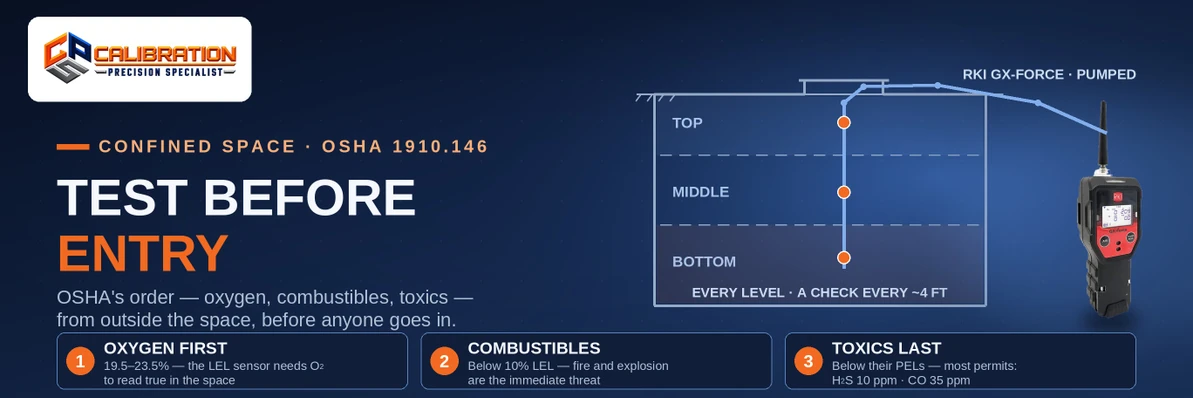
Test a permit-required confined space from outside, before anyone enters, in this order: oxygen first (acceptable range 19.5% to 23.5%), combustible gas second (below 10% of the lower explosive limit), and toxic gases last (below their permissible exposure limits — most permits use 10 ppm hydrogen sulfide and 35 ppm carbon monoxide), testing at the top, middle, and bottom of the space and about every 4 feet as the entrant descends, then monitor continuously for as long as anyone is inside. OSHA 29 CFR 1910.146(d)(5) sets that order because most combustible gas sensors are oxygen-dependent and will not read reliably in an oxygen-deficient atmosphere.
That sequence — before entry, in that order, at every level, and then during entry — is the whole structure of confined space atmospheric testing. The rest of this post is why the order is physics rather than paperwork, what "acceptable" means in numbers, why a single reading at the opening proves almost nothing, and which instrument belongs in each phase of the job.
What Counts as a Confined Space, and Why Is the Air the Main Hazard?
A confined space is large enough for a worker to enter and work, has limited or restricted entry and exit, and is not designed for continuous occupancy — tanks, vessels, vaults, manholes, pits, silos, and sewers are the classic examples. A permit-required confined space adds one or more serious hazards, and the one that kills most often is the atmosphere: oxygen displaced or consumed, combustible gas accumulated, or toxic gas such as hydrogen sulfide or carbon monoxide built up to a lethal concentration in a space that looks, from the opening, completely ordinary.
You cannot see, smell, or feel most of it. Oxygen deficiency gives no warning sensation until judgment and coordination are already impaired. Hydrogen sulfide deadens the sense of smell at higher concentrations, so the rotten-egg odor disappearing is a sign of danger, not safety. That is why the standard puts testing — with a calibrated, direct-reading instrument, by a person who knows how to use it — before entry, and why the sequence of that testing is specified instead of left to habit.
Step 0: What Do You Do Before You Test the Space?
The test is only as good as the instrument, so the sequence starts before the probe ever reaches the opening:
- Calibrate on schedule, bump test before the day's use. A bump test confirms every sensor responds to gas and the alarms work; a calibration confirms the readings are accurate. A pre-entry test performed with an instrument that would have failed its morning bump is not a test — it is a guess with a display. (Our post on why bump tests fail works through the delivery problems that fake a sensor failure.)
- Zero in clean air. Fresh-air zero the instrument in air you are certain is uncontaminated — away from the space opening, vehicle exhaust, and running equipment. Zeroing in dirty air teaches the instrument that background gas is "zero" and suppresses every reading that follows by that amount.
- Check the sampling path. On a pumped instrument, inspect the probe and hose for cracks, kinks, blockages, and loose fittings, and confirm the pump draws. A leaking sample line dilutes the sample with outside air and reads low on everything — the most dangerous failure a pre-entry test can have, because it reports a bad space as a good one.
- Know the response time. Every reading has to be held for at least the manufacturer's minimum response time for that instrument — longer with a long sample hose, because the gas has to travel the hose before the sensors see it. Rushing the probe up and down a space collects numbers, not measurements.
Step 1: Test Before Entry — In What Order, and Why?
OSHA 1910.146(d)(5)(iii) is explicit: when testing for atmospheric hazards, test first for oxygen, then for combustible gases and vapors, then for toxic gases and vapors. Appendix B to the standard explains the reasoning, and it is worth understanding rather than just memorizing:
- Oxygen first — because most combustible gas meters are oxygen-dependent and will not provide reliable readings in an oxygen-deficient atmosphere. Test LEL first in a space where something has displaced the oxygen, and the flammable reading can come back falsely low: the one result that sends a crew into an explosive atmosphere believing it was checked.
- Combustibles second — because, in most cases, the threat of fire or explosion is more immediate and more life-threatening than exposure to toxic gases. If the space is in the flammable range, that fact governs everything else you do next.
- Toxics last — hydrogen sulfide, carbon monoxide, and whatever process-specific contaminants the hazard assessment identified. Last in order, not least in importance: H₂S and CO are the gases that account for a large share of confined space fatalities, and they are measured against their exposure limits, not against whether the space will burn.
The testing is done from outside the space, with a pumped (sample-draw) instrument and a probe — the tester never leans into the opening to get the reading, because the air at the opening of a bad space is exactly the air the test exists to warn about. Pumped instruments built for this phase include the RKI GX-Force ($794, LEL/O₂/CO/H₂S) and the SENKO SP-MGTP ($850, up to 6 gases when the hazard assessment calls for more than the standard four). A diffusion monitor can also be made into a pre-entry instrument with a sample-draw pump — the RKI RP-3R pump ($369) clips onto a GX-3R — which is a practical way for a crew that already owns diffusion portables to test before entry without buying a second fleet. Browse the full pumped monitors range for the options.
What Readings Are Acceptable for Entry?
Acceptable entry conditions are the values the entry permit sets for that space, built on the standard's definition of a hazardous atmosphere. The numbers nearly every permit uses:
| Test | Acceptable for entry | Why it is the line |
|---|---|---|
| Oxygen (O₂) | 19.5% to 23.5% | Below 19.5% is oxygen-deficient — impaired judgment and coordination begin before a worker feels anything. Above 23.5% is oxygen-enriched — materials burn faster and more easily, and flammability ranges widen. |
| Combustible gas/vapor | Below 10% of the LEL (LFL) | 10% of the lower explosive limit leaves a working margin below the concentration that can ignite; at or above it, the space meets OSHA's definition of a hazardous atmosphere. |
| Hydrogen sulfide (H₂S) | Below the PEL — most permits set 10 ppm | OSHA's ceiling limit is 20 ppm; many programs adopt 10 ppm as the entry condition so there is margin before any exposure limit is approached. |
| Carbon Monoxide (CO) | Below the PEL — most permits set 35 ppm | OSHA's PEL is 50 ppm as an 8-hour average; 35 ppm is the widely used permit limit (and NIOSH's recommended exposure limit). |
| Other toxics | Below their PELs | Whatever the hazard assessment identified for that space and process — tested with a sensor or method that actually measures that contaminant. |
Two things about this table matter as much as the numbers. First, a reading outside the acceptable range is a stop, not a judgment call: no entry, ventilate and retest, or escalate to the respiratory protection and rescue provisions the program requires — the attendant and entry supervisor do not get to round a 19.2% oxygen reading up to acceptable. Second, the instrument only clears the gases it can measure. A 4-gas monitor says nothing about a solvent vapor, a pesticide, or any contaminant it has no sensor for; the hazard assessment decides what must be tested, and a space is only as cleared as its full list.
Step 2: Why Do You Test at the Top, Middle, and Bottom?
Because the atmosphere in a confined space is rarely one atmosphere. Gases stratify by density and by how they entered the space: methane and other light gases collect near the top; hydrogen sulfide, solvent vapors, and most heavier-than-air contaminants settle to the bottom; carbon monoxide mixes roughly with air and can be anywhere; and oxygen can be deficient at one level and normal at another in the same space. A single reading at the opening describes the air at the opening — which the entrant will occupy for about two seconds on the way to the level where the work, and the hazard, actually are.
So the pre-entry test samples top, middle, and bottom, and anywhere the work will take the entrant. OSHA's Appendix B gives the working method for entries involving a descent into a possibly stratified atmosphere: test the atmospheric envelope a distance of approximately 4 feet in the direction of travel and to each side, and slow the entrant's progress to match the sampling speed and the detector's response time. In plain terms: the probe goes ahead of the person, about a body's length at a time, and the person does not outclimb the instrument. Each measurement is held for at least the instrument's minimum response time — with a pumped instrument, that means response time plus the time the sample spends traveling up the hose.
Step 3: What If the Space Fails? Ventilate, Then Retest
A failed pre-entry test is information, and the standard response is mechanical ventilation with clean air: position the blower so its intake draws uncontaminated air (never beside an engine exhaust or another space's discharge), direct the air to where the entrants will work, and run it long enough to exchange the space's air — then retest, in the same order and at the same levels, before entry is authorized. Ventilation changes the numbers; only retesting proves it changed them enough.
Two cautions that get missed:
- Never test through the ventilation to manufacture a pass. A probe held in the blower's clean-air stream reads the blower's air, not the space's. Test the space as the entrant will experience it, including the corners and low spots the duct does not sweep.
- If ventilation is what keeps the space acceptable, it keeps running for the whole entry, and if it stops, the entry stops: entrants exit, and the space is retested before anyone goes back in. Conditions that were only acceptable because of the blower revert the moment the blower does.
Step 4: What Happens During Entry?
Passing the pre-entry test authorizes entry to begin. It says nothing about the next hour — stirring up sludge releases H₂S, cutting and welding consume oxygen and generate CO, product migrates in through connected lines. So 1910.146(d)(5) requires the space to be tested or monitored as necessary during entry to confirm acceptable conditions are being maintained, and in practice that means:
- Continuous monitoring in the entrant's breathing zone. The entrant wears a personal diffusion monitor — the RKI GX-3R ($640) is the standard pattern: 4 gases, clipped at the chest, reading the air the entrant is actually breathing — or the space is monitored continuously by a pumped instrument from outside. Continuous monitoring is specifically required where pre-entry testing could not fully characterize the space (large spaces and continuous systems such as sewers, under (d)(5)(i)) and wherever ventilation is the control keeping the atmosphere acceptable. Even where periodic testing is technically permitted, continuous is the practice that catches the change while there is still time to act on it. See the full portable multi-gas monitors and diffusion monitors ranges.
- The attendant stays outside, in communication, watching the readings that matter. The attendant never enters for rescue; their job is to monitor conditions and the entrant, order evacuation, and summon the rescue the permit specifies.
- Entrants can observe the testing. The standard gives every authorized entrant (or their representative) the opportunity to observe pre-entry and subsequent testing, and to get the results. Use it — a crew that has watched the numbers is a crew that believes the alarm.
- Any alarm, symptom, or change means out. An instrument alarm, a prohibited condition, a ventilation failure, or an entrant showing signs of exposure — dizziness, headache, confusion, a rotten-egg smell that suddenly stops — ends the entry. The space is re-evaluated before re-entry, not argued back into.
- Interruptions reset the clock. If the entry is interrupted — a break, a shift change, an evacuation, work that stirs the space up — the atmosphere is retested before entry resumes. The morning's passing numbers do not cover the afternoon's entry.
Results of pre-entry and subsequent testing are recorded on the entry permit, next to the acceptable entry conditions they were checked against. That record is not bureaucracy: it is the proof, later, that the sequence was actually followed — and the first thing asked for after any incident.
Which Instrument Belongs in Which Phase?
| Phase | Instrument type | Why |
|---|---|---|
| Pre-entry testing | Pumped / sample-draw multi-gas | Samples from outside the space, at every level, without exposing the tester. |
| During entry | Diffusion multi-gas on the entrant (plus pumped area monitoring where the job calls for it) | Reads the entrant's actual breathing zone continuously, with no hose to kink or manage in the space. |
| Specialty hazards | Pumped monitor configured with the extra sensors the assessment identified (the SENKO SP-MGTP carries up to 6 gases) | A 4-gas fleet clears 4 gases; the permit's contaminant list decides what else must be measured. |
Whichever fleet does the work, it has to be calibrated with in-date calibration gas, bump tested the day it is used, and maintained on schedule — a confined space program is exactly as strong as the least-maintained instrument in it. CPS calibrates every channel and reports as-found and as-left data on the certificate, on site through our calibration services or in our Rockwood lab through in-house calibrations — for gas detectors and for the temperature, flow, and pressure instruments the rest of the permit system depends on.
The Mistakes We See Most Often
- Testing in the wrong order — LEL before oxygen — and trusting a flammable reading taken in displaced air.
- One reading at the opening treated as a clearance for a 20-foot-deep space.
- Outrunning the probe — descending faster than the sample can travel and the sensors can respond.
- A diffusion-only crew attempting pre-entry clearance by lowering an unpumped instrument on a rope: no controlled sampling rate, no way to hold a level for the response time, and readings that arrive after the decision point. If the instrument has no pump, it is a during-entry instrument, not a pre-entry one.
- Ventilating to pass, then testing in the duct stream — and stopping the blower once the crew is inside.
- Treating yesterday's permit as today's test. Conditions are per-entry, per-shift, and after every interruption.
The Bottom Line
Test before entry, from outside, with a calibrated pumped instrument — oxygen first (19.5% to 23.5%), combustibles second (below 10% of the LEL), toxics last (below their exposure limits) — at the top, middle, and bottom and about every 4 feet of descent, holding each reading for the instrument's full response time. Ventilate and retest any space that fails. Then keep monitoring continuously while anyone is inside, retest after every interruption, and treat any alarm or symptom as an evacuation, not a discussion. The sequence is short enough to memorize and strict enough to save the crew that follows it exactly.
Setting up or auditing a confined space program? Start with pumped monitors for pre-entry testing and portable multi-gas monitors for the entrants, or call 865-900-8844 and describe the space — we will help you match the instrument to the phase. Fleet due for calibration before the next entry season? Book on-site calibration or ship the instruments to our lab.
Frequently Asked Questions
In what order do you test a confined space? Oxygen first, then combustible gases and vapors, then toxic gases and vapors — the order OSHA 29 CFR 1910.146(d)(5)(iii) requires. Oxygen is first because most combustible gas sensors are oxygen-dependent and read unreliably in an oxygen-deficient atmosphere; combustibles are second because fire and explosion are usually the most immediate threat.
What oxygen level is acceptable for confined space entry? 19.5% to 23.5% by volume. Below 19.5% the atmosphere is oxygen-deficient; above 23.5% it is oxygen-enriched, which widens flammability ranges and makes materials burn faster. Readings outside that band are not acceptable entry conditions.
What LEL reading is acceptable for confined space entry? Below 10% of the lower explosive limit (LEL). At or above 10% of the LEL, the space meets OSHA's definition of a hazardous atmosphere and entry is not authorized until ventilation brings the reading down and a retest confirms it.
Can I test a confined space with a diffusion detector? Not for pre-entry clearance. Pre-entry testing must sample the space from outside at multiple levels, which requires a pumped (sample-draw) instrument — or a diffusion monitor fitted with a sample-draw pump such as RKI's RP-3R. A diffusion monitor is the right instrument for continuous monitoring of the entrant once inside.
Why do you test the top, middle, and bottom of a confined space? Because gases stratify. Light gases such as methane collect at the top, heavier contaminants such as hydrogen sulfide and solvent vapors settle at the bottom, and oxygen can differ by level. OSHA's Appendix B method tests the envelope about 4 feet ahead of the entrant in the direction of travel, slowed to the detector's response time.
Do you have to monitor during entry, or is the pre-entry test enough? The pre-entry test only authorizes entry to begin. OSHA requires the space to be tested or monitored during entry as necessary to confirm acceptable conditions are maintained — and continuous monitoring is required where the space could not be fully characterized before entry or where ventilation is the control keeping it acceptable, and is standard practice everywhere else.
What happens if the monitor alarms while an entrant is inside? The entrant exits immediately and the entry is terminated. The space is re-evaluated — and retested — before any re-entry. The attendant outside never enters for rescue; they summon the rescue capability the permit specifies.
What if the space fails the pre-entry test? No entry. Ventilate with clean air directed to where entrants will work, then retest in the same order and at the same levels. If acceptable conditions cannot be achieved and maintained, the entry proceeds only under the full respiratory-protection and rescue provisions of the employer's permit program — or not at all.
CPS Calibrations · 109 S. Front Street, Rockwood, TN 37854 · Portable Gas Detection · Calibration Gas · Calibration Services · Contact Us
Recent Posts
-
Flame Detector vs. Gas Detector: What's the Difference — and Do You Need Both?
A gas detector and a flame detector guard opposite ends of the same incident: a gas detector reads l …Oct 21st 2026 -

How Do You Test a Flame Detector? Self-Tests, Test Lamps, and NFPA 72
You test a flame detector with light, not gas — there is no span gas, no zero gas, and never an open …Oct 21st 2026 -

Why Does a Flame Detector False Alarm — and Which Type Won't?
A flame detector false alarms because something that is not a fire is producing the signal it watche …Oct 21st 2026