
Flame Detector vs. Gas Detector: What's the Difference — and Do You Need Both?
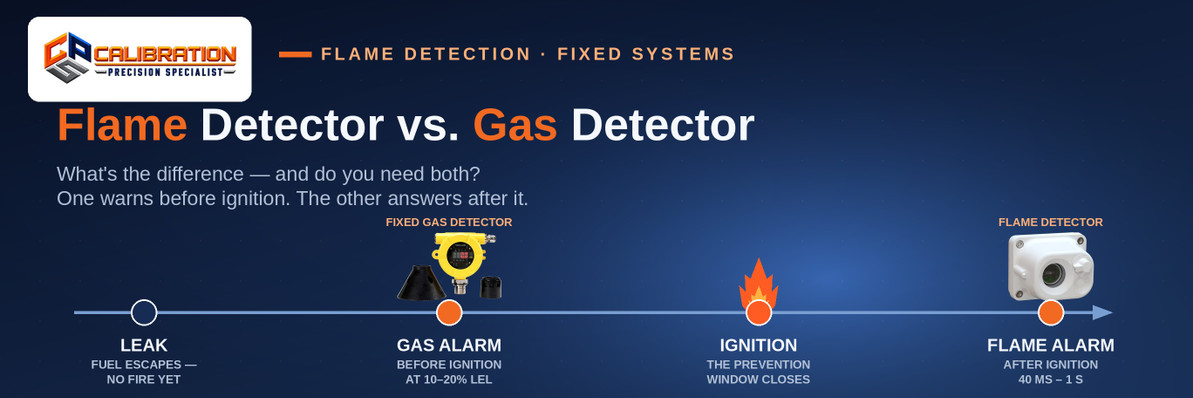
A gas detector and a flame detector guard opposite ends of the same incident: a gas detector reads leaked fuel and alarms before ignition — standard practice sets the low alarm at 10–20% of the lower explosive limit, while there is still time to shut down, ventilate, and evacuate — while a flame detector ignores the leak entirely and answers only after ignition, in milliseconds to seconds (the OTIS OI-660 UV flame detector is certified to catch a 1 sq ft gasoline flame at 50 ft in under 1 second, and RKI's FlameSpec IR3 answers a fire burst in 40 ms). Neither replaces the other, because each is blind to exactly the event the other one catches: gas detection is the prevention window, flame detection is the mitigation layer.
Both instruments get called "detectors," both live in explosion-proof housings, both wire into the same controllers — and buyers routinely treat them as alternatives, as if the budget question were which one to install. It isn't. They detect different things, at different moments, for different reasons, and the facilities that get hurt worst are usually the ones that picked one and skipped the other without understanding the blind spot they were accepting. This post works through what each instrument actually detects, walks a single incident past both of them, and ends with the decision criteria for when one is enough and when you need the pair. If the flame side is new to you, start with our breakdown of the flame technologies themselves — UV vs. IR vs. UV/IR vs. IR3 — and for the gas side, our guide to how a fixed gas detection system works.
What Does a Gas Detector Actually Detect? Molecules
A gas detector measures concentration. A fixed point detector — catalytic bead or infrared sensor in a wall-mounted housing — continuously samples the air at its location and reports how much fuel is in it: percent of the lower explosive limit (%LEL) for combustibles, parts per million (ppm) for toxics. When the reading crosses the alarm setpoint, it alarms. For flammable gas, standard practice puts the low alarm in the 10–20% LEL range — that is, the detector calls for action when the atmosphere at the sensor reaches a tenth to a fifth of the concentration that could burn. (If %LEL itself is new territory, our post on what LEL means works through the scale.) The entire value of that alarm is when it happens: at 10–20% LEL there is no fire yet. There is a leak, a rising trend on the readout, and time — time to start ventilation, close a valve, kill ignition sources, and walk people out before the cloud ever finds a spark.
Everything about a gas detector follows from the fact that it reads molecules, and molecules have to arrive. A point detector only knows about the air that reaches its sensor, which is why placement is a discipline of its own: gases rise, sink, or mix according to their vapor density, and a detector mounted for a ceiling gas will never taste a floor-hugging leak — the subject of our guide to where fixed gas detectors should be placed and our explainer on where gas goes when it leaks. Where a point sensor can't be put where the gas will be, sample-draw systems pull air through tubing to the sensor instead — the arrangement behind sample-draw detectors like the RKI GD-70D. And because it reads concentration continuously, a gas detection system produces something a flame detector never can: a trend. A slow rise from 0% to 8% LEL over a shift is a leaking flange announcing itself days before it becomes an emergency.
What Does a Flame Detector Actually Detect? Radiation
A flame detector measures light. It is an optical instrument that watches a cone of space — the OTIS OI-660 sees across a 120° field of view — for the ultraviolet or infrared radiation a flame emits, and it alarms when the signature matches fire. It does not sample air, it is never calibrated with gas, and it needs no fuel to reach it: it sees radiation straight across a room, the instant combustion starts. That is why its response figures live in a different world from gas detection. The OI-660 is certified to catch a 1 sq ft gasoline flame at 50 ft within 1 second; RKI's FlameSpec IR3 answers a fast fire burst or explosion in 40 ms. Across the lines CPS carries, flame heads run $2,310 for the OI-660 UV detector, $2,810 for the OTIS OI-860 UV/IR, $3,000 for the OTIS OI-760 multi-spectrum IR, $4,690 for the RKI FlameSpec UV-IR, and $5,700 for the FlameSpec IR3 and IR3-H2 — the full ranges are in the RKI and OTIS flame detector categories.
The flip side is just as absolute: a flame detector has nothing to say before ignition. A leak can build for an hour directly in front of its lens and it will sit silent, because there is no flame to see. It reports no concentration, no trend, no early warning of any kind — the first thing it ever tells you is that you already have a fire. What it buys with that silence is certainty and speed at the one moment gas detection is weakest: the moment fuel lights.
One Incident, Two Alarms: The Timeline
Put both instruments in a compressor room and run the same event past them, step by step:
Step 1 — the leak starts. A flange weeps pressurized gas. Nothing is burning. The flame detector sees nothing and will keep seeing nothing; this is not its moment. The gas detector's reading begins to climb as the cloud reaches it.
Step 2 — the gas alarm window. The concentration at the sensor crosses the low alarm — 10–20% LEL. This is the prevention window, and it belongs entirely to gas detection: ventilation starts, the process shuts down, ignition sources are isolated, people evacuate. Handled well, the incident ends here, as a maintenance story. Note what decides whether this window exists at all: whether leaked gas actually reaches a sensor at alarm concentration — a function of leak location, airflow, and placement, which is why the same leak can give one facility ten minutes of warning and another facility none.
Step 3 — ignition. Say the cloud finds a hot surface or a spark before the window closes — or say there never was a window, because the release ignited the instant it escaped, as pressurized jet leaks can. The gas detector's job is over; its reading can peg at 100% LEL and it changes nothing about the fire now burning. The event has crossed into the flame detector's territory.
Step 4 — the flame alarm window. The flame detector answers in milliseconds to seconds — 40 ms for an IR3 facing a fire burst, under a second for the OI-660 at its certified test — and that speed is what the mitigation layer is for: releasing suppression, tripping emergency shutdown, and alerting responders while the fire is still the size the detector first saw. A flame alarm that arrives a minute later is a report, not a protection layer.
Read the timeline backward and the layering logic explains itself: gas detection exists to make Step 4 unnecessary, and flame detection exists for the times Step 2 never happens or doesn't work.
Flame Detector vs. Gas Detector, Head to Head
| Gas detector (fixed point) | Flame detector | |
|---|---|---|
| Detects | Molecules: the concentration of leaked gas in the air at its sensor, in %LEL or ppm | Radiation: the UV/IR light signature of a flame, anywhere in its field of view |
| When it answers | Before ignition — low alarm typically at 10–20% LEL, while shutdown and evacuation are still possible | After ignition — milliseconds to seconds (IR3: 40 ms to a fire burst; OI-660: 1 sq ft gasoline flame at 50 ft in under 1 s) |
| What it needs | The gas itself: leaked fuel must physically reach the sensor at alarm concentration | A line of sight: the flame must burn inside its cone with a reasonably clear lens |
| Its blind spot | Instant ignition and flash fires; fires fed from outside its area; gas that never reaches a sensor | The slow leak building toward ignition; any hazard that hasn't lit yet; gives no concentration or trend data |
| What it gives your panel | A number: live concentration, alarm levels, and a trend over time | A verdict: fire or no fire, plus fault/self-test status |
| CPS examples | Fixed point detectors and sample-draw systems wired to controllers (see our fixed system guide) | OTIS OI-660 UV — $2,310 · OTIS OI-860 UV/IR — $2,810 · OTIS OI-760 multi-spectrum IR — $3,000 · RKI FlameSpec UV-IR — $4,690 · RKI FlameSpec IR3 / IR3-H2 — $5,700 |
Both layers land in the same place electrically: relays, analog loops, and Modbus into a controller or fire panel — the world covered in our post on choosing the right RKI controller. Layering them is a design decision, not a wiring problem.
When the Gas Detector Wins: The Slow Leak
Most industrial fuel releases are not dramatic. A flange gasket relaxes, a valve stem packing starts to weep, a threaded joint gives up a bubble at a time. The release runs for hours or shifts, building concentration slowly. This is gas detection's home ground and flame detection's total blind spot: the flame detector watches the leak the entire time and reports nothing, because nothing has ignited — and if your protection plan is the flame detector, your first notification of a problem that started yesterday is a fire. The gas detector, reading its trend climb through 10–20% LEL, turns that same event into a controlled shutdown and a gasket replacement. Anywhere fuel can leak slowly and accumulate — enclosed rooms, compressor buildings, processes with many flanged joints — the prevention window is the layer that does the daily work.
When the Flame Detector Wins: Instant Ignition
Now run it the other way. A high-pressure line fails and the jet of gas ignites at the rupture — from intact pipe to established jet fire in less than a second, with no leak phase at all. Or a fuel transfer spills and flashes. In these events the gas detector's timeline collapses: there is no Step 2, because the fuel lit before any cloud could wander over to a sensor and be read. The point detector may eventually alarm on the fire's unburned fuel and combustion environment, or it may sit outside the event entirely — either way it contributes nothing to the first seconds, which are the seconds suppression and emergency shutdown have to work with. The flame detector, staring at the area the whole time, answers in 40 ms to under a second and starts that mitigation clock immediately. It also covers the fire whose fuel never belonged to your process at all — the fire fed from outside the gas detector's area, which no point sensor was ever placed to taste. Open areas, transfer points, and anywhere pressurized fuel can ignite on release are flame detection's home ground.
When You Need Both
The honest answer for serious fuel-handling areas is both, layered, because their blind spots are mirror images. Loading racks see slow drips during connection and disconnection and the possibility of an instant flash during transfer. Compressor stations combine enclosed accumulation risk — gas detection's case — with high-pressure release risk — flame detection's case. Aircraft hangars hold large volumes of fuel vapor potential above parked aircraft, wide open sight lines, and fires that must trigger suppression in seconds. In areas like these, layered protection — gas detection to prevent, flame detection to mitigate, both reporting to the same panel — is standard practice in fuel handling, and it is what insurers and fire-protection engineers expect to see: not two redundant systems, but two systems whose blind spots don't overlap. The purchase is not detector versus detector; it is window versus window.
Do You Need Both? How to Decide
Work through four questions:
- Can fuel leak here without igniting right away — and would anyone know? If a slow, accumulating leak is a credible scenario and the area isn't continuously occupied, you need gas detection. That is the only layer that speaks before ignition.
- Can a release ignite the instant it happens? Pressurized gas, transfer operations, hot surroundings: if yes, gas detection alone leaves the worst case uncovered. You need flame detection watching the area.
- What has to happen in the first seconds of a fire? If a flame signal must release suppression or trip an emergency shutdown, that signal has to come from a flame detector — nothing else answers in milliseconds.
- What is burning, and where is it relative to your sensors? Fuel that can pool or drift away from point sensors, open-air areas, and very large spaces all push toward optical coverage; tight enclosures with well-understood release points are where point gas detection earns its keep most reliably.
If only the first question bites, a gas-only design can be defensible. If only the second and third bite, flame coverage is the priority. When both sets bite — as they do in most fuel-handling areas — the answer is both, and the real design work is placement: point sensors where the gas will go, optical cones over where a fire would burn.
Frequently Asked Questions
What is the difference between a flame detector and a gas detector? A gas detector measures the concentration of leaked gas in the air — in %LEL for flammables or ppm for toxics — and alarms before ignition, typically at 10–20% LEL. A flame detector watches for the ultraviolet or infrared light of a flame and alarms only after ignition, in milliseconds to seconds. Gas detection is the prevention layer; flame detection is the mitigation layer.
Which alarms first — a gas detector or a flame detector? The gas detector, whenever the leak gives it the chance: it alarms at 10–20% LEL, before there is any fire for a flame detector to see. But if a release ignites instantly, the gas detector may never get a useful reading in time, and the flame detector becomes the first — and only — alarm, answering in as little as 40 ms (RKI FlameSpec IR3) to under 1 second (OTIS OI-660, certified on a 1 sq ft gasoline flame at 50 ft).
Can a flame detector detect a gas leak? No. A flame detector is an optical instrument: it watches for the light signature of combustion and reports nothing about unburned fuel. A leak can build to a dangerous concentration directly in front of its lens and it will stay silent until the moment the gas ignites. Detecting leaks — early, while they can still be fixed safely — is exclusively the gas detector's job.
Can a gas detector detect a fire? Not directly. A gas detector reports the concentration of gas at its sensor; a fire burning fuel that never reaches a sensor — or a flash fire that ignites instantly — produces no warning from it at all. A gas detector may alarm during a fire as unburned fuel and combustion products reach it, but that is a side effect, not fire detection, and it arrives far too late to trigger suppression.
How fast does a flame detector respond compared to a gas detector? A flame detector answers in milliseconds to seconds after ignition, because it sees light: RKI's FlameSpec IR3 responds to a fast fire burst in 40 ms, and the OTIS OI-660 UV detector is certified to catch a 1 sq ft gasoline flame at 50 ft within 1 second. A gas detector answers when a cloud physically reaches its sensor at alarm concentration — seconds to minutes after a leak starts, depending on leak location and airflow, or never, if the gas never reaches it.
Do I need both flame detection and gas detection? In most fuel-handling areas, yes, because their blind spots are mirror images: gas detection misses instant ignition and flash fires, and flame detection misses the slow leak building toward ignition. Loading racks, compressor stations, and aircraft hangars are standard examples where both layers are installed, reporting to the same controller or fire panel. Layered protection — gas to prevent, flame to mitigate — is the expected practice in serious fuel handling.
Does a flame detector replace a gas detector? No, and the reverse isn't true either. A flame detector cannot warn you about a leak, so it cannot replace the prevention window a gas detector provides at 10–20% LEL. A gas detector cannot confirm a fire or trigger suppression in the first seconds, so it cannot replace the mitigation layer. They are complements, not substitutes — most protected areas need the one whose blind spot matches their risk, and many need both.
What does a gas detector measure that a flame detector doesn't? Concentration and trend. A gas detector continuously reports how much fuel is in the air — %LEL for flammables, ppm for toxics — so you can watch a leak develop, alarm at setpoints like 10–20% LEL, and log the history. A flame detector reports a verdict, not a measurement: flame or no flame. It cannot tell you a leak is building, how big the cloud is, or whether the atmosphere is getting better or worse.
How much does a flame detector cost? At CPS, flame detector heads run $2,310 to $5,700 depending on technology: the OTIS OI-660 UV detector is $2,310, the OTIS OI-860 UV/IR is $2,810, the OTIS OI-760 multi-spectrum IR is $3,000, the RKI FlameSpec UV-IR is $4,690, and the FlameSpec IR3 and IR3-H2 are $5,700. Budget the aiming mount on top: RKI mounts are $330–$350 and are required with each FlameSpec head, and the OTIS OI-208 swivel bracket is $180 in aluminum or $315 in stainless.
How do you test a flame detector if it doesn't use calibration gas? A flame detector has no gas sensor to calibrate — its sensing is verified by a built-in automatic optical self-test that continuously checks it can still see, and reports a fault if its view is impaired by dirt, oil film, or damage. Gas detectors, by contrast, are bump tested and calibrated with calibration gas on a schedule, because their sensors drift. The two instruments are maintained completely differently, which is another reason one can't stand in for the other.
The Bottom Line
A gas detector reads molecules and a flame detector reads light, and that single difference decides everything else. The gas detector's alarm — set at 10–20% LEL, before ignition — is the only warning a slow leak will ever give you, and it depends entirely on fuel physically reaching a sensor. The flame detector's alarm — 40 ms to under a second after ignition — is the only signal fast enough to start suppression, and it depends on the fire burning in plain sight. Asking which one is better is asking whether prevention is better than mitigation; the facilities that answer "both, layered" are the ones whose incident reports end at Step 2. Match the layers to your scenarios: gas where leaks can build, flame where ignition can be instant, and both wherever fuel is handled seriously.
Not sure which layers your area actually needs? That is a conversation worth having before the purchase order — call 865-900-8844 or reach us through Contact Us. Browse the flame lines in the RKI flame detector and OTIS flame detector categories, and see how both layers wire together in our fixed system overview.
CPS Calibrations · 109 S. Front Street, Rockwood, TN 37854 · Calibration Gas · Calibration Services · Contact Us
Recent Posts
-
Flame Detector vs. Gas Detector: What's the Difference — and Do You Need Both?
A gas detector and a flame detector guard opposite ends of the same incident: a gas detector reads l …Oct 21st 2026 -

How Do You Test a Flame Detector? Self-Tests, Test Lamps, and NFPA 72
You test a flame detector with light, not gas — there is no span gas, no zero gas, and never an open …Oct 21st 2026 -

Why Does a Flame Detector False Alarm — and Which Type Won't?
A flame detector false alarms because something that is not a fire is producing the signal it watche …Oct 21st 2026