
What Is the Right RKI Controller for Your Fixed Gas Detection System?
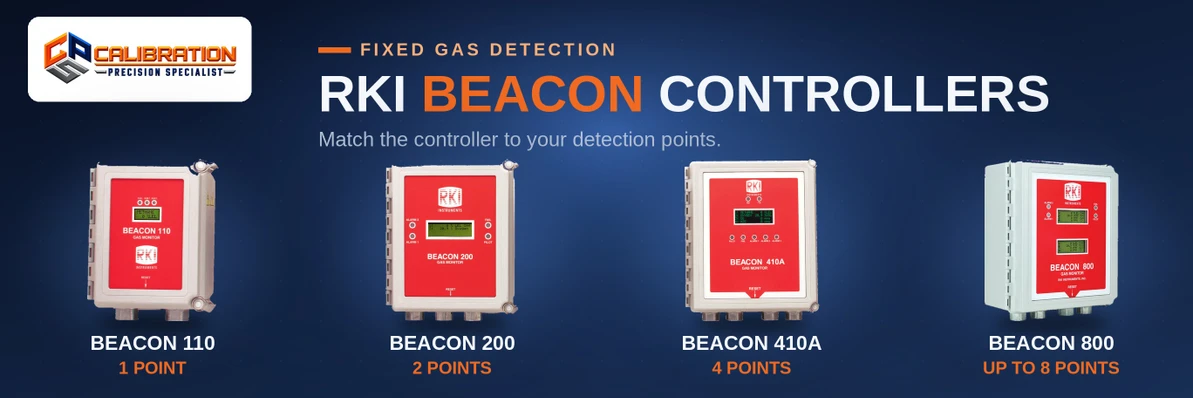
The right RKI controller is the one whose channel count matches your detection points: the Beacon 110 runs one point (listed from $1,275), the Beacon 200 two (from $2,500), the Beacon 410A four (from $2,825), and the Beacon 800 anywhere from one to eight points ($2,835). What actually separates them is the input side — the 110, 200 and 410A accept RKI direct-connect sensors as well as any 4–20 mA transmitter, while the 800 accepts transmitters only — and the output side, where the 410A adds a 4–20 mA output per channel and standard RS-485 Modbus for plants that log readings centrally.
A controller is the brain of a fixed gas detection system. The detector heads scattered around your plant sense the gas, but the controller is what displays every reading in one place, sounds the alarm, throws the relays that start ventilation or shut a process down, and supplies power to the heads. RKI's Beacon line is the wall-mount controller family behind most RKI fixed systems: four models, all in NEMA 4X enclosures, all built by RKI around the same job at four different scales. Choosing among them is not a good-better-best ladder. It comes down to three questions — how many points you need to watch, what kind of detector heads you are wiring to it, and what the system has to talk to when it alarms. This guide walks all four Beacons with live CPS pricing, then works through those three questions in order.
The RKI Beacon Lineup at a Glance
| Model | Points | Detector inputs | Relays & outputs | Price at CPS |
|---|---|---|---|---|
| Beacon 110 | 1 | Direct-connect RKI sensors (LEL, O₂, CO, H₂S) or any 4–20 mA transmitter | 3 relays — 2 alarm + 1 fail, 10 A · one 4–20 mA output | Listed from $1,275; configurations $1,340–$1,620 |
| Beacon 200 | 2 | Direct-connect RKI sensors (LEL, O₂, CO, H₂S) or any 4–20 mA transmitter | 7 relays — 2 per channel + 3 common, 10 A · 4–20 mA output | Listed from $2,500; configurations $2,625–$2,780 |
| Beacon 410A | 4 | Direct-connect RKI sensors (LEL, O₂, CO₂, toxics) or any 4–20 mA transmitter | 2 relays per channel + common bank — up to 3 per channel · 4–20 mA per channel · RS-485 Modbus standard | Listed from $2,825; configurations $2,965–$3,440 |
| Beacon 800 | 1–8 | 4–20 mA transmitters only — direct-connect sensors are not compatible | 2 relays per channel + 3 common · per-channel analog outputs optional | $2,835 |
Two pricing notes before the details. First, the headline figure on each listing sits below the configured builds: the options that move the price are battery-backup chargers, horns and strobes, so the ranges above are what the configurations actually run. Second — and this is the line item that surprises buyers — every configuration of every Beacon is the controller only. RKI sells the sensing side separately, and each configuration name on the listings says so ("no sensor"). Budget the heads per point on top of the controller prices above; what those heads are is the subject of the input section below.
One more oddity the table makes obvious: the eight-channel Beacon 800 lists for $10 more than the four-channel 410A. That is real, and it does not make the 800 the automatic buy. The reasons are in the inputs and outputs — read the next two sections before you let channel count make the decision.
How Many Detection Points Do You Actually Have?
One channel is one point: one gas, sensed at one location, by one detector head. A boiler room with a single combustible head over the burner is one point. A wastewater lift station that needs hydrogen sulfide inside the wet well and combustibles at the hatch is two points — two gases, two heads, two channels — even though both hazards live in the same structure. A room that needs four gases watched is four points, because RKI's fixed heads are single-gas devices.
Count the points first, then count them honestly with growth in mind:
- The Beacon 110, 200 and 410A are fixed counts. A 200 with a third point in its future is a 200 plus a second controller later. If a third point is plausible, price the step up now.
- The Beacon 800 is the flexible chassis. It runs anywhere from one to eight transmitter points, so a system can start at three points and grow to eight on the same controller — as long as every head is a transmitter (see below).
- Every point is a cable run home. Each head wires back to the controller, so controller location is part of the count: two points in two separate buildings can be better served by two small controllers than one big one with two long runs. Distance itself rarely rules a model out — RKI rates sensor wiring up to 5,000 feet on the 110 and 200, and up to 8,000 feet on the 410A and 800.
Where the heads go matters as much as how many there are — a controller only reports what reaches its sensors. Our guide to where fixed gas detectors should be placed covers mounting heights and placement by gas density; settle the points on the wall before you settle the controller that serves them.
Direct-Connect Sensor or 4–20 mA Transmitter? The Input Decision That Splits the Line
This is the decision that actually divides the Beacon family, and it is about what sits at the far end of the wire.
Direct-connect sensors are sensing heads without their own transmitter electronics: the sensor wires straight to the controller, the controller does the amplifying, and calibration adjustments for that head are made at the controller. They are the economical way to build a point — CPS lists RKI direct-connect sensors in explosion-proof junction boxes from $390, across the LEL, oxygen and toxic ranges — and the sensor can mount right at the controller or remote from it. On the Beacon 110 and 200 the direct-connect menu is LEL combustibles, oxygen, carbon monoxide and hydrogen sulfide; the 410A's direct menu widens to carbon dioxide and the broader toxic sensor range.
4–20 mA transmitters carry their own electronics at the head and send the controller a standard industrial signal. RKI's M2A-XL transmitters (from $1,270 at CPS) are the typical example, and the type covers heads a plain sensor can't be — including sample-draw transmitters like the GD-70D ($1,595), which pulls a sample to the sensor for points a diffusion head can't sit in; our GD-70D spotlight walks that unit in full. Calibration on a transmitter head happens at the head. The signal is brand-agnostic: any manufacturer's 4–20 mA transmitter (2- or 3-wire, 24 VDC) can feed a Beacon channel, which makes transmitters the natural choice when a system mixes head types or replaces one brand's heads over time.
The hard line in the family: the Beacon 800 accepts transmitters only. RKI states it plainly — direct-connect sensors are not compatible with the 800. If your existing points are direct-connect heads, the 800 is not a controller swap; it is a controller plus a new transmitter at every point. The 110, 200 and 410A take either input, channel by channel, so a system can mix a direct-connect LEL head on one channel with a transmitter on the next.
What Has to Happen When It Alarms? Relays, Outputs and Signals Out
A controller earns its keep in the ten seconds after a reading crosses a setpoint. What each Beacon can do in that moment:
- Relay muscle. The 110 carries three relay contacts (two gas-alarm levels plus a fail relay) and the 200 seven (two per channel plus three common relays serving both channels) — all rated 10 amps, strong enough to drive most horns, strobes and fan starters directly, with no slave relay in between. The 410A gives each channel two dedicated, fully configurable relays plus a common relay bank that can be assigned to push a channel to three alarm relays, matching its three configurable alarm points per channel. The 800 provides two relays per channel plus three common relays; RKI rates its channel relays at 3 amps — plenty for strobes, beacons and interposing relays — and offers an optional heavy-duty relay card (four relays at 30 amps) when a channel has to switch a serious load directly.
- Fail supervision. Every model watches its own health and its heads': a fail circuit that announces a dead head or a wiring fault instead of letting the point go silently dark. On a system that guards an unmanned room, that supervision is half the value.
- Signals to the rest of the plant. The 110 and 200 each output a 4–20 mA signal proportional to the reading, for a recorder or PLC input. The 410A outputs 4–20 mA per channel and adds a standard RS-485 Modbus interface for remote logging — the richest signal set in the line, built in rather than added on. The 800's per-channel analog outputs are an optional expansion card, not standard equipment; if central logging matters on an 800, price the card into the quote.
Alarm hardware follows the same option pattern across the line: built-in 94 dB audible alarms are standard, and strobes, horns and battery-backup chargers are the configuration options behind the price ranges in the table.
Beacon Controller or PLC — Do You Need a Dedicated Controller at All?
For one to eight points, the honest answer is usually yes, and the reason is what a Beacon is out of the box: displays for every channel, alarm logic, relays, sensor power and a fail circuit, all configured from its own buttons and menus. There is no programming, no I/O module list to engineer, and nothing to integrate before the first point goes live. A PLC can absolutely run gas detection — but at Beacon scale you would be buying the processor, the analog input cards and the programming time to rebuild what the controller already is.
A PLC earns its place when the readings have to live inside plant control: trended in SCADA, woven into process interlocks, or counted in dozens of points. Even then the two often pair rather than compete — a 410A's Modbus and per-channel 4–20 mA outputs let a PLC read and log the Beacon's channels while the Beacon keeps the local display, alarm and relay duties it was built for.
And when a job outgrows the Beacon line entirely — more than eight points, or wireless heads where conduit runs don't make sense — the architecture changes rather than the brand loyalty. CPS lists OTIS controllers up to 32 channels and RKI's own AirLink 7010 hybrid controller ($3,520) for wireless and hybrid systems. Those are different systems for different problems; inside eight wired points, a Beacon is the straightforward answer.
Which Beacon Fits Which Job?
- One point, one room: the Beacon 110. A single LEL point over a boiler, one CO point in a mechanical room — the least expensive way into a real fixed system, with 10-amp relays that act on the alarm without help.
- Two points: the Beacon 200. The classic pairings — H₂S plus LEL at a lift station, twin CO points — with common relays that let either channel trip the same horn or fan. CPS also lists hydrogen-specific versions of the 200 (configurations at $2,730) for battery-room hydrogen duty, where one or both channels are built for H₂.
- Three to four points, especially with records: the Beacon 410A. The only Beacon that shows all its channels at once on one OLED screen, sets up to three alarm points per channel, and speaks Modbus as standard — the pick when readings get logged, audited or fed to a plant system.
- Five to eight transmitter points: the Beacon 800. A warehouse or process floor of M2A-XL and GD-70D transmitters lands here — one controller, two displays showing all eight channels continuously, and room to grow inside the same box.
- Points that don't need a controller at all: if each point is a single gas and the head can act on its own, a smart fixed head with its own display, relays and 4–20 mA output — SENKO's SI series is the example we sell, walked through in our SENKO fixed detectors guide — skips the central controller entirely. Controller-and-heads versus self-contained heads is an architecture choice: central display and shared alarming on one side, independence and simpler wiring on the other.
What a Beacon Controller Doesn't Do
- It doesn't include the sensors. Worth repeating, because it is the most common quote misunderstanding in fixed gas detection: every Beacon price above is the controller alone. The system price is the controller plus a head — direct-connect sensor or transmitter — at every point.
- It doesn't fix bad placement. The controller reports what its heads see. Heads mounted at the wrong height for the gas, or away from the credible leak source, give you a very reliable record of clean air; placement is a design decision, not a controller feature.
- It doesn't end calibration. Fixed heads drift exactly like portable sensors do. RKI's Beacon 110 manual puts it plainly: a calibration frequency of every 3 to 6 months is adequate for most applications, and RKI recommends every 3 months unless experience in the application dictates otherwise. CPS designs and sells these systems and calibrates them afterward — we calibrate every channel — and the same bottled gas your portable program uses does the work. All four controllers carry RKI's one-year materials-and-workmanship warranty.
The full Beacon range and the heads that pair with it are in our fixed systems category, and the wider line is on the RKI brand page. If you have a point count and a gas list and want the matching done for you — controller, heads, relays and the calibration plan behind them — call 865-900-8844.
Frequently Asked Questions
How much does an RKI Beacon 110 cost? At CPS the Beacon 110 is listed from $1,275, and its five configurations run $1,340 to $1,620: $1,340 for the controller alone (72-2110RK), up to $1,620 with the battery charger, horn and small red strobe. Every configuration is the controller only — the sensor or transmitter for the point is priced separately.
What is the difference between the RKI Beacon 410A and the Beacon 800? Channels, inputs and outputs. The 410A runs four channels and accepts RKI direct-connect sensors as well as 4–20 mA transmitters; the 800 runs up to eight channels but accepts 4–20 mA transmitters only. The 410A includes a 4–20 mA output per channel and standard RS-485 Modbus; the 800's per-channel analog outputs are an optional card. Their headline prices are nearly identical — $2,825 versus $2,835 — so the choice turns on your heads and your logging needs, not on channel count alone.
Can the Beacon 800 use direct-connect sensors? No. RKI states that all sensors connected to the Beacon 800 must use a 4–20 mA transmitter and that direct-connect sensors are not compatible with it. If your points are direct-connect heads, the Beacon 110, 200 and 410A all accept them; the 800 would require a transmitter at every point.
Do RKI Beacon controllers come with sensors? No. Every Beacon configuration CPS lists is the controller only — the configuration names say "no sensor." The sensing side is bought per point: RKI direct-connect sensors in explosion-proof junction boxes list from $390 at CPS, and stand-alone transmitters such as the M2A-XL list from $1,270.
How many gas detectors can one Beacon controller run? One per channel: the Beacon 110 runs 1 detector, the Beacon 200 runs 2, the Beacon 410A runs 4, and the Beacon 800 runs from 1 up to 8. Each detector is a single-gas head, so a location needing three gases watched uses three channels regardless of model.
Can a Beacon controller connect to a PLC or building system? Yes, three ways depending on the model. Every Beacon has relay contacts a PLC or starter can read as discrete inputs. The 110 and 200 output a 4–20 mA signal; the 410A outputs 4–20 mA per channel and adds a standard RS-485 Modbus interface for data logging. On the 800, per-channel analog outputs are an optional expansion card.
How far can a detector head be from a Beacon controller? RKI rates sensor wiring distances up to 5,000 feet for the Beacon 110 and Beacon 200, and up to 8,000 feet for the Beacon 410A and Beacon 800. In practice the controller goes in a central, accessible spot and the runs inside one facility come nowhere near those limits — but two points in separate buildings can still favor two smaller controllers over one long home run.
What gases can a Beacon system detect? Whatever the heads are built for — the controller itself is gas-agnostic. Direct-connect sensors cover LEL combustibles, oxygen, carbon monoxide and hydrogen sulfide (the 410A's direct range adds carbon dioxide and the broader toxic sensors), and through 4–20 mA transmitters RKI's sensor catalog extends to ammonia, chlorine, arsine and more. One gas per point; the gas list is set by the heads you hang on the channels.
How often does a Beacon fixed system need calibration? RKI's Beacon 110 manual states that a calibration frequency of every 3 to 6 months is adequate for most applications, and recommends every 3 months unless experience in a particular application dictates otherwise — more often where gas is present regularly or catalyst poisons are likely. Calibration is done at the heads with bottled calibration gas; CPS calibrates every channel on the systems it sells. Call 865-900-8844.
Is one Beacon 200 better than two Beacon 110s? On price it is nearly a wash — the 200 lists from $2,500 against $1,275 apiece for two 110s. The 200 wins when both points belong together: one enclosure, one display, and common relays that let either channel trip the same horn, strobe or fan. Two 110s win when the points are far apart — separate buildings, separate floors — because each controller can sit near its own head instead of both heads wiring home to one box.
CPS Calibrations · 109 S. Front Street, Rockwood, TN 37854 · Beacon 110 · Beacon 200 · Beacon 410A · Beacon 800 · Fixed Systems · Contact Us
Recent Posts
-
Flame Detector vs. Gas Detector: What's the Difference — and Do You Need Both?
A gas detector and a flame detector guard opposite ends of the same incident: a gas detector reads l …Oct 21st 2026 -

How Do You Test a Flame Detector? Self-Tests, Test Lamps, and NFPA 72
You test a flame detector with light, not gas — there is no span gas, no zero gas, and never an open …Oct 21st 2026 -

Why Does a Flame Detector False Alarm — and Which Type Won't?
A flame detector false alarms because something that is not a fire is producing the signal it watche …Oct 21st 2026