
Where Should Fixed Gas Detectors Be Placed? Mounting Heights and Placement Rules
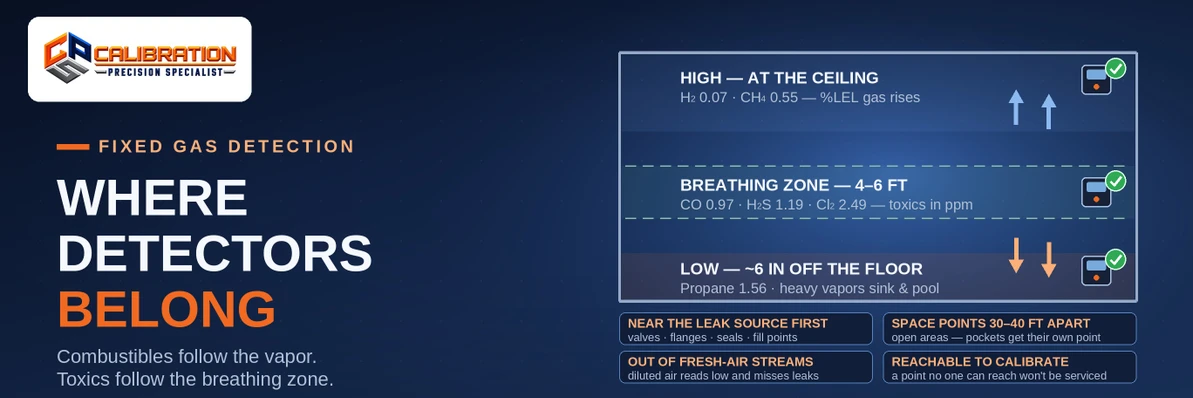
Mount fixed gas detectors where the gas goes first: hydrogen and methane, which are lighter than air, on or within inches of the ceiling; heavy combustible vapors such as propane and gasoline about 6 inches above the floor; and toxic gases measured in ppm — carbon monoxide, hydrogen sulfide, chlorine, and oxygen — in the breathing zone, 4 to 6 feet above the floor, as close as practical to the likely leak source. In a large open area, space point detectors roughly 30 to 40 feet apart, and never where fresh-air ventilation dilutes the sample before it reaches the sensor.
That is the short answer, and it follows the mounting guidance RKI publishes for its fixed systems. The rest of this post is why height splits two different ways depending on what you are measuring, why "near the leak" beats "textbook height across the room," how airflow quietly defeats good layouts, and the placement mistakes we find when a system that should have alarmed early alarms late — or not at all.
Why Does Placement Matter More Than the Sensor?
A point detector is not watching a room. It is sampling the few cubic inches of air immediately around its sensor — RKI's own analogy is that a sensor is like your nose: it can only smell what reaches it. A top-tier transmitter mounted in the wrong place is a blind system with an excellent data sheet. Gas has to travel to the sensor, accumulate to the alarm concentration at the sensor, and do it while there is still time to act. Every placement rule below is really the same rule stated different ways: shorten the distance between where gas escapes and where it is measured, and put the sensor in the layer of air the gas will occupy when it gets there.
Placement is also the one part of a fixed system you cannot calibrate your way out of. A calibration corrects what the instrument reports for the gas that reaches it. It does nothing for gas that pools at the ceiling while the detector sits at waist height, or vapor that hugs the floor under a detector mounted over a doorway. Get the layout right and ordinary instruments perform well; get it wrong and no sensor upgrade fixes it.
Rule 1: How High Should a Fixed Gas Detector Be Mounted?
Height follows the gas — but it follows it differently for combustible gas than for toxic gas, and confusing the two is the most common placement error we see.
For combustible gas measured in %LEL or % volume, follow the vapor density (relative density, air = 1.0):
| Gas or vapor | Relative density | Mounting height |
|---|---|---|
| Hydrogen (H₂) | 0.07 | On or within inches of the ceiling |
| Methane / natural gas (CH₄) | 0.55 | On or within inches of the ceiling |
| Propane (C₃H₈) | 1.56 | About 6 inches above the floor |
| Butane (C₄H₁₀) | 2.0 | About 6 inches above the floor |
| Gasoline, diesel, and jet fuel vapors | ~3–4 | About 6 inches above the floor |
| Hexane, pentane, toluene, xylene, refrigerants | Heavier than air | About 6 inches above the floor |
A methane leak rises and fills a room from the ceiling down: a detector at waist height can sit in clean air under a ceiling layer that is already in the explosive range. A propane leak does the opposite — it sinks, spreads across the floor, and pools in pits, trenches, and low corners while a detector at eye level reads zero. For %LEL points, density is not a suggestion; it is the whole decision.
For toxic gas measured in ppm, mount in the breathing zone — 4 to 6 feet above the floor — regardless of density. At low ppm concentrations, a toxic gas does not hold together as a rising or sinking cloud; it mixes and travels with the room's normal ventilation. What matters is the concentration in the air people actually breathe, so that is where the sensor belongs. RKI's mounting table puts carbon monoxide (density 0.97), hydrogen sulfide (1.19), chlorine (2.49), sulfur dioxide, hydrogen cyanide, nitrogen dioxide, ozone, phosphine, and oxygen itself in the breathing zone for ppm monitoring — including gases that are considerably heavier than air. Chlorine is the example that catches people out: the pure vapor is heavy, but a chlorine point protecting workers belongs at breathing height, not at the floor.
Oxygen monitoring follows the same logic. An oxygen-deficiency point such as the PureAire 99016 Oxygen Deficiency Monitor ($2,255, alarms factory-set at 19.5% and 18.0% O₂) protects people, so it mounts where people stand and breathe — not at the floor where the nitrogen pooled, and not at the ceiling. Measure the exposure where the exposure happens.
One honest exception: carbon dioxide is measured both ways. As a ppm toxic/asphyxiant exposure, CO₂ belongs in the breathing zone; as a % volume combustible-area measurement it is a heavy gas (1.52) and RKI's table places it near the floor. Decide which hazard the point exists for, then mount for that hazard.
Rule 2: How Close to the Leak Source Should the Detector Be?
Height is the second decision. The first is distance. Place the detector as close as practical to the most likely leak sources — valve stems, flanges, threaded connections, pressure regulators, compressor seals, pump packing, storage vessels, and fill points. Those are where gas actually escapes, and gas escaping there reaches a nearby sensor at high concentration, fast, before ventilation dilutes it below the alarm point.
A detector at the perfect height on the far wall of a large room may eventually alarm — after the leak has filled enough of the room to matter. A detector a few feet from the gas train, at approximately the right height, alarms while the leak is still small. When the two conflict — the leak source is low but the gas rises — mount near the source and in the gas's path: for a methane regulator or meter set, that means high, near or above the equipment, not high on the opposite wall.
If gas could leak from anywhere in the space — a solvent store, a battery room, a process hall with gas-using equipment throughout — there is no single leak source to favor, and the job becomes area coverage, which is the next rule.
Rule 3: How Far Apart Should Fixed Gas Detectors Be Spaced?
For a large, open area, the industry rule of thumb RKI publishes is to space point sensors 30 to 40 feet apart. Treat that as a starting grid, not a guarantee, and adjust for reality:
- Obstructions break the grid. Racking, machinery, tanks, and partial walls create pockets where gas accumulates without ever crossing an open-floor sensor's path. Each pocket, bay, or enclosed corner is effectively its own area and needs its own point.
- Separate rooms are separate areas. A detector in the compressor hall does nothing for the storage room next door, even if the wall between them has a doorway. One point per enclosed space is the floor, not the ceiling, of a layout.
- Low spots collect heavy gas. Pits, trenches, sumps, and below-grade areas need their own low-mounted points for heavier-than-air gases — gas that sinks into a pit is below and away from every detector on the main floor.
- Ceiling pockets collect light gas. Beams, mezzanines, and raised ceiling sections trap hydrogen and methane the same way. Put the high point where the gas will actually collect, which is the highest pocket near the source, not the geometric center of the ceiling.
More points at the right places beat fewer expensive points spread thin — and the hardware spans the range: a stand-alone point like the RKI PS 2 combustible monitor ($450) or a transmitter like the RKI M2A-XL ($1,320, 4–20 mA plus Modbus, two alarm relays) feeding a Beacon controller costs far less than one incident in an unmonitored corner.
Rule 4: How Does Ventilation Change Where a Detector Should Go?
Airflow moves gas, so airflow moves the right answer. Three working rules:
- Keep detectors out of fresh-air streams. A sensor mounted beside a supply diffuser, an open doorway, a window, or a makeup-air intake reads diluted air that does not represent the room. It will read low on real leaks and can miss them entirely. This is the single most common ventilation mistake.
- Exhaust draw can work for you. Air in the room moves toward exhaust points, so a location near — not inside — an exhaust path sees air drawn from across the monitored area. That makes it a more representative sample than a stagnant corner.
- Heat changes the path. Gas released from hot processes, and vapor above hot liquids, rises on thermal lift at first even when the pure vapor is heavier than air, then cools and settles. Where a hot heavy-vapor source is the concern, ask where the vapor ends up after it cools — low and downwind of the source — and do not assume the still-air density table alone answers it.
Walk the room and think like the air: where does air enter, where does it leave, and what path does it take past the leak sources on the way? The detector belongs on that path, downstream of the source, at the height from Rule 1.
Rule 5: Where Should a Fixed Gas Detector Never Be Mounted?
- Where it cannot be calibrated. Every fixed point needs periodic calibration, so a detector mounted where no technician can safely reach the sensor will quietly stop being maintained. Favor transmitters designed for service in place — the M2A-XL calibrates with a magnetic wand without opening the housing or declassifying the area, and the SENKO SI-200E ($950) supports wireless configuration and calibration — and still mount them where a person can physically get to them.
- In direct spray, washdown, or steam beyond the enclosure's rating, or where paint, dust, or process coating will blind the sensor. The SI-200E's IP66 enclosure and −40°C to +60°C range cover harsh industrial conditions, not a pressure-washer lance at close range.
- Where the environment exceeds the instrument — temperatures, vibration, or corrosive exposure outside its specification. A sensor destroyed by its location fails silently.
- Directly above a door or in a traffic path where it will be struck, blocked by stored material, or sampled by every gust from outside. If forklifts or pallets can reach it, expect them to.
- So close to a normal emission that it alarms constantly. A point that nuisance-alarms on routine process venting teaches everyone to ignore it. Move it to measure the area's exposure rather than the vent's discharge — alarm fatigue is a placement failure, not a people failure.
What If You Cannot Mount a Detector Where the Gas Is?
Sometimes the right location is unreachable, too hot, inside equipment, or in a space no one should enter to service a sensor. That is what sample-draw (pumped) systems exist for: the detector sits in an accessible place and a pump pulls air to it through tubing from the sample point. The RKI GD-70D sample-drawing transmitter ($1,595) and the SENKO SI-H100 pumped detector head ($1,518) are built for exactly this — monitoring pits, ducts, tanks, and hard-to-reach points from a serviceable location. The trade is response time: the sample has to travel the tube before it is measured, so keep runs as short as the layout allows and account for draw time when you set expectations for alarm response.
Three Layouts, Worked Through
Natural-gas boiler room. Leak sources are the gas train — regulator, valves, unions, burner connections. Methane rises, so the point goes high: on or near the ceiling, near and above the gas train, out of the boiler's direct heat plume and away from the combustion-air intake that would dilute it. One point covers a small boiler room; a long room with two boilers gets a point over each gas train.
Propane storage or forklift fueling. Propane sinks and pools. The point goes about 6 inches above the floor, near the cylinders, the fill connection, and any pit or low corner where vapor collects — and low enough that a small leak reaches it before a floor-level layer builds to ignition range at a water heater or motor across the room.
Inert-gas and cryogenic areas (nitrogen, argon, CO₂). The hazard is oxygen displacement, and the victims are people standing in the room, so the point goes in the breathing zone where staff work — the PureAire 99016 pattern above, with its alarms at 19.5% and 18.0% O₂. Put it near where gas is stored, dispensed, or vented indoors, and where a person would be standing when they work there — not beside the door they would enter through after the room is already deficient, and consider alarming outside the entrance as well so the warning arrives before entry.
The Detector Is Half the System: Controllers and Alarms
Placement thinking applies to the alarm end too. Transmitters like the M2A-XL and SI-200E report to controllers — an RKI Beacon 110 (single channel, $1,275) up through multi-channel Beacon and PureAire panels — and the controller, strobes, and horns belong where people will actually see and hear them: outside the monitored room's entrance as well as inside it, so the alarm warns the next person before they walk in. Browse the full fixed systems range — detector heads and stand-alone detectors included — and lay the points out on the room before you count them.
Final layouts also answer to the detector manufacturer's instructions, your site survey, and your local code and authority having jurisdiction. Rules of thumb get a layout started; a walk-through of the actual room — sources, airflow, obstructions, and where people stand — is what finishes it. That walk-through is part of what we do: call us at 865-900-8844 before the conduit goes in, because moving a detector on paper is free and moving it after installation is not.
The Bottom Line
Place fixed detectors where the gas goes first and where people breathe: ceiling for hydrogen and methane in %LEL service, about 6 inches off the floor for propane and heavy solvent vapors, breathing zone at 4 to 6 feet for ppm toxics and oxygen — always near the likely leak source, out of fresh-air dilution, spaced roughly 30 to 40 feet apart in open areas with extra points for pockets, pits, and separate rooms, and always somewhere a technician can reach to calibrate. A fixed system is only as good as its layout, and the layout is decided once, on installation day, for the life of the system.
Planning a fixed system or fixing one that alarms late? Start with fixed systems or call 865-900-8844 and describe the room — we will talk through the layout before you buy a single head. Already installed? Keep every point honest with calibration services on site or in our Rockwood lab — we calibrate every channel and report as-found and as-left readings on the certificate.
Frequently Asked Questions
How high should a methane detector be mounted? On or within inches of the ceiling. Methane (relative density 0.55) is lighter than air and collects at the highest point in the room, so a combustible-gas point for methane belongs high, near and above the likely leak source such as a boiler gas train.
How high should a propane detector be mounted? About 6 inches above the floor. Propane (relative density 1.56) is heavier than air; it sinks, spreads across the floor, and pools in pits and low corners, so the detector belongs low and near storage, fill points, and low spots.
Why are toxic gas detectors mounted at breathing height if the gas is heavy? Because at ppm concentrations the gas mixes and travels with the room's ventilation instead of holding together as a sinking cloud. The point of a ppm toxic measurement is the concentration in the air workers breathe, so RKI's guidance places CO, H₂S, chlorine, and similar toxic points in the breathing zone, 4 to 6 feet above the floor.
How many fixed gas detectors do I need for one room? Start with one point per likely leak source, at least one per enclosed room, and the 30-to-40-foot spacing rule of thumb for large open areas. Then add points for obstructions, pits, ceiling pockets, and areas airflow does not connect. A site survey of the actual room is what turns the rule of thumb into a count.
Where should a gas detector not be installed? Not beside fresh-air intakes, supply diffusers, doors, or windows, where dilution makes readings unrepresentative; not where spray, coating, or traffic will damage or blind it; not beyond the instrument's temperature and environmental ratings; and not anywhere a technician cannot reach it for calibration.
What do I do if the gas is where a detector cannot be mounted? Use a sample-draw system: a pumped detector such as RKI's GD-70D or SENKO's SI-H100 pulls air through tubing from the point that needs monitoring to a transmitter mounted somewhere accessible. Keep the sample run short, because the gas must travel the tube before it can be measured.
Who decides the final detector placement? The manufacturer's installation instructions, a site survey of the actual space, and your local code and authority having jurisdiction. Published rules of thumb — density heights, breathing zone, 30-to-40-foot spacing — are the starting point, not a substitute for any of the three.
CPS Calibrations · 109 S. Front Street, Rockwood, TN 37854 · Fixed Systems · Calibration Gas · Calibration Services · Contact Us
Recent Posts
-

Flame Detector vs. Gas Detector: What's the Difference — and Do You Need Both?
A gas detector and a flame detector guard opposite ends of the same incident: a gas detector reads l …Oct 21st 2026 -

How Do You Test a Flame Detector? Self-Tests, Test Lamps, and NFPA 72
You test a flame detector with light, not gas — there is no span gas, no zero gas, and never an open …Oct 21st 2026 -

Why Does a Flame Detector False Alarm — and Which Type Won't?
A flame detector false alarms because something that is not a fire is producing the signal it watche …Oct 21st 2026