
Why Does a Flame Detector False Alarm — and Which Type Won't?
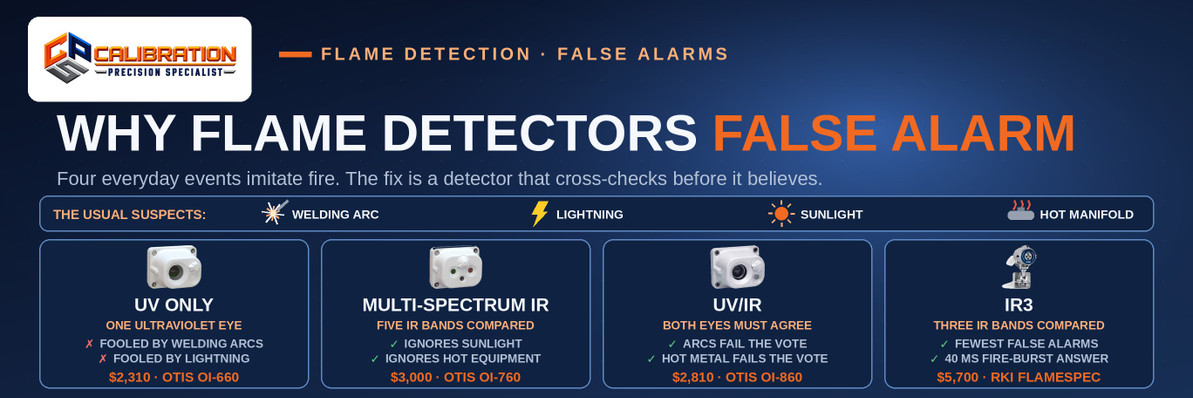
A flame detector false alarms because something that is not a fire is producing the signal it watches for: welding arcs and lightning pour out ultraviolet light, so UV detectors trip on them, and sunlight chopped into flicker by trees or fencing — along with hot, vibrating machinery — imitates the flickering infrared of burning fuel, so single-band IR detectors trip on those. The detectors that won't false alarm are the ones built to cross-check before they believe: UV/IR detectors that require an ultraviolet and an infrared channel to agree at the same time, multi-spectrum IR detectors that compare several infrared bands instead of one, and triple-IR designs that compare three — with solar-blind UV, the ultraviolet channel in RKI's FlameSpec UV-IR, removing sunlight from the list entirely. In the CPS line the trade runs from the $2,310 OTIS OI-660 — a UV detector you aim away from the weld bay — to the $5,700 RKI FlameSpec IR3, the hardest flame detector we sell to fool.
Every flame detector is a pattern matcher. It does not smell smoke or sample air; it watches a cone of space for one slice of a flame's radiation and alarms when the pattern matches. That is why false alarms are so predictable: whatever else in the plant produces the same pattern produces the same alarm. Name the pattern a technology trusts and you have named its false-alarm list — the fix is a detector whose pattern your plant's scenery cannot fake. This post works through the culprits technology by technology, then puts the fixes head to head. For the underlying technology comparison, see UV vs. IR vs. UV/IR vs. IR3 flame detectors; for how far each type can see and how aiming works, see how far a flame detector can see.
Why Is a False Alarm Worse Than a Nuisance?
A nuisance trip costs a work stoppage and an annoyed walk to the panel. The real damage starts with the third or fourth one. Crews learn to say "it's just that detector again" — alarm fatigue — and a real alarm gets the same shrug. Plants start bypassing or inhibiting the detector that cries wolf, and a bypassed flame detector is not reduced protection, it is zero protection wearing a normal-looking panel face. Where a flame detector is tied to suppression or shutdown, every false alarm can also mean a dumped suppression charge, a tripped process, an evacuated building, and a restart — which is exactly the cost pressure that pushes people toward bypassing. The result: the false-alarming detector trains the plant to ignore the system, and quietly converts itself into no detector at all.
What Fools a UV Flame Detector?
A UV detector like the OTIS OI-660 watches ultraviolet light — its sensor peaks at 0.22 µm — and that open eye is why UV sees nearly every flame chemistry there is, including hydrogen, silane, and hydrazine, and why it is fast: the OI-660 is certified to catch a 1 sq ft gasoline flame at 50 ft within 1 second across a 120° field of view. The flip side is that anything else making ultraviolet light makes the same signal:
- Arc welding is the classic UV false alarm. A welding arc is an intense ultraviolet source; to a UV-only detector, an arc struck inside its cone looks like a flame appearing out of nowhere.
- Lightning is a sky full of ultraviolet in a single flash, and it can trip a UV detector watching open sky.
- Radiography and X-ray sources — the inspection sources used around plants — emit radiation a UV sensor can register, and electrical corona and arc faults speak the same language in smaller doses.
Sunlight is usually not the UV detector's problem: the atmosphere strips most of the flame-band ultraviolet out of sunlight before it reaches the ground, which is why the industry calls that band "solar-blind" — RKI uses the term outright for the UV sensor in its FlameSpec UV-IR. The OI-660's own answer to reliability is a different one: an automatic through-the-lens self-test that continuously proves the eye can still see and faults if its view is impaired. Its false-alarm list is the welding-and-lightning list — manageable, as long as you know it before you mount the detector.
What Fools an IR Flame Detector?
An infrared detector watches the flickering IR radiation of burning fuel — above all the band around 4.3–4.4 µm where hot carbon dioxide from a hydrocarbon flame radiates — and checks that the signal flickers the way a flame flickers. A single-band IR detector trusting that one band is the design with the longest false-alarm list:
- Modulated sunlight. Sunlight itself is steady, but sunlight chopped — passing through trees, fencing, fan blades, louvers, or glinting off moving surfaces and water — arrives as a flicker, and flicker in the flame band is precisely what the detector is looking for.
- Hot, vibrating machinery. A hot manifold, exhaust stack, or compressor housing radiates strongly in the infrared; vibrate it, rotate it, or move its heat shimmer and its output pulses like a flame's.
- Radiant heaters and other hot equipment in the cone give the detector a strong flame-band signal to misread whenever anything modulates it.
The fix inside the IR family is comparison: a real flame's energy is distributed across the infrared spectrum in a characteristic pattern that sunlight and hot metal do not reproduce. The OTIS OI-760 is a multi-spectrum design watching five IR bands at once — 2.2, 2.9, 3.7, 4.4, and 5.8 µm — so it can tell a real flame's spectrum apart from hot equipment and sunlight instead of trusting one band and a flicker. That band comparison is the listing's own false-alarm story, and it is aimed at hydrocarbon fire risk in refineries, compressor stations, paint booths, and fuel-transfer areas. Its staged 0–20 mA output separates warning levels from distinct fault states, so the panel can tell a sighting from a sick detector.
How Does UV/IR Voting Stop False Alarms?
A UV/IR detector puts both eyes in one housing and requires them to agree, at the same time, before it will call something a fire. Walk the culprit list through that vote and it collapses: a welding arc produces ultraviolet but no flame-pattern infrared, so the IR channel vetoes it; a hot manifold produces infrared but no ultraviolet, so the UV channel vetoes it; chopped sunlight is an infrared-only event; lightning is an ultraviolet-only flash. A real flame is nearly the only event in a plant that produces both signatures simultaneously — which is the whole design.
The OTIS OI-860 pairs its UV and IR channels and runs them through a Fire Event Analysis algorithm — fast detection with strong false-alarm immunity, in its listing's words — while still detecting hydrocarbon and non-hydrocarbon flames, hydrogen and silane included, in one unit. RKI's FlameSpec UV-IR adds a second lock on the UV side: its ultraviolet sensor is solar-blind and its special logic circuit prevents false alarms from solar radiation, while the IR channel (2.7 µm) confirms hydrocarbon fuel and gas fires — plus hydroxyl, hydrogen, metal, and inorganic fires. The OI-860 is $2,810 and the FlameSpec UV-IR is $4,690, which is why UV/IR is the standard answer for mixed scenery: aircraft hangars, fuel transfer, compressor stations, silane storage, paint booths, and gas cabinets, where welding, sunlight, and hot equipment all live within sight of the fuel.
Why Is IR3 the Hardest Flame Detector to Fool?
An IR3 — triple IR — detector compares three infrared bands simultaneously and alarms on the relationship between them, not on any one band's strength. Each added band is another dimension a nuisance source has to fake correctly at the same time: sunlight, hot machinery, and heaters each fail the ratio test in a different band. RKI's FlameSpec IR3 carries the highest immunity to false alarms in its triple-spectrum design — the listing's phrase, and the reason IR3 is the default for long outdoor sight lines in ugly scenery. It is also the sprinter: it answers a fast fire burst or explosion in 40 ms, so the immunity is not bought with a slow, cautious alarm. The FlameSpec IR3-H2 runs the same triple-band platform tuned for energy-transition fires, detecting invisible hydrogen flames at long distance alongside hydrocarbons — the version to look at where hydrogen is the fuel. Both are $5,700. IR3 is the honest answer to "which type won't false alarm" — with UV/IR close behind, and the better buy in most indoor, mixed-fuel rooms.
Which Nuisance Fools Which Detector?
| Nuisance source | UV only | Single-band IR | Multi-spectrum IR | UV/IR | IR3 |
|---|---|---|---|---|---|
| Arc welding | Vulnerable — an arc is an intense UV source | Largely resistant — an arc has no flame flicker pattern | Resistant | Resistant — the arc fails the IR side of the vote | Resistant |
| Lightning | Vulnerable — a flash is a burst of UV | Resistant | Resistant | Resistant — UV flash alone cannot pass the vote | Resistant |
| Sunlight, steady or chopped | Resistant — the atmosphere strips flame-band UV from sunlight | Vulnerable — chopped sunlight imitates flame flicker | Resistant — five-band comparison rejects it | Resistant | Resistant |
| Hot equipment & radiant heaters | Resistant — hot metal emits no UV | Vulnerable — hot, vibrating surfaces pulse in the flame band | Resistant — built to discriminate hot equipment | Resistant — hot metal fails the UV side of the vote | Resistant |
| Radiography / X-ray sources | Vulnerable — UV sensors can register inspection radiation | Resistant | Resistant | Resistant — no flame-pattern IR to complete the vote | Resistant |
| CPS example | OTIS OI-660 — $2,310 | The baseline design the others improve on | OTIS OI-760 — $3,000 | OTIS OI-860 — $2,810 · RKI FlameSpec UV-IR — $4,690 | RKI FlameSpec IR3 — $5,700 |
The pattern in the table is the whole post: each technology is fooled by the sources that live in its own slice of the spectrum, and immune to the ones outside it. Cross-checking technologies — voting UV/IR, multi-band IR, IR3 — shrink the vulnerable cells to nearly none, because a nuisance source would have to fake two or three signatures at once, in the right proportions, and almost nothing in a plant does that by accident.
When Do You Want the Sensitive One Anyway?
Sometimes the answer to false alarms is not a pickier detector — it is the UV detector, in scenery that cannot fool it. The OI-660's home ground is indoors and welding-free: turbine enclosures (a high-temperature version is rated to +125 °C), generator rooms, battery rooms, gas cabinets, and munitions facilities. In that scenery you get UV's full package at the lowest price in the line — $2,310 — including flames no IR detector at any price can see: hydrogen, silane, and hydrazine, plus the fastest certified answer in the OTIS line, 1 second to a 1 sq ft gasoline flame at 50 ft across a 120° cone. Sensitivity is not the flaw. A UV detector pointed at a weld bay is a mismatched detector; the same detector watching a turbine enclosure is the right instrument doing exactly its job.
Can Aiming and Placement Fix a False-Alarming Detector?
Often, yes — because an optical detector only reports on its cone, and what is outside the cone cannot fool it:
- Aim the cone at the hazard and away from the scenery. Angle the detector so weld bays, heater faces, and sun-struck fencing sit outside its field of view while the fuel stays inside it — free, at installation.
- Use the mount to make the aim precise and permanent. RKI FlameSpec heads must be ordered with a mount, sold separately at $330–$350; OTIS heads aim with the OI-208 swivel bracket at $180 in aluminum or $315 in stainless. A detector zip-tied "about right" drifts; a bracketed one holds its cone.
- Where the manufacturer offers shields or visors for a model, they exist for this — cutting stray light at the lens. Use the maker's accessories for your model rather than improvised covers, which can narrow the cone you are counting on.
- Do not reach for the sensitivity setting first. False-alarm immunity and sensitivity trade against each other: desensitize a detector to stop nuisance trips and you have also made it slower to confirm a real flame and shrunk the fire it can catch at distance — the detection envelope you paid for, quietly reduced. The right fix order is: identify which culprit is tripping it, re-aim if geometry allows, and change technology if the scenery itself is the culprit.
- Act on the self-test faults. These detectors continuously verify they can still see and report a fault when the view is impaired. A fault ignored long enough becomes a blind detector — the opposite failure, and the one nobody notices until it matters.
More on cones, distances, and placement in how far a flame detector can see, and on how detectors wire into controllers and alarms in how a fixed gas detection system works.
Frequently Asked Questions
Why does my flame detector keep false alarming? Because something in its field of view produces the signal it watches for, without a fire. A UV detector trips on non-flame ultraviolet — arc welding is the classic source, and lightning can do it. A single-band IR detector trips on infrared that imitates flame flicker — chopped sunlight and hot, vibrating machinery. The fix is to aim the cone away from the culprit or change to a cross-checking technology (UV/IR, multi-spectrum IR, IR3) — not to ignore the alarm.
Will welding set off a flame detector? It will set off a UV-only detector: a welding arc is an intense ultraviolet source, and UV is exactly what that detector watches. It will not normally set off a UV/IR detector, because the arc produces no flame-pattern infrared and fails the two-channel vote — or an IR3, whose three-band comparison an arc cannot reproduce. If welding happens anywhere in the detector's cone on a regular basis, UV-only is the wrong technology for that spot no matter how it is aimed.
Can sunlight cause a flame detector false alarm? Yes — for single-band IR detectors, when the sunlight is chopped or modulated: passing through trees, fencing, or fan blades, or glinting off moving surfaces, steady sunlight becomes flicker in the flame band, which is what a single-band IR detector alarms on. Multi-spectrum IR (the OTIS OI-760 compares five bands), UV/IR, and IR3 designs reject sunlight by comparing bands or channels. Sunlight does not trip UV detectors — the atmosphere strips the flame-band ultraviolet out of it before it reaches the ground.
Can lightning trip a flame detector? It can trip a UV-only detector: a lightning flash is a large, brief burst of ultraviolet light, and a UV detector watching open sky can read it as a flame event. Lightning does not carry the matching infrared signature, so UV/IR detectors — which require both channels to agree — and the infrared family (multi-spectrum IR and IR3) are not fooled by it. Outdoors, lightning belongs on the UV detector's false-alarm list alongside welding.
Which type of flame detector has the fewest false alarms? IR3 — triple infrared. Comparing three infrared bands simultaneously and alarming on the relationship between them gives IR3 the highest false-alarm immunity of the flame detector types; RKI describes its FlameSpec IR3 ($5,700) as having the highest immunity to false alarms in its triple-spectrum design. UV/IR is close behind and often the better buy indoors, because its two-channel vote rejects both the UV culprits (welding, lightning) and the IR culprits (sunlight, hot equipment), for less — $2,810 for the OTIS OI-860.
What does solar-blind mean in a flame detector? Solar-blind describes an ultraviolet sensor that watches the UV band the atmosphere absorbs out of sunlight before it reaches the ground — so the sun itself is "invisible" to the sensor and cannot false alarm it, while flames, which emit strongly in that band, still register. RKI describes the UV sensor in its FlameSpec UV-IR as solar-blind, with a logic circuit that prevents false alarms from solar radiation. Solar-blind UV removes sunlight from the false-alarm list; it does not remove welding arcs or lightning, which are genuine ultraviolet sources.
How does a UV/IR flame detector avoid false alarms? By voting. A UV/IR detector has an ultraviolet channel and an infrared channel in one housing, and its logic requires both to report a flame at the same time. The classic false-alarm sources are one-sided: a welding arc makes UV but no flame-pattern IR, hot machinery makes IR but no UV, chopped sunlight is IR-only, lightning is UV-only. Each fails the vote. A real flame produces both signatures simultaneously, so it passes — the OTIS OI-860 runs its two channels through a Fire Event Analysis algorithm for exactly this, at $2,810.
Can hot equipment or a heater set off an IR flame detector? It can set off a single-band IR detector: hot equipment radiates strongly in the infrared, and if the equipment vibrates, rotates, or is modulated by anything moving in front of it, that radiation pulses the way a flame flickers. Multi-band designs exist to end exactly this — the OTIS OI-760 compares five IR bands (2.2, 2.9, 3.7, 4.4, and 5.8 µm) so it can discriminate a real flame's spectrum from hot equipment and sunlight. UV and UV/IR detectors are not fooled by hot equipment either: hot metal emits no ultraviolet, so there is nothing for the UV channel to agree with.
Should I turn down the sensitivity to stop false alarms? Not as the first move. Sensitivity and false-alarm immunity trade against each other: a desensitized detector is also slower to confirm a real flame and can only catch a bigger fire at the same distance — you shrink the detection envelope you paid for. Work the problem in order: identify the culprit (welding, lightning, chopped sunlight, hot equipment), re-aim the cone away from it if the geometry allows, and if the scenery itself produces the signal, change technology — UV/IR where a UV detector is tripping on arcs, multi-spectrum IR or IR3 where a single-band IR is tripping on sun and heat.
How much does a flame detector cost? At CPS, flame detectors run $2,310 to $5,700 depending on technology: the OTIS OI-660 UV detector is $2,310, the OTIS OI-860 UV/IR is $2,810, the OTIS OI-760 multi-spectrum IR is $3,000, the RKI FlameSpec UV-IR is $4,690, and the FlameSpec IR3 and IR3-H2 are $5,700. The false-alarm-proofing is in that spread: the cross-checking designs (UV/IR, multi-spectrum, IR3) cost more than the single-eye UV detector because they are doing more verification before they alarm. Budget the aiming mount on top: RKI mounts are $330–$350 and required with each FlameSpec head; the OTIS OI-208 swivel bracket is $180 in aluminum or $315 in stainless.
The Bottom Line
A flame detector false alarms because its slice of the spectrum has tenants that are not fire: ultraviolet belongs to welding arcs and lightning as much as to flames, and a single infrared band belongs to chopped sunlight and hot machinery as much as to burning fuel. The types that won't false alarm are the ones that refuse to trust a single signal — UV/IR, which makes an ultraviolet and an infrared channel vote; multi-spectrum IR, which compares five bands; and IR3, which compares three and carries the highest false-alarm immunity in the line. And when the scenery is controlled — no welding, no open sky, no chopped sunlight — the plain UV detector is not the cheap compromise, it is the fastest, widest-seeing instrument in the room. Match the technology to the scenery first, aim it second, and never solve a false-alarm problem by bypassing the detector or turning it down until it can barely see.
Detector tripping and you're not sure what's fooling it? Tell us the technology and what's in its line of sight — that is usually enough to name the culprit. Call 865-900-8844 or reach us through Contact Us. Browse the lines in the RKI flame detector and OTIS flame detector categories, compare the technologies in UV vs. IR vs. UV/IR vs. IR3, and see how they wire into the whole system in Calibration Services and our fixed system overview.
CPS Calibrations · 109 S. Front Street, Rockwood, TN 37854 · Calibration Gas · Calibration Services · Contact Us
Recent Posts
-
Flame Detector vs. Gas Detector: What's the Difference — and Do You Need Both?
A gas detector and a flame detector guard opposite ends of the same incident: a gas detector reads l …Oct 21st 2026 -

How Do You Test a Flame Detector? Self-Tests, Test Lamps, and NFPA 72
You test a flame detector with light, not gas — there is no span gas, no zero gas, and never an open …Oct 21st 2026 -

Why Does a Flame Detector False Alarm — and Which Type Won't?
A flame detector false alarms because something that is not a fire is producing the signal it watche …Oct 21st 2026