
How Far Can a Flame Detector See? Range, Field of View, and Where to Aim It
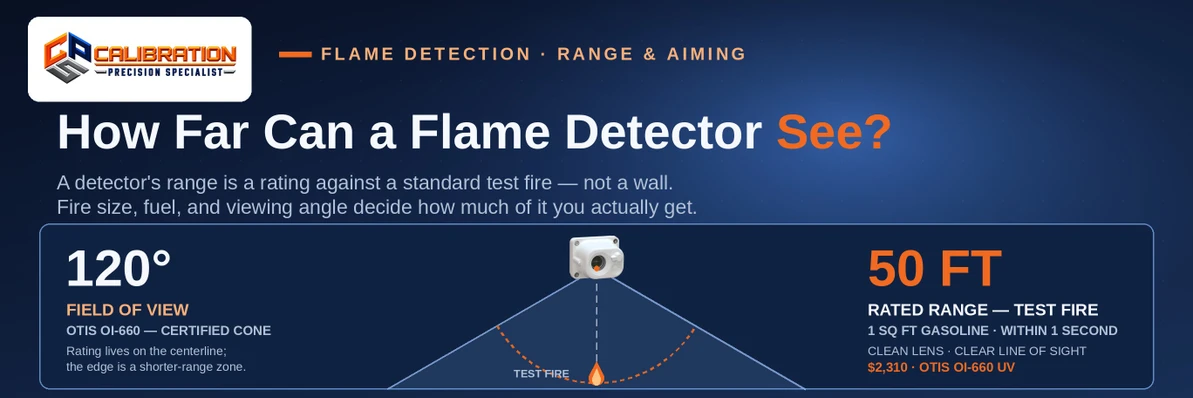
A flame detector's range is a rating, not a wall: it is the distance at which the detector is certified against a standard test fire — for the OTIS OI-660, a 1-square-foot gasoline flame at 50 feet, caught within 1 second across a 120° field of view. A bigger fire throws more radiation and can be seen farther away; a smaller fire must be closer — double the distance and the fire needs roughly four times the output to register the same — and sensitivity fades toward the edge of the cone, so real-world reach is set as much by fire size, fuel, and where you aim the detector as by the number on the datasheet.
Post #86 in this series answered which flame detector technology fits which fire — UV vs. IR vs. UV/IR vs. IR3. This one answers the next question every buyer asks, and it is a geometry question, not a technology question: how far away can the detector be and still catch the fire in time? The honest answer is that "range" on a flame detector means something more specific — and more conditional — than most people assume. Read it as a rating taken under stated conditions and it is genuinely useful. Read it as a guarantee and it will mislead you in exactly the situations that matter.
Range Is a Rating, Not a Wall
An optical flame detector does not reach out and touch a fire at a set distance. It sits still and waits for enough flame radiation to arrive at its lens — and the amount that arrives depends on how much the fire radiates and how far away it is. So manufacturers do not rate range in the abstract. They rate it against a standard test fire: a defined fuel, burned in a defined pan, at a defined size. The classic reference is a 1-square-foot gasoline pan fire, and it is the basis printed right in the listing for the OTIS OI-660: certified to catch a 1 sq ft gasoline flame at 50 ft within 1 second.
That phrasing is doing real work. Change any term in it — a smaller pan, a different fuel, a dirtier lens, a fire off to the side of the cone — and the 50 ft figure changes with it. The rating is a reference point that lets you compare detectors on equal terms, not a fence line inside which every fire is caught and outside which none is.
How Does Fire Size Change a Flame Detector's Range?
Radiation spreads out as it travels, and flame radiation follows the inverse-square law: double the distance between fire and detector and the radiation arriving at the lens drops to roughly one quarter. Run that law both ways and the practical rules fall out:
- A bigger fire is seen farther. A fire with four times the radiant output of the test fire presents the same signal at twice the distance. The OI-660's rating, restated: roughly a 4 sq ft fire at 100 ft delivers about what a 1 sq ft fire delivers at 50 ft.
- A smaller fire must be closer. At half the distance, the detector receives four times the radiation — so at 25 ft, a fire of about a quarter of a square foot delivers roughly the test-fire signal.
- Distance is expensive. Going from 50 ft of coverage to 100 ft does not ask twice as much of the fire; it asks four times as much. This is why "just mount it farther back" fails quietly in coverage plans.
Fuel matters too, because the test fire is gasoline and your fire may not be. Different fuels radiate different amounts of energy, and they distribute it differently across the ultraviolet and infrared bands each technology watches — a detector rated on gasoline does not perform identically on an alcohol, hydrogen, or metal fire, which is one reason manufacturers publish fuel-by-fuel sensitivity data for their heads. The certified figure is the yardstick; your fuel and your fire size are the adjustments. And note what this post does not do: it prints a distance for exactly one detector, because exactly one listing in the CPS line publishes one. RKI's FlameSpec IR3 is specified for hydrocarbon fires at long distance — that is the manufacturer's own language, and it is all any seller can honestly quote. Anyone who gives you an exact footage for a detector whose maker doesn't publish one is making the number up.
Field of View: The Cone Is the Coverage
Range is only half the geometry. A flame detector watches a cone of space in front of its lens, and the cone's width is its field of view. The OI-660's field of view is 120° — a genuinely wide cone, wider than it is long in feel: stand the detector at one end of a bay and it is watching well off to both sides, not just straight ahead.
The rating inside that cone is not uniform, and this is the part coverage plans get wrong:
- Sensitivity is highest on the centerline. The detector's axis — the direction the lens points — is where its rated performance lives.
- Sensitivity falls off toward the edge. Manufacturers publish cone-of-vision curves showing exactly this derating: the farther a fire sits from the axis, in angular terms, the less of its radiation the detector effectively uses, so the distance at which a given fire can be caught shrinks toward the cone's edge.
- The rated distance and the full cone do not multiply. "50 ft" and "120°" do not promise a 1 sq ft gasoline fire caught at 50 ft at the very edge of the cone. They promise the test fire at the rated distance on rating terms — treat anywhere near the edge as a shorter-range zone and plan accordingly.
The working habit this produces: draw coverage as cones on the plot plan, put the hazard near the centerline of a cone rather than at its edge, and never let a floor-plan circle substitute for the cone. It is the same discipline as placing point gas detectors where the gas actually goes — the subject of our post on where fixed gas detectors should be placed — except that a flame detector's placement question is about sight lines, not air movement.
What Shortens a Flame Detector's Real-World Reach?
Every figure above assumes the rating's conditions: a clean lens and an unobstructed line of sight. Plants do not maintain those conditions for free. The reach you actually get shrinks with:
- A fouled lens. Dirt, oil film, dust, ice, and paint overspray all absorb radiation before the sensor sees it — range erodes gradually, not all at once. This is why the automatic self-test matters: the OI-660's through-the-lens self-test continuously verifies the detector can still see and reports a fault when its view is impaired, turning a dirty lens into a maintenance ticket instead of a silent failure.
- Anything between the detector and the fire. Steam, heavy smoke, rain, and dust in the air absorb and scatter the radiation in transit; equipment, tanks, and stored material block it entirely. A fire the detector cannot see is a fire it cannot report, whatever the datasheet says.
- Smoke over the fire itself. A sooty fire's own smoke plume sits between flame and lens absorbing radiation — hardest on ultraviolet, whose wavelengths smoke absorbs most readily.
- Weather and window condition outdoors. The detectors themselves are built for it — explosion-proof, weatherproof housings are standard in this class — but a lens filmed with driven rain, ice, or salt is a shorter-range lens until it is cleaned.
None of this is an argument against the technology. It is an argument for treating the published range as the starting condition and the installation — sight lines, lens maintenance, self-test faults actually getting answered — as what preserves it.
Where Should You Aim a Flame Detector?
Aim at the hazard, not at the room. Flame detectors earn their keep watching the specific places where a leak would ignite: pump seals, flanges, compressor faces, loading and transfer points, valve clusters, fuel-handling equipment. The questions, in order:
- What is the fire this detector exists to catch? Name the equipment and the leak point. The cone's centerline belongs on that point, at the closest practical distance — every foot closer is signal the inverse-square law gives you for free.
- What stands between? Walk the sight line. If a skid, a tank, or routine stored material crosses it, move the detector, not the hope.
- How high? Mounting higher widens the footprint the cone covers at floor level, but it also lengthens the slant distance to a floor-level fire — footprint and distance trade against each other, and the hazard point, not the widest possible circle, should win.
- What covers the blind spot? On critical coverage, overlap cones: two detectors whose cones cross over the hazard, so one fouled lens or one blocked view is not a single point of failure.
- Can it be aimed precisely — and stay aimed? This is what the mounts are for, and they are not optional extras. Every RKI FlameSpec head must be ordered with a mount, sold separately at $330–$350 (tilt mounts and a fixed high-vibration bracket); OTIS heads aim with the OI-208 swivel bracket, $180 in aluminum or $315 in stainless. A swivel bracket exists because the last few degrees of aim are the difference between the hazard sitting on the centerline and sitting at the cone's weak edge.
A flame detector is one layer of a system — it confirms the fire; fixed gas detection warns about the leak before it — and the two are planned together, as laid out in how a fixed gas detection system works. Both flame lines are in the RKI flame detector and OTIS flame detector categories.
| Worked Example: What the OTIS OI-660's Numbers Do and Don't Promise |
|---|
|
The OTIS OI-660 ($2,310) is the one detector in the CPS line whose listing states its geometry outright, so it is the honest worked example:
|
Frequently Asked Questions
How far can a flame detector see? It depends on the fire, not just the detector: range is rated against a standard test fire, and a bigger fire is seen farther while a smaller one must be closer. The one certified example in the CPS line is the OTIS OI-660 UV detector, rated to catch a 1 sq ft gasoline flame at 50 ft within 1 second across a 120° field of view. RKI's FlameSpec IR3 is specified for long-distance hydrocarbon coverage, but its listing publishes no distance figure — any exact footage quoted for it would be invented.
What size fire can a flame detector detect? Detectors are rated against a standard test fire — conventionally a 1-square-foot gasoline pan fire, which is the stated basis of the OTIS OI-660's 50 ft certification. Because radiation follows the inverse-square law, a fire with about four times the output can be caught at about twice the rated distance, and a fire a quarter the size must be about half as far away. "What size fire" and "at what distance" are the same question asked twice.
What is the field of view of a flame detector? It is the width of the cone of space the detector watches, measured in degrees. The OTIS OI-660's field of view is 120°. Sensitivity is highest along the cone's centerline and falls off toward the edges — manufacturers publish cone-of-vision curves for the derating — so the rated distance applies on rating terms near the axis, and a fire near the edge of the cone must be closer to be caught.
How far can the RKI FlameSpec IR3 see? RKI specifies the FlameSpec IR3 for hydrocarbon fuel and gas fires at long distance, with a 40 ms response to a fast fire burst or explosion — but neither RKI's listing nor CPS's publishes a specific detection distance or field-of-view figure for it, so there is no honest number to give. Choose it as the long-distance, highest-false-alarm-immunity class of detector (it is $5,700 at CPS, mount sold separately), and get the manufacturer's cone and sensitivity data for your specific fuel before finalizing a coverage plan.
Where should a flame detector be mounted? Where its cone's centerline covers the specific hazard — pump seals, flanges, compressors, loading and transfer points — at the closest practical distance with an unobstructed sight line. Mounting higher widens the floor-level footprint but lengthens the distance to the fire, so let the hazard point win over the widest circle. Critical coverage should overlap two detectors' cones so one blocked or fouled unit is not a single point of failure.
Can one flame detector cover a whole room? Only if the whole room fits inside its cone with clear sight lines — and rooms rarely cooperate. A detector watches a cone, not a volume: anything behind tanks, skids, or stored equipment is in a blind spot, and sensitivity fades toward the cone's edges even where the view is clear. Real coverage plans draw the cones on the plot plan, center them on the hazards, and overlap them where the risk justifies it.
What blocks a flame detector from seeing a fire? Anything that absorbs, scatters, or blocks flame radiation between the fire and the lens: equipment and stored material (total blockage), and steam, heavy smoke, dust, and rain (partial absorption that shortens effective range). A fouled lens — dirt, oil film, ice, paint overspray — does the same damage at the detector itself. Ratings assume a clean lens and a direct line of sight; installations have to defend both.
Does a dirty lens really shorten a flame detector's range? Yes — gradually and silently, which is the dangerous way. Film on the window absorbs part of the flame's radiation before the sensor sees it, so the detector needs a bigger or closer fire to respond; range erodes long before the detector goes fully blind. That is what the automatic optical self-test is for: the OTIS OI-660's through-the-lens self-test continuously proves the detector can still see and raises a fault when its view is impaired — provided somebody acts on the fault and cleans the lens.
How do you aim a flame detector? With its aiming mount, at the hazard: the detector is fixed to a tilt mount or swivel bracket, pointed so the leak-and-ignition point sits near the cone's centerline, and the aim is locked. The mount is part of the installation, not an accessory — every RKI FlameSpec head must be ordered with a mount ($330–$350, sold separately), and OTIS heads aim with the OI-208 swivel bracket at $180 in aluminum or $315 in stainless steel.
Do flame detectors work outdoors? Yes — industrial flame detectors are built for outdoor classified areas in explosion-proof, weatherproof housings, and the geometry rules are the same outdoors. What changes is the environment the rating has to survive: driven rain, ice, salt film, and dust foul lenses faster, and long outdoor sight lines invite obstructions. Plan on the cone and test-fire math as usual, then defend the lens and the sight line with cleaning and self-test fault response.
The Bottom Line
A flame detector's range is a measurement, not a force field: the distance at which it is certified against a standard test fire — 1 sq ft of gasoline at 50 ft, inside 1 second, for the OTIS OI-660 — under a clean lens and a clear line of sight. Fire size moves that number by the inverse-square law, four times the fire for twice the distance; the cone's edge quietly takes some of it back; dirt, steam, and obstructions take more. So the buying question is never just "how far can it see?" It is "how far is my hazard, how big is my credible fire, and can I keep a clean, centered cone on it?" Answer those three and the right detector — and the right mounting spot — usually pick themselves.
Not sure your coverage plan actually covers the hazard? That is a conversation worth having before the purchase order — call 865-900-8844 or reach us through Contact Us. Browse the lines in the RKI flame detector and OTIS flame detector categories, and see how flame detection fits the whole system in Calibration Services and our fixed system overview.
CPS Calibrations · 109 S. Front Street, Rockwood, TN 37854 · Calibration Gas · Calibration Services · Contact Us
Recent Posts
-
Flame Detector vs. Gas Detector: What's the Difference — and Do You Need Both?
A gas detector and a flame detector guard opposite ends of the same incident: a gas detector reads l …Oct 21st 2026 -

How Do You Test a Flame Detector? Self-Tests, Test Lamps, and NFPA 72
You test a flame detector with light, not gas — there is no span gas, no zero gas, and never an open …Oct 21st 2026 -
Why Does a Flame Detector False Alarm — and Which Type Won't?
A flame detector false alarms because something that is not a fire is producing the signal it watche …Oct 21st 2026