
UV vs. IR vs. UV/IR vs. IR3 Flame Detectors: What's the Difference?
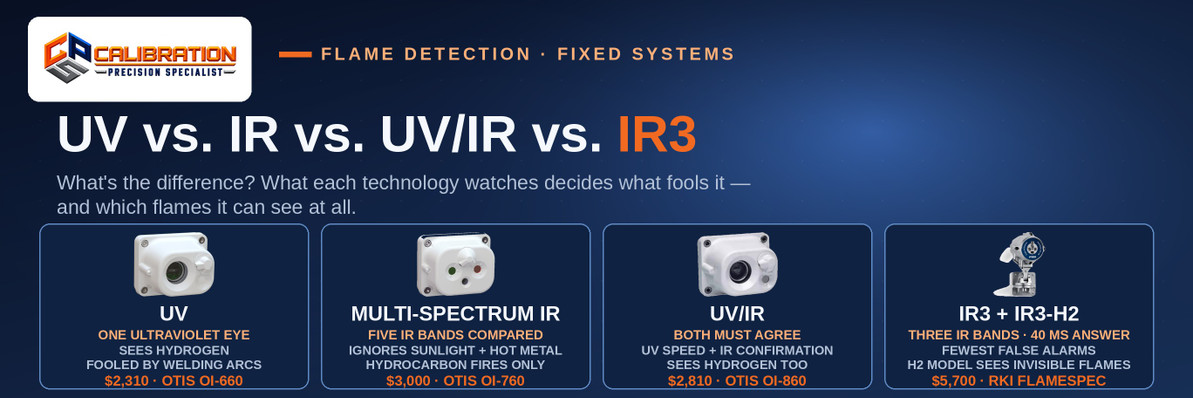
The difference between UV, IR, UV/IR, and IR3 flame detectors is what each one watches. A UV detector watches ultraviolet light, so it sees hydrocarbon and non-hydrocarbon flames — hydrogen included — but welding arcs and lightning speak its language too; an IR detector watches the flickering infrared bands of burning fuel, which leaves standard IR blind to hydrogen, whose flame puts almost nothing into those bands; a UV/IR detector makes both channels agree before it alarms; and an IR3 compares three infrared bands at once for the highest false-alarm immunity of the four, with the IR3-H2 variant tuned to catch hydrogen's invisible flame. Across the CPS line the trade runs from the $2,310 OTIS OI-660 UV detector to the $5,700 RKI FlameSpec IR3 — speed and fuel coverage on one end, distance and false-alarm immunity on the other.
All four technologies do the same job — spot a flame in a hazardous area fast enough to matter — and all four sit in explosion-proof housings doing it. What separates them is the slice of the flame's radiation each one is built to see, and that single choice decides which fuels the detector can see at all, which everyday events can fool it, and how far away it can be trusted. Pick the wrong slice and you can own a perfectly good detector that is blind to your fire, or one that alarms every time a welder strikes an arc two bays over. This post works through each technology, puts them head-to-head, and matches each one to the jobs it actually fits. For where flame detectors sit inside the larger system — sensors, controllers, relays, alarms — see our post on how a fixed gas detection system works.
First, What a Flame Detector Is — and Is Not
A flame detector is an optical instrument. It does not sample air and it is never calibrated with gas; it watches a cone of space for the light a flame emits, and it answers in seconds or fractions of a second — long before a gas detector at the same location would see leaked fuel arrive, and only once fuel has actually ignited. That makes flame detection the second layer, not a substitute for the first: gas detection warns you about the leak, flame detection confirms the fire. The two are normally installed side by side and wired into the same class of controller — the relay and 4–20 mA world covered in our post on choosing the right RKI controller. Every detector in this post is a fixed, explosion-proof unit for classified areas: Class I/II Division 1 and NEMA 4X across the OTIS line, with the RKI FlameSpec heads built to the same hazardous-location duty. What changes from model to model is the eye.
UV Flame Detectors: One Ultraviolet Eye
A UV flame detector watches the ultraviolet radiation every flame emits, in the "solar-blind" band — the slice of UV that the atmosphere absorbs out of sunlight before it reaches the ground, so a properly built UV sensor can stare toward daylight without seeing the sun. The OTIS OI-660 peaks at 0.22 µm, and that wavelength choice buys the widest fuel coverage of any single technology here: UV sees hydrocarbon flames (gasoline, propane, methane, alcohol) and non-hydrocarbon flames — hydrogen, silane, hydrazine — that produce little or no infrared signature in the fuel bands. It is also fast: the OI-660 is certified to catch a 1 sq ft gasoline flame at 50 ft within 1 second, across a 120° field of view, and its automatic through-the-lens self-test continuously proves the eye can still see, reporting a fault if its view is impaired. Outputs are two configurable relays, 0–20 mA, and RS-485 Modbus. OTIS lists it for turbine enclosures, generator rooms, battery rooms, gas cabinets, and munitions facilities, with a high-temperature version rated to +125 °C for turbine enclosures.
The honest limits are the flip side of that open eye. Anything that makes ultraviolet light looks like a flame to a UV detector: arc welding is the classic false alarm, and lightning and some arc sources can trip one as well. Smoke is the quieter problem — a smoky fire absorbs UV before it reaches the lens, and oil film or dirt on the window shortens the detector's reach the same way. UV is the right answer where non-hydrocarbon fuels are the risk and welding is not part of the scenery.
IR and Multi-Spectrum IR: Watching the Fuel Burn
An infrared flame detector watches the infrared radiation of burning fuel — above all the band around 4.3–4.4 µm where hot carbon dioxide from a hydrocarbon flame radiates strongly — and it checks that the signal flickers the way a flame flickers, because a steady hot pipe should not count as a fire. A single-band IR detector doing only that is the weak version: modulated sunlight and hot, vibrating machinery can imitate parts of the signature, which is why serious IR detectors compare several bands at once. The OTIS OI-760 is a multi-spectrum design that watches five IR bands simultaneously — 2.2, 2.9, 3.7, 4.4, and 5.8 µm — so it can tell a real flame's spectrum apart from hot equipment and sunlight instead of trusting one band and a flicker. Its staged 0–20 mA output reports ready, warning, and fire levels plus distinct fault states, alongside two relays and Modbus, and OTIS aims it at hydrocarbon fire risk in refineries, compressor stations, paint booths, and fuel-transfer areas.
The hard limit is written into the physics: a detector keyed to the hot-CO₂ band is watching for the exhaust of a carbon fire. Hydrogen, silane, and metal flames put little energy into that band, so a standard IR detector cannot see them — including hydrogen, whose flame is nearly invisible to people as well. If the fuel has no carbon in it, plain IR is the wrong eye no matter how many bands it compares.
UV/IR Flame Detectors: Both Must Agree
A UV/IR detector puts both eyes in one housing and requires them to agree — with an algorithm weighing the two channels — before it will call something a fire. That one design decision cancels most of both parents' weaknesses: a welding arc makes UV but no flame-pattern IR, sunlight and hot metal make IR but no UV, so neither gets past the vote, while a real flame produces both at once. The OTIS OI-860 pairs a 0.22 µm UV channel with a 4.4 µm IR channel and runs them through its Fire Event Analysis algorithm; it detects hydrocarbon and non-hydrocarbon flames (hydrogen, silane) in one unit, and its 0–20 mA output even carries a 16 mA "UV or IR presence" level that tells the panel one channel sees something before full alarm. RKI's FlameSpec UV-IR works the same territory from the other direction — an IR sensor at 2.7 µm plus a solar-blind UV sensor whose logic circuit specifically prevents false alarms from solar radiation — and it is rated for hydrocarbon and non-hydrocarbon fires including hydroxyl, hydrogen, metal, and inorganic fires. The FlameSpec UV-IR-F variant is optimized for hydrocarbon fires. Both brands deliver relays, analog output, and Modbus from a Division 1 housing.
UV/IR is the versatile middle of the line: nearly UV's fuel coverage, most of IR's false-alarm manners, at $2,810 (OI-860) to $4,690 (FlameSpec UV-IR) — which is why it shows up in mixed-fuel areas like aircraft hangars, fuel transfer, compressor stations, silane storage, paint booths, and gas cabinets.
IR3 and IR3-H2: Three Bands, the Fewest False Alarms
An IR3 — triple IR — detector compares three infrared bands simultaneously and judges the relationship between them. With three bands to cross-check instead of one or two, it achieves the highest false-alarm immunity of any technology in this post and the long-distance performance to watch large areas: RKI's FlameSpec IR3 is built for hydrocarbon fuel and gas fires at long distance, and it answers a fast fire burst or explosion in 40 ms — the response that matters when the event is a flash, not a slow-growing flame. Outputs are a tri-colour LED, 4–20 mA, three SPST relays (fire, fault, auxiliary), and Modbus RS485.
The standard IR3 still shares IR's blind spot: it is a hydrocarbon detector, and hydrogen is not a hydrocarbon. That is exactly the gap the FlameSpec IR3-H2 exists to close — a triple-IR detector tuned for energy-transition fires, detecting invisible hydrogen flames at long distance alongside hydrocarbons, with the same false-alarm immunity. For hydrogen production, storage, and fueling — and for the battery rooms in our post on why battery rooms need hydrogen detection — the IR3-H2 is the IR-family answer that does not go blind. Both FlameSpec IR3 models are $5,700.
UV vs. IR vs. UV/IR vs. IR3, Head to Head
| Technology | What it senses | Fuels it sees | Sees hydrogen? | What fools it | Response | CPS example |
|---|---|---|---|---|---|---|
| UV | Ultraviolet light in the solar-blind band (OI-660 peaks at 0.22 µm) | Hydrocarbon + non-hydrocarbon: hydrogen, silane, hydrazine, alcohol | Yes | Welding arcs, lightning; can be blinded by smoke or a dirty lens | Certified: 1 sq ft gasoline flame at 50 ft within 1 second (OI-660) | OTIS OI-660 — $2,310 |
| IR (multi-spectrum) | Flickering infrared compared across five bands: 2.2, 2.9, 3.7, 4.4, 5.8 µm (OI-760) | Hydrocarbons only | No | Very little — multi-band comparison rejects the sunlight and hot machinery that fool single-band IR | Staged warning levels ahead of full fire alarm | OTIS OI-760 — $3,000 |
| UV/IR | UV + IR together — the alarm logic requires both channels to agree | Hydrocarbon + non-hydrocarbon, incl. hydrogen and silane | Yes | Very little — a false source must fake UV and flame-pattern IR at the same time | UV speed with IR confirmation | OTIS OI-860 — $2,810 · RKI FlameSpec UV-IR — $4,690 |
| IR3 | Three infrared bands compared simultaneously | Hydrocarbons | No | Least of all — highest false-alarm immunity of the four | 40 ms to a fast fire burst or explosion | RKI FlameSpec IR3 — $5,700 |
| IR3-H2 | Three IR bands tuned for energy-transition fuels | Hydrocarbons + hydrogen | Yes — including invisible hydrogen flames, at long distance | Least of all — same triple-band immunity | Built for long-distance hydrogen fires | RKI FlameSpec IR3-H2 — $5,700 |
The full flame detector lines are in the RKI flame detector and OTIS flame detector categories.
Which Flame Detector for Which Job?
- Hydrogen, silane, hydrazine, or metal fires are the risk: UV, UV/IR, or IR3-H2. Standard IR and standard IR3 cannot see these flames at all — this is the first filter, before price or distance.
- Welding happens anywhere nearby: skip plain UV. A UV/IR or an IR3 will ignore the arcs that a UV-only detector cannot.
- Turbine enclosures, generator rooms, battery rooms, gas cabinets: UV (OI-660) is built for exactly these — and its high-temperature version is rated to +125 °C for turbine enclosures.
- Refineries, compressor stations, paint booths, fuel transfer — hydrocarbons in sun and weather: multi-spectrum IR (OI-760) for band-comparison immunity at $3,000, or step up to IR3 where the sight lines are long.
- Large open areas, long distances, or fast flash-fire risk: IR3 — three bands, long-distance hydrocarbon performance, and a 40 ms answer to a fire burst.
- Hydrogen production, storage, fueling, and battery energy storage: IR3-H2, the one IR-family detector that sees the invisible hydrogen flame — or UV/UV-IR where distances are shorter.
- Mixed fuels and one detector to cover the room: UV/IR — the hangars, booths, and cabinets case, where the fuel list includes both hydrocarbons and non-hydrocarbons.
What All Four Technologies Share
Underneath the sensing differences, these detectors are built the same way, because they do the same job in the same places. Every model in this post ships in an explosion-proof housing rated for classified areas (Class I/II Division 1, NEMA 4X on the OTIS line) and runs on 24 VDC. Every one talks to your panel three ways: relays for alarm and fault, an analog loop (0–20 mA on OTIS, 4–20 mA on RKI), and RS-485 Modbus. Every one runs an automatic optical self-test that continuously verifies it can still see — and reports a fault when its view is impaired, which is what makes a dirty lens a maintenance ticket instead of a silent failure. And every one has to be aimed: an optical detector only watches its cone, so the aiming mount is not an accessory to skip. RKI FlameSpec heads must be ordered with a mount, sold separately at $330–$350; OTIS heads aim with the OI-208 swivel bracket at $180 in aluminum or $315 in stainless.
The Honest Limits of Every Optical Detector
- Line of sight is absolute. A flame detector cannot see around a tank, through a wall, or behind stored equipment. If the fire can start somewhere the cone does not cover, that spot is unmonitored no matter which technology you bought.
- The lens is part of the instrument. Dirt, oil film, ice, and paint overspray shorten range before they cause blindness — the automatic self-test exists precisely to catch a view going bad, and its fault output only helps if somebody acts on it.
- Smoke hurts UV most. Heavy smoke absorbs ultraviolet, so a smoky, sooty fire can be partially hidden from a UV detector even in plain view; IR-based technologies see through that scenario better.
- Distance shrinks the fire it can catch. A rating like "1 sq ft gasoline flame at 50 ft in 1 second" is a reference point, not a promise at any range — the farther away the fire, the bigger it has to be before any optical detector can confirm it.
- None of them detects a leak. A flame detector's fastest possible alarm is still after ignition. Leak prevention belongs to fixed gas detection; flame detection is the layer that answers when prevention fails.
Frequently Asked Questions
What is the difference between a UV and an IR flame detector? A UV flame detector watches ultraviolet light — the OTIS OI-660 peaks at 0.22 µm — and sees both hydrocarbon flames and non-hydrocarbon flames like hydrogen, silane, and hydrazine, but it can be fooled by welding arcs and lightning. An IR flame detector watches the flickering infrared bands of burning fuel (centered on the hot-CO₂ band around 4.4 µm), which makes it a hydrocarbon-only detector: it cannot see hydrogen flames at all. UV is the broader, faster eye with more false-alarm sources; IR and its multi-band versions are the pickier eye with a shorter fuel list.
Can a flame detector detect a hydrogen flame? Yes — but only the right technologies. Hydrogen flames are nearly invisible and emit little in the infrared bands a standard IR detector watches, so plain IR and standard IR3 detectors cannot see them. UV detectors (OTIS OI-660) and UV/IR detectors (OTIS OI-860, RKI FlameSpec UV-IR) see hydrogen directly, and RKI's FlameSpec IR3-H2 is a triple-IR detector tuned specifically to detect invisible hydrogen flames at long distance alongside hydrocarbons.
What does IR3 mean in a flame detector? IR3 means triple infrared: the detector compares three separate infrared bands simultaneously and alarms on the relationship between them, instead of trusting one band. That cross-check gives IR3 detectors the highest false-alarm immunity of the flame detector types and strong long-distance performance on hydrocarbon fires. RKI's FlameSpec IR3 answers a fast fire burst or explosion in 40 ms and costs $5,700 at CPS.
Why does my flame detector keep false alarming? The usual cause depends on the technology. A UV detector false alarms on ultraviolet sources that are not fire — arc welding is the classic one, and lightning can do it too. A single-band IR detector can be fooled by modulated sunlight or hot, vibrating machinery that imitates a flame's flicker. The fixes are built into the other technologies: multi-spectrum IR compares five bands to reject hot equipment and sunlight, UV/IR requires both channels to agree, and IR3 compares three bands — all three exist largely to end nuisance alarms.
How fast does a flame detector respond? Much faster than any gas detector, because it sees light instead of waiting for gas to travel. The OTIS OI-660 UV detector is certified to detect a 1 sq ft gasoline flame at 50 ft within 1 second, and RKI's FlameSpec IR3 answers a fast fire burst or explosion in 40 ms. Exact response depends on the fire's size and distance: the farther away a fire is, the larger it must be before any optical detector can confirm it.
How much does a flame detector cost? At CPS, flame detectors run $2,310 to $5,700 depending on technology: the OTIS OI-660 UV detector is $2,310, the OTIS OI-860 UV/IR is $2,810, the OTIS OI-760 multi-spectrum IR is $3,000, the RKI FlameSpec UV-IR is $4,690, and the FlameSpec IR3 and IR3-H2 are $5,700. Budget the aiming mount on top of the head: RKI mounts are $330–$350 and are required with each FlameSpec head, and the OTIS OI-208 swivel bracket is $180 in aluminum or $315 in stainless.
Do flame detectors need calibration gas? No. A flame detector is not a gas detector — it watches for the optical signature of a flame rather than sampling air, so there is no span gas and no gas calibration. Its sensing ability is verified continuously by a built-in automatic optical self-test, which reports a fault if the detector's view is impaired. Flame detectors are normally installed alongside fixed gas detection: gas detectors warn about the leak, flame detectors confirm the fire.
What is a UV/IR flame detector? It is a flame detector with an ultraviolet sensor and an infrared sensor in one housing, whose alarm logic requires both channels to agree that a flame is present. A welding arc produces UV but no flame-pattern IR, and sunlight or hot machinery produces IR but no UV, so requiring both cancels most false alarms while keeping UV's ability to see non-hydrocarbon flames like hydrogen and silane. Examples at CPS: the OTIS OI-860 at $2,810 and the RKI FlameSpec UV-IR at $4,690.
Can flame detectors be used outdoors? Yes — industrial flame detectors are built for it. The OTIS OI-660, OI-760, and OI-860 carry Class I/II Division 1 explosion-proof ratings, NEMA 4X weatherproof housings, ATEX/IECEx certifications, and a −40 to +85 °C operating range; a high-temperature OI-660 version reaches +125 °C. Outdoors is also where technology choice matters most, because sunlight is a standing false-alarm source for single-band IR and lightning can trip UV — multi-spectrum IR, UV/IR, and IR3 designs are built to reject both.
Does a flame detector need a mounting bracket? Yes — an optical detector only watches the cone it is aimed at, so aiming is part of the installation, and the mount is sold separately from the head. Each RKI FlameSpec head must be ordered with a mount: the standard tilt mount and HD tilt mount are $350, and the fixed high-vibration bracket is $330. OTIS flame detectors aim with the OI-208 swivel bracket, $180 in aluminum or $315 in stainless steel.
The Bottom Line
"What's the difference between them all" is really one question: what does the eye watch? UV watches ultraviolet and sees nearly every flame chemistry there is — hydrogen included — at the price of believing welding arcs and lightning too. IR watches the infrared of burning carbon and is blind to everything without carbon in it; comparing more bands — five in a multi-spectrum IR, three in an IR3 — buys immunity from the sunlight and hot machinery that fool simpler IR, and the IR3 adds long distance and a 40 ms burst response. UV/IR makes the two eyes vote, which is why it covers mixed fuels with so few nuisance alarms. And the IR3-H2 exists because the newest fuel, hydrogen, burns invisibly: it is the triple-IR detector tuned to see it. Match the eye to your fuel list first, your false-alarm scenery second, and your distances third — in that order, the choice usually makes itself.
Not sure which technology your fuel list calls for? That is a conversation worth having before the purchase order — call 865-900-8844 or reach us through Contact Us. Browse the lines in the RKI flame detector and OTIS flame detector categories, and see how they wire into the whole system in Calibration Services and our fixed system overview.
CPS Calibrations · 109 S. Front Street, Rockwood, TN 37854 · Calibration Gas · Calibration Services · Contact Us
Recent Posts
-
Flame Detector vs. Gas Detector: What's the Difference — and Do You Need Both?
A gas detector and a flame detector guard opposite ends of the same incident: a gas detector reads l …Oct 21st 2026 -

How Do You Test a Flame Detector? Self-Tests, Test Lamps, and NFPA 72
You test a flame detector with light, not gas — there is no span gas, no zero gas, and never an open …Oct 21st 2026 -

Why Does a Flame Detector False Alarm — and Which Type Won't?
A flame detector false alarms because something that is not a fire is producing the signal it watche …Oct 21st 2026