
Why Do Battery Rooms Need Hydrogen Detection? H₂ Monitoring for Charging Areas
Charging lead-acid batteries vents hydrogen gas, and hydrogen ignites at just 4% by volume in air — its lower explosive limit (LEL). The fire codes written for battery rooms (IFC Section 608 and NFPA 1 Chapter 52) require ventilation designed to hold hydrogen at or below 1% of the room's volume, which is exactly 25% of that LEL — and a hydrogen detector, mounted at the room's highest point and typically alarming at 10% of LEL (0.4% vol), is how a facility proves the ventilation is working and gets warned the moment it isn't.
Every UPS room, telecom battery plant, data-center battery string and forklift charging area shares the same quiet hazard: the batteries are calmest when they're doing nothing, and they make their gas exactly when they're working hardest — on charge. This guide explains where the hydrogen comes from, the three numbers that govern battery-room safety, how detection and ventilation divide the job, and which detector technology can actually see hydrogen.
Why Does Charging a Battery Make Hydrogen?
A lead-acid cell stores energy in a chemical reaction between lead plates and sulfuric acid electrolyte. As the battery approaches full charge, there is less and less discharged material left to convert, and an increasing share of the charging current goes into a side reaction instead: splitting the water in the electrolyte into oxygen at one plate and hydrogen at the other. That is why hydrogen generation peaks at the end of charge and during boost or equalize charging, when voltages are deliberately pushed highest — the worst case the codes design for is simultaneous boost charging of every battery in the room.
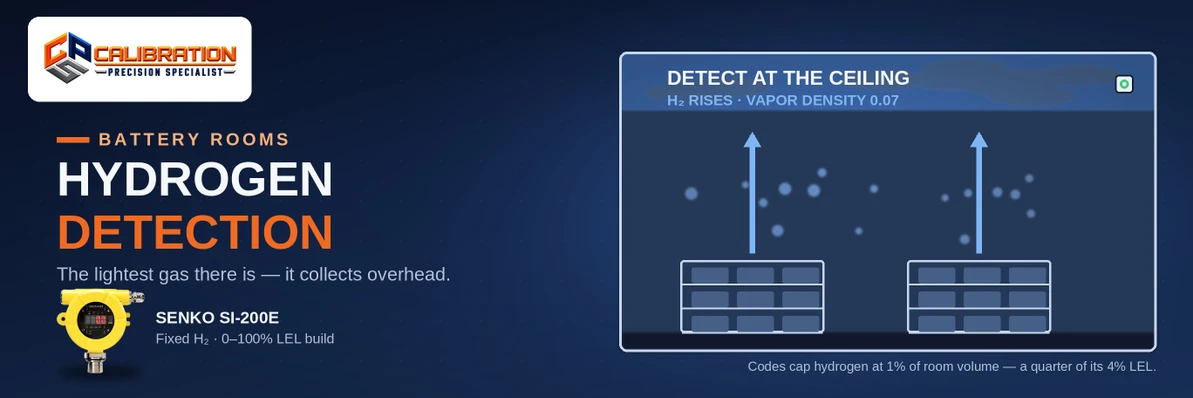
Flooded (vented) cells release that hydrogen freely through their caps — they are the main source in any charging area. Valve-regulated (VRLA) batteries recombine most of their gas internally under normal operation, which is why they vent far less — but "far less" is not "none," and a VRLA string that is overcharged, failing, or in thermal runaway vents hard. The gas itself is the problem's quiet part: hydrogen is colorless, odorless, and at about 0.07 times the density of air it is the lightest gas there is — it leaves the battery, rises immediately, and collects wherever the ceiling gives it a pocket to sit in.
The Three Numbers That Run a Battery Room
| Number | What it means |
|---|---|
| 4% vol = 100% LEL | Hydrogen's lower explosive limit: at 4% hydrogen in air, the mixture can ignite. Its flammable range runs from 4% to about 75% — one of the widest of any common gas. |
| 1% vol = 25% LEL | The code ceiling. IFC Section 608 and NFPA 1 require battery-room ventilation designed to limit hydrogen to 1% of the room's total volume. |
| 0.4% vol = 10% LEL | The typical first detector alarm: fans start or boost, staff get notified — at one-tenth of the way to the explosive threshold, with the code ceiling still far away. |
Everything in battery-room gas safety is arithmetic on the first number. Because hydrogen's LEL is 4% by volume, each 1% of hydrogen in the room is 25% of the way to an ignitable mixture. Codes set the design ceiling at the first of those percent; detectors stage their alarms inside it.
What Do the Codes Require for Battery Rooms?
For stationary storage battery systems above the code's capacity thresholds (the IFC provisions apply to larger systems — more than 50 gallons of electrolyte for flooded lead-acid, nickel-cadmium and VRLA), IFC Section 608.6.1 gives two compliance paths for flooded lead-acid, flooded Ni-Cd and VRLA rooms: design the ventilation system to limit the maximum hydrogen concentration to 1% of the room's total volume, or provide continuous ventilation at not less than 1 cfm per square foot of floor area. NFPA 1's battery chapter carries the same pair of options, with the 1% design judged against the worst case of simultaneous boost charging. OSHA's battery rules come at it from the employer's side — its charging-area standard requires ventilation that ensures diffusion of the gases from the batteries and prevents the accumulation of an explosive mixture.
Read those together and the shape is clear: the code's control is ventilation, designed to a hydrogen number. Detection is not named as the control — it is the instrument that verifies the control, catches its failure, and lets a demand-controlled system prove it is holding the room at or below the 1% ceiling. As always with model codes, the edition your jurisdiction adopted governs; your AHJ has the final word on your room.
Ventilation Is the Control — Detection Is the Proof
Ventilation and detection do different jobs, and a battery room needs both:
- Ventilation dilutes. Continuous exhaust sized to the code paths above keeps hydrogen from ever approaching 1% — provided the fan actually runs, the intake isn't blocked, and the room's air pattern sweeps the ceiling pockets where hydrogen lands.
- Detection verifies. A hydrogen sensor reads the result, not the intention. If the fan trips, a damper fails, or an equalize charge out-produces the design, the detector is the only thing in the room that knows.
- Detection actuates. Detector relays can start or boost the exhaust fan on a rising reading — demand-controlled ventilation that runs hard only when the batteries are gassing — and drive a fault alarm when the detector itself fails, so a dead sensor never reads as a safe room.
- Detection documents. A logged, calibrated detector is the evidence that the 1% ceiling was held, which is what an insurer or an investigator asks for after the fact.
Where Does the Hydrogen Detector Go?
At the top of the room — the placement logic we cover generally in our guide to where fixed gas detectors should be placed, in its purest form. Hydrogen rises straight off the batteries and pools at the highest available points: above the racks and chargers, inside ceiling coffers and beam pockets, at the peak of any sloped ceiling. A detector at breathing height in the middle of the room is measuring the last place hydrogen will reach. Mount high, over the charging positions, and think about pockets: a beamed ceiling can hold several separate hydrogen pools, and one sensor cannot see into all of them.
Which Detector Technology Can See Hydrogen?
Not all of them — and this is the selection mistake battery rooms punish. Infrared LEL sensors physically cannot detect hydrogen: hydrogen does not absorb infrared light, so an IR sensor reads zero in a hydrogen leak (we cover the physics in catalytic bead vs. infrared LEL sensors). Hydrogen detection is catalytic-bead or electrochemical territory.
The fixed head we fit for battery rooms is the SENKO SI-200E, in one of two hydrogen configurations:
- 0–100% LEL — the ventilation-control build: reads in the same units as the code math, with relay stages at 10% and 25% of LEL driving fans and alarms.
- 0–1,000 ppm — the early-warning build: sees a venting battery problem in parts per million, long before the room's concentration is a meaningful fraction of LEL.
The SI-200E lists from $950 at CPS, with configured builds at $1,092.50–$2,300 depending on the sensor fitted. Its enclosure is certified ATEX/IECEx Ex db IIC — and the "IIC" matters here: hydrogen sits in the most demanding gas group, so a detector certified for IIC atmospheres is certified for hydrogen specifically, not just for generic flammables. Its three relays (1st alarm, 2nd alarm, fault, 2.0 A @ 30 VDC) plus 4–20 mA and RS-485 outputs cover both the fan-starter job and the monitored-system job. Our SENKO fixed detector comparison covers the rest of the SI series it sits in.
What Are the Honest Limits?
- A detector does not dilute anything. It warns and it switches fans. If the room's ventilation is undersized for a boost charge, the detector's job is to tell you loudly — the fix is airflow, not a better sensor.
- Lithium-ion is a different hazard. The IFC's hydrogen-ventilation scheme is written for lead-acid and nickel-cadmium chemistry; lithium-ion systems are handled separately because their failure mode — thermal runaway — vents a flammable, toxic off-gas mixture on its own schedule, not a steady hydrogen stream tied to charging. An H₂ LEL detector is not a thermal-runaway detection strategy.
- Catalytic sensors have needs. A catalytic hydrogen sensor requires oxygen to work (roughly 10% or more) and can be poisoned by silicones and sulfur compounds — in a battery room the practical point is simpler: it is a sensor that drifts and ages, and it earns its keep only on a calibration schedule.
- VRLA is lower risk, not no risk. Recombination keeps normal VRLA off-gassing small, which is why some small VRLA cabinets are ventilated lightly — but the codes still include VRLA in the battery-room provisions, because the fault case is the case that matters.
How Are Battery Room Detectors Maintained?
Like every fixed head: in place, with bottled gas. A catalytic hydrogen channel is calibrated with a certified hydrogen span gas applied at the sensor through its calibration cap — the same calibration gas program as the rest of the fixed system, with the mix matched to the sensor and the date checked before you trust the cylinder. Log each calibration with the room's ventilation checks, so the detector record and the fan record tell one story. If your room's head is overdue and nobody on staff owns the job, a fixed head can be removed and shipped to us, or calibrated in place with gas and phone guidance — we calibrate every channel. Questions about a charging area — call 865-900-8844.
Frequently Asked Questions
Why do battery rooms need hydrogen detection? Because charging lead-acid batteries vents hydrogen, an odorless gas that ignites at 4% by volume. Ventilation is the code-required control, designed to hold hydrogen at or below 1% of the room's volume — but only a detector can prove the ventilation is working, catch a fan failure, and warn staff while there is still a wide margin to the explosive threshold.
How much hydrogen does a charging battery produce? It depends on the battery's size, age and state of charge — and it peaks at the end of charge and during boost or equalize charging, when more of the charge current splits water in the electrolyte. That is why the codes don't size ventilation to an average: NFPA 1 judges the design against the worst case of simultaneous boost charging of all the batteries in the room.
What hydrogen concentration is dangerous in a battery room? Hydrogen's lower explosive limit is 4% by volume — at that concentration the air-hydrogen mixture can ignite, and it stays flammable up to about 75%. Fire codes don't let rooms get anywhere near it: the design ceiling is 1% by volume (25% of LEL), and detectors typically alarm first at 10% of LEL, which is 0.4% by volume.
What alarm setpoints should a battery room hydrogen detector use? The common staging is a first alarm at 10% of LEL (0.4% vol) — start or boost ventilation, notify staff — and a high alarm at 25% of LEL (1.0% vol), the code ceiling, for urgent response. Exact setpoints belong to your design and your AHJ, but every stage should sit inside the 1% vol ceiling the IFC and NFPA 1 ventilation rules are built on.
Where should a hydrogen detector be mounted in a battery room? At the highest point of the room, above the batteries and chargers. Hydrogen is about 0.07 times the density of air — the lightest common gas — so it rises off the cells and pools in ceiling pockets, coffers and beam bays. A sensor at breathing height reads the last air the hydrogen reaches, not the first.
Do VRLA (sealed) batteries need hydrogen detection? VRLA batteries recombine most of their gas and vent far less than flooded cells in normal service — but they still vent under overcharge, failure and thermal runaway, and the IFC battery-room provisions expressly include VRLA systems. The size of the installation and your AHJ decide the exact requirement; the fault case, not the normal case, is what the detector exists for.
Do lithium-ion battery rooms need hydrogen detectors? Not for the hydrogen-charging hazard — lithium-ion cells don't off-gas hydrogen on charge the way lead-acid does, and the IFC treats lithium-ion separately from the lead-acid ventilation scheme. Their failure mode is thermal runaway, which vents a mixed flammable off-gas; managing it is a different detection and design conversation, not an H₂ LEL detector on the ceiling.
Can an infrared gas detector detect hydrogen? No. Hydrogen does not absorb infrared light, so an infrared LEL sensor reads zero in a hydrogen leak no matter how much gas is present. Hydrogen requires a catalytic-bead or electrochemical sensor — which is why the sensor technology choice, not just the detector brand, decides whether a battery room system works at all.
Is ventilation alone enough for a battery room, without a detector? Ventilation is the code's control, and a correctly designed, continuously running system meets the letter of the IFC/NFPA options. What it can't do is report its own failure: a tripped fan or blocked intake leaves a room that looks compliant and isn't. Detection is what verifies the control, alarms the failure, and lets demand-controlled fans prove they're holding the 1% ceiling.
How much does a fixed hydrogen detector cost? The SENKO SI-200E in a hydrogen configuration lists from $950 at CPS, with configured builds at $1,092.50–$2,300 depending on the sensor — choose the 0–100% LEL build for ventilation control in code units, or the 0–1,000 ppm build for early leak warning. It is certified ATEX/IECEx Ex db IIC, the gas group that covers hydrogen, with relays for fan control plus 4–20 mA and RS-485 outputs.
CPS Calibrations · 109 S. Front Street, Rockwood, TN 37854 · SI-200E · SENKO Fixed Gas Detectors · Fixed Detector Placement · Catalytic vs. Infrared LEL · Calibration Gas · Contact Us
Recent Posts
-

Flame Detector vs. Gas Detector: What's the Difference — and Do You Need Both?
A gas detector and a flame detector guard opposite ends of the same incident: a gas detector reads l …Oct 21st 2026 -

How Do You Test a Flame Detector? Self-Tests, Test Lamps, and NFPA 72
You test a flame detector with light, not gas — there is no span gas, no zero gas, and never an open …Oct 21st 2026 -

Why Does a Flame Detector False Alarm — and Which Type Won't?
A flame detector false alarms because something that is not a fire is producing the signal it watche …Oct 21st 2026