
SENKO Fixed Gas Detectors: Which SI-Series Monitor Does Your Facility Need?
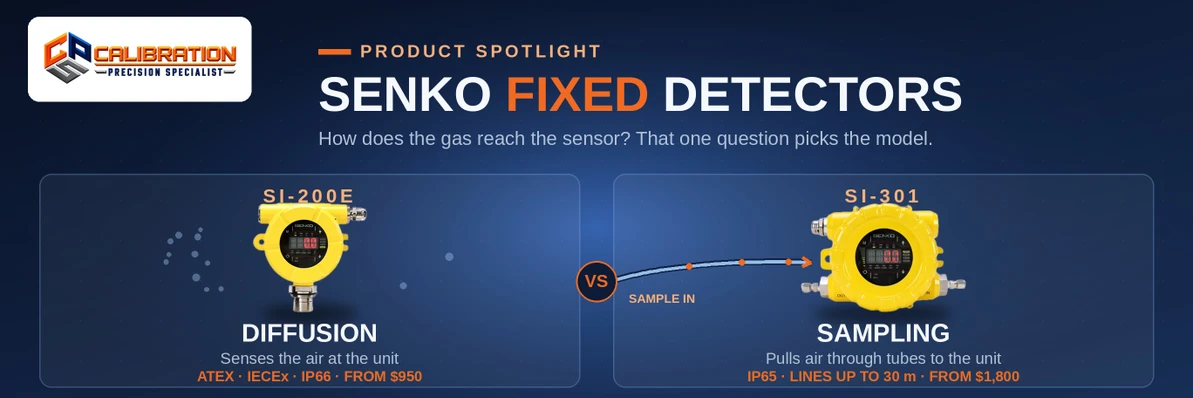
SENKO's fixed gas detectors come down to one question — how does the gas reach the sensor? The SI-200E (from $950) is an explosion-proof diffusion detector, ATEX/IECEx rated and IP66, that continuously watches the air around it for oxygen, toxic and combustible gases. The SI-301 (from $1,800) is an explosion-proof sampling detector (IP65) whose built-in pump pulls gas through up to 30 m of tubing from the point that matters into a cartridge sensor. The SI-H100 (from $1,518) is a sample-draw detector head aimed at semiconductor specialty gases at ppm and ppb levels. All three output 4–20 mA and alarm relays, so a leak can trip alarms, ventilation or a PLC at 3 a.m., whether or not anyone is standing in the room.
A portable gas detector protects one person, in one place, while it is worn and switched on. A fixed detector protects a point — a gas cabinet, a boiler room, a chlorine store, a battery room — continuously, including the hours when nobody is in the building. SENKO's SI series is the fixed half of the SENKO line we carry (the portable half — SP-SGT, SP-MGT and the rest — is covered in our SENKO portable spotlights). This guide walks the three fixed models CPS lists, what each one actually does, and how to match the model to the room.
What Does a Fixed Gas Detector Do That a Portable Can't?
Three things, and they are the whole reason fixed systems exist:
- It watches continuously. A fixed head is powered around the clock and never goes home in a truck. It catches the leak that starts at night, on a weekend, or in a room nobody enters for days.
- It acts on what it finds. Alarm relays and a 4–20 mA output let the detector do something about a leak — sound local alarms, start exhaust ventilation, shut down a process, or report to a PLC, controller or building system. A portable can only warn the person wearing it.
- It watches the point, not the person. Sensor placement follows the gas and the likely leak source — which is exactly what our guide to where fixed gas detectors should be placed covers: mounting heights and placement rules by gas density.
The trade is just as clear: a fixed detector only sees the air that reaches its sensor. It does nothing for a worker who walks into a different room, a pit or a confined space — which is why fixed and portable detection are partners, not substitutes.
The SENKO Fixed Lineup at a Glance
| Model | How it samples | Hazardous-area rating | Outputs & signals | Price at CPS |
|---|---|---|---|---|
| SI-200E | Diffusion — gas reaches the sensor on its own | Explosion-proof: ATEX / IECEx Ex db IIC T6 · IP66 | 4–20 mA · RS-485 · 1st/2nd/fault alarm relays · Bluetooth configuration · HART optional | $950 headline; configured builds $1,092.50–$2,300 |
| SI-301 | Pumped sampling — built-in pump, sample tube up to 30 m | Explosion-proof · IP65 | 4–20 mA · RS-485 · TCP Ethernet · 3 internal relays | $1,800 headline; configured builds $2,070–$2,415 |
| SI-H100 | Pumped sample-draw — sample tube up to 30 m | CE (semiconductor-duty head; no Ex rating) | 4–20 mA · RS-485 · TCP Ethernet · 1st/2nd-stage + fault relays | $1,518 headline; sensor configurations $1,380–$1,840 |
Every model is a single-gas detector: you choose the sensor when you order, and the sensor decides the gas, the range and much of the price. That is why each listing carries a configuration range rather than one flat price — a carbon monoxide build and a silane build are not the same instrument wearing a different label.
When Is the SI-200E the Right Fixed Detector?
When the detector can sit where the gas will be, the SI-200E is the default SENKO fixed head. It is a diffusion detector: no pump, no tubing, just a sensor in an explosion-proof housing that continuously reads the air around it and shows the concentration on a 4-digit digital display, with self-diagnostic results alongside.
- Gases and ranges (46 configurations at CPS): oxygen 0–30% vol; carbon monoxide 0–200, 0–500 or 0–2,000 ppm; hydrogen sulfide 0–100 or 0–500 ppm; combustibles 0–100% LEL — methane, propane, LPG, LNG, hydrogen, acetylene, ethanol and general hydrocarbons, with infrared versions of the methane and propane sensors; ammonia 0–100 or 0–1,000 ppm; chlorine 0–5, 0–10 or 0–20 ppm; nitrogen dioxide 0–20 ppm; sulfur dioxide 0–20 ppm; nitric oxide 0–100 ppm; carbon dioxide 0–5,000 ppm or 0–5% vol; plus methanol, formaldehyde, hydrogen peroxide and specialty gases.
- Built for classified areas: explosion-proof enclosure certified ATEX II 2 GD (Ex db IIC T6) and IECEx, sealed to IP66, and rated from −40 °C to +60 °C — outdoor, washdown and freezer-adjacent duty included.
- Signals out: 4–20 mA analog and RS-485 digital to a controller or PLC; three relay contacts (1st alarm, 2nd alarm, fault, rated 2.0 A @ 30 VDC) for local action; configuration and settings over Bluetooth/wireless, with HART available as an option.
- Power and ownership: 24 VDC ±10% at about 3.6 W. SENKO warranties the device for 2 years and the sensor for 1 year.
- Price: $950 headline on the listing; configured builds run $1,092.50–$2,300 depending on the sensor chosen — the oxygen and common toxic builds sit at the low end, infrared and specialty-gas builds at the top.
When Do You Need the SI-301's Sampling Pump?
When the gas is somewhere the detector can't be. The SI-301 keeps the explosion-proof construction (IP65) but replaces passive diffusion with a built-in sampling pump and flow control: it actively draws gas through tubing — up to 30 m of inlet tube and 30 m of exhaust — into a replaceable sensor cartridge inside the unit. Ducts, gas cabinets, pits, high ceilings and rooms that are hostile to electronics are the natural fits.
- Flow is measured, not assumed: built-in flow control runs 100–1,000 mL/min (normal operation about 300–500 mL/min), and the large LCD shows flow alongside concentration — a blocked or leaking sample line announces itself instead of silently reading clean air.
- Gases and ranges (24 configurations at CPS): oxygen 0–30% vol; carbon monoxide 0–100 ppm; hydrogen sulfide 0–100 or 0–500 ppm; ammonia 0–100 ppm; methane 0–100% LEL, including an infrared version; carbon dioxide 0–5% vol; hydrogen peroxide 0–20 ppm; carbonyl sulfide 0–100 ppm; and the silane family — silane 0–15 ppm, disilane and aminosilane process gases — that semiconductor fabs monitor around gas cabinets and tools.
- Signals out: 4–20 mA, RS-485 and TCP Ethernet, with three internal relays (low alarm, high alarm, fault) and configuration by keypad, RS-485, Ethernet or wireless.
- Power: 24 VDC ±10%, or Power over Ethernet (36–57 V) where network cabling is easier to run than DC — about 5 W either way. SENKO's own application list for the SI-301 runs to semiconductor plants, sewage treatment, mining, petrochemical plants, steelworks and power generation.
- Price: $1,800 headline; configured builds $2,070–$2,415. The pump, the flow control and the cartridge system are what the step up from the SI-200E buys.
What About the SI-H100?
Briefly — because it deserves its own article — the SI-H100 is SENKO's sample-draw detector head for the semiconductor world: an internal pump draws a sample from up to 30 m away (500 mL/min, 900 max) into one of 56 sensor options, most of them specialty process gases at levels portable instruments never see — arsine 0–400 ppb, diborane 0–400 ppb, germane 0–800 ppb, phosphine 0–1.2 ppm, nitrogen trifluoride 0–40 ppm, hydrogen fluoride 0–6 ppm — alongside standard gases such as ammonia 0–100 ppm, carbon monoxide 0–100 ppm and methane 0–100% LEL (catalytic or infrared). It carries a graphic LCD, a 90 dB alarm, stage and fault relays, 4–20 mA, RS-485 and TCP Ethernet, runs on 24 VDC or PoE, and lists from $1,518 (sensor configurations $1,380–$1,840). If your hazard list reads like a fab's gas cabinet inventory, this is the SENKO fixed unit built for it; the diffusion and general-industrial work belongs to the two models above.
Which SENKO Fixed Detector Fits Which Application?
- Ammonia refrigeration (cold storage, food plants): SI-200E with the ammonia sensor — 0–100 ppm for leak warning around machinery rooms, 0–1,000 ppm where a bigger release has to be tracked. Diffusion is right here: the head mounts where a leak would collect.
- Parking garages: SI-200E carbon monoxide (0–200 or 0–500 ppm) and nitrogen dioxide (0–20 ppm) heads, with relays driving the ventilation fans — the classic fixed-detection job, and the fixed counterpart to the carbon dioxide question we covered in our look at dedicated CO₂ monitoring.
- Water and wastewater treatment: SI-200E chlorine (0–5/10/20 ppm) at the chlorination point and hydrogen sulfide (0–100 ppm) at wet wells and headworks; the SI-301 where the sample point is a duct or a space the head can't occupy.
- Boiler rooms and mechanical spaces: SI-200E methane 0–100% LEL at ceiling level and carbon monoxide at breathing height — one head per gas, per the placement rules in our fixed detector placement guide.
- Battery rooms: SI-200E hydrogen — 0–100% LEL for ventilation control, or 0–1,000 ppm where early warning at low levels matters more than the LEL scale.
- Semiconductor and specialty chemical: SI-301 sampling for classified areas and the silane family; SI-H100 where the gas list runs to ppb-level hydrides and etch gases.
- General industrial oxygen depletion: SI-200E oxygen 0–30% vol anywhere inert gas is stored or used — liquid nitrogen, argon, CO₂ — and a room can quietly lose its air.
What Are the Honest Limits of Fixed Detection?
- It watches a point, not a plant. Gas that never reaches the sensor is never detected. Coverage is a design exercise — sensor count and placement — not a single box on a wall, and a fixed system never follows a worker into a confined space or across the floor. Crews still need portables; the SENKO portable line (see our SP-MGT spotlight) is the other half of the same program.
- It is one gas per head. Every SI-series unit carries one sensor. A room with three credible hazards is three detectors (or a sampling design), and the budget should be built that way from the start.
- It needs installation. Power, signal wiring or network, relay wiring to whatever it must trip — fixed detection is a small electrical project, not a clip-on. Sampling models add tubing and a pump to maintain.
- Sensors still age. Fixed sensors drift and die on the same chemistry as portable ones. A fixed head that is never calibrated is a wall ornament with a display — which brings us to the part owners most often under-plan.
How Are Fixed Gas Detectors Calibrated and Maintained?
In place, with bottled gas. A diffusion head like the SI-200E is calibrated by fitting its calibration cap and applying certified span gas at the sensor with a regulator; a sampling unit like the SI-301 or SI-H100 is fed span gas through its sample path. Either way the consumables are the same ones the portable program uses — the right mix, in the right balance, before its expiration date. (If balance is the part you have never had explained, our guide to air balance vs. nitrogen balance settles which cylinder a given sensor actually needs.) Browse the full calibration gas range, keep a calibration entry in the log for every head, and treat sensor replacement as scheduled maintenance: SENKO warranties fixed-line sensors for 1 year against the device's 2 years, which tells you which part is the consumable.
Fixed wall-mounted units are also the detectors owners most often ask us to simply take off the maintenance list: you can remove a head and ship it to us, or calibrate in place with gas and phone guidance — the right choice depends on distance and the overall job. However it is handled: we calibrate every channel. Questions about matching a model or a sensor to a room — call 865-900-8844.
Frequently Asked Questions
What does a fixed gas detector do that a portable can't? It monitors one location continuously, 24/7, and acts on what it finds. A fixed detector's relays and 4–20 mA output can sound alarms, start ventilation, shut down equipment or report to a PLC whether or not anyone is present. A portable only protects the person wearing it, only while it is worn — the two cover different risks and most facilities with fixed hazards run both.
Which SENKO fixed gas detector do I need — SI-200E, SI-301 or SI-H100? Start with how gas reaches the sensor. If the head can mount where the gas will be, choose the SI-200E diffusion detector (from $950). If the point is a duct, cabinet, pit or hostile room, choose the SI-301 sampling detector (from $1,800), which pumps a sample through up to 30 m of tubing. If the gases are semiconductor specialty gases at ppm/ppb levels, choose the SI-H100 sample-draw head (from $1,518).
How much do SENKO fixed gas detectors cost? At CPS the SI-200E lists from $950, with configured builds at $1,092.50–$2,300; the SI-301 lists from $1,800, with builds at $2,070–$2,415; the SI-H100 lists from $1,518, with sensor configurations at $1,380–$1,840. The spread inside each model is the sensor: common gases like CO and O₂ sit at the low end, infrared and specialty-gas sensors at the top.
What gases can the SI-200E detect? One gas per unit, chosen from 46 configurations: oxygen 0–30% vol; CO 0–200/500/2,000 ppm; H₂S 0–100/500 ppm; combustibles 0–100% LEL (methane, propane, LPG, LNG, hydrogen and more, catalytic or infrared); ammonia 0–100/1,000 ppm; chlorine 0–5/10/20 ppm; NO₂ and SO₂ 0–20 ppm; CO₂ 0–5,000 ppm or 0–5% vol; and specialty gases including methanol, formaldehyde and hydrogen peroxide.
What is the difference between a diffusion and a sampling fixed gas detector? A diffusion detector (SI-200E) waits for gas to reach its sensor — simple, no moving parts, but it must be mounted where the gas will actually go. A sampling detector (SI-301, SI-H100) uses a pump to pull gas through tubing from the measurement point to the sensor, so the point and the instrument can be up to 30 m apart — at the cost of a pump, tubing and flow monitoring to maintain.
Can a SENKO fixed detector start ventilation or shut down equipment? Yes. The SI-200E carries three relay contacts (1st alarm, 2nd alarm, fault — rated 2.0 A @ 30 VDC) sized for driving fan starters, beacons and shutdown circuits, and its 4–20 mA and RS-485 outputs feed PLCs and controllers for larger actions. The SI-301 provides the same pattern with three internal relays plus 4–20 mA, RS-485 and Ethernet.
Are SENKO fixed gas detectors explosion-proof? The two general-industrial models are: the SI-200E is certified ATEX II 2 GD (Ex db IIC T6) and IECEx with an IP66 enclosure, and the SI-301 is an explosion-proof design sealed to IP65. The SI-H100 carries no explosion-proof rating — it is a sample-draw head for semiconductor environments, not classified-area duty.
How far can the SI-301 sample from? Up to 30 m of inlet tubing and 30 m of exhaust tubing. Its built-in flow control runs 100–1,000 mL/min with normal operation around 300–500 mL/min, and the display shows the flow rate next to the concentration, so a pinched or blocked line shows up as a flow problem instead of a false "all clear."
How do you calibrate a fixed gas detector? In place, with bottled calibration gas and a regulator: a cap over a diffusion sensor, or span gas fed through the sample path on a sampling unit. The mix and balance must match the sensor (reactive gases in nitrogen balance, oxygen-bearing mixes where a catalytic or O₂ channel needs them), and every calibration belongs in the maintenance log. Fixed sensors drift like portable ones — an uncalibrated fixed head is decoration.
Can fixed gas detectors replace portable monitors? No. A fixed detector only sees gas that reaches its sensor at its one location; it cannot protect a worker entering a confined space, walking a plant, or working in a room with no head installed. Regulations and common sense both treat them as complementary layers: fixed systems guard the facility and its process, portables guard the person.
CPS Calibrations · 109 S. Front Street, Rockwood, TN 37854 · SI-200E · SI-301 · SI-H100 · Calibration Gas · Contact Us
Recent Posts
-
Flame Detector vs. Gas Detector: What's the Difference — and Do You Need Both?
A gas detector and a flame detector guard opposite ends of the same incident: a gas detector reads l …Oct 21st 2026 -

How Do You Test a Flame Detector? Self-Tests, Test Lamps, and NFPA 72
You test a flame detector with light, not gas — there is no span gas, no zero gas, and never an open …Oct 21st 2026 -

Why Does a Flame Detector False Alarm — and Which Type Won't?
A flame detector false alarms because something that is not a fire is producing the signal it watche …Oct 21st 2026