
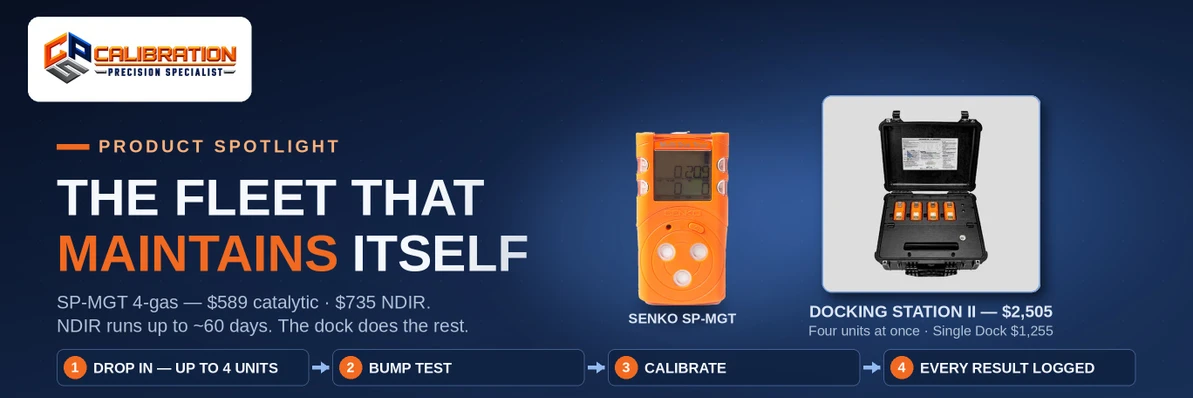
SENKO SP-MGT and Docking Station II: A 4-Gas Fleet That Maintains Itself
Most 4-gas detectors get bought on the instrument alone: price, size, sensor list. But fleets don't fail on instruments — they fail on upkeep. Bump tests get skipped on busy mornings, calibrations stretch past due, and the records live in three notebooks and one supervisor's memory. The hardware was fine. The discipline around it wasn't.
The SENKO SP-MGT is worth a look precisely because it's sold as a system, not just a detector: a compact diffusion 4-gas monitor (LEL, O₂, CO, H₂S), a real choice of LEL sensor technology, and a docking station that automates the testing and paperwork fleets struggle to sustain by hand. Here's what each piece actually does for you in the field — and how to choose between the versions.
Four Gases, One Screen, Nothing to Fiddle With at 6 A.M.
The SP-MGT monitors combustible gas (LEL), oxygen, carbon monoxide, and hydrogen sulfide simultaneously, and shows all four readings at once on a backlit LCD. That simultaneous display matters more than it sounds: the worker glances down and sees the whole picture — no button-pressing through channels with gloved hands while standing in the hazard the instrument is there to detect.
Alarms are audible, visual (LED), and vibrating — because a detector that only beeps is useless next to running equipment, and one that only flashes is useless in a worker's pocket. The unit tracks TWA and STEL exposures alongside the instantaneous readings: the alarms protect the moment, the TWA/STEL math protects the shift, and it runs a self-test at power-on so a fault announces itself before the instrument goes to work, not during.
It's a diffusion instrument — it samples the air immediately around it, which is what personal monitoring means. (If your work needs remote sampling before entry, that's the pumped step-up covered below.)
The Choice That Matters: Pellistor (SP-MGT-P) or Infrared (SP-MGT-N)
Every SP-MGT decision flows from one choice: how the LEL channel senses combustible gas. The two versions are the same monitor with different physics inside, and the trade-offs are real in both directions.
The SP-MGT-P (Pellistor/catalytic) burns a trace of combustible gas on a heated catalyst bead and measures the heat. It's the technology the industry has run for decades: proven, responsive across a broad range of combustible gases, and the lower-cost option — the 4-gas configuration is $589 on our store. Its limits are physical, not flaws. A catalytic bead needs oxygen present to burn gas, so it can't be trusted in oxygen-starved or inerted atmospheres. And it can be poisoned — silicones, sulfur compounds, and lead permanently desensitize the bead, silently. A poisoned sensor reads clean air perfectly and barely responds to gas, which is exactly the failure bump tests exist to catch. Catalytic sensors also draw more power: the P version runs approximately 25 hours per charge.
The SP-MGT-N (NDIR infrared) shines infrared light through the sample and measures how much the gas absorbs. No combustion, which flips the P version's limits: it works in low-oxygen and inerted atmospheres, and there is no catalyst to poison — the classic silent failure mode is engineered out. Infrared also sips power. The N version runs up to approximately 60 days on a charge under specified operating conditions. The cost is literal: the 4-gas N configuration is $735, and infrared responds to the gases that absorb in its band (hydrocarbons like methane), so exotic combustible targets deserve a conversation before you order.
What 60 days actually changes: charging stops being a fleet ritual. With the P version, "charge every night or two" has to be a habit somebody owns. With the N version, a unit can go out on a multi-week turnaround, a rental-style rotation, or a remote job and come back still running. A detector that's charged is a detector that gets carried; a detector that's dead in the gang box is an expensive paperweight and a compliance gap. For fleets with strong charging discipline and standard atmospheres, the P version is the sensible spend. For poison-prone environments (silicone sealants, sulfur service), inerted spaces, remote work, or any fleet whose charging habits are honestly unreliable, the N version's battery and poison immunity pay for the difference.
Both versions are also offered in 1-, 2-, and 3-gas layouts on the same product page, if your hazard assessment doesn't call for all four channels.
Built for Where Fleets Actually Work
The SP-MGT is rated IP67 — dust-tight, and sealed against immersion. In plain terms: rain, washdowns, dust, and a drop into a puddle are survivable events, not replacement events. For an instrument that lives on a belt in industrial weather, ingress protection isn't a spec-sheet ornament; it's the difference between a detector that ages out on schedule and one that dies in its first wet season.
Power is a rechargeable 2,000 mAh lithium-ion battery, charged over USB-C with the supplied cable and adapter. No proprietary charging cradle to lose, no alkaline battery cages to stock — it charges from a truck port, a laptop, or any USB adapter. SENKO backs the monitor with a 2-year warranty.
The Records Live in the Instrument
Compliance runs on records, and the SP-MGT keeps its own. On board, it stores up to 30 alarm events, 30 calibration records, and 30 bump-test records, plus roughly two months or more of data logging. When an auditor or an incident investigator asks what a specific unit saw and when it was last verified, the answer is in the instrument — not in someone's recollection.
That on-board history complements the paper trail rather than replacing it: a calibration certificate proves what a unit read against a known standard on a given day (we wrote a whole post on what a calibration certificate actually proves), and the event log shows what the unit did in the field between those days. Together they're a program you can defend.
Docking Station II: The Other Half of the Product
Here's where the system earns its name. The SENKO MGT Docking Station II (part # AAA047000, $2,505) is a rugged carry-case station that docks up to four SP-MGTs at once — P and N versions alike — and reduces the daily maintenance routine to two buttons: Bump Test and Calibration.
Drop the units in, press a button, walk away. The station runs the test the same way every time:
- Automated bump tests and full zero/span calibrations — same gas delivery, same duration, same pass/fail criteria for every unit, every morning. The technique variance that makes manual testing unreliable (a cap that isn't sealing, a timer cut short, a regulator that doesn't match) is removed from the process entirely.
- Every result is recorded. Bump and calibration logs are written automatically to the station's removable USB memory (8 GB standard — capacity for millions of test records), along with each monitor's individual event logs, firmware, and unit configurations. An audit request gets a file, not a story.
- Fleet-wide consistency. Safety managers can update configurations and firmware across the fleet through the dock (via IR Link or USB), so alarm setpoints and settings stay identical unit to unit instead of drifting with whoever last adjusted each detector.
- It works where the fleet works. The station runs on its own rechargeable battery — up to roughly 1,000 bump tests per charge — or on 12 V DC power, so it lives as happily in a shutdown trailer or gang box as on the shop bench. It uses standard 58 L and 116 L calibration gas cylinders, and a built-in ventilation system purges residual gas after testing. Per-bay LEDs walk through each stage of the test and flag pass or fail at a glance.
How it pays for itself: do the arithmetic on labor and risk, not on the sticker. Four units tested at once, in minutes, by whoever drops them in — versus a supervisor spending the first part of every shift doing one-at-a-time manual bumps and calibrations, and hand-writing (or skipping) the log entries. Multiply the manual version by a fleet and a year. Then add the part that's hard to price until you need it: when an incident or an audit asks for proof, the dock's records either exist or they don't. Manual programs produce proof only on the days discipline held. The dock produces it every day.
And when a unit fails on the dock, that's the system working — it comes out of service and gets a real look, instead of being waved through by a rushed manual test. Ship it to our Rockwood lab or have us come to your facility, and we'll tell you what the as-found data says.
Dock II or Single Dock? Fleet Size Decides
SENKO also makes the MGT Single Docking Station ($1,255), which does the same job one unit at a time: automated bump test and zero/span calibration, event logs saved after each test, settings adjustable via IR Link, on the same 58 L/116 L cylinder platform. For a single detector or a two-unit crew where testing happens serially anyway, it's the right-sized spend.
The Docking Station II earns its premium when units queue up: crews turning around at shift change, fleets big enough that serial testing becomes somebody's whole morning, or any operation where configuration control across the fleet matters. One person with one detector doesn't need a four-bay case. A ten-unit fleet loses real money without one.
When the Job Outgrows Diffusion 4-Gas
If your work needs a pump — pre-entry sampling, remote draw from outside a confined space — or more channels, SENKO's step-up is the SP-MGTP ($850): a pumped multi-gas monitor covering up to six gases. Same family, same service bench behind it, different sampling job. Choose diffusion for personal monitoring on the worker; choose pumped when the sample has to travel to the instrument.
The Bottom Line
The SP-MGT is a well-built 4-gas monitor with the decision that matters — catalytic vs. infrared LEL — priced honestly: $589 for the 4-gas P, $735 for the 4-gas N, and up to 60 days of runtime riding on that choice. But the real product is the system around it. Paired with the Docking Station II, the daily bump, the periodic calibration, and the records an auditor wants all stop depending on human discipline and start happening by default. Fleets don't fail on instruments. They fail on upkeep — and upkeep is exactly what the dock automates.
Ready to spec a fleet? Start with the SENKO SP-MGT, add the Docking Station II or Single Dock, and keep it fed with fresh calibration gas. Questions about P vs. N for your atmosphere, or which dock your fleet size justifies? Call us at 865-900-8844 — we'll talk through the application, not just the catalog. Browse the rest of our portable gas detection lineup for the full picture.
Frequently Asked Questions
How much does the SENKO SP-MGT cost? The SP-MGT starts at $485 on our store, with price set by the sensor layout you choose. The standard 4-gas (LEL/O₂/CO/H₂S) configuration is $589 with the catalytic (Pellistor) LEL sensor and $735 with the NDIR infrared sensor; 1-, 2-, and 3-gas layouts are also available. The MGT Docking Station II is $2,505, and the MGT Single Docking Station is $1,255.
What's the difference between the SP-MGT-P and the SP-MGT-N? The LEL sensor. The P uses a Pellistor/catalytic bead — proven, broad-range, lower cost, about 25 hours of runtime — but it needs oxygen to work and can be permanently desensitized ("poisoned") by silicones, sulfur compounds, and lead. The N uses NDIR infrared — it works in low-oxygen and inerted atmospheres, can't be poisoned, and runs up to about 60 days per charge — at a higher purchase price.
What does the MGT Docking Station II actually do? It automates the two recurring jobs: bump tests and full zero/span calibrations, for up to four SP-MGTs at once (P and N versions). Insert the units, press the Bump Test or Calibration button, and the station runs the test. Results are logged automatically to removable USB memory, along with each monitor's event logs, and fleet configurations and firmware can be managed through the dock. It runs on its own rechargeable battery (up to ~1,000 bump tests per charge) or 12 V DC, and uses standard 58 L and 116 L calibration gas cylinders.
Docking Station II or Single Docking Station — which do I need? Fleet size and turnaround. The Single Dock ($1,255) automates the same bump/calibration/logging jobs for one unit at a time — right for individual users and very small crews. The Docking Station II ($2,505) handles four units simultaneously and adds fleet-level configuration management — right when crews turn around together at shift change or the fleet is big enough that serial testing eats the morning.
Does the SP-MGT keep its own bump and calibration records? Yes. The monitor stores up to 30 alarm events, 30 calibration records, and 30 bump-test records on board, plus roughly two months or more of data logging. The docking stations add the fleet-level archive: every dock test is written to the station's USB memory with the monitor's event logs.
How long does the SP-MGT battery last, and how does it charge? About 25 hours per charge for the catalytic (P) version, and up to about 60 days for the NDIR (N) version under specified operating conditions. The rechargeable 2,000 mAh lithium-ion battery charges over USB-C with the supplied cable and adapter — truck port, laptop, or wall adapter.
What calibration gas does the docking station use? Standard 4-gas mix (LEL/CO/H₂S/O₂) in 58 L or 116 L cylinders — the same platform sizes used across SENKO's MGT docks. Keep it fresh and in date: expired gas fails bump tests and invalidates calibrations, whichever station or hand rig you run it through. Browse our calibration gas selection for current stock.
CPS Calibrations · 109 S. Front Street, Rockwood, TN 37854 · Portable Gas Detection · Calibration Gas · Calibration Services · Contact Us
Recent Posts
-

Open-Path vs. Point Gas Detectors: What's the Difference?
The difference between an open-path and a point gas detector is what each one measures: an open-path …Oct 21st 2026 -

What Does IDLH Mean?
IDLH stands for Immediately Dangerous to Life or Health, and it is NIOSH's escape line: the maximum …Oct 21st 2026 -

Carbon Dioxide vs. Carbon Monoxide: What's the Difference?
Carbon dioxide (CO2) and carbon monoxide (CO) differ by one oxygen atom — and by almost everything t …Oct 21st 2026