
Carbon Dioxide vs. Carbon Monoxide: What's the Difference?
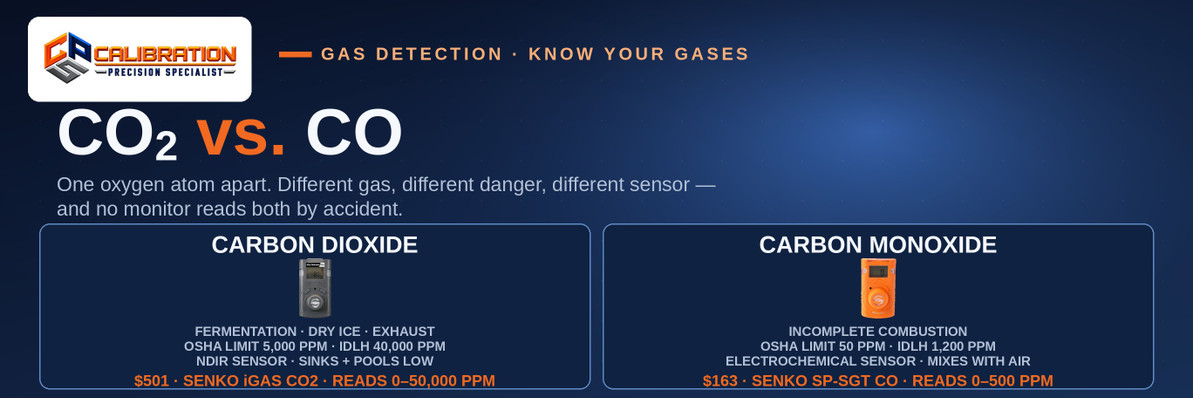
Carbon dioxide (CO2) and carbon monoxide (CO) differ by one oxygen atom — and by almost everything that matters: CO2 is a heavy gas that sinks and pools, measured in thousands of ppm (OSHA's exposure limit is 5,000 ppm as an 8-hour average; its IDLH is 40,000 ppm), while CO is a chemical asphyxiant that binds to hemoglobin and is limited by OSHA to 50 ppm, with an IDLH of 1,200 ppm. They are also read by different sensors — CO2 by an NDIR infrared sensor, CO by an electrochemical cell — so a monitor built for one gas is blind to the other.
The confusion is understandable. The names are one letter apart, both gases are colorless and effectively odorless, both come out of combustion, and both get shortened to "carbon" something in shop talk. But the two gases come from different processes, hurt you by different mechanisms, live at opposite ends of the concentration scale, and require different instruments. Treating them as interchangeable is more than a vocabulary problem — it leads buyers to assume the CO channel on a standard 4-gas monitor also covers carbon dioxide. It does not, and this post works through why: what each gas is, where each comes from, how each one harms you, and which monitor actually reads it. For the deep dive on CO's limits alone, see our post on carbon monoxide exposure limits: OSHA vs. NIOSH vs. ACGIH; for the CO2 instrument itself, see why you need a dedicated CO2 monitor.
What Is Carbon Dioxide (CO2)?
Carbon dioxide is what complete combustion produces — carbon fully burned, with nothing left over. Engines and furnaces that are burning clean still exhaust CO2, your own body exhales it, and outdoor air already contains about 400 ppm (0.04%) of it. The industrial sources that matter for gas detection are the concentrated ones: fermentation in breweries, wineries, and ethanol plants; dry ice sublimating in storage and shipping; beverage carbonation systems and bulk CO2 tanks in restaurants, bars, and bottling plants; and compressed CO2 used in greenhouses, welding, and food processing.
CO2 hurts you two ways at once. It displaces oxygen, and — the part people underestimate — it is toxic in its own right at percent-level concentrations, even when oxygen is still present. Rising CO2 drives your breathing rate up and produces headache, dizziness, and confusion; OSHA's permissible exposure limit is 5,000 ppm (0.5%) as an 8-hour TWA, NIOSH adds a 30,000 ppm short-term limit, and NIOSH's IDLH — immediately dangerous to life or health — is 40,000 ppm (4%). CO2 is also about 1.5 times heavier than air (vapor density 1.53), so it sinks and accumulates at the lowest point in a space: pits, cellars, trenches, and the bottom of a fermenter — exactly the low spots where leaked gas goes and where a worker descends into it. It does not burn; it is what burning finishes as.
What Is Carbon Monoxide (CO)?
Carbon monoxide is what incomplete combustion produces — a fuel that didn't get enough oxygen to finish burning. Its sources are engines idling in enclosed spaces, furnaces and boilers with faulty burners, gas and propane heaters, forklifts on loading docks, and generators. Where CO2 announces a process working as intended, CO usually announces one that isn't.
CO's mechanism is entirely different, and far more potent per molecule. It is a chemical asphyxiant: inhaled CO binds to the hemoglobin in your blood roughly 240 times more readily than oxygen does, forming carboxyhemoglobin and quietly starving your tissues of oxygen while your lungs keep breathing normally. That potency is why the limits live in tens of ppm instead of thousands: OSHA's PEL is 50 ppm as an 8-hour TWA, NIOSH recommends 35 ppm with a 200 ppm ceiling, and the IDLH is 1,200 ppm — about one-thirtieth of CO2's IDLH. CO's density (0.97) is close to air's, so it mixes rather than sinking or rising, and unlike CO2 it is flammable, with a lower explosive limit of 12.5% by volume — though its toxicity will always be the emergency long before its flammability is.
Carbon Dioxide vs. Carbon Monoxide, Head to Head
| Carbon dioxide (CO2) | Carbon monoxide (CO) | |
|---|---|---|
| Formula | One carbon, two oxygens | One carbon, one oxygen |
| Comes from | Complete combustion, fermentation, dry ice, beverage carbonation, bulk CO2 systems | Incomplete combustion — engines, furnaces, heaters, forklifts, generators |
| How it harms | Displaces oxygen AND is toxic itself at percent levels — drives breathing up, headache, confusion | Chemical asphyxiant — binds hemoglobin ~240× more readily than oxygen, starving tissue |
| OSHA limit (8-hr TWA) | 5,000 ppm | 50 ppm — one one-hundredth of the CO2 limit |
| IDLH (NIOSH) | 40,000 ppm (4%) | 1,200 ppm |
| Behavior in air | Heavier than air (1.53) — sinks and pools in pits, cellars, fermenter bottoms | Near air density (0.97) — mixes evenly through the space |
| Burns? | No — it is the end product of combustion | Yes — flammable, LEL 12.5% by volume (its toxicity is the real hazard) |
| Measured with | NDIR infrared sensor | Electrochemical sensor |
| CPS example | SENKO iGas CO2 — $501, reads 0–50,000 ppm | SENKO SP-SGT CO — $163, reads 0–500 ppm · RKI CO-04 — $205 |
The row in that table that decides purchases is the limits row. CO's OSHA limit is 1% of CO2's. An instrument scaled and alarmed for one gas is not approximately right for the other — it is working on the wrong scale entirely, off by a factor of one hundred.
Why the Sensors Are Different — and Why One Monitor Can't Read Both
The two gases are measured by completely different physics, and that is why no single sensor covers both. A CO2 sensor is an NDIR sensor — non-dispersive infrared. CO2 absorbs infrared light at a characteristic wavelength, so the sensor shines infrared through the sample and measures how much is absorbed; the more CO2, the less light arrives. NDIR is the standard for CO2 because the concentrations involved run to percent levels — the SENKO iGas CO2 reads 0–50,000 ppm (0–5.0% by volume) on its NDIR sensor. A CO sensor is an electrochemical cell: CO reacts chemically at an electrode and generates a tiny current proportional to concentration — the right technology for resolving tens of ppm, which is the scale CO demands. The SENKO SP-SGT in its CO version reads 0–500 ppm for $163, and the RKI CO-04 is a dedicated CO monitor at $205.
Neither sensor responds to the other gas in any usable way. An electrochemical CO cell does not measure CO2, and an NDIR CO2 sensor does not measure CO. Which brings up the most common buying mistake in this whole subject: the standard 4-gas monitor — oxygen, %LEL, CO, and H2S — does not measure CO2. Its "CO" channel is carbon monoxide only. A brewery that issues 4-gas monitors and considers its carbon gases covered has covered the 50-ppm poison and left the 5,000-ppm one unmeasured. If your hazard assessment names both gases, you need both channels — either as separate instruments or in a monitor configured with an NDIR CO2 channel alongside the electrochemical cells. Both kinds live in the single gas monitors category, listed by the gas they actually read — which is the only honest way to shop for them.
Which Gas Is Your Problem?
Match the gas to the process, not to the name:
- Breweries, wineries, beverage plants, dry-ice storage, grow rooms: your primary carbon gas is CO2, in thousands of ppm, pooling low. A dedicated CO2 monitor like the iGas CO2 ($501, ~14 days per charge, IP67) is the instrument; our dedicated CO2 monitor post covers it in full.
- Loading docks, parking garages, warehouses with propane forklifts, boiler and furnace rooms: your primary carbon gas is CO, in tens of ppm, mixed through the air. A personal CO monitor — SP-SGT CO at $163 or the RKI CO-04 at $205 — or CO channels in your multi-gas monitors, with alarms set against the CO exposure limits.
- Combustion on site AND fermentation, carbonation, or bulk CO2: you have both hazards, at both scales, and you need both measurements. This is common in food and beverage plants, where the boiler room makes CO and the process makes CO2.
- Not sure which gas your process makes? Ask what is actually being burned, fermented, stored, or dispensed. The gas list follows from the process — never from the fact that the two names sound alike.
Frequently Asked Questions
What is the difference between carbon dioxide and carbon monoxide? Carbon dioxide (CO2) is the product of complete combustion, fermentation, and dry ice; it is heavier than air, sinks and pools, and is hazardous in thousands of ppm — OSHA's limit is 5,000 ppm. Carbon monoxide (CO) is the product of incomplete combustion; it binds to hemoglobin about 240 times more readily than oxygen and is hazardous in tens of ppm — OSHA's limit is 50 ppm. CO2 is measured with an NDIR infrared sensor; CO is measured with an electrochemical sensor. One oxygen atom separates the formulas; almost nothing else about them is shared.
Can a carbon monoxide detector detect carbon dioxide? No. A CO detector uses an electrochemical cell that reacts to carbon monoxide; it does not measure CO2 at any concentration. The reverse is equally true — an NDIR carbon dioxide monitor does not detect CO. If both gases are hazards in your facility, you need both sensors, either as separate instruments or in a monitor built with both channels.
Which is more dangerous, carbon monoxide or carbon dioxide? Per ppm, carbon monoxide by a wide margin: its OSHA limit (50 ppm) is one one-hundredth of CO2's (5,000 ppm), and its IDLH (1,200 ppm) is about one-thirtieth of CO2's (40,000 ppm). But CO2 kills in the real world too, because it is produced and stored in bulk — a fermenter or dry-ice room can reach IDLH concentrations that a CO source rarely approaches. The practical answer is that each is dangerous in the concentration range its own process generates, and each needs its own monitor.
What are the OSHA exposure limits for carbon dioxide? OSHA's permissible exposure limit for carbon dioxide is 5,000 ppm (0.5%) as an 8-hour time-weighted average. NIOSH's recommended limit matches at 5,000 ppm TWA and adds a 30,000 ppm short-term exposure limit, and NIOSH sets the IDLH — immediately dangerous to life or health — at 40,000 ppm (4%). For scale, normal outdoor air contains about 400 ppm of CO2.
What are the OSHA exposure limits for carbon monoxide? OSHA's permissible exposure limit for carbon monoxide is 50 ppm as an 8-hour time-weighted average. NIOSH recommends a stricter 35 ppm TWA with a ceiling of 200 ppm that should never be exceeded, and sets the IDLH at 1,200 ppm. Because CO's limits are so much lower than CO2's, CO alarms are set in tens of ppm — which is why a CO monitor and a CO2 monitor are scaled completely differently.
Does a 4-gas monitor measure carbon dioxide? No. The standard 4-gas configuration — oxygen, combustible gas in %LEL, carbon monoxide, and hydrogen sulfide — contains no CO2 sensor. Its CO channel reads carbon monoxide only. Facilities with a CO2 hazard (breweries, beverage plants, dry-ice storage) need a dedicated CO2 instrument such as the SENKO iGas CO2, or a monitor specifically configured with an NDIR CO2 channel.
Can you smell carbon dioxide or carbon monoxide? No — neither gas gives you a usable warning by smell. Carbon monoxide is odorless, which is a core part of its danger. Carbon dioxide is also effectively odorless at the concentrations that matter, and its early symptoms (faster breathing, headache, dizziness) arrive without any scent announcing the cause. For both gases, the instrument is the warning; your nose is not part of the detection plan.
Does carbon dioxide sink or rise in a room? It sinks. Carbon dioxide's vapor density is 1.53 — about one and a half times heavier than air — so released CO2 flows downward and accumulates at the lowest point in a space: pits, cellars, trenches, and the bottoms of tanks and fermenters. Carbon monoxide, at a density of 0.97, behaves oppositely: it mixes evenly with air instead of pooling. That difference drives where each gas is monitored.
What type of sensor measures carbon dioxide? An NDIR (non-dispersive infrared) sensor. Carbon dioxide absorbs infrared light at a characteristic wavelength, so the sensor measures how much infrared the sample absorbs and converts that to a concentration — across a range that runs to percent levels, 0–50,000 ppm on the SENKO iGas CO2. Carbon monoxide, by contrast, is measured with an electrochemical sensor, which suits its far lower, parts-per-million scale.
How much does a carbon dioxide monitor cost? The SENKO iGas CO2 — a rechargeable personal CO2 monitor with an NDIR sensor reading 0–50,000 ppm — is $501 at CPS. For comparison on the CO side, a dedicated carbon monoxide monitor costs considerably less because the electrochemical technology is simpler: the SENKO SP-SGT in its CO version is $163, and the RKI CO-04 is $205. The prices differ for the same reason the sensors do — the two gases are different measurement problems.
The Bottom Line
Carbon dioxide and carbon monoxide are separated by one oxygen atom and by a factor of one hundred in their exposure limits, opposite behavior in air, different sources, different injury mechanisms, and different sensors. CO2 is the bulk gas of fermentation, carbonation, and dry ice — heavy, sinking, hazardous in the thousands of ppm, and read by NDIR. CO is the stealth poison of incomplete combustion — hemoglobin-binding, hazardous in the tens of ppm, and read electrochemically. The expensive mistake is assuming one instrument, or one sensor channel, covers both. Name the gas your process actually produces, then buy the sensor that reads it.
Not sure which carbon gas your process makes — or whether you need both monitors? Call 865-900-8844 or reach us through Contact Us and we'll match the instrument to the hazard. Browse both in Single Gas Monitors, and keep both honest with Calibration Gas and Calibration Services.
CPS Calibrations · 109 S. Front Street, Rockwood, TN 37854 · Calibration Gas · Calibration Services · Contact Us
Recent Posts
-

PID vs. LEL for VOC Detection: Which Sensor Do You Actually Need?
Use a PID to detect VOCs and an LEL sensor to detect explosive atmospheres — they measure different …Oct 21st 2026 -

Semiconductor (MOS) Gas Sensors: Where They Work and Where They Lie
A semiconductor (MOS) gas sensor measures gas with a heated film of metal oxide — usually tin dioxid …Oct 21st 2026 -

What Do Firefighters Use a Gas Meter For?
Firefighters use a gas meter — usually a 4-gas monitor reading oxygen (O₂), combustible gas as a per …Oct 21st 2026