
What Are the Exposure Limits for Carbon Monoxide? OSHA vs. NIOSH vs. ACGIH
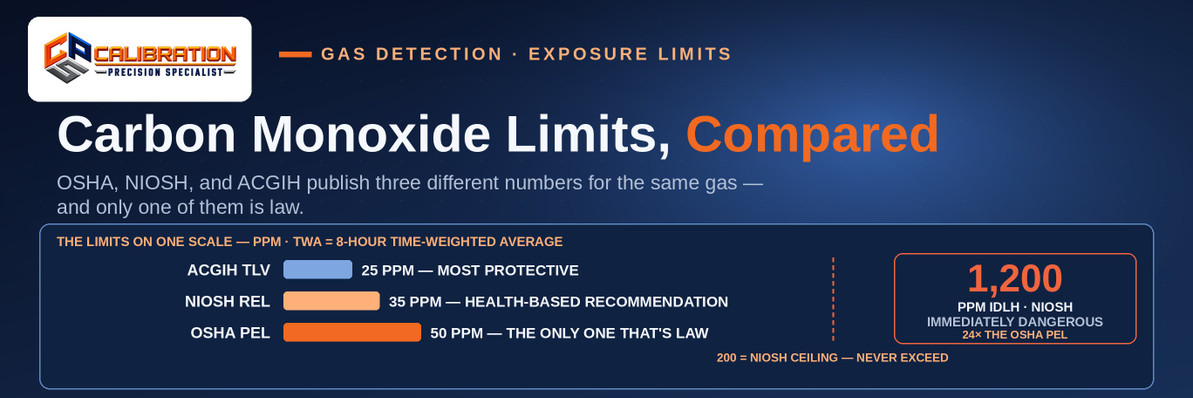
The exposure limits for carbon monoxide in the United States are OSHA's permissible exposure limit (PEL) of 50 ppm as an 8-hour time-weighted average — the only one of the three that carries the force of law — NIOSH's recommended exposure limit (REL) of 35 ppm as a time-weighted average, with a ceiling of 200 ppm that must never be exceeded at any moment, and the ACGIH threshold limit value (TLV) of 25 ppm as a time-weighted average, the most protective of the three. Above all of them sits NIOSH's IDLH value of 1,200 ppm, the concentration considered immediately dangerous to life or health. Three authorities publish three different numbers for the same gas because they answer to different masters — enforceable law, health research, and professional consensus — and the number your CO monitor alarms at should usually follow the health-based limits, not the legal one.
If you have ever stood in front of a CO monitor wondering whether it should alarm at 25, 35, or 50 ppm, you have already met the problem this post sorts out. Carbon monoxide is the most common toxic gas in industrial monitoring — forklifts, furnaces, loading docks, engine repair, parking structures — and it is also the gas where the three big US limit-setters disagree the widest in proportional terms: the strictest limit is exactly half the legal one. This post puts the three limits side by side, explains the terms they are written in, shows why the numbers diverged, and ends where it matters — with what each number means for your compliance file and for the alarm settings on the monitor on your worker's collar.
The Three Carbon Monoxide Limits, Side by Side
| Authority | Limit | Type | Is it law? |
|---|---|---|---|
| ACGIH (American Conference of Governmental Industrial Hygienists) | 25 ppm | TLV, 8-hour TWA | No — professional guideline |
| NIOSH (National Institute for Occupational Safety and Health) | 35 ppm | REL, TWA | No — federal research recommendation |
| NIOSH | 200 ppm | Ceiling — never to be exceeded | No — federal research recommendation |
| OSHA (Occupational Safety and Health Administration) | 50 ppm | PEL, 8-hour TWA (29 CFR 1910.1000, Table Z-1) | Yes — enforceable |
| NIOSH | 1,200 ppm | IDLH — immediately dangerous to life or health | Emergency/respirator benchmark |
Read the table top to bottom and you are reading from most protective to most permissive, with the emergency line at the bottom. Everything else in this post is an explanation of why the rows landed where they did — and which row governs which decision.
What Do TWA, Ceiling, and STEL Actually Mean?
The limits above are written in three different dialects, and mixing them up is how facilities end up "compliant" on paper while a worker breathes a ceiling-busting spike. (Our post on what TWA and STEL alarms are works through how these concepts live inside a gas monitor's alarm logic; here is how they apply to the CO table.)
TWA — time-weighted average. A TWA limit is an average over the shift, conventionally 8 hours. The concentration can rise above the number and fall below it, as long as the shift average stays at or under the limit. The arithmetic is unforgiving in a specific way: a worker who spends 4 hours at 80 ppm and 4 hours at 20 ppm has an 8-hour TWA of exactly 50 ppm — legal under OSHA's PEL, and over both the NIOSH REL and the ACGIH TLV for the entire day. Short, high excursions are "paid for" only by genuinely low exposure the rest of the shift.
Ceiling. A ceiling is not an average at all. It is a line the concentration must never cross, at any instant, for any duration. In the US CO table, the ceiling belongs to NIOSH: 200 ppm. A one-minute excursion to 250 ppm inside an otherwise spotless shift violates the ceiling while barely moving the TWA — which is precisely the kind of exposure a ceiling exists to catch.
STEL — short-term exposure limit. A STEL is a 15-minute average, used for gases whose short bursts matter. Notably, you will not find a STEL for carbon monoxide in the three US columns: the short-term guardrail for CO is NIOSH's ceiling instead. If a data sheet or an older chart shows a short-term 200 ppm figure for CO, it is almost always that NIOSH ceiling being quoted — the number is real, but it is a ceiling, not a 15-minute average you are allowed to use up.
Why Do Three Authorities Publish Three Different Numbers?
Because they were built for three different jobs, and two of them have been free to follow the science while one has been locked in a courtroom-grade process.
OSHA's 50 ppm is a 1971 number. When the OSH Act passed, OSHA adopted the existing consensus exposure limits wholesale — the late-1960s values — as its first PELs, CO at 50 ppm among them. Updating a PEL requires full federal rulemaking: proposed rule, comment periods, feasibility analysis for every affected industry, and survival of the inevitable legal challenges. That machinery is so slow that most PELs, CO included, still sit where 1971 put them. It is not that nobody tried: in 1989 OSHA adopted a modernized air-contaminants rule that set CO at 35 ppm with a 200 ppm ceiling — NIOSH's numbers, exactly. In 1992 a federal court vacated that rule, and the CO limit reverted to 50 ppm, where it remains. The legal number is not the current health consensus; it is the health consensus of the Johnson administration, preserved by process.
NIOSH's 35 ppm and 200 ppm ceiling are health-based. NIOSH is the federal research institute for occupational health; it recommends, it does not enforce. Its CO limits were set on the risk of cardiovascular effects — carbon monoxide's earliest measurable harm lands on the heart and circulation — and because NIOSH answers only to the evidence, its recommendation could go where the data pointed: a 35 ppm average with a hard 200 ppm ceiling on peaks.
ACGIH's 25 ppm is a professional consensus, revised as the science moves. ACGIH is a scientific society of industrial hygienists, and its Threshold Limit Values are reviewed and republished on a continuing cycle. Its 25 ppm TLV for CO rests on keeping carboxyhemoglobin — the share of a worker's blood locked up by CO — from rising to levels associated with cardiovascular strain and impaired thinking. Because ACGIH can revise a value as studies accumulate, without rulemaking or litigation, its number has tracked the modern evidence to half the legal limit.
So the three numbers are not a disagreement about chemistry. They are three snapshots taken by three institutions with three different update speeds: 1971 law, health research, and living professional consensus.
What Is Each Limit Actually Protecting Against?
Carbon monoxide kills by impersonation. Inhaled CO crosses into the blood and binds to hemoglobin — the molecule that ferries oxygen — roughly 240 times more strongly than oxygen itself binds. Every hemoglobin site holding CO is a site not delivering oxygen, and the resulting compound, carboxyhemoglobin (COHb), builds with both concentration and time. That is why every limit in the table is an average or a ceiling rather than a single magic threshold: the dose is concentration × time, and the limits are drawn to keep a full shift's COHb burden below the level where the effects start — first the cardiovascular system working harder to compensate, then headache, dizziness, and impaired judgment, and at the extreme end, collapse. NIOSH built its REL explicitly on the cardiovascular risk; ACGIH built its TLV on holding COHb down; the IDLH at 1,200 ppm marks the territory where a short exposure can incapacitate before escape is possible. One gas, one mechanism — three guardrails placed at three distances from the cliff, plus a marker at the cliff edge itself.
Which Limit Does Your Facility Actually Have to Follow?
The law is OSHA's PEL: 50 ppm as an 8-hour TWA. If an OSHA inspector samples your workers and the shift average exceeds 50 ppm, that is a citation — full stop. Two qualifications matter. First, some state-plan states run their own enforceable limits and several are stricter than federal OSHA; California's PEL for CO, for example, is 25 ppm — the ACGIH number, with legal force. Check your state plan before assuming 50 is your ceiling. Second, "legal" and "defensible" are not the same thing. NIOSH and ACGIH numbers are the ones insurers, auditors, and plaintiff's experts reach for, and a facility that knowingly runs its people at 49 ppm all shift — legal, and double the ACGIH value — will find that the PEL is a floor for enforcement, not a character reference. The common professional practice is to comply with OSHA by designing to ACGIH or NIOSH: run the operation to the strictest number you can, and the legal one takes care of itself.
The IDLH is nobody's target — it is a boundary condition. At 1,200 ppm the rules change category: that atmosphere is immediately dangerous to life or health, the domain of supplied-air respiratory protection and emergency procedure, not of general ventilation and personal monitors alarming a little louder. Its practical job in your program is to mark where "monitor and respond" ends and "respirator-required, escape-only" begins.
What Should Your CO Monitor Alarm At?
Here is where the three numbers stop being a trivia question. A personal CO monitor does not enforce an 8-hour average by itself — it alarms on the concentration in front of it right now, plus (on monitors with the feature) calculated TWA and STEL-style alarms that track the running averages. Typical industrial practice sets the instantaneous low alarm in the 25–35 ppm band — which is to say, industry practice follows the ACGIH and NIOSH thinking, not the OSHA PEL. The reasoning is the arithmetic from earlier: a monitor that stays silent until 50 ppm is silent through exposures that already consume the entire legal shift budget, and it never warns at all about a day spent at 40 ppm — legal, and above both health-based limits. Alarming at 25–35 ppm buys response time while the average is still recoverable: find the source, ventilate, rotate the worker out. High alarms are commonly set well above the low alarm — anywhere in the 100–200 ppm range in typical practice — with the understanding that NIOSH's 200 ppm ceiling is the line a peak should never cross, so an alarm that only sounds at the ceiling is an alarm that sounds too late to prevent the excursion it is reporting.
Two practical consequences follow. First, adjustable alarms and TWA tracking matter more than the badge on the box. The RKI CO-04 ($205) is a dedicated CO monitor reading 0–2,000 ppm with user-adjustable alarm settings and built-in datalogging — the combination that lets a safety manager set the low alarm to the facility's chosen limit and pull the shift's actual TWA record afterward, instead of trusting that nobody was overexposed. Second, a monitor is only honest if it is maintained: toxic sensors drift, and the exposure record is only as good as the last calibration — the discipline covered in our calibration services work. For workers whose CO exposure is incidental rather than continuous, a disposable maintenance-free instrument like the SENKO SP-SGT in its CO version (0–500 ppm, $163) covers the shift without a calibration program of its own. Both styles live in our single gas monitors category.
One warning that belongs in every version of this conversation: the CO alarm on a break-room wall is not a workplace exposure monitor. Residential CO alarms are built to a different standard (UL 2034) on purpose — they are deliberately slow, allowed to sit silent at moderate concentrations and to take one to four hours to sound at 70 ppm, so that cooking fumes don't train homeowners to unplug them. That logic is fine for a hallway at home. In a workplace governed by TWA limits measured in tens of ppm, a device designed not to alarm at 30 ppm and to deliberate for hours at 70 is not protection — it is décor. CO in parking structures, warehouses, and dock areas — the settings in our guide to what gases you monitor in a parking garage — belongs on industrial monitors with industrial alarm settings.
Frequently Asked Questions
What is the OSHA limit for carbon monoxide? The OSHA permissible exposure limit (PEL) for carbon monoxide is 50 ppm as an 8-hour time-weighted average, set in 29 CFR 1910.1000, Table Z-1. It is the only CO limit with the force of federal law: an inspector who measures a worker's shift average above 50 ppm can issue a citation. Some state-plan states enforce stricter PELs — California's is 25 ppm.
What is the NIOSH recommended exposure limit for carbon monoxide? NIOSH recommends a REL of 35 ppm as a time-weighted average, plus a ceiling of 200 ppm that must never be exceeded at any moment. The REL is a health-based recommendation, not law — NIOSH is a research institute and does not enforce. Its CO limits were based on the risk of cardiovascular effects from elevated carboxyhemoglobin.
What is the ACGIH TLV for carbon monoxide? The ACGIH threshold limit value (TLV) for carbon monoxide is 25 ppm as an 8-hour time-weighted average — half the OSHA PEL and the most protective of the three US limits. ACGIH is a professional society, so the TLV is a guideline, not a regulation, but it is revised as new health evidence appears and is widely used by industrial hygienists and insurers as the working standard.
What is the IDLH for carbon monoxide? The NIOSH IDLH — immediately dangerous to life or health — value for carbon monoxide is 1,200 ppm. It is not an operating limit: it marks the concentration at which a short exposure could incapacitate or kill and escape could be impaired, the boundary where supplied-air respiratory protection and emergency procedures take over from ordinary monitoring and ventilation.
Why are the OSHA, NIOSH, and ACGIH carbon monoxide limits different? Because they are different kinds of numbers maintained at different speeds. OSHA's 50 ppm PEL is enforceable law adopted in 1971 from the consensus limits of the late 1960s, and changing it requires federal rulemaking — OSHA adopted 35 ppm with a 200 ppm ceiling in 1989, but a court vacated the rule in 1992 and the limit reverted to 50. NIOSH's 35 ppm REL and ACGIH's 25 ppm TLV are health-based recommendations that could follow newer evidence on cardiovascular effects and carboxyhemoglobin without that legal machinery.
What does TWA mean for carbon monoxide exposure? TWA means time-weighted average: the average concentration over the shift, conventionally 8 hours. Readings may rise above the limit and fall below it as long as the average holds — 4 hours at 80 ppm plus 4 hours at 20 ppm averages exactly 50 ppm, which meets OSHA's PEL but exceeds the NIOSH REL and ACGIH TLV. Averages forgive peaks mathematically, which is why NIOSH pairs its TWA with a ceiling.
What is a ceiling limit, and which carbon monoxide limit is one? A ceiling is a concentration that must never be exceeded at any instant, regardless of averages. In the US carbon monoxide table, the ceiling is NIOSH's 200 ppm: a one-minute spike to 250 ppm violates it even inside a shift whose 8-hour average is low. Neither OSHA's PEL nor ACGIH's TLV for CO is expressed as a ceiling — both are TWAs — and CO has no STEL in the three US columns; the ceiling does the short-term protective work.
Which carbon monoxide limit do I legally have to follow? OSHA's PEL — 50 ppm as an 8-hour TWA — or your state plan's version of it, which may be stricter (California enforces 25 ppm). NIOSH's REL and ACGIH's TLV are not law, and no inspector will cite you for exceeding them; they are, however, the numbers insurers, auditors, and industrial hygienists design to, and the ones that show your program followed current health science rather than a 1971 minimum.
What should a carbon monoxide detector alarm at? Typical industrial practice sets a personal CO monitor's low alarm in the 25–35 ppm band — the ACGIH TLV and NIOSH REL territory, not the 50 ppm OSHA PEL — because alarming at 50 leaves no response time before the legal shift average is spent. High alarms are commonly set in the 100–200 ppm range, mindful that 200 ppm is NIOSH's never-exceed ceiling. Monitors with TWA alarms and datalogging, like the RKI CO-04, let you alarm on the running shift average as well as the instantaneous reading.
Is a home carbon monoxide alarm enough protection at work? No. Residential CO alarms are built to UL 2034, a standard that deliberately makes them slow: they may not sound for an extended period at moderate concentrations and are allowed one to four hours to alarm at 70 ppm, to avoid nuisance alarms at home. Workplace limits are 8-hour averages of 25–50 ppm, so a device designed to ignore 30 ppm and deliberate at 70 cannot demonstrate compliance or protect a worker. Workplaces need industrial personal or fixed CO monitors with appropriate alarm settings.
The Bottom Line
One gas, three numbers, and the spread between them is the whole story: OSHA's 50 ppm is the law because it was locked in by 1971 rulemaking and a 1992 court decision, not because the science stopped there; NIOSH's 35 ppm average and 200 ppm ceiling are the federal health recommendation; ACGIH's 25 ppm is the living professional consensus, half the legal limit. Comply with the PEL — but design, ventilate, and set your alarms to the health-based numbers, alarm low in the 25–35 ppm band, treat 200 ppm as a line a peak never crosses, and keep 1,200 ppm where it belongs, in the emergency plan. The monitor on the collar is where all three authorities finally meet: set it to the strictest number and every row of the table is satisfied at once.
Trying to decide which limit your program — and your alarm settings — should run on? That is a conversation worth having before an inspector or an incident decides it for you — call 865-900-8844 or reach us through Contact Us. Browse dedicated CO monitors and the rest of the single-gas line in our single gas monitors category, and see how the TWA and STEL alarms on those instruments work in our post on TWA and STEL alarms.
CPS Calibrations · 109 S. Front Street, Rockwood, TN 37854 · Calibration Gas · Calibration Services · Contact Us
Recent Posts
-

PID vs. LEL for VOC Detection: Which Sensor Do You Actually Need?
Use a PID to detect VOCs and an LEL sensor to detect explosive atmospheres — they measure different …Oct 21st 2026 -

Semiconductor (MOS) Gas Sensors: Where They Work and Where They Lie
A semiconductor (MOS) gas sensor measures gas with a heated film of metal oxide — usually tin dioxid …Oct 21st 2026 -

What Do Firefighters Use a Gas Meter For?
Firefighters use a gas meter — usually a 4-gas monitor reading oxygen (O₂), combustible gas as a per …Oct 21st 2026