
What Gases Do You Monitor in a Parking Garage? CO and NO₂ Fixed Detection Explained
In an enclosed parking garage you monitor two gases: carbon monoxide (CO), produced mainly by gasoline engines, and nitrogen dioxide (NO₂), the marker gas for diesel exhaust. The International Mechanical Code's ventilation model for enclosed garages (Section 404 in recent editions) runs the exhaust system automatically from CO and NO₂ detectors working together — full ventilation at not less than 0.75 cfm per square foot of floor area, dropping to a standby rate of not less than 0.05 cfm per square foot when the detectors say the air is clean.
A parking garage is a room full of combustion engines with a roof on it. Every cold start, every vehicle crawling to a space, every diesel pickup idling at the ramp adds exhaust to a fixed volume of air, and the mechanical ventilation system's whole job is to dilute it faster than it accumulates. Gas detection is what turns that ventilation from a guess — fans on a timer, or fans running at full speed 24/7 — into a controlled system that responds to the air that's actually in the garage. This guide covers which gases matter, why both are required, where the detectors mount, and how the detection drives the fans.
Which Gases Build Up in a Parking Garage — and Where Does Each Come From?
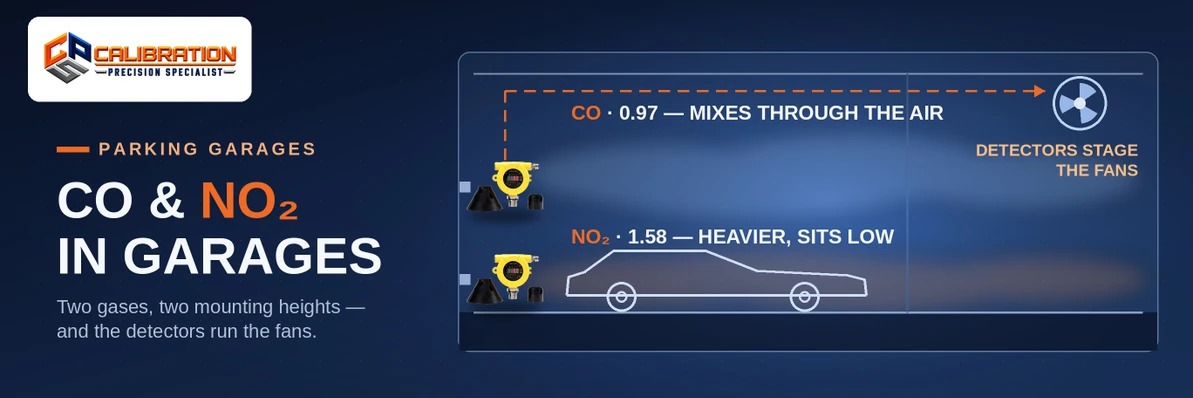
Carbon monoxide is the primary exhaust gas of gasoline engines, worst at cold start and idle — exactly the conditions a parking garage specializes in. It is colorless and odorless, and at a density of about 0.97 relative to air it neither rises nor sinks in any useful way: it mixes evenly through the garage air. For the people who work in garages all day, the occupational benchmarks are OSHA's permissible exposure limit of 50 ppm as an 8-hour average and NIOSH's recommended limit of 35 ppm averaged over the shift, with a 200 ppm ceiling.
Nitrogen dioxide is the gas that tracks diesel exhaust. Diesel engines produce far more NO₂ relative to CO than gasoline engines do, which is precisely why a CO-only system can be fooled: in a diesel-heavy garage — delivery vehicles, work trucks, transit and fleet parking — NO₂ and diesel particulates can reach harmful levels while the CO reading still looks comfortable. NO₂ is a deep-lung irritant with tight limits: OSHA sets a ceiling of 5 ppm that may never be exceeded, NIOSH recommends a short-term limit of 1 ppm, and ACGIH's current threshold limit value is 0.2 ppm as an 8-hour average. At about 1.58 times the density of air, it also behaves differently in the space, which matters for placement below.
| Gas | Main source in a garage | Why it's monitored | Key exposure benchmarks |
|---|---|---|---|
| Carbon monoxide (CO) | Gasoline vehicle exhaust, worst at cold start and idle | The primary toxic load in a typical garage; the classic garage-ventilation control gas | OSHA PEL 50 ppm (8-hr TWA) · NIOSH REL 35 ppm TWA, 200 ppm ceiling |
| Nitrogen dioxide (NO₂) | Diesel vehicle exhaust | Marks the diesel fraction CO can't see; a potent lung irritant at low ppm | OSHA ceiling 5 ppm · NIOSH STEL 1 ppm · ACGIH TLV 0.2 ppm TWA |
What Does the Code Actually Require for Garage Ventilation?
Most local mechanical codes follow the International Mechanical Code, and the IMC's model for enclosed parking garages (Section 404) offers two ways to run the exhaust system: continuously at not less than 0.75 cfm per square foot of floor area, or automatically, by detection — cycling between that full rate and a standby rate of not less than 0.05 cfm per square foot, with the change driven by carbon monoxide detectors applied in conjunction with nitrogen dioxide detectors, listed in accordance with UL 2075 and installed per their listing. The IMC commentary is explicit about why both gases are named: the detection system cannot rely on CO alone, because other contaminants can reach harmful concentrations before CO rises to its detection threshold.
Two honest qualifications. First, the IMC is a model code — what governs your garage is the edition your jurisdiction adopted, plus any local amendments, so the design belongs to your engineer of record and your authority having jurisdiction. Second, some jurisdictions go further than the model: California's energy code, for example, requires CO to be maintained at or below 25 ppm at all sensors in larger garages, which is why 25 ppm is the fan-start figure you will see on most garage detection designs.
Where Do Parking Garage Gas Detectors Go?
Placement follows each gas's behavior, and the general rules are the same ones we lay out in our guide to where fixed gas detectors should be placed:
- CO detectors mount at breathing height. Because CO mixes evenly with air (density ≈ 0.97), a sensor at roughly standing head height reads the same air the attendant, the valet and the returning driver breathe. There is no ceiling pocket or floor layer to chase.
- NO₂ detectors mount low. At about 1.58 times the density of air, NO₂ tends to settle, so its sensors go low on the wall or column, near the lanes and ramps where diesel vehicles actually run — not averaged across the whole floor.
- Both belong in the air the vehicles make. Detectors go where exhaust concentrates — drive lanes, ramps, queuing points at gates and pay stations — distributed across ventilation zones, not clustered at the fresh-air intake where they would read the cleanest air in the building.
- Coverage is a layout, not a guess. There is no single national spacing number in the IMC model; as a concrete example of how one jurisdiction writes it, California's energy code requires at least one CO sensor per 5,000 square feet, located where the highest concentration is expected, with at least two sensors per proximity zone. Your detector layout should come from the ventilation design, zone by zone.
How Does Detection Control the Ventilation?
The detector is the sensor; the relays are the point. A fixed head watching a garage zone typically works in stages: at the first setpoint — commonly 25 ppm CO — its relay starts or speeds up the exhaust fans for that zone; at a higher second stage, fans go to full rate and an audible/visual alarm warns people in the space. When the air clears, the system drops back to the 0.05 cfm/ft² standby rate the IMC model allows, which is where the energy savings live: the fans move air in proportion to the vehicle load instead of running a worst-case schedule all night for an empty garage.
The hardware has to be able to act, not just read. The SENKO SI-200E — the fixed head we fit for this duty — carries three relay contacts (1st alarm, 2nd alarm and fault, rated 2.0 A @ 30 VDC) for driving fan starters and beacons directly, plus 4–20 mA and RS-485 outputs for a controller or building system that wants the actual concentration, not just a contact closure. Our comparison of the SENKO fixed SI series covers how the SI-200E's outputs compare with the sampling models.
Which Detector Fits a Parking Garage?
For garage duty the choice is mostly about gas and range:
- Carbon monoxide: the SI-200E in its CO configuration, 0–200 ppm or 0–500 ppm — the 0–200 ppm build gives the resolution that matters around 25–100 ppm control points.
- Nitrogen dioxide: the SI-200E in its NO₂ configuration, 0–20 ppm — a range matched to single-digit-ppm limits.
- One gas per head. Every SI-200E carries one sensor, so a monitored point that must watch both gases is two detectors. Budget and layout should be built that way from the start — it is the most common surprise in garage detection projects.
- Price: the SI-200E lists from $950 at CPS, with configured builds at $1,092.50–$2,300 depending on the sensor fitted. Its explosion-proof, IP66 construction is more than a garage strictly needs — the same head also serves classified industrial areas — but the relays, outputs and sensor menu are exactly the garage feature set.
- Sampling for problem points: where exhaust collects somewhere a wall-mounted head can't sit — a duct, a dead-air corner — the pumped SI-301 in our SENKO fixed detector guide pulls a sample through up to 30 m of tubing instead.
What Are the Honest Limits of Garage Gas Detection?
- Detectors don't move air. A sensor can call for ventilation, but if the fans and dampers are undersized or failed, detection only documents the problem. The fault relay exists so a dead detector announces itself — wire it to something that gets attention.
- Electrochemical sensors drift. CO and NO₂ cells age and drift like every electrochemical sensor; an uncalibrated garage system quietly loses the accuracy the whole control strategy is built on. California's acceptance rules underline the point: sensors must hold accuracy within ±5% with no more than 5% drift per year, and calibration is expected at least on the manufacturer's schedule.
- EVs don't retire the system. The code trigger is the enclosed garage and its mechanical ventilation, not this year's vehicle mix — garages serve mixed fleets, service vehicles and emergency generators, and the ventilation plant the detectors control will be there for decades. An all-electric facility questioning its detection should put the question to its AHJ, not assume the answer.
- A detector only sees its zone. One head in a multi-level garage is a sample, not a system. Zoning follows the ventilation design.
How Are Parking Garage Detectors Maintained?
In place, with bottled calibration gas: a calibration cap over the sensor, certified CO or NO₂ span gas from a cylinder, a few minutes per head, and an entry in the log. The consumables are the same calibration gas the portable program uses — the mix has to match the sensor, and the cylinder has to be in date. Keep a per-head calibration record with the ventilation maintenance file; if an inspector or an insurer ever asks how the garage proves its air is controlled, that log is the proof. If your heads are due and nobody on staff owns the job, you can remove a head and ship it to us or calibrate in place with gas and phone guidance — we calibrate every channel. Questions about laying out a garage system — call 865-900-8844.
Frequently Asked Questions
What gases do you monitor in a parking garage? Two: carbon monoxide (CO) and nitrogen dioxide (NO₂). CO comes mainly from gasoline engines and is the primary control gas for garage ventilation; NO₂ tracks diesel exhaust, which produces far more NO₂ relative to CO — so a diesel-heavy garage can have harmful NO₂ levels while CO still reads low. The IMC's garage ventilation model names both gases together for exactly that reason.
Why do parking garages need NO₂ monitoring if most cars burn gasoline? Because the fleet isn't all gasoline. Diesel pickups, delivery trucks, transit and fleet vehicles concentrate in garages, and diesel exhaust raises NO₂ and particulates long before it raises CO proportionally. NO₂ also has much tighter exposure limits — OSHA ceiling 5 ppm, NIOSH short-term limit 1 ppm — so a small diesel presence can be the controlling hazard even in a mostly gasoline garage.
What CO level should start a parking garage's ventilation fans? The most common design figure is 25 ppm CO for the first fan stage, with a higher second stage for full ventilation and alarm. California's energy code writes it as a performance rule — CO must be maintained at or below 25 ppm at all sensors in larger garages. Fan setpoints are part of the mechanical design and local code, so confirm yours against the adopted code edition.
Where should CO detectors be mounted in a parking garage? At breathing height, in the zones where vehicle exhaust actually accumulates — drive lanes, ramps, gate queues. Carbon monoxide's density (about 0.97 relative to air) means it mixes evenly rather than pooling high or low, so the sensor should sample the air people breathe, distributed across the ventilation zones rather than clustered at the fresh-air intake.
Where should NO₂ detectors be mounted in a parking garage? Low. Nitrogen dioxide is about 1.58 times as dense as air and tends to settle, so NO₂ sensors mount low on walls or columns, close to the lanes diesel vehicles use. That split — CO at breathing height, NO₂ low — follows the same density rules as fixed detector placement generally.
How many gas detectors does a parking garage need? There is no single national number; the count follows the ventilation zones and floor layout. As one concrete benchmark, California's energy code requires at least one CO sensor per 5,000 square feet, placed where the highest concentration is expected, and at least two sensors per proximity zone. Each monitored point also needs one detector per gas — CO and NO₂ are separate sensors, so a two-gas point is two heads.
Can one detector monitor both CO and NO₂? Not in the SENKO fixed line we sell: each SI-200E carries a single sensor, chosen at order — CO 0–200/500 ppm or NO₂ 0–20 ppm. A point that must watch both gases gets two heads, which is also how the IMC model describes the system: CO detectors applied in conjunction with NO₂ detectors. Budget for the pair from the start.
How much ventilation does an enclosed parking garage need? Under the IMC model, the full ventilation rate is not less than 0.75 cfm per square foot of floor area. With automatic CO + NO₂ detection control, the system may cycle down to a standby rate of not less than 0.05 cfm per square foot when the air is clean — which is where detector-controlled garages save their energy. Your adopted local code edition governs the actual design.
Do electric vehicles eliminate the need for parking garage gas detection? No. The requirement attaches to the enclosed garage and its mechanical ventilation system, not to the current vehicle mix, and real garages still serve gasoline and diesel vehicles, service trucks and engine-driven equipment. If a facility goes truly all-electric, whether detection can be reduced is a question for its authority having jurisdiction — not an assumption to build on.
How often do parking garage gas detectors need calibration? On the sensor manufacturer's schedule, verified with bottled calibration gas at the head. Electrochemical CO and NO₂ sensors drift with age; California's acceptance criteria for garage sensors cap drift at 5% per year and expect accuracy within ±5% of reading. A garage system that is never calibrated is controlling its fans from numbers nobody has checked.
CPS Calibrations · 109 S. Front Street, Rockwood, TN 37854 · SI-200E · SENKO Fixed Gas Detectors · Fixed Detector Placement · Calibration Gas · Contact Us
Recent Posts
-

Flame Detector vs. Gas Detector: What's the Difference — and Do You Need Both?
A gas detector and a flame detector guard opposite ends of the same incident: a gas detector reads l …Oct 21st 2026 -

How Do You Test a Flame Detector? Self-Tests, Test Lamps, and NFPA 72
You test a flame detector with light, not gas — there is no span gas, no zero gas, and never an open …Oct 21st 2026 -

Why Does a Flame Detector False Alarm — and Which Type Won't?
A flame detector false alarms because something that is not a fire is producing the signal it watche …Oct 21st 2026