
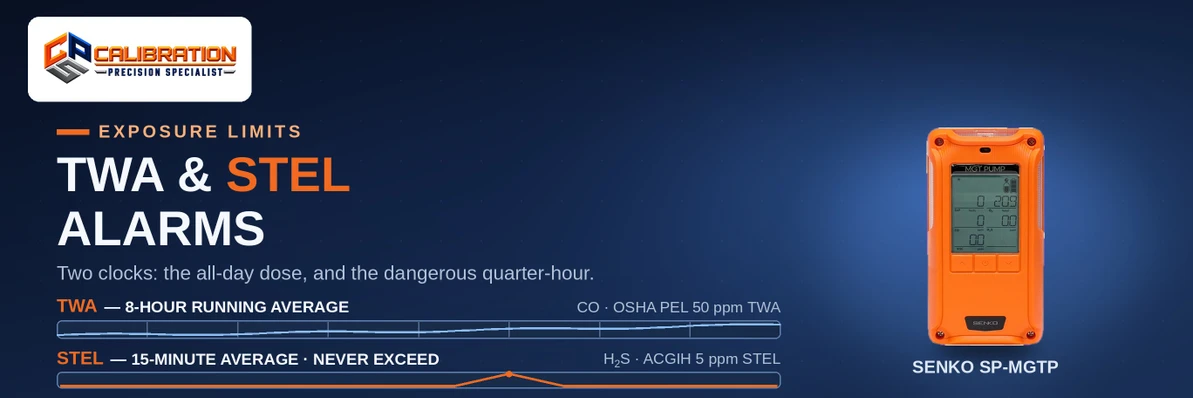
What Are TWA and STEL Alarms? Exposure Limits Explained
A TWA alarm means your accumulated exposure — averaged over an 8-hour shift — has reached its limit: for carbon monoxide, OSHA's PEL is 50 ppm as an 8-hour TWA. A STEL alarm means your average exposure over the last 15 minutes has breached a short-term limit set for acute effects. The two protect against different harms, which is why the same gas carries different numbers from different authorities — for CO, OSHA allows 50 ppm TWA, NIOSH recommends 35 ppm TWA with a 200 ppm ceiling, and ACGIH's TLV is 25 ppm TWA.
Instantaneous readings tell you what the air is doing now. TWA and STEL tell you what the air has done to the person breathing it. That difference is why a monitor can sit silent through a dangerous quarter-hour on a TWA basis, and why a different monitor can alarm at the end of a shift when the air at that moment is perfectly clean.
What Is a TWA (Time-Weighted Average)?
A TWA is a dose calculation: concentration multiplied by time, summed over the shift, and divided by 8 hours. Two hours at 100 ppm followed by six hours of clean air is a TWA of (100 × 2 + 0 × 6) ÷ 8 = 25 ppm — the exposure equivalent of breathing 25 ppm steadily all shift.
Worked through for carbon monoxide, the three published limits sort one shift three different ways. Say a mechanic spends 2 hours at 100 ppm CO around running engines and 6 hours at 25 ppm elsewhere in the shop. His 8-hour TWA is (100 × 2 + 25 × 6) ÷ 8 = 43.75 ppm. Against the three authorities:
- OSHA PEL, 50 ppm TWA — compliant.
- NIOSH REL, 35 ppm TWA — over the recommendation.
- ACGIH TLV, 25 ppm TWA — over the guideline by a wide margin.
Same shift, same air, three verdicts — because a PEL is a legal limit, a REL is a research agency's recommendation, and a TLV is a professional guideline, and they were set with different evidence and different safety margins. Section four covers who issues each and which one governs.
The TWA's strength is that it matches how chronic harm works: for gases that damage by accumulation, what matters is total dose. Its weakness is the mirror image — an 8-hour average smooths out spikes. A worker can absorb a genuinely dangerous 15 minutes and still finish the day under the TWA. That gap is what the STEL exists to close.
What Is a STEL (Short-Term Exposure Limit)?
A STEL is a 15-minute time-weighted average that must not be exceeded at any point in the shift — even if the 8-hour TWA is comfortably within its limit. It guards against acute effects: irritation, narcosis, and the sudden incapacitation that precedes a fatal exposure.
Hydrogen sulfide makes the distinction concrete. ACGIH sets H₂S an 8-hour TWA TLV of 1 ppm and a STEL of 5 ppm. A worker whose 15-minute average reaches 8 ppm has breached the STEL — full stop. The arithmetic shows why the TWA cannot catch it: 15 minutes at 8 ppm contributes just 2 ppm-hours toward the day's 8 ppm-hour TWA budget (1 ppm × 8 hours), so his shift average can finish comfortably compliant while the STEL was violated in a single quarter-hour. The STEL alarm exists to catch exactly that: a short exposure the shift average would forgive.
What Is a Ceiling Limit?
A ceiling is the third clock, and it is not an average at all: a concentration that must not be exceeded at any moment, however briefly. NIOSH sets carbon monoxide a ceiling of 200 ppm alongside its 35 ppm TWA. For hydrogen sulfide, OSHA's entire general-industry limit is a ceiling structure rather than a TWA: 20 ppm ceiling, with a single allowance to peak at 50 ppm for up to 10 minutes once in a shift, only if no other measurable exposure occurs (29 CFR 1910.1000, Table Z-2). NIOSH recommends a tighter H₂S ceiling of 10 ppm over a 10-minute period.
Ceilings exist for gases whose harm can arrive faster than any average can track. You do not manage a ceiling gas by watching the day's dose; you manage it by never letting the number cross the line.
OSHA PEL vs. NIOSH REL vs. ACGIH TLV: Who Sets What?
| Authority | Limit type | Legal force | Carbon monoxide | Hydrogen sulfide |
|---|---|---|---|---|
| OSHA | PEL | Enforceable federal law | 50 ppm, 8-hr TWA | 20 ppm ceiling; 50 ppm peak, ≤10 min once per shift if no other exposure |
| NIOSH | REL | Recommendation | 35 ppm TWA; 200 ppm ceiling | 10 ppm ceiling (10-minute) |
| ACGIH | TLV | Professional guideline | 25 ppm TWA | 1 ppm TWA; 5 ppm STEL |
- An OSHA PEL (Permissible Exposure Limit) is the law of the workplace: exceeding it is a citable violation.
- A NIOSH REL (Recommended Exposure Limit) comes from the federal research agency that studies occupational health; it is guidance, often more protective than the PEL, and carries no direct enforcement.
- An ACGIH TLV (Threshold Limit Value) comes from a professional association of industrial hygienists and is updated as the science moves — which is why TLVs are usually the tightest numbers on the page. H₂S is the extreme case: OSHA's ceiling of 20 ppm against ACGIH's 1 ppm TWA is a twenty-to-one spread on the same gas.
Many employers and many instrument alarm programs simply adopt the most protective published values, and nothing stops a facility from alarming at the TLV. What you may not do is treat the loosest number as the only one that exists. One more figure to know: NIOSH also publishes the IDLH — Immediately Dangerous to Life or Health — concentration (1,200 ppm for CO; 100 ppm for H₂S). IDLH is not an alarm setpoint; it is the escape-or-respirator line, and any atmosphere near it is a different conversation than exposure-limit management. (For what H₂S does at rising concentrations, see our post on why hydrogen sulfide is so dangerous in wastewater.)
How Does a Gas Detector Calculate TWA and STEL?
A datalogging personal monitor does not wait for someone to do the math. It samples the air continuously and keeps two running calculations alongside the instantaneous reading:
- The TWA accumulator sums every sample's concentration × time into a dose total and divides by the shift length — 8 hours by default — so the displayed TWA climbs through the shift even during clean-air stretches (it just climbs more slowly). A TWA alarm fires when the accumulated dose reaches the limit's dose: the alarm is essentially saying "at this point, even clean air for the rest of the shift cannot bring your average back under the line" — many instruments alarm on precisely that projected basis.
- The STEL window is a rolling 15-minute average, recomputed continuously; a STEL alarm fires the moment any 15-minute window's average crosses the setpoint.
- Ceiling and instantaneous alarms need no calculation at all — they watch the live reading against a fixed line.
Two practical consequences. First, TWA and STEL alarms are features of datalogging instruments: a basic monitor that only shows the instantaneous value cannot compute either, and a bump test (see bump test vs. calibration) does not verify them — calibration and correct limit settings in the instrument's configuration do. Second, the log is the paper trail: after an incident or a disputed exposure, the instrument's record of its own TWA/STEL computation is how a safety department reconstructs what actually happened, minute by minute.
What Should You Do When a TWA or STEL Alarm Sounds?
Treat them as different instructions. A STEL alarm describes the recent past: the last 15 minutes were too hot. Move to fresh air, get the source controlled or ventilated, and do not re-enter on the assumption that the average has reset — the window is still rolling. A TWA alarm describes the whole shift: the wearer's dose budget is spent, and the correct response is to end that worker's exposure for the day, because no later clean air un-accumulates dose. In both cases, the alarm is the instrument doing arithmetic the wearer cannot do in their head — silencing it and carrying on converts a managed exposure into an unmeasured one.
The Bottom Line
TWA is an 8-hour dose average, STEL is a 15-minute average that operates independently of it, and a ceiling is an instantaneous line. OSHA's PELs are law, NIOSH's RELs are recommendations, and ACGIH's TLVs are guidelines — frequently the strictest of the three, as hydrogen sulfide shows (OSHA ceiling 20 ppm; NIOSH ceiling 10 ppm; ACGIH 1 ppm TWA / 5 ppm STEL). A datalogging monitor computes all of these continuously and keeps the record; a monitor that only shows a live number leaves the two most important exposure calculations undone.
If your fleet's TWA/STEL setpoints have never been checked against the limits your safety program actually adopted — or if the instruments are due — we calibrate every channel and verify the readings against certified gas. The monitors doing this work are in our single-gas and portable multi-gas categories; service is on our calibration services page. Call 865-900-8844 or reach us through Contact Us.
Frequently Asked Questions
What does TWA stand for in gas detection? Time-Weighted Average: your exposure averaged over a normal 8-hour workday. It is a dose calculation — each period's concentration multiplied by its duration, summed, and divided by 8 hours. Carbon monoxide's OSHA PEL of 50 ppm is an 8-hour TWA, meaning brief readings above 50 ppm do not by themselves violate it, and a full shift at a steady 50 ppm sits exactly at it.
What is a STEL alarm? A STEL alarm fires when your average exposure over the last 15 minutes exceeds the Short-Term Exposure Limit. The STEL operates independently of the TWA: you can breach a STEL in a quarter-hour spike while your 8-hour average remains compliant, and that is precisely the exposure pattern the STEL exists to catch — short, intense exposure with acute effects.
What is the difference between TWA and STEL? Time window and purpose. TWA averages a full 8-hour shift and manages cumulative, chronic dose. STEL averages any 15-minute window and manages acute, short-term effects. A complete alarm program uses both, because each one can be violated while the other is satisfied.
What is a ceiling limit on a gas detector? A ceiling is a concentration that must not be exceeded at any moment — it is not averaged over any period. NIOSH sets carbon monoxide a 200 ppm ceiling alongside its 35 ppm TWA. For hydrogen sulfide, OSHA's limit is a ceiling: 20 ppm, with one allowance to peak at 50 ppm for up to 10 minutes in a shift, and only if no other measurable exposure occurs.
What is the OSHA PEL for carbon monoxide? 50 ppm as an 8-hour time-weighted average (29 CFR 1910.1000, Table Z-1). For comparison, NIOSH recommends 35 ppm TWA with a 200 ppm ceiling, and ACGIH's TLV is 25 ppm TWA. The OSHA figure is the enforceable one; the others are a recommendation and a guideline respectively — and both are stricter.
What are the exposure limits for hydrogen sulfide? OSHA's PEL is a 20 ppm ceiling, with a single peak allowance of 50 ppm for up to 10 minutes per shift if no other measurable exposure occurs. NIOSH recommends a 10 ppm ceiling measured over 10 minutes. ACGIH's TLV is 1 ppm as an 8-hour TWA with a 5 ppm STEL. NIOSH's IDLH for H₂S is 100 ppm.
Can you exceed the STEL if your TWA is within limits? No — the STEL is a standalone limit, not an allowance granted by a good TWA. Fifteen minutes averaging 8 ppm hydrogen sulfide breaches ACGIH's 5 ppm STEL outright. That quarter-hour spends a quarter of the day's TWA dose budget (2 of the 8 ppm-hours a 1 ppm × 8-hour TWA allows), and the STEL violation stands regardless of how the TWA resolves.
How does a gas monitor calculate TWA? A datalogging monitor samples the air continuously and accumulates dose — concentration multiplied by time — then divides by the shift length, normally 8 hours. The displayed TWA therefore rises through the shift whenever exposure continues and holds (rather than resetting) in clean air. Many instruments alarm on the projected basis: once accumulated dose reaches the limit's full-shift dose, no remaining clean air can bring the average back under the line.
What is the difference between a PEL and a TLV? Force of law. A PEL is OSHA's enforceable Permissible Exposure Limit; exceeding it is a citable violation. A TLV is ACGIH's Threshold Limit Value — a health-based guideline from a professional association, with no direct legal force, but updated with current science and usually more protective. Many safety programs adopt TLVs as their internal limits and alarm setpoints.
Does a TWA alarm mean the air is dangerous right now? Not necessarily — and the reverse is also true. A TWA alarm means the accumulated dose for the shift has reached the limit; the air at that instant may be clean. But a low instantaneous reading late in a shift does not clear a worker whose dose is already spent. TWA alarms end a person's exposure day; instantaneous and STEL alarms clear them from the area in front of them.
CPS Calibrations · 109 S. Front Street, Rockwood, TN 37854 · Portable Gas Detection · Calibration Gas · Calibration Services · Contact Us
Recent Posts
-

PID vs. LEL for VOC Detection: Which Sensor Do You Actually Need?
Use a PID to detect VOCs and an LEL sensor to detect explosive atmospheres — they measure different …Oct 21st 2026 -

Semiconductor (MOS) Gas Sensors: Where They Work and Where They Lie
A semiconductor (MOS) gas sensor measures gas with a heated film of metal oxide — usually tin dioxid …Oct 21st 2026 -

What Do Firefighters Use a Gas Meter For?
Firefighters use a gas meter — usually a 4-gas monitor reading oxygen (O₂), combustible gas as a per …Oct 21st 2026