
Semiconductor (MOS) Gas Sensors: Where They Work and Where They Lie
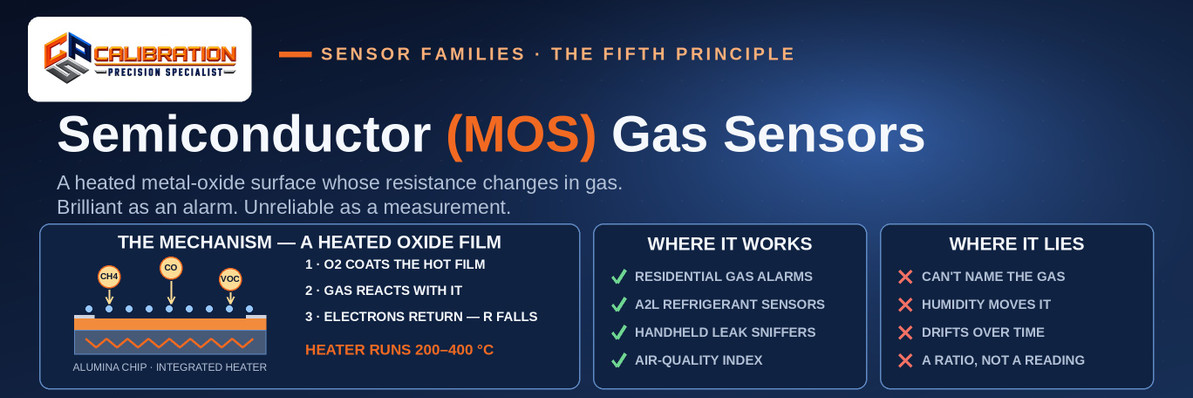
A semiconductor (MOS) gas sensor measures gas with a heated film of metal oxide — usually tin dioxide (SnO₂) held at roughly 200–400 °C — whose electrical resistance falls when gases react with the oxygen adsorbed on its hot surface. That single resistance change is the whole measurement, and it explains both halves of the sensor's character: MOS sensors are cheap, small, sensitive, and long-lived, which is why they run residential gas alarms, A2L refrigerant leak sensors, handheld leak sniffers, and air-quality monitors — but the same change is produced by many gases at once, shifts with humidity and temperature, and drifts over time, so an MOS sensor reports a resistance ratio rather than a true concentration of a named gas. It is an excellent alarm and a poor witness: trust it to say "something is here," never to testify "this much of this gas."
Our series on sensing principles — how a gas detector works — covered the four principles that carry industrial safety: the catalytic bead, the electrochemical cell, the infrared (NDIR) sensor, and the PID. There is a fifth principle, and in raw numbers it may be the most widely deployed gas sensor on earth. It sits in millions of homes, appliances, cars, and HVAC units. It is also, deliberately, absent from the certified safety monitors described in that series. This post is about that sensor — the semiconductor, or metal-oxide-semiconductor (MOS), sensor — how it works, where its peculiar strengths make it exactly the right choice, and the specific ways its readings can mislead you if you ask it to do a measuring instrument's job.
How Does a Semiconductor Gas Sensor Work? A Hot Surface Covered in Oxygen
A MOS sensor is a chip of ceramic (usually alumina) carrying three things: a thin film of metal oxide, a pair of electrodes touching the film, and a tiny heater underneath it. The oxide is most often tin dioxide (SnO₂); zinc oxide (ZnO), titanium dioxide (TiO₂), and tungsten trioxide (WO₃) fill out the family. The heater is not optional decoration — it holds the film at its operating temperature, typically somewhere in the 200–400 °C range, because the surface chemistry that does the sensing only runs properly when the oxide is hot.
Here is the mechanism, in three steps:
- In clean air, oxygen coats the surface. Oxygen molecules adsorb onto the hot oxide and capture electrons from it, forming a depleted surface layer. With its electrons tied up, the film conducts poorly — its electrical resistance is high. This high, stable resistance in clean air is the sensor's baseline.
- A reducing gas gives the electrons back. When a gas that can be oxidized — methane, carbon monoxide, hydrogen, LPG, alcohol and solvent vapors, most VOCs — reaches the hot surface, it reacts with the adsorbed oxygen. The reaction releases the captured electrons back into the film, conductivity rises, and the resistance falls — further, the more gas arrives.
- An oxidizing gas does the opposite. Gases like nitrogen dioxide and ozone grab additional electrons instead of releasing them, pushing the resistance of an n-type oxide like SnO₂ up. One film, two directions — which direction and how far the needle moves is the entire signal.
The instrument's electronics do the rest: measure the film's resistance, compare it to the clean-air baseline, and convert the change into an output. Sensor makers such as Figaro express the response as a resistance ratio (Rs/Ro — resistance in gas versus resistance in a reference condition), and that word ratio deserves attention, because it is the first clue to everything in the "where it lies" half of this post. The sensor never measures a gas. It measures how much its own surface chemistry has been disturbed.
Why Is This Sensor Everywhere? Because the Physics Is Generous
Before the indictment, the defense — because the MOS sensor's virtues are real, and they are why it won the consumer world outright.
It is cheap and small. An oxide film, two electrodes, and a heater on a ceramic chip is one of the simplest gas sensors ever manufactured. Miniaturized versions come in a standard TO-5 can or smaller, and the supporting circuit is little more than a voltage divider.
It is genuinely sensitive. MOS films respond to combustible and toxic gases at low ppm concentrations — sensitive enough that one air-contaminant model detects hydrogen at a level of several ppm. Sensitivity is not this sensor's problem.
One element sees a whole family. Because the mechanism keys on surface reactivity rather than one molecule's fingerprint, a single MOS element responds to methane, propane, CO, hydrogen, alcohol, and solvent vapors. Sensor makers steer that breadth toward a target gas with different oxides, dopants and catalyst additives, different operating temperatures, and even physical filters — Figaro's methane sensor for home alarms, for example, uses filter material specifically to suppress the influence of alcohol vapor, the classic household interference gas.
Nothing is consumed. There is no electrolyte to dry out, no lead anode being eaten the way a galvanic oxygen cell eats itself, and no catalyst being burned away. The surface chemistry runs forward and backward as gas comes and goes, so in clean conditions the element itself is long-lived — HVAC guides credit semiconductor leak-detector elements with years of service, up to a decade in clean air.
The one running cost is heat. The heater must hold the film at temperature continuously, and it draws power the whole time — even miniaturized chips pull roughly 42–56 mA of heater current in Figaro's current lines, and the sensor needs warm-up time before its baseline settles and means anything. For a wall-powered alarm, that cost is invisible. For a battery-powered portable, it is a serious design tax — one reason electrochemical cells, which sip power, own the personal-monitor world.
Where MOS Sensors Work
Put the virtues together and a pattern emerges: MOS wins wherever the job is detection — is something here that shouldn't be? — rather than measurement — how much of this named gas, exactly?
Residential gas alarms. This is the MOS sensor's flagship job. Semiconductor methane sensors sit inside home natural-gas and LPG alarms built to residential performance standards such as UL 1484 and EN 50194. The environment is controlled, the event being detected is gross (a leak building toward a dangerous fraction of the LEL), and the required output is an alarm, not a reading. Cheap, sensitive, and long-lived is exactly the right specification.
A2L refrigerant leak sensors in HVAC equipment. As mildly flammable A2L refrigerants (R-32, R-454B) spread through residential and commercial HVAC, equipment increasingly ships with built-in leak detection — and MOS is one of the two common sensing principles used, precisely because it is sensitive, compact, and inexpensive enough to build into every unit. The HVAC trade press documents the flip side honestly: these sensors also react to VOCs off-gassed by curing adhesives and sealants, a known source of nuisance alarms after construction work. That is not a defect of a particular brand; it is this sensor's nature, arriving in a new industry.
Handheld leak sniffers. Refrigerant and combustible-gas leak detectors built on semiconductor elements are a standard HVAC service tool: wave the wand along a line set or a gas pipe, and the instrument's changing tone tells you when you're getting warmer. Pinpointing a leak is a relative job — strongest signal wins — and relative is what a resistance ratio does well. (Technicians still verify performance against a calibrated reference leak, because a sniffer that has drifted is a sniffer that walks past leaks.)
Air-quality indication and ventilation control. Figaro's air-contaminant line exists to answer questions like "is the air in this room stale?" — its ventilation-index sensor's output correlates with the contaminant load from room occupants and is used to run ventilation fans, range hoods, and air cleaners. Note the honest vocabulary: an index, a correlation. An MOS air-quality sensor tells a building "the air got worse," which is all a damper needs to know. It does not tell anyone how many ppm of which compound did it.
Inexpensive alcohol screening. The same alcohol sensitivity that household-alarm makers filter against is the product in cheap semiconductor breath testers: a pocket device that gives a rough indication, at a price no fuel-cell instrument can touch — with accuracy to match, which is why evidentiary breath testing uses other principles.
Where MOS Sensors Lie
Every weakness below is the mechanism viewed from the other side. None of them is a manufacturing flaw; all of them follow from "the sensor measures how much its surface chemistry was disturbed."
Lie #1: It cannot name the gas. Anything that reacts at the surface moves the needle. A MOS methane alarm cannot distinguish methane from alcohol vapor, cleaning solvents, hydrogen, or CO — which is why the home-alarm industry fits filters against alcohol and why A2L refrigerant sensors trip on construction sealants. If two reactive gases are present, you get one combined disturbance and no way to apportion it. Compare the principles in our series: an electrochemical cell is built around one gas's reaction; an NDIR sensor watches one gas's wavelength. An MOS sensor watches a class of chemistry — and reports it as if it were your target gas.
Lie #2: The weather moves its baseline. Water vapor competes for the same surface, and the reaction rates shift with ambient temperature, so the same concentration of the same gas produces a different resistance on a humid August afternoon than in dry winter air. This is not a subtle effect buried in a footnote: manufacturers publish temperature and humidity dependency curves for every MOS model, specified against a reference condition (Figaro uses 20 °C and 65% relative humidity), and instruments that use these sensors seriously have to compensate for both. Uncompensated, the environment writes part of every reading.
Lie #3: It drifts, and its surface can be permanently changed. The clean-air baseline wanders over weeks and months; contaminants can bond irreversibly to the surface — poisoning, the same failure family our catalytic bead vs. infrared head-to-head covers for the bead — and fouling dulls the response. A MOS sensor that was honest in January is making a somewhat different claim by summer unless someone re-zeros it and checks it against a known gas. Drift is the quiet failure: nothing alarms, nothing faults, the numbers just slowly stop meaning what they meant.
Lie #4: The number is a ratio, not a concentration. MOS response is strongly non-linear — datasheet sensitivity curves are plotted as resistance ratios on logarithmic scales because the relationship compresses: large resistance swings at low concentrations, shrinking swings as concentration climbs. And the conversion from ratio to ppm is different for every gas, every oxide formulation, and every humidity. So when a MOS instrument displays "ppm," that number is a model — factory-fitted for one target gas, under reference conditions. Present a different gas, or different weather, and the displayed number can be off by a large factor while the sensor is working exactly as designed. As one sensor reference puts it, the technology is suited to detection and alarms, not to precise ppm measurement.
MOS vs. the Other Four Principles
| Principle | What it actually measures | Its number is… | Home ground |
|---|---|---|---|
| Catalytic bead | Heat of combustion on a catalyst, as bridge imbalance | A real %LEL | Personal and fixed combustible-gas safety |
| Electrochemical | Current from a reaction in a cell | A real ppm | Toxic gas and oxygen safety, battery portables |
| Infrared (NDIR) | Light absorbed at a gas-specific wavelength | A real % volume / %LEL | CO₂ and hydrocarbon monitoring, long-life fixed points |
| PID | Charge from UV-ionized vapor molecules | A real total-VOC ppm | VOC survey and leak investigation |
| Semiconductor (MOS) | Resistance change on a heated oxide surface | A ratio — gas- and conditions-specific | Alarms, leak sniffing, air-quality index |
The table also explains the one absence that matters. Walk through any lineup of professional multi-gas monitors — including the portable multi-gas monitors CPS carries — and the channels are catalytic, electrochemical, NDIR, and PID. A monitor that must produce a defensible number — for a confined-space entry decision, an exposure record, an OSHA citation defense — cannot be built on a sensor whose reading depends on which gas, which humidity, and which month it is. That is not snobbery about a cheap part; it is what the words measurement and indication mean.
Can You Calibrate a Semiconductor Sensor?
Yes — within limits that define the technology. A MOS instrument can be zeroed in clean air and its span set against a known concentration of its target gas, and residential alarms and leak detectors are factory-calibrated exactly that way; HVAC practice is to check a leak detector's response against a calibrated reference leak. What calibration cannot do is freeze the result: the span you set holds for that gas, near those temperature and humidity conditions, and then drift begins eroding it. So a MOS calibration is best understood as setting an alarm threshold honestly today, with a re-check schedule doing the work that stability does in other technologies. If your application needs a calibration that still means the same thing in six months, you are describing a different sensor.
The Buying Rule
Ask what question the instrument has to answer:
- "Is something there?" — a leak to pinpoint, a home to alarm, a room that needs ventilating, refrigerant escaping where it shouldn't. MOS is often the best answer: cheapest, most sensitive per dollar, and long-lived. This is real work, and the sensor is genuinely good at it.
- "How much of this gas, exactly — and can you prove it?" — entry decisions, exposure documentation, compliance readings, calibration records. That is a measurement, and it belongs to the catalytic bead, electrochemical cell, NDIR sensor, or PID, chosen by gas — the subject of our guide to how a gas detector works and our catalytic bead vs. infrared head-to-head.
The mistake is never buying an MOS sensor. The mistake is believing its display the way you'd believe a measuring instrument's — or, just as bad, dismissing the alarm on your wall because the technology is "cheap." In its home ground, doing its actual job, it has probably saved more buildings than any principle in this series.
Frequently Asked Questions
What is a semiconductor (MOS) gas sensor? A semiconductor gas sensor — MOS stands for metal-oxide semiconductor — is a sensor whose sensing element is a heated film of metal oxide, most often tin dioxide (SnO₂). Gases reacting at the film's hot surface change its electrical resistance, and the instrument converts that resistance change into its output. MOS sensors are the cheapest, smallest gas sensors in wide use: they run residential gas alarms, refrigerant leak sensors, leak sniffers, and air-quality monitors.
How does a metal oxide gas sensor work? In clean air, oxygen adsorbs onto the heated oxide surface and captures electrons, leaving the film with a high electrical resistance. When a reducing gas — methane, carbon monoxide, hydrogen, alcohol or solvent vapor — reaches the surface, it reacts with that adsorbed oxygen and releases the electrons back, so the film's resistance falls as concentration rises. Oxidizing gases such as nitrogen dioxide push the resistance the other way. The size of the resistance change, expressed as a ratio to the clean-air baseline, is the measurement.
Why does a semiconductor gas sensor need a heater? Because the surface chemistry that does the sensing only runs at temperature. The built-in heater holds the metal-oxide film at its operating point — typically about 200–400 °C — which keeps the oxygen adsorption and gas reactions fast and repeatable. The heater is also the sensor's main running cost: it draws power continuously (roughly 42–56 mA of heater current even in miniaturized chips), and the sensor needs warm-up time before its baseline settles.
What gases can a semiconductor sensor detect? A very wide range — that breadth is the technology's defining trait. MOS elements respond to combustible gases (methane, propane, butane, hydrogen), carbon monoxide, alcohol and solvent vapors, and many VOCs; other oxide formulations target oxidizing gases like nitrogen dioxide and ozone. Sensor makers tune the response toward a chosen gas with the oxide material, dopants, operating temperature, and filters — but "tuned toward" is not "specific to," and the sensor will still respond to other reactive gases.
Are semiconductor gas sensors accurate? Accurate enough for alarms, not for measurement. An MOS sensor's output is a resistance ratio whose conversion to ppm differs by gas, by humidity, and by temperature, and its baseline drifts over time. It is very good at detecting that a target gas has crossed a threshold and poor at certifying an exact concentration — the technology is suited to detection and alarms, not precise ppm measurement. For a defensible concentration reading, use a catalytic, electrochemical, infrared, or PID instrument matched to the gas.
Why does my semiconductor gas detector alarm when there's no leak? Because something reactive reached the sensor and it cannot tell gases apart. The classic household false alarms are alcohol vapor (hand sanitizer, cleaning products, cooking wine), aerosol sprays, and solvent fumes; in HVAC equipment, MOS refrigerant sensors are documented tripping on VOCs off-gassed by curing adhesives and sealants. A sharp humidity change can also move the baseline. The sensor is usually working as designed — it detected chemistry, just not the chemistry you meant.
Can a semiconductor sensor tell which gas it is detecting? No. It produces one signal — a resistance change — for every gas that reacts at its surface, and mixtures produce one combined response. Filters, dopants, and operating temperature can bias it toward a target gas (residential methane sensors filter against alcohol vapor, for example), but bias is not identification. If knowing which gas is present matters, you need principles that key on the gas itself: an electrochemical cell's reaction, an infrared sensor's wavelength, or a PID's ionization.
Do semiconductor gas sensors need calibration? They can be zeroed in clean air and span-set against a known concentration of their target gas, and alarms and leak detectors are factory-calibrated that way. But an MOS calibration holds only for that gas, near the temperature and humidity it was set in, and drift erodes it — so these instruments need periodic re-zeroing and response checks (HVAC technicians check leak detectors against a calibrated reference leak). A calibration date means less on a MOS instrument than on any other principle; the re-check schedule is what keeps it honest.
How long does a semiconductor gas sensor last? The element itself is long-lived: nothing is consumed in the measurement — no electrolyte, no anode — so in clean conditions MOS elements commonly serve for years, and HVAC guides credit semiconductor leak-detector elements with up to a decade in clean air. The honest limit is not survival but accuracy: over that life the baseline drifts and the surface can foul or poison, so "still responding" and "still reading true" diverge. Plan on periodic checks, and replace the sensor when it can no longer hold a zero or respond properly to a test gas.
Why aren't semiconductor sensors used in professional 4-gas monitors? Because a personal safety monitor must report accurate, gas-specific concentrations — ppm of CO and H₂S, %LEL of combustibles — that hold up for entry decisions and exposure records. An MOS sensor's reading shifts with humidity and temperature, drifts between calibrations, responds to gases it wasn't set for, and converts to ppm through a gas-specific model. That is why professional monitors are built from catalytic bead, electrochemical, infrared, and PID sensors, and why MOS is found instead where an alarm or an indication — not a measurement — is the job.
The Bottom Line
A semiconductor sensor is a surface-chemistry alarm wearing a sensor's clothing. Its heated oxide film gives it the best sensitivity-per-dollar in gas detection, a working life nothing else at its price can match, and an honest career in homes, HVAC equipment, leak sniffers, and air-quality controls. The same film guarantees that it cannot name its gas, that weather and time move its answers, and that its numbers are ratios dressed as readings. Use it where "something is here" is the whole question and it will serve you for years. Ask it "how much, exactly, of what" — the question safety decisions turn on — and you need a measuring instrument.
Not sure which sensing principle your application actually needs? That is a conversation worth having before the purchase order — call 865-900-8844 or reach us through Contact Us. Start with our guide to how a gas detector works, browse portable gas detection, and see the refrigerant leak detectors the technology discussion points to.
CPS Calibrations · 109 S. Front Street, Rockwood, TN 37854 · Calibration Gas · Calibration Services · Contact Us
Recent Posts
-

PID vs. LEL for VOC Detection: Which Sensor Do You Actually Need?
Use a PID to detect VOCs and an LEL sensor to detect explosive atmospheres — they measure different …Oct 21st 2026 -

Semiconductor (MOS) Gas Sensors: Where They Work and Where They Lie
A semiconductor (MOS) gas sensor measures gas with a heated film of metal oxide — usually tin dioxid …Oct 21st 2026 -

What Do Firefighters Use a Gas Meter For?
Firefighters use a gas meter — usually a 4-gas monitor reading oxygen (O₂), combustible gas as a per …Oct 21st 2026