
How Does a Gas Detector Work?
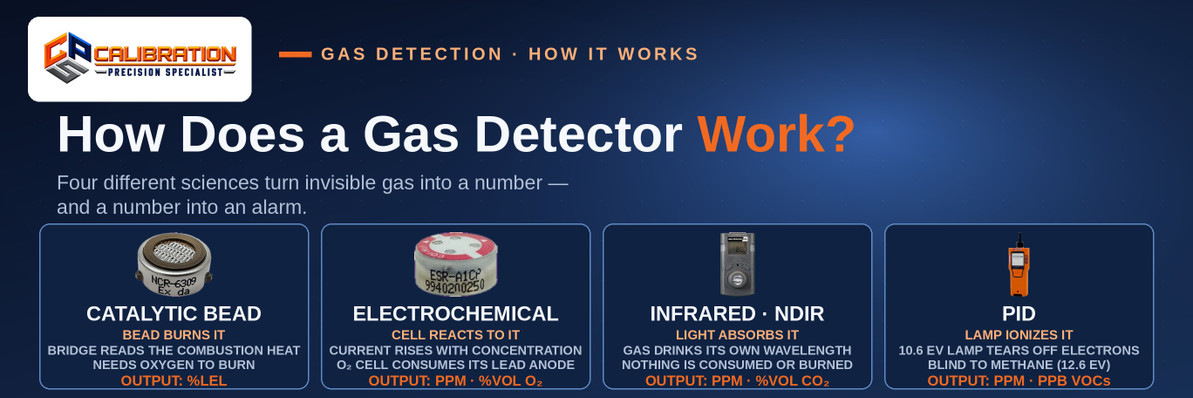
A gas detector works by turning gas into an electrical signal, and the signal into a number. A catalytic bead burns combustible gas on a heated catalyst and reads the heat as a change in resistance; an electrochemical cell produces a current proportional to the toxic gas reacting inside it; an infrared sensor measures how much light the gas absorbs at a wavelength only that gas drinks; and a photoionization detector (PID) uses an ultraviolet lamp to tear electrons off vapor molecules and counts the charge. The instrument's electronics scale whichever signal it gets into ppm, %LEL, or % volume and compare it against alarm setpoints. Because each principle keys on a different physical property of the gas, no single sensor can see every gas — which is why a multi-gas monitor carries several principles in one case.
Strip any gas detector down and the same chain appears: gas has to reach a sensor, the sensor has to produce a signal, electronics turn the signal into a concentration, and firmware compares the concentration to alarm limits. What varies — completely — is the middle step. There are four sensing principles in everyday industrial use, they work on four unrelated pieces of physics and chemistry, and each one is blind to gases another one sees easily. This post walks the chain end to end: how the gas gets in, how each principle works, how a raw signal becomes the number on the screen, and why "which gases can it detect?" is really a question about which principles are in the box. For the gases themselves — the standard four and their setpoints — see our companion post on what a 4-gas monitor detects.
First, the Gas Has to Get There: Diffusion vs. Pumped Sampling
A sensor can only measure the gas that physically arrives at it, and instruments move gas two ways. In a diffusion detector — the standard arrangement for personal monitors — the sensor sits exposed behind a membrane or sinter, and gas wanders in on its own by molecular diffusion and whatever air movement exists. The RKI GX-3R, for example, is a diffusion instrument as standard: it measures the air right where it is worn, in the worker's breathing zone, with no moving parts in the sampling path.
In a pumped (sample-draw) detector, a small motor pump pulls air through a hose and probe into the sensor block. That buys reach: the instrument can taste a tank, pit, or vessel from outside it, before anyone enters, and can sample spots a person can't yet stand in. The cost is time — the sample has to travel the hose before the sensors see it, so response stretches with hose length — plus a pump and filters to maintain. Many portables straddle both worlds: the GX-3R offers an optional clip-on motorized pump that converts it from diffusion to sample-draw duty. The full comparison is in our post on pumped vs. diffusion gas detectors.
Everything after this point — all four principles — happens inside the sensor the gas finally reaches.
Catalytic Bead Sensors: The Bead Burns the Gas
The catalytic bead (or pellistor) is the classic combustible-gas sensor, and it works by literally burning the gas it measures. Inside the sensor are two tiny coils of platinum wire embedded in ceramic beads, wired as two arms of a Wheatstone bridge. One bead is coated with a catalyst and exposed to the air — the active bead. The other is treated to stay inert — the reference bead, which compensates for temperature and humidity. Both beads are electrically heated to several hundred degrees Celsius.
When combustible gas reaches the hot catalyst, it oxidizes — burns without a flame — on the bead's surface. The combustion heat raises the active bead's temperature, which raises its wire's electrical resistance, which unbalances the bridge. The size of the imbalance is proportional to how much combustible gas is burning, and the electronics scale it directly as 0–100% LEL. Elegant, cheap, and honest — with three physics-imposed limits. It needs oxygen to burn anything, so in an oxygen-starved or inerted atmosphere it under-reads or reads nothing; it responds to anything combustible, not to a specific gas; and the catalyst can be poisoned — silicones, lead compounds, and sulfur compounds coat or kill the active surface, sometimes permanently, as our post on what happens when a sensor is poisoned works through. The bead's main rival inside LEL instruments is the infrared sensor covered below; our head-to-head on catalytic bead vs. infrared LEL sensors covers when each wins.
Electrochemical Sensors: The Cell Reacts With the Gas
Toxic gases are dangerous at parts per million — far too dilute to burn measurably — so they're measured chemically instead. An electrochemical sensor is a small sealed cell holding electrodes in an electrolyte behind a gas-permeable membrane. Gas diffuses in and reacts at the working electrode — carbon monoxide, for instance, is oxidized to carbon dioxide — and that reaction drives a current between the electrodes. The current is directly proportional to the reaction rate, which is proportional to how much gas is arriving: more gas, more current, in a clean linear relationship the electronics scale straight into ppm. That's the channel that produces a GX-3R's CO reading (0–2,000 ppm range) and its H₂S reading (0–200 ppm).
The oxygen sensor is a self-powered cousin called a galvanic cell. Oxygen diffuses in and is reduced at the cathode while a lead anode is consumed — the cell is essentially a small battery whose output current tracks the oxygen partial pressure, and it generates that current with no external power. The trade is written into the design: the lead is used up whether the instrument is working or sitting in a drawer, which is why oxygen sensors have a finite life measured from manufacture — the subject of our post on why oxygen sensors die. Electrochemical cells are sensitive, specific-ish, and sip power — but "specific-ish" matters: a cell built for one gas will often react somewhat to another, the cross-sensitivity problem detailed in our post on electrochemical sensor cross-sensitivities.
Infrared Sensors (NDIR): The Gas Drinks Its Own Wavelength
Infrared gas sensors measure light that doesn't arrive. An infrared source shines through a sample chamber to a detector, and the target gas absorbs the beam at a wavelength characteristic of its molecular structure — carbon dioxide drinks strongly at about 4.26 µm, hydrocarbons around 3.3–3.4 µm — while a second, reference wavelength that the gas doesn't absorb lets the electronics cancel out dust, aging lamps, and dirty optics. The more gas in the chamber, the more light vanishes at the sensing wavelength (the Beer–Lambert relationship), and the deficit becomes the reading. This is NDIR: non-dispersive infrared.
Because the gas is measured, not consumed or burned, an NDIR sensor has no catalyst to poison and nothing that wears out on a short clock — they are the long-life option, and they work in inert atmospheres where a bead can't burn anything. Dedicated CO₂ instruments are the commonest portable example: SENKO's iGas CO₂ is an NDIR monitor reading 0–50,000 ppm for $501. The physical limit is just as absolute: a gas only registers if it absorbs infrared. Hydrogen's molecule has no infrared absorption to measure, and oxygen doesn't either — no light-based sensor of this type will ever see H₂ or O₂, which is why infrared complements the other principles instead of replacing them.
Photoionization Detectors (PID): The Lamp Tears Molecules Apart
The fourth principle doesn't burn, react, or watch absorption — it ionizes. A PID shines intense ultraviolet light from a lamp — 10.6 electron-volts (eV) is the standard lamp — through a chamber the sample flows across. Any vapor molecule whose ionization energy is below the lamp's energy gets an electron knocked off it, becoming a charged ion; electrodes collect the ions, and the resulting current is proportional to how many molecules were ionized. Hundreds of volatile organic compounds (VOCs) — benzene, toluene, xylene, solvent vapors of every kind — ionize under 10.6 eV, so one PID sees a whole chemical family that no bead, cell, or IR sensor can detect at ppm levels.
SENKO's V-PRO shows what the principle delivers in a portable: a 10.6 eV lamp, a built-in sampling pump, and ranges of 0–4,000 ppm in the standard version or 0–40 ppm with 1 ppb resolution in the high-sensitivity version, at $3,947. Two honest limits. The PID reports total ionizable vapor — it cannot tell you which VOC it's smelling, so readings are corrected per-gas with published factors (our post on PID correction factors explains the math). And anything with an ionization energy above the lamp is invisible: methane sits at 12.6 eV, so the most common combustible gas on any site passes through a 10.6 eV PID without registering at all.
The Four Principles, Side by Side
| Principle | What it actually measures | Typical gases | Reading in | Its blind spot |
|---|---|---|---|---|
| Catalytic bead | Heat of combustion on a catalyst, as bridge imbalance | Combustible gases (as a class) | %LEL | Needs oxygen to work; poisoned by silicones, lead, sulfur; can't name the gas |
| Electrochemical | Current from a chemical reaction in a cell | CO, H₂S and other toxics; O₂ (galvanic) | ppm; % volume for O₂ | Finite life (O₂ cells are consumed); cross-reacts to some other gases |
| Infrared (NDIR) | Light absorbed at a gas-specific wavelength | CO₂, hydrocarbons | ppm or % volume (CO₂), %LEL | Blind to H₂ and O₂ — no infrared absorption to measure |
| PID | Charge from UV-ionized vapor molecules | VOCs — solvents, benzene family | ppm or ppb, total VOC | Can't identify which VOC; blind to methane (12.6 eV > 10.6 eV lamp) |
From Signal to Number: How the Reading Is Built
The raw outputs are tiny — microamps from a cell, a millivolt bridge imbalance, a percentage of missing light. The instrument's electronics amplify the signal, compensate it for temperature, and scale it into engineering units against the calibration stored in the unit: a zero point taken in clean air and a span point taken on gas of known concentration, which together pin the signal-to-concentration conversion. That's why calibration isn't paperwork — it is literally the ruler the detector measures with.
The units follow the hazard. Toxics read in ppm because they're dangerous in traces (the GX-3R's H₂S channel spans 0–200 ppm). Oxygen reads in % volume against the 20.9% in fresh air (the GX-3R's O₂ channel spans 0–40.0% vol). Combustibles read in %LEL — percent of the lower explosive limit — because what matters is how close the atmosphere is to being able to burn. And the number climbs rather than snaps: response is quoted as T90, the time to reach 90% of the final reading once gas arrives — within 30 seconds on the GX-3R. A detector reading is a short climb, not an instantaneous photograph, which is exactly why pumped sampling's hose time matters.
What Makes It Alarm: Instant Limits, TWA, and STEL
Crossing a number is only half the design; the firmware decides which crossings count. Every channel carries instantaneous alarm setpoints — a low and a high — that trip the moment the reading passes them. Toxic channels usually add two time-weighted alarms on top: the TWA, an 8-hour time-weighted average that catches a whole shift of low-level exposure nobody noticed hour by hour, and the STEL, a 15-minute short-term average that catches brief excursions. Our post on what TWA and STEL alarms are works through how those averages are calculated. When an alarm trips, the instrument spends every output it has — the GX-3R pairs an audible alarm up to 100 dB with flashing LEDs and vibration, because a detector you can miss in a loud plant is no detector at all.
So Why Can't One Sensor See Everything?
Because each principle keys on a different property of the molecule, and no property is universal. A catalytic bead reads flammability — it can't see carbon monoxide at toxic-but-nonflammable levels, and it starves without oxygen. An electrochemical cell reads reactivity — it's superb on CO and H₂S and useless on methane. An infrared sensor reads molecular light absorption — perfect for CO₂, blind to hydrogen and oxygen, which don't absorb. A PID reads ionization energy — it opens up the entire VOC family and can't see methane, the commonest combustible of all.
Line the blind spots up and the design of the standard 4-gas monitor stops looking like a bundle and starts looking like an argument: the bead covers combustibles, the galvanic cell covers oxygen, electrochemical cells cover the two classic toxics, each principle watching the others' blind spots. Add a job the four can't do — solvents, CO₂, a specific toxic — and you add the principle that can, which is how 5- and 6-gas instruments and dedicated PID and CO₂ monitors come to exist. "How does a gas detector work?" always has the same first answer: which principle is in it?
Frequently Asked Questions
How does a gas detector work? A gas detector turns gas into an electrical signal and scales the signal into a concentration. Catalytic beads burn combustible gas and read the heat; electrochemical cells generate current proportional to reacting toxic gas; infrared sensors measure light absorbed at a gas-specific wavelength; PIDs ionize vapor with an ultraviolet lamp and count the charge. Electronics convert the signal to ppm, %LEL, or % volume, and the instrument alarms when the reading crosses its setpoints.
What are the main types of gas sensors? Four principles cover nearly all industrial detection: catalytic bead sensors for combustible gas in %LEL; electrochemical cells for toxic gases like CO and H₂S in ppm, and for oxygen; infrared (NDIR) sensors for CO₂ and hydrocarbons; and photoionization detectors (PID) for volatile organic compounds. Each works on different physics, which is why multi-gas monitors combine several in one instrument.
How does a catalytic bead LEL sensor work? Two heated beads form a Wheatstone bridge — one catalyst-coated and exposed to the air, one inert reference. Combustible gas oxidizes on the hot catalyst, the extra heat raises the bead's resistance, and the bridge imbalance is proportional to the gas concentration, scaled as 0–100% LEL. It needs oxygen to burn the gas, and its catalyst can be poisoned by silicones, lead compounds, and sulfur compounds.
How does an electrochemical gas sensor work? Gas diffuses through a membrane into a sealed cell and reacts at an electrode in an electrolyte. The reaction produces an electrical current directly proportional to the gas concentration, which the instrument reads in ppm. The oxygen version — a galvanic cell — consumes a lead anode to generate its current, which makes it self-powered but gives it a finite life whether the instrument is used or not.
How does an infrared gas sensor work? An infrared source shines through a sample chamber, and the target gas absorbs light at a wavelength specific to its molecules — about 4.26 µm for CO₂, around 3.3–3.4 µm for hydrocarbons. A detector measures how much light is missing versus a reference wavelength; the deficit is proportional to concentration. Nothing is consumed, so NDIR sensors are long-lived — but they're blind to gases like hydrogen and oxygen that don't absorb infrared.
What does a PID detect that other gas detectors can't? A PID detects volatile organic compounds — solvent vapors, benzene, toluene, and hundreds of similar chemicals — at ppm and even ppb levels, far below what a catalytic bead registers and on gases electrochemical cells don't cover. Its ultraviolet lamp (10.6 eV standard) ionizes any vapor with an ionization energy below the lamp's. It reports total VOCs rather than identifying the chemical, and it cannot see methane, whose 12.6 eV ionization energy is above the lamp.
Can one gas detector detect all gases? No — and no single sensor ever will, because each sensing principle keys on a different physical property: flammability, reactivity, infrared absorption, or ionization energy. A gas invisible to one property may be obvious to another — hydrogen defeats infrared, methane defeats a PID, carbon monoxide at toxic levels defeats a catalytic bead. Multi-gas monitors exist precisely to stack principles so their blind spots don't overlap.
Why does a catalytic LEL sensor need oxygen? Because it measures by burning. The catalyst oxidizes combustible gas on the heated bead, and oxidation requires oxygen — in an oxygen-depleted or inerted atmosphere there isn't enough O₂ to burn the gas fully, so the sensor under-reads or reads zero even in a dangerous concentration of fuel. Infrared LEL sensors don't burn anything, which is why they're specified for inert-atmosphere work.
How does a gas detector turn a sensor signal into a reading? The sensor's raw output — microamps, a bridge imbalance, a light deficit — is amplified, temperature-compensated, and scaled against the instrument's stored calibration: a zero set in clean air and a span set on known-concentration gas. That calibration is the conversion ruler. Readings are quoted with a T90 response time — the seconds needed to reach 90% of the final value, within 30 seconds on an RKI GX-3R.
What's the difference between diffusion and pumped gas detectors? A diffusion detector's sensors sit exposed and measure the air that drifts into them — simple, no moving parts, and standard for personal monitors worn in the breathing zone. A pumped detector draws air through a hose and probe with a motor pump, so it can sample a tank or pit remotely before entry — at the cost of sample travel time that grows with hose length, plus pump maintenance. Many monitors, like the GX-3R with its clip-on pump, can work both ways.
The Bottom Line
A gas detector is a chain — sampling, sensing, scaling, alarming — and the sensing link is four different sciences wearing one name. The bead burns, the cell reacts, the infrared beam thins, the lamp ionizes; each produces a signal only for the gases its physics can touch. Once you know which principles are inside an instrument, its capabilities and its blind spots stop being surprises: you can predict what it will catch, what it will miss, and what it will never see coming. Choose the principles to match your gas list, keep them calibrated so the signal-to-number conversion stays honest, and the reading on the screen deserves the trust your crew puts in it.
Shopping for the principle your gas list needs? Browse the portable multi-gas monitors at CPS — from the 4-gas RKI GX-3R to the PID-equipped SENKO V-PRO — or call 865-900-8844 and we'll match the sensor to the hazard. Details on keeping them honest are under Calibration Services, or reach us through Contact Us.
CPS Calibrations · 109 S. Front Street, Rockwood, TN 37854 · Calibration Gas · Calibration Services · Contact Us
Recent Posts
-

What Is a Confined Space? OSHA's Definition, the 3 Tests, and When It Becomes Permit-Required
A confined space is a space that passes all three of OSHA's tests at the same time: it is large enou …Oct 21st 2026 -

PID vs. LEL for VOC Detection: Which Sensor Do You Actually Need?
Use a PID to detect VOCs and an LEL sensor to detect explosive atmospheres — they measure different …Oct 21st 2026 -

Semiconductor (MOS) Gas Sensors: Where They Work and Where They Lie
A semiconductor (MOS) gas sensor measures gas with a heated film of metal oxide — usually tin dioxid …Oct 21st 2026