
Why Oxygen Sensors Die — and How to Make Them Last
Every 4-gas monitor has an oxygen channel, and it's the only channel with a built-in expiration date. Your LEL, CO, and H₂S sensors can last for years in normal service. Your O₂ sensor is dying on a schedule — and the clock starts the day it's manufactured, not the day you install it.
That sounds dramatic until you understand what's actually happening inside the sensor. Then it makes perfect sense — and you can do something about it.
How an Oxygen Sensor Works (and Why It's a Consumable)
Most portable instruments — the RKI GX-3R, the SENKO SP-MGT, and nearly every 4-gas on the market — measure oxygen with a galvanic sensor. Inside that little capsule is a lead anode sitting in an electrolyte, with oxygen diffusing through a membrane onto a cathode. The chemical reaction produces an electrical current proportional to the oxygen present. More oxygen, more current, higher reading.
Here's the part people miss: the lead anode is consumed by that reaction. The sensor isn't wearing out the way a tire wears out — it's burning itself up to take the measurement. Every second it sits in normal air at 20.9% oxygen, a little more lead is gone forever.
Think of it as a fuel gauge on a running engine. The reading it gives you is honest. But the act of reading drains the tank, and the tank cannot be refilled. This is why oxygen sensors have a finite life no matter how gently you treat them — typically one to two years in a portable instrument.
What Runs the Clock Faster
Since the death of an O₂ sensor is a chemical reaction, anything that speeds up chemistry speeds up the dying:
Heat. Chemical reactions run faster hot. A monitor left baking in a truck cab through a Tennessee summer is aging its O₂ sensor far faster than one stored at room temperature. This is the single most common life-shortener we see.
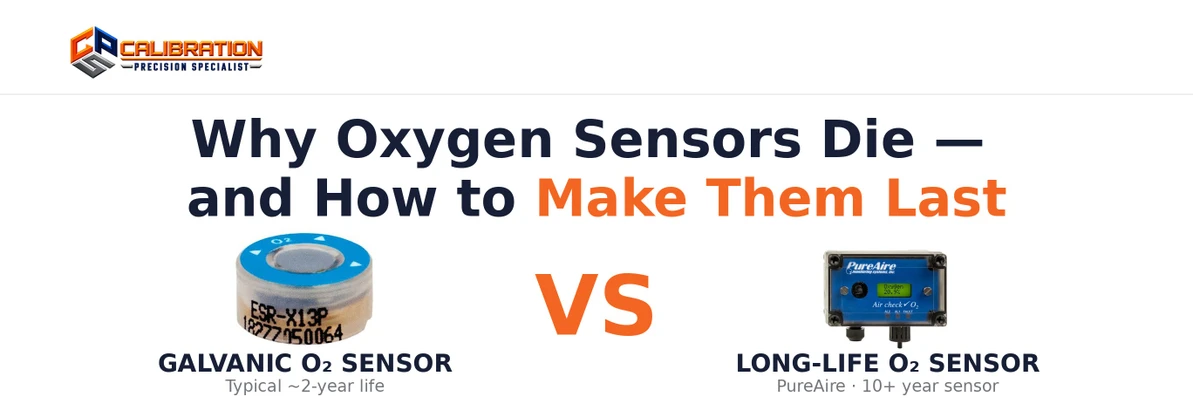
Age on the shelf. The sensor doesn't know it's not installed yet. A replacement sensor sitting in a drawer at 20.9% oxygen is consuming its lead anode at nearly full rate. When you buy a spare O₂ sensor, check the manufacture date — RKI date-stamps their sensors (you can see the code printed right on the ESR-X13P sensor body). A "new" sensor that's already two years old is a sensor that's mostly used up.
Storage conditions. The good news: the chemistry can be slowed. Sensors shipped in sealed, nitrogen-flushed packaging barely age until the seal is broken. Keep that seal intact until install day, and store spares cool and sealed.
Contaminants. Solvent vapors and some chemicals can damage the membrane and electrolyte. This isn't the everyday killer that heat and age are, but it's real — another reason the sensor's environment matters.
How a Dying O₂ Sensor Behaves
A galvanic O₂ sensor doesn't usually die suddenly. It fades — and the fade has a pattern worth knowing:
- It fails calibration first. The classic symptom: the O₂ channel passes its fresh-air zero just fine, but won't reach span, or the calibration takes longer and longer to settle. The sensor can still see oxygen, but its output has dropped below what the instrument expects. The calibration routine is telling you the truth — listen to it.
- Response gets sluggish. A fresh sensor snaps to a new reading. An aging one lags. In a confined space, where oxygen can drop fast, a slow sensor is a dangerous sensor.
- Eventually it reads low or flatlines. A fully depleted cell produces little or no current — the reading drops toward zero. Ironically, this is the honest failure: it alarms, and you know something's wrong.
The insidious phase is the middle one — reduced sensitivity that still passes a casual glance. The display reads 20.9% in fresh air and looks fine. But the sensor's ability to track a real drop is degraded. This is exactly what a bump test is designed to catch: expose the sensor to a known challenge gas and verify it actually responds, not just that it sits at 20.9%.
For confined-space work, this matters more than any other channel. Oxygen deficiency is the number-one killer in confined spaces — more than flammables, more than toxics. The O₂ channel is arguably the most important sensor in the instrument, and it's the one with the shortest, least negotiable life.
How to Make Them Last
You can't stop the chemistry. But you can stop feeding it:
- Buy fresh, check the date. When a replacement sensor arrives, check the date code before it goes in the drawer. If it's already old, send it back. We stock RKI O₂ replacement sensors for the GX-3R, GX-3R Pro, GX-Force, GX-6100, and GX-9000 series, plus the CO/O₂ combo sensor for the GasWatch 3 and 04 series — and we watch the date codes so you don't have to.
- Keep the seal until install day. Nitrogen-flushed packaging is the sensor's pause button. Don't break it "just to check."
- Store cool. Room temperature or cooler. Never the truck cab, never next to the heater, never in direct sun.
- Bump test before every use. Not weekly, not monthly — every use. It's the only way to catch a sensor that's fading but not yet failed. A bump test takes seconds and it's the cheapest insurance in gas detection.
- Replace on failed calibration — don't negotiate. An O₂ sensor that won't calibrate isn't broken; it's done. It's a consumable, like a filter. Swapping it is the repair. Fighting it with repeated calibration attempts just wastes gas and time.
The Long-Life Alternative: Zirconia
For fixed installations — a room that needs oxygen deficiency monitoring around the clock for years — swapping a galvanic sensor every couple of years gets old fast. That's where a different technology earns its keep.
Zirconia (zirconium dioxide) sensors are solid-state devices that measure oxygen electrochemically at high temperature. There's no lead anode being consumed, so there's no built-in expiration date from the measurement chemistry itself. PureAire builds its Air Check O₂ monitors around this technology — the PureAire 99016 oxygen deficiency monitor carries a sensor rated for 10+ years of service. That's five times the life of a typical galvanic cell, in a wall-mounted unit watching over labs, gas storage rooms, and anywhere nitrogen or other inert gases could displace the air.
It doesn't replace the galvanic sensor in your portable — portables need the small size, low power draw, and fast response that galvanic cells deliver. But for a fixed point you never want to think about, long-life zirconia is the right answer.
The Calibration Reality Nobody Skips
O₂ is part of every 4-gas calibration that comes through our lab, and we treat it with the respect its short life demands. Every channel — O₂ included — gets bump-tested, zeroed in clean air, and spanned against NIST-traceable calibration gas. The certificate shows as-found and as-left readings, so when an O₂ sensor arrives fading, you see it in the data: sluggish response, weak span, the signature of a cell near the end of its chemistry.
We calibrate every channel — gas detection and process instruments alike — and if your O₂ sensor is done, we'll tell you straight and get a fresh, date-checked replacement in. Call us at 865-900-8844 or ship your detectors to our lab — or have us come to your facility and we'll check the whole fleet on site.
The Bottom Line
Your oxygen sensor is the hardest-working, shortest-lived part of your gas detector — and it's guarding against the hazard most likely to kill in a confined space. Respect the chemistry: buy fresh, store cool, keep the seal, bump test every time, and replace the sensor when calibration says it's done. For fixed installations where you don't want to touch the sensor for a decade, long-life zirconia is worth a look.
The sensor is only as trustworthy as its last verification. Keep it honest.
Shopping for instruments or replacement sensors? Browse portable gas detection — 4-gas workhorses like the RKI GX-3R and SENKO SP-MGT — or shop O₂ sensors directly: the RKI O₂ replacement sensor and the PureAire 99016 with 10+ year sensor. Need your fleet verified? Ship your detectors to our lab or have us come to your facility — gas detection and process instruments alike.
Frequently Asked Questions
How long do oxygen sensors last? Typical galvanic O₂ sensors last 1–2 years in a portable instrument at normal temperatures. Heat shortens that significantly, and shelf time counts — the sensor ages whether it's installed or not. Zirconia-based fixed monitors, like the PureAire 99016, are rated for 10+ years.
Why does my O₂ channel fail calibration? Almost always because the sensor is near the end of its life. It can usually still zero in fresh air, but its output has dropped too far to reach span. This is the normal end-of-life signature of a galvanic cell — replace the sensor rather than fighting the calibration.
Does an O₂ sensor die in storage? Yes, if it's exposed to air. A sealed sensor in nitrogen-flushed packaging barely ages; an unsealed sensor in a drawer at 20.9% oxygen consumes itself at nearly full rate. Keep the seal intact until install day and check the date code.
Can heat really kill an O₂ sensor? Heat accelerates the chemical reaction that consumes the sensor's lead anode, shortening its life — sometimes dramatically. Don't leave monitors in hot vehicles or in direct sun.
What is a zirconia oxygen sensor? A solid-state sensor made of zirconium dioxide that measures oxygen at high temperature. With no consumable anode, it lasts far longer than galvanic cells — 10+ years in products like the PureAire Air Check O₂. It's ideal for fixed installations; portables still use galvanic cells for size, power, and response speed.
How do I know when to replace my O₂ sensor? When it fails calibration or span, when response gets sluggish on a bump test, or when it's past its expected life based on the date code. When in doubt, replace it — it's a consumable, and it's guarding against the deadliest confined-space hazard.
Recent Posts
-

Electrochemical Toxic Sensors: Cross-Sensitivities That Fool Your Readings
Your carbon monoxide alarm goes off in the battery room. You sweep the area — there's no CO source a …Oct 8th 2026 -

Why Oxygen Sensors Die — and How to Make Them Last
Every 4-gas monitor has an oxygen channel, and it's the only channel with a built-in expiration date …Oct 7th 2026 -
Catalytic Bead vs. Infrared LEL Sensors: When Each Wins
Most gas detectors read %LEL the same way on the display. What's happening behind that number is any …Oct 6th 2026