
What Are the Key Differences Between the GX-6000 and GX-6100?
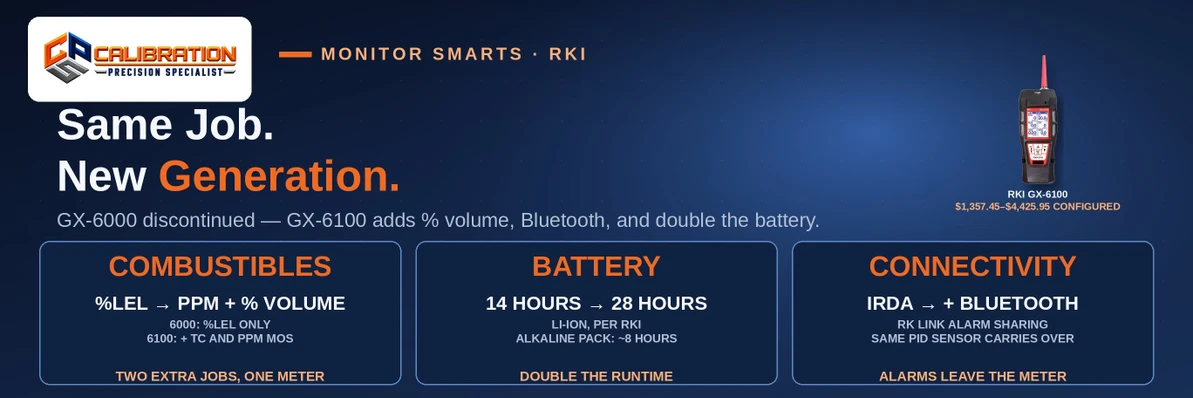
The RKI GX-6100 is the current replacement for the discontinued GX-6000: both are pumped 6-gas monitors with two smart sensor slots and the same PID options (10.0, 10.6 and 11.7 eV), but the GX-6100 doubles battery life from 14 to up to 28 hours, adds Bluetooth on top of IrDA, and measures combustibles in ppm, %LEL and % volume where the GX-6000 read %LEL only.
RKI published its own short Q&A when the GX-6100 replaced the GX-6000. This post takes those manufacturer facts and answers the questions RKI’s announcement cannot: what a GX-6000 owner should actually do now, which differences change daily work, and which are spec-sheet decoration. It is a same-brand sibling comparison — the only kind we publish — and every figure below comes from RKI’s GX-6100 data or RKI’s own difference list, checked at write time.
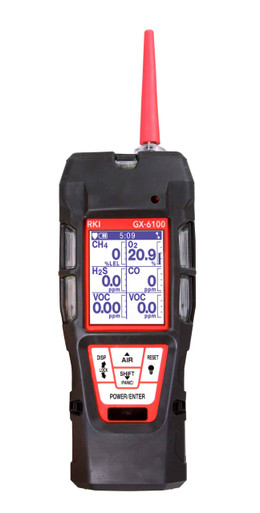
RKI GX-6100 Pumped 6-Gas Monitor – PID, VOC & Multi-Gas
Pumped 6-gas monitor — the current replacement for the GX-6000, with ppm/%LEL/% volume combustibles and Bluetooth.
$1,357.45–$4,425.95 configured
See the GX-6100GX-6000 vs. GX-6100: The Head-to-Head Table
| Feature | GX-6000 (discontinued) | GX-6100 (current) |
|---|---|---|
| Status | Discontinued — no longer the current model | Current model and GX-6000 replacement |
| Combustible measurement | %LEL only | PPM, %LEL and % volume in the same instrument |
| Combustible sensors | Earlier sensor configurations | Adds a thermal-conductivity (TC) sensor for % volume and new ppm MOS sensors for methane and hydrocarbons |
| Battery (Li-ion) | 14 hours | Up to 28 hours (8 hours on the alkaline pack) |
| Data / connectivity | IrDA only — no Bluetooth | IrDA plus Bluetooth for alarm sharing through the RK Link app |
| Standard 4-gas sensors | Earlier-generation sensors | New R-series sensors shared with the GX-3R, GX-3R Pro and GX-Force, with up to a 3-year sensor warranty |
| PID | PID options at 10.0, 10.6 and 11.7 eV | Same PID sensor as the GX-6000 — PID performance carries over |
| Shared core | Up to 6 gases, 2 smart slots, internal pump, IR and super-toxic options, man-down and panic alarms, flashlight, leak-check mode, IP67 | Same — the job and the form factor did not change |
Why Does the Combustible Range Matter So Much?
%LEL answers one question: how close is this atmosphere to exploding, as a percentage of the lower explosive limit? It is the right scale for entry decisions, and it is the only combustible scale the GX-6000 offered. Two common jobs need other scales. Leak checking works in ppm — a leak you are hunting is far below 1% LEL, and a %LEL display barely moves. Line purging and inerting checks work in % volume — the gas is at or above 100% LEL by design, where a %LEL sensor is over range. The GX-6100 covers all three scales in one instrument: ppm MOS sensors for the low end, the standard LEL channel for entry work, and a thermal-conductivity sensor for % volume. That is not a nicer display — it is two extra jobs the same meter can now legally and usefully do. Our %LEL vs. % volume explainer walks through the scales themselves.
What Changes in Daily Work?
Battery. 14 hours versus up to 28 hours on Li-ion is the difference between charging every night without fail and having margin on a long turnaround day. The GX-6100 also accepts an alkaline pack (about 8 hours) for sites where charging is impractical.
Alarms that leave the instrument. The GX-6000 moved data by IrDA only — a deliberate, at-the-desk transfer. The GX-6100 adds Bluetooth and RKI’s RK Link app, so alarm notifications can be shared off the instrument while the work is happening, not just downloaded after it.
Sensor stocking. The GX-6100’s 4-gas R-series sensors are the same family used in the GX-3R, GX-3R Pro and GX-Force, with up to a 3-year warranty. A mixed RKI fleet standardizes on fewer spare sensors. The GX-6000’s earlier-generation sensors do not share that pool.
What Did Not Change?
Deliberately, a lot. Both instruments monitor up to 6 gases: the standard four (LEL, O2, CO, H2S) plus two interchangeable smart sensor slots accepting PID, IR, ppm and super-toxic sensors. The PID sensor itself is the same unit, with 10.0, 10.6 and 11.7 eV lamps and a 600-plus VOC library — see our PID correction-factor chart guide for how those readings convert. Both are pumped sample-draw instruments with man-down and panic alarms, a flashlight, leak-check mode and IP67 sealing. A crew’s GX-6000 habits — bump, draw, read, log — transfer directly.
You Own a GX-6000. What Should You Do Now?
Keep using it while it passes. A discontinued badge does not change a reading. Keep the bump tests and calibrations current, and the instrument remains a working 6-gas monitor. CPS still calibrates and services the GX-6000 — every channel as configured, full certificate — through the same bench process as our GX-6100 calibration service.
Plan for the platform’s tail. On any discontinued instrument, sensors, pumps and boards get scarcer and pricier over time, and a single major repair can approach the value of the meter. Ask for a written repair quote before authorizing major work on a 6000, and compare it honestly against a configured 6100 at $1,357.45–$4,425.95.
Upgrade on a trigger, not on a date. The triggers that justify the move: ppm leak-check or % volume purge work the 6000 cannot do, shifts that outrun a 14-hour battery, a requirement for Bluetooth alarm sharing, or consolidating spares across a GX-3R / GX-Force fleet. Browse the wider pumped monitor range if the replacement conversation opens up beyond one model.
Frequently Asked Questions
1. Is the RKI GX-6000 discontinued?
Yes. Per RKI, the GX-6000 has been discontinued and the GX-6100 is its current replacement. A GX-6000 you already own is not obsolete overnight — it can still be bump tested, calibrated and used — but new purchases, and planning for parts and sensor support over time, should assume the 6100 platform.
2. What is the main difference between the GX-6000 and GX-6100?
Combustible range. The GX-6000 measured combustibles in %LEL only; the GX-6100 measures them in ppm, %LEL and % volume in the same instrument, using a thermal-conductivity sensor for % volume and new ppm MOS sensors for low-level methane and hydrocarbons. That one change covers leak checking in ppm and purge work in % volume that the 6000 could not do.
3. How long does the GX-6100 battery last compared to the GX-6000?
Up to 28 hours on the Li-ion pack, versus 14 hours for the GX-6000 — double. On the alkaline pack the GX-6100 runs about 8 hours. In practice, 28 hours covers multi-shift turnaround work without a mid-job charge; 14 hours often does not.
4. Does the GX-6100 have Bluetooth?
Yes. The GX-6100 keeps IrDA data transfer and adds Bluetooth, used with RKI’s RK Link app for sharing alarm notifications. The GX-6000 was IrDA only, with no Bluetooth capability.
5. Do the GX-6000 and GX-6100 use the same PID sensor?
Yes. RKI states the GX-6100 uses the same PID sensor as the GX-6000, with the same lamp options — 10.0, 10.6 (two ranges) and 11.7 eV — and a library of over 600 VOCs. If your VOC method was built around the 6000’s PID, it carries over to the 6100.
6. Are GX-6100 sensors interchangeable with other RKI monitors?
The GX-6100’s standard 4-gas R-series sensors (LEL, O2, CO, H2S) are shared with the GX-3R, GX-3R Pro and GX-Force and carry up to a 3-year warranty. Fleets running those models alongside a 6100 can stock fewer spare sensor types. GX-6000 sensors are an earlier generation and should not be assumed interchangeable — match sensors by model before ordering.
7. Can CPS still calibrate my GX-6000?
Yes. CPS calibrates and services the GX-6000 as well as the GX-6100 — discontinuation by the manufacturer does not end bench support at CPS. Every channel is calibrated as configured, with as-found and as-left data and a full certificate. See our GX-6100 calibration service for how the bench work runs; the same process covers the 6000.
8. How much does the RKI GX-6100 cost?
At CPS the GX-6100 is $1,357.45–$4,425.95 configured, depending on the sensor combination fitted in its two smart slots — a base 4-gas build sits at the low end and dual-PID, IR, TC or super-toxic builds at the high end. Price the exact configuration you need on the GX-6100 product page, not a headline number.
9. Should I upgrade from a GX-6000 to a GX-6100 now?
Upgrade when a trigger applies: you need ppm leak checking or % volume / purge measurement, your crews run past 14 hours between charges, you want Bluetooth alarm sharing or logged data without an IrDA cradle workflow, or a 6000 needs a repair large enough that the money is better spent on the current platform. If none applies and your 6000 passes calibration, keeping it in service is a defensible, honest choice.
10. What stays the same between the GX-6000 and GX-6100?
The core job: up to 6 gases at once, the standard 4 confined-space gases plus two interchangeable smart sensor slots, an internal sample pump (the GX-6100 draws up to 100 feet), PID, IR and super-toxic options, man-down and panic alarms, an LED flashlight, leak-check mode, and an IP67 dust- and water-resistant case. Crews trained on the 6000 do not start over on the 6100.
The Bottom Line
The GX-6100 is not a different instrument from the GX-6000 — it is the same 6-gas, pumped, PID-capable platform with the three limits of the old model removed: %LEL-only combustibles, a 14-hour battery, and IrDA-only data. If your GX-6000 passes calibration and none of those three limits bites your work, keep it and let CPS keep it honest. When one of them does bite — or a major repair lands — the GX-6100 at $1,357.45–$4,425.95 configured is the replacement RKI built for exactly that moment.
Need a calibration you can file?
In-house calibration at CPS in Rockwood, Tennessee — $55 for single-gas instruments, $90 for 4- and 5-gas — every channel, as-found and as-left data, full certificate.
See Calibration Servicesor call 865-900-8844
Recent Posts
-

What Is Remote Monitoring for Fixed Gas Detection?
Remote monitoring for fixed gas detection means a fixed system's live readings, trends, and alarm hi …Nov 23rd 2026 -

What Are the Key Differences Between the GX-6000 and GX-6100?
The RKI GX-6100 is the current replacement for the discontinued GX-6000: both are pumped 6-gas monit …Nov 22nd 2026 -

How to Read a PID Correction Factor Chart
To read a PID correction factor chart, find your vapor’s row, take the factor under your own lamp en …Nov 21st 2026