
%LEL vs. % Volume: What's the Difference?
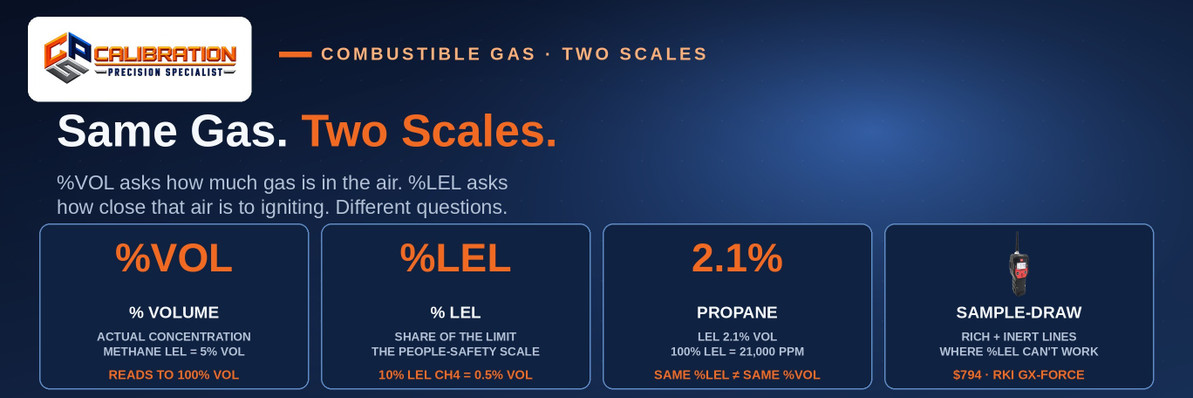
%LEL and % volume measure the same gas two different ways: %VOL is the gas's actual share of the air — methane becomes explosive at 5% VOL — while %LEL is the percentage of the way to that explosive limit, so 100% LEL methane = 5% VOL = 50,000 ppm and 10% LEL = 0.5% VOL. Because every gas has a different explosive limit (propane 2.1% VOL, hydrogen 4% VOL), the same %LEL reading is a different %VOL — and a different ppm — for every gas.
Both scales appear on combustible-gas instruments, sometimes on the same instrument, and they answer different questions. %VOL answers "how much gas is in this air?" %LEL answers "how close is this air to igniting?" Confusing the two understates some hazards and overstates others — this post works the conversions, shows when each scale is the right one, and explains why the sample-draw head on a process line reads %VOL instead of %LEL. If ppm is the unfamiliar unit, start with what ppm means in gas detection.
What Does % Volume Measure?
The gas's literal share of the air, by volume. 5% VOL methane means 5 of every 100 molecules in that air are methane — 50,000 ppm. %VOL is an absolute concentration: it does not depend on which gas it is, what its properties are, or what anyone plans to do about it. Oxygen is read on this scale (normal air is 20.9% VOL), and so are high-range combustible measurements: a %VOL instrument can read from clean air all the way to 100% VOL, pure gas. That full range is exactly what %LEL cannot do.
What Does %LEL Measure?
The percentage of the way to the lower explosive limit — the minimum concentration in air that will ignite. Each combustible gas has its own LEL, expressed in %VOL: methane 5%, propane 2.1%, hydrogen 4%. %LEL rescales each gas so that its ignition point sits at the same number — 100. A reading of 10% LEL therefore means "one-tenth of the way to an ignitable mixture" for any gas, which is why safety alarms are set in %LEL: 10% LEL methane and 10% LEL propane carry the same urgency even though they are 0.5% VOL and 0.21% VOL — different concentrations, same fraction of the danger line. Monitors in portable multi-gas monitors display combustible gas this way, and confined-space practice treats readings on this scale as the go/no-go number.
How Do the Two Scales Convert, Gas by Gas?
Through the gas's own LEL. %VOL = %LEL × (LEL in %VOL) ÷ 100 — and the ppm column follows from %VOL × 10,000:
| Gas (LEL) | 10% LEL | 50% LEL | 100% LEL |
|---|---|---|---|
| Methane (5% VOL) | 0.5% VOL · 5,000 ppm | 2.5% VOL · 25,000 ppm | 5% VOL · 50,000 ppm |
| Propane (2.1% VOL) | 0.21% VOL · 2,100 ppm | 1.05% VOL · 10,500 ppm | 2.1% VOL · 21,000 ppm |
| Hydrogen (4% VOL) | 0.4% VOL · 4,000 ppm | 2% VOL · 20,000 ppm | 4% VOL · 40,000 ppm |
Read the table both ways. Down a column, the urgency is constant — every 10% LEL is one-tenth of the way to ignition — while the actual concentration changes by more than a factor of two between methane and propane. That is the entire argument for %LEL as the safety scale, and the entire reason %LEL numbers cannot be compared as concentrations.
When Is Each Scale Used?
%LEL for people-safety in open and confined work areas. Personal and area monitors alarm on %LEL because the question is ignition risk, and the scale normalizes every gas to the same danger line. Low alarms around 10% LEL give a working margin — nine-tenths of the distance to the limit still in hand.
%VOL for process, purging, and rich atmospheres. When the job is measuring the gas itself — clearing a line, verifying a purge, checking an inerted vessel, or sampling a stream that may be mostly fuel — the concentration can sit at or far above the LEL, where a %LEL display has nothing left to say. %VOL reads the whole 0–100% range, so it can watch a concentration fall from 80% VOL down through the explosive range and out the bottom during a purge, or confirm a vessel is truly inerted rather than merely below an alarm point.
Why Does a Sample-Draw Head Read %VOL?
Because of where it samples and what its sensor needs. The standard %LEL sensor — a catalytic bead — measures by burning a trace of the gas on a heated element, and burning requires oxygen. In a rich or inerted sample — a sample-draw head pulling from a tank, duct, or process line where gas may have displaced the air — there may not be enough oxygen for that measurement to work at all, and a concentration above 100% LEL over-ranges the scale instead of reading. A %VOL-range measurement does not depend on combustion in the same way and covers the full 0–100% VOL range, so the sample-draw head can report the actual concentration in exactly the atmospheres where %LEL fails: too rich, too inert, or both. A pumped instrument such as the RKI GX-Force ($794) draws the sample to the instrument from outside the space — the working pattern for pre-entry testing — while the entrant's personal monitor, such as the RKI GX-3R ($640), reads %LEL in the breathing zone where ignition risk is the question.
Can You Compare a %LEL Reading to a %VOL Limit Directly?
Not without converting, and not across gases at all. A procedure written as "stop work above 1% VOL" and an instrument reading %LEL disagree silently: 1% VOL methane is 20% LEL, but 1% VOL propane is about 48% LEL — nearly halfway to ignition under a limit that sounded identical. Convert first, with the gas's own LEL, every time. The same discipline applies to toxic limits, which are written in ppm by an entirely different set of authorities — what a PEL is explains who sets those numbers.
Calibration is what keeps both scales honest. A combustible channel is calibrated against a known gas, and its %LEL and %VOL readings both descend from that one calibration — drift moves both scales together. We calibrate every channel on the instruments above, through calibration services — in-house at our Rockwood, Tennessee shop, or shipped in from anywhere.
Frequently Asked Questions
What is the difference between %LEL and % volume?
%VOL is the gas's actual share of the air — 5% VOL methane means 5 of every 100 molecules are methane. %LEL is the percentage of the way to that gas's lower explosive limit — the concentration that will ignite. Methane's LEL is 5% VOL, so 100% LEL methane = 5% VOL, and 10% LEL = 0.5% VOL. %VOL is an absolute concentration; %LEL is a relative danger scale that resets for every gas.
What is 100% LEL in percent volume?
It depends on the gas, because 100% LEL is that gas's explosive limit by definition: 5% VOL for methane, 2.1% VOL for propane, and 4% VOL for hydrogen. In ppm, those are 50,000 ppm, 21,000 ppm, and 40,000 ppm respectively. There is no single %VOL value for 100% LEL — anyone who gives you one without naming the gas is leaving out the number that matters.
How do you convert %LEL to %VOL?
Multiply the %LEL reading by the gas's LEL (in %VOL) and divide by 100. Methane at 50% LEL: 50 × 5 ÷ 100 = 2.5% VOL. Propane at 50% LEL: 50 × 2.1 ÷ 100 = 1.05% VOL. To get ppm from there, multiply %VOL by 10,000 — 2.5% VOL methane = 25,000 ppm. The conversion always runs through the specific gas's LEL.
How many ppm is 10% LEL methane?
5,000 ppm. Ten percent of methane's 5% VOL explosive limit is 0.5% VOL, and 0.5 × 10,000 = 5,000 ppm. For comparison, 10% LEL propane is 2,100 ppm (0.21% VOL) and 10% LEL hydrogen is 4,000 ppm (0.4% VOL) — the same alarm point on the %LEL scale, at three different actual concentrations.
Why do gas detectors display %LEL instead of %VOL?
Because the safety question is "how close is this air to igniting?", and %LEL answers it identically for every gas: 10% LEL is one-tenth of the way to an ignitable mixture whether the gas is methane, propane, or hydrogen. On a %VOL display, the danger line would move with every gas — 5% for methane, 2.1% for propane — and every alarm setpoint would have to be re-derived per gas. %LEL keeps one memorable rule: act at low double digits, never approach 100.
What does 10% LEL mean?
It means the atmosphere holds one-tenth of the concentration needed to ignite — for methane, 0.5% VOL (5,000 ppm); for propane, 0.21% VOL (2,100 ppm). It is a common low-alarm and action level precisely because it leaves a wide margin: at 10% LEL, nine-tenths of the distance to the explosive limit remains. It is an early warning, not a safe/unsafe boundary — the trend and the source matter as much as the number.
Why does a sample-draw detector read % volume?
Because sample-draw heads serve rich and inerted atmospheres — tanks, ducts, and process lines — where a %LEL catalytic sensor cannot work: it needs oxygen to burn its trace sample, and its scale ends at 100% LEL. A %VOL-range measurement covers the full 0–100% VOL range without depending on combustion, so it can report actual concentrations during purging, line clearing, and inerting verification, where the gas may be far above its explosive limit.
Is 100% LEL the same concentration for every gas?
No. 100% LEL is each gas's own explosive limit: 5% VOL (50,000 ppm) for methane, 2.1% VOL (21,000 ppm) for propane, 4% VOL (40,000 ppm) for hydrogen. %LEL equalizes the risk — every 100% LEL is an ignitable mixture — while the concentrations underneath differ by more than two to one. That is why %LEL readings can be compared as urgency but never as amounts.
What happens above 100% LEL on an LEL sensor?
The display over-ranges: above 100% LEL the instrument is past the top of its scale and cannot tell you whether the air is at 6% VOL or 60% VOL. The atmosphere is at or beyond the explosive limit, which is an evacuate-and-ventilate condition, not a measurement condition. Reading concentrations in that territory is a %VOL job — the full-range scale used by sample-draw instruments on rich and inerted lines.
How much does it cost to calibrate a gas detector?
At CPS Calibrations, in-house calibration is $55 for a single-gas instrument and $90 for a 4- or 5-gas instrument; ship-in calibration is billed at the same rates. On-site work at your facility is quoted in writing and costs more than bench work. Both display scales descend from the same combustible-channel calibration, so a drifting sensor moves %LEL and %VOL together — another reason the calibration date matters as much as the reading.
The Bottom Line
%VOL tells you how much gas is in the air; %LEL tells you how close that air is to igniting. 100% LEL is 5% VOL for methane, 2.1% for propane, and 4% for hydrogen — so convert with the gas's own limit, use %LEL for people-safety alarms, and use %VOL where the sample can be rich, inerted, or above the explosive limit, which is exactly where sample-draw heads work.
Not sure which scale your application needs? Call CPS Calibrations at 865-900-8844 — monitors, calibration, and the CPS Calibration Program behind them, from Rockwood, Tennessee.
CPS Calibrations · 109 S. Front Street, Rockwood, TN 37854 · Calibration Services · The CPS Calibration Program
Need a calibration you can file?
In-house calibration at CPS in Rockwood, Tennessee — $55 for single-gas instruments, $90 for 4- and 5-gas — every channel, as-found and as-left data, full certificate.
See Calibration Servicesor call 865-900-8844
Recent Posts
-

Can You Add a Pump to a SENKO SGT-P or MGT?
Yes — SENKO's SP-Pump101 external sampling pump ($330, part AAA006000) fits the SGT, SGT-P, and MGT, …Nov 12th 2026 -

What Refrigerant Detection Does a Grocery Store Need?
A grocery store needs refrigerant detection in three places: low-mounted carbon dioxide (R-744) sens …Nov 11th 2026 -

What Is LEL and UEL? The Explosive Range, Gas by Gas
The LEL is the lowest concentration of a gas in air that can explode, and the UEL is the highest: me …Nov 10th 2026