
What Is a PEL? Permissible Exposure Limits, Explained
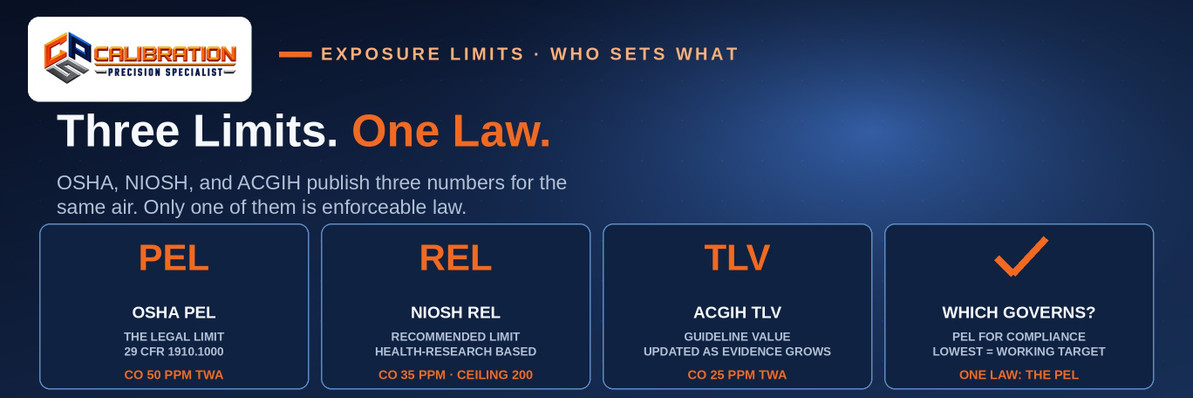
A PEL (permissible exposure limit) is OSHA's legally enforceable limit on how much of a gas a worker may breathe, published in 29 CFR 1910.1000 — and it is only one of three numbers on the same air: for carbon monoxide, OSHA's PEL is 50 ppm as an 8-hour average, NIOSH's recommended REL is lower at 35 ppm (with a 200 ppm ceiling), and ACGIH's TLV guideline is 25 ppm. The OSHA PEL is the number that governs legal compliance; the REL and TLV are recommendations many safety programs adopt as their working target because they are more protective.
Three organizations publish exposure limits for the same gases, the numbers often differ, and only one set carries the force of law. This post separates them — who sets what, what TWA, STEL, and ceiling actually mean, a verified three-gas comparison table, and which number governs when they disagree. For the unit these limits are written in, see what ppm means in gas detection.
What Is a Permissible Exposure Limit?
A PEL is the maximum concentration of a substance in air that a worker may be exposed to under OSHA rules, expressed for gases in ppm and usually as an 8-hour time-weighted average (TWA). Federal OSHA's PELs for general industry sit in 29 CFR 1910.1000 — most air contaminants in Table Z-1, a set with special structures (including hydrogen sulfide) in Table Z-2. Exceeding a PEL is a compliance violation: the limit is not advice, it is the legal line an employer's exposure controls have to hold. Note what a PEL is not: it is not an alarm setpoint handed down by OSHA for your detector, and it is not a guarantee of safety for every worker — it is the enforceable ceiling on average exposure around which a safety program is built.
Who Sets PELs, RELs, and TLVs?
| Limit | Set by | Legal force | Basis |
|---|---|---|---|
| PEL — Permissible Exposure Limit | OSHA (U.S. Department of Labor) | Enforceable law (29 CFR 1910.1000) | Health evidence weighed with feasibility when the standard was adopted |
| REL — Recommended Exposure Limit | NIOSH (CDC's occupational-health institute) | Recommendation — not enforceable by itself | Health research; RELs are typically set for up to a 10-hour workday |
| TLV — Threshold Limit Value | ACGIH (professional association of industrial hygienists) | Guideline — not law, unless separately adopted | Scientific review, updated as evidence develops |
The practical consequence: NIOSH and ACGIH review health evidence continuously and frequently land lower — more protective — than OSHA, whose PELs change only through full rulemaking and are older for many substances. That is why the three columns disagree, most visibly for hydrogen sulfide below. State-plan states can also enforce limits stricter than federal OSHA's — the federal PEL is the floor of protection, not the ceiling.
What Are the Three Limits for Common Gases?
Verified against OSHA and NIOSH sources. Carbon monoxide is worked in full in carbon monoxide exposure limits: OSHA, NIOSH, and ACGIH.
| Gas | OSHA PEL | NIOSH REL | ACGIH TLV |
|---|---|---|---|
| Carbon monoxide (CO) | 50 ppm TWA | 35 ppm TWA · 200 ppm ceiling | 25 ppm TWA |
| Hydrogen sulfide (H2S) | 20 ppm ceiling · 50 ppm peak, 10 minutes, once per shift if no other measurable exposure | 10 ppm ceiling (10 minutes) | 1 ppm TWA · 5 ppm STEL |
| Ammonia (NH3) | 50 ppm TWA | 25 ppm TWA · 35 ppm STEL | 25 ppm TWA · 35 ppm STEL |
Read H2S row carefully, because it teaches the whole system: OSHA's enforceable structure is a 20 ppm ceiling, NIOSH recommends never exceeding 10 ppm even briefly, and ACGIH's guideline average is 1 ppm — twenty times lower than the legal ceiling. A program that alarms only at the OSHA number is legal on that point and still far from best practice. Instruments carried for these gases — portable multi-gas monitors like the RKI GX-3R ($640) — alarm on instantaneous readings, which is why ceiling and STEL values matter to detector settings, not just TWA math.
What Do TWA, STEL, and Ceiling Mean?
TWA (time-weighted average) is the average concentration over the workday — 8 hours for OSHA PELs and ACGIH TLVs, up to 10 hours for NIOSH RELs. Brief excursions above a TWA are averaged against cleaner air below it; the average is the compliance number.
STEL (short-term exposure limit) is a 15-minute average that must not be exceeded even when the full-day TWA is within limits — it caps the peaks the TWA would otherwise forgive.
Ceiling is an instantaneous line: the concentration that must not be exceeded at any moment, however briefly. NIOSH's 200 ppm ceiling for CO and 10 ppm 10-minute ceiling for H2S, and OSHA's 20 ppm H2S ceiling, are ceiling-type limits — no averaging saves an excursion above them.
Which Number Governs When They Disagree?
For legal compliance, the OSHA PEL (or a stricter state-plan limit where one applies) — that is the number an inspection measures against. For the safety program's working target, many employers adopt the lowest of the three — usually the REL or TLV — because those reflect the more current health evidence, and a program holding CO to ACGIH's 25 ppm average or H2S to NIOSH's 10 ppm ceiling is automatically inside the OSHA line. What no program may do is treat a REL or TLV as permission to exceed a PEL: the recommendation can tighten the legal limit in practice, never loosen it. Above all three systems sits the emergency line — the IDLH, the concentration immediately dangerous to life or health (100 ppm for H2S, 1,200 ppm for CO) — explained in what IDLH means. Combustible limits run on a separate scale entirely, covered in %LEL vs. % volume.
Calibration is what makes any limit real. A limit is a number on a page until an instrument measures your air against it — and a CO channel drifting low will happily report 35 ppm in air that is over the 50 ppm PEL. We calibrate every channel on the instruments above, through calibration services — in-house at our Rockwood, Tennessee shop, or shipped in from anywhere.
Frequently Asked Questions
What is a PEL in gas detection?
A PEL is a permissible exposure limit: OSHA's legally enforceable cap on how much of a gas a worker may breathe, published in 29 CFR 1910.1000 and expressed in ppm, usually as an 8-hour time-weighted average. Carbon monoxide's PEL is 50 ppm TWA and ammonia's is 50 ppm TWA; hydrogen sulfide's is structured as a 20 ppm ceiling. A PEL is the legal line a workplace exposure program must hold — not an alarm setpoint and not a guarantee for every individual.
Who sets permissible exposure limits?
OSHA — the Occupational Safety and Health Administration, part of the U.S. Department of Labor — sets and enforces PELs for general industry in 29 CFR 1910.1000 (Tables Z-1 and Z-2). Two other bodies publish limits for the same gases without legal force of their own: NIOSH, the CDC's occupational-health research institute, issues recommended exposure limits (RELs), and ACGIH, a professional association of industrial hygienists, issues threshold limit values (TLVs).
What is the difference between a PEL, a REL, and a TLV?
Authority and number. A PEL is OSHA's law, enforceable with citations. A REL is NIOSH's health-research recommendation, typically written for up to a 10-hour day. A TLV is ACGIH's scientific guideline, updated as evidence develops. For carbon monoxide the three are 50 ppm (PEL), 35 ppm (REL), and 25 ppm (TLV) as time-weighted averages; for hydrogen sulfide they diverge further — a 20 ppm OSHA ceiling versus a 1 ppm ACGIH average.
Which exposure limit is legally enforceable?
The OSHA PEL — or a state-plan state's own limit, which must be at least as protective and can be stricter. RELs and TLVs are not enforceable by themselves, though they can become binding when an employer adopts them into its own program or a contract requires them. Exceeding a PEL is a compliance violation; exceeding a REL or TLV is evidence that the more current health guidance says exposure should come down.
What does TWA mean in an exposure limit?
TWA means time-weighted average: the average concentration over the reference period — 8 hours for OSHA PELs and ACGIH TLVs, up to 10 hours for NIOSH RELs. Short excursions above a TWA limit are averaged against lower exposures during the same shift; the shift average is the number compared to the limit. TWA is why a momentary detector reading above 50 ppm CO is not automatically a PEL violation — and why averaging never applies to ceiling limits.
What is a ceiling limit?
A ceiling is a concentration that must not be exceeded at any moment, with no averaging. OSHA's hydrogen sulfide PEL is a 20 ppm ceiling (with a narrow 50 ppm, 10-minute peak exception once per shift when no other measurable exposure occurs). NIOSH sets a 200 ppm ceiling for carbon monoxide and a 10 ppm 10-minute ceiling for hydrogen sulfide. Ceiling limits are the values that map most directly onto instantaneous detector alarms.
What is the OSHA PEL for carbon monoxide?
50 ppm as an 8-hour time-weighted average (29 CFR 1910.1000, Table Z-1). For context, NIOSH's REL is 35 ppm TWA with a 200 ppm ceiling, and ACGIH's TLV is 25 ppm TWA — both lower than the legal limit. The full comparison, including what each number is based on, is in carbon monoxide exposure limits: OSHA, NIOSH, and ACGIH.
What is the OSHA PEL for hydrogen sulfide?
For general industry, a 20 ppm ceiling — exposure must not exceed 20 ppm, except for a single peak up to 50 ppm lasting no more than 10 minutes in a shift with no other measurable exposure (Table Z-2). NIOSH recommends a 10 ppm ceiling over 10 minutes, and ACGIH's TLV is 1 ppm as an 8-hour TWA with a 5 ppm STEL. H2S is immediately dangerous at 100 ppm (IDLH).
What happens if a PEL is exceeded?
The employer is out of compliance with an enforceable OSHA standard and can be cited and required to bring exposure down — through engineering controls, work practice changes, and respiratory protection where required. Exposure above a PEL is also a health event, not just a paperwork one: the controls have to change, not just the record. Programs that track the lower REL or TLV as their working target usually find the exceedance in their own monitoring long before it becomes an OSHA exceedance.
How much does it cost to calibrate a gas detector?
At CPS Calibrations, in-house calibration is $55 for a single-gas instrument and $90 for a 4- or 5-gas instrument; ship-in calibration is billed at the same rates. On-site work at your facility is quoted in writing and costs more than bench work. Calibration is the link between this page and your air: every PEL, REL, and TLV comparison assumes the instrument's ppm reading is true, and only calibration keeps it that way.
The Bottom Line
A PEL is OSHA's enforceable exposure limit (29 CFR 1910.1000); a REL is NIOSH's recommendation and a TLV is ACGIH's guideline, and both usually sit lower — CO at 50/35/25 ppm, H2S at a 20 ppm ceiling versus a 1 ppm guideline average, ammonia at 50 versus 25 ppm. The PEL governs legal compliance, the lowest number makes the soundest working target, and only a calibrated instrument can tell you where your air stands against any of them.
Building an exposure-monitoring program around real limits? Call CPS Calibrations at 865-900-8844 — monitors, calibration, and the CPS Calibration Program behind them, from Rockwood, Tennessee.
CPS Calibrations · 109 S. Front Street, Rockwood, TN 37854 · Calibration Services · The CPS Calibration Program
Need a calibration you can file?
In-house calibration at CPS in Rockwood, Tennessee — $55 for single-gas instruments, $90 for 4- and 5-gas — every channel, as-found and as-left data, full certificate.
See Calibration Servicesor call 865-900-8844
Recent Posts
-
Can You Add a Pump to a SENKO SGT-P or MGT?
Yes — SENKO's SP-Pump101 external sampling pump ($330, part AAA006000) fits the SGT, SGT-P, and MGT, …Nov 12th 2026 -

What Refrigerant Detection Does a Grocery Store Need?
A grocery store needs refrigerant detection in three places: low-mounted carbon dioxide (R-744) sens …Nov 11th 2026 -

What Is LEL and UEL? The Explosive Range, Gas by Gas
The LEL is the lowest concentration of a gas in air that can explode, and the UEL is the highest: me …Nov 10th 2026