
Can You Add a Pump to a SENKO SGT-P or MGT?
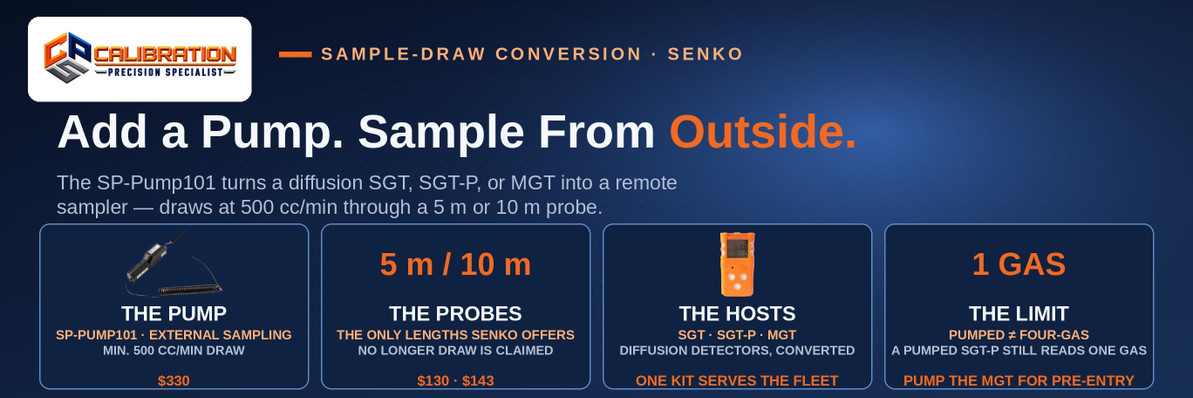
Yes — SENKO's SP-Pump101 external sampling pump ($330, part AAA006000) fits the SGT, SGT-P, and MGT, draws at a minimum of 500 cc/min, and with SENKO's 5 m ($130) or 10 m ($143) extension probe lets a diffusion detector sample a manhole, tank, or vault from outside it — but a pumped single-gas SGT-P still measures only its one gas, so it is not a substitute for a pumped 4-gas pre-entry check.
That distinction is the whole post. The pump conversion is real, inexpensive next to a second instrument, and genuinely useful — and it is also easy to oversell. A pump changes where a detector samples from. It does not change what the detector can measure. Read both halves before you put a converted single-gas unit on a confined-space permit.
This is the companion to our earlier answer for the single-gas model alone — does the SENKO SP-SGTP have a pump? — which covers the SP-SGTP's diffusion design in depth. Here the question is wider: the whole diffusion family, the MGT conversion in particular, and the jobs each converted instrument can and cannot honestly do.
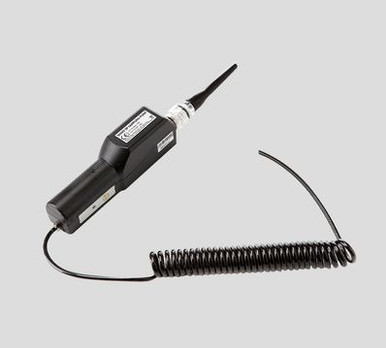
SENKO SP-Pump101 for SGT / SGT-P / MGT Accessory
External sampling pump for SENKO SGT, SGT-P, and MGT detectors — minimum 500 cc/min draw, low-flow and low-battery alarms.
$330
See the SP-Pump101What Is the SP-Pump101, Exactly?
The SENKO SP-Pump101 is an external sampling pump — a separate, hand-held unit that connects to the detector and pulls air to the sensor, instead of the detector waiting for gas to diffuse to it. SENKO's own stated job for it is plain: checking for gas leakage when measuring gas in an underground manhole. The specifications that decide whether it fits your work are these:
- Flow rate: minimum 500 cc/min — half a litre per minute, drawn continuously while the pump runs.
- Alarms that matter: low flow and low battery, both on a red LED. Low flow is the safety-critical one — a kinked, blocked, or split probe can starve the sample, and the pump tells you instead of letting a starved reading pass as a clean space.
- Battery: one 1.5 V AA alkaline, more than 10 hours of life. Separate from the detector's battery — the pump can be flat while the detector is full, so both get checked before the job.
- Size and weight: 30 × 254 × 47 mm, 260 g including the battery. It is a wand-shaped unit about 10 inches long, not a pocket accessory — plan for it in the hand, not on the collar.
- Operating range: −20 °C to +50 °C, 5% to 99% RH (non-condensing).
Two of those numbers shape daily use more than buyers expect. The separate AA battery means the pump is shared equipment with its own readiness check, exactly like a spare instrument: battery in, flow alarm tested, probe inspected. And at 260 g plus the detector, a pumped check is a two-handed, deliberate sampling job — which is what pre-entry testing is supposed to be. Nobody clips this on and forgets it, and that is a feature.
Which SENKO Detectors Does the Pump Fit?
SENKO names three hosts, and only those three should be assumed compatible:
| Detector | Type | Live configured price | What pumping it gives you |
| SENKO SP-SGT | Disposable single-gas, diffusion | $163–$412 | Remote sampling of its one gas — a leak or space check for that gas only |
| SENKO SP-SGTP | Maintainable single-gas, diffusion | $172–$578 | The same one-gas remote sample, on a detector whose sensor and battery you can replace |
| SENKO SP-MGT | Portable 4-gas (LEL, O2, CO, H2S), diffusion | $514–$735 | A genuine pre-entry sample of the standard four gases, drawn from outside the space |
The detector that is deliberately not on that list is the SENKO SP-MGTP ($850–$3,569 configured). It already samples with a built-in pump — it does not need the SP-Pump101, and it is the step-up to compare against when remote sampling stops being an occasional job and becomes the instrument's main work.
Compatibility discipline matters here because the SENKO names are close enough to confuse: SGT, SGT-P, MGT, and MGTP are four different instruments. If your fleet list just says "SENKO," check the model on the unit before ordering the pump — or call us and read us the model off the case.
The Kit, Priced Honestly
The pump alone does not reach into a space. The working kit is the pump plus a probe, and SENKO offers exactly two probe lengths:
- SP-Pump101 — $330
- Extension Probe 5M — $130 (5 metres, about 16 feet)
- Extension Probe 10M — $143 (10 metres, about 33 feet)
So the conversion costs $460 with the 5 m probe or $473 with the 10 m probe, on top of a detector you may already own. That last phrase is where the economics live:
- Already own an MGT? For $460–$473 it becomes a pumped 4-gas you can test a space with from outside — instead of $850 and up for a second, built-in pumped multi-gas instrument that then sits beside the MGT you still use every day.
- Buying everything new? An MGT at $514–$735 plus the $473 10 m kit totals $987–$1,208. Compare that with the SP-MGTP's $850–$3,569 configured range before assuming the conversion is the cheaper route — at the low end of the MGTP's range, buying the built-in pump outright can cost less than converting, and you get an instrument designed around its pump full-time.
- Running a fleet of single-gas units? One pump and both probes can be shared across every compatible SGT, SGT-P, and MGT in the fleet, because remote sampling is an occasional job for most of them. The pump is the only item on this page you do not have to buy once per worker.
One limit in that pricing deserves its own sentence: 10 m is the longest probe SENKO offers for this pump. This post claims no draw distance beyond it, and neither should a sales pitch — if your sampling point sits farther than the 10 m probe honestly reaches, that is a different instrument's job, not a longer hose on this one. Buyers comparing dedicated pumped monitors should weigh that ceiling alongside the price.
What Changes When You Pump — and What Does Not
Diffusion and pumped sampling answer different questions. A diffusion detector on a worker's collar answers "what is the air this person is breathing, right now?" A pumped detector with its probe in a space answers "what is the air in there, before anyone breathes it?" Adding the SP-Pump101 gives a diffusion instrument the second job. It changes nothing else:
- The gas list does not change. An SGT-P built for H2S still reads H2S only. Pumping it over a manhole tells you the H2S level in that manhole — and says nothing at all about oxygen, combustibles, or carbon monoxide in the same air.
- The sensor does not change. Same electrochemical cell, same range, same cross-sensitivities, same calibration requirements — the sample simply arrives by pump instead of by diffusion.
- The reading takes longer to arrive. The sample has to travel the full probe before the sensor sees it, and 10 m takes longer than 5 m. Hold the probe at each sampling level until the reading settles; a pumped check done at diffusion speed is a check of the hose, not the space.
- The personal-monitoring job does not transfer. Once the check is done and the worker enters, the detector goes back on the collar in diffusion mode as their personal monitor. The pump is for sampling a place; the worn detector protects the person.
That first bullet is the one with consequences. The standard pre-entry sequence tests oxygen, combustibles, and toxics — the four gases of a 4-gas instrument — before entry. A pumped MGT covers that sequence. A pumped SGT-P covers one line of it. Crews who understand that distinction get real value from this accessory; crews who treat "pumped" as a synonym for "entry-ready" get a false clearance with a motor attached.
When Does the Add-On Pump Make Sense — and When Doesn't It?
Add the SP-Pump101 when:
- Your diffusion SENKOs are already in service and the missing capability is occasional remote sampling — a manhole, a tank opening, a vault, a leak check at a fitting you cannot put your head next to.
- The remote job is a one-gas question: Is there H2S at that hatch? Is oxygen normal in that pit? A pumped single-gas unit answers a named-gas question honestly.
- You run the MGT and want pre-entry capability from the 4-gas fleet you already own, without buying a second fleet.
- Remote sampling is shared, scheduled work — one kit in the truck or the tool room genuinely serves the fleet.
Buy a built-in pumped instrument instead when:
- Remote sampling is the instrument's daily work. A pump that lives on the instrument, with no separate AA battery and no kit to assemble, removes friction that eventually becomes skipped checks.
- Your sampling points sit beyond a 10 m probe, or the work is continuous remote monitoring rather than a spot check — both are outside what this accessory is.
- The permit requires the full multi-gas sequence and the fleet in question is single-gas. No accessory fixes a missing sensor.
If the choice between the two single-gas hosts is still open, our SENKO SGT vs. SGT-P comparison works through the disposable-versus-maintainable math, and the wider single-gas range shows where both sit. The pump fits either host, so sampling method does not decide that choice — maintainability and gas list do.
Keeping a Converted Detector Honest
A pumped sample is only as good as the path it travelled. Three habits keep the conversion trustworthy:
- Respect the low-flow alarm. It exists because a blocked probe produces the most dangerous reading in gas detection: a confident zero. If it alarms, clear or replace the probe and sample again — never record the reading it interrupted.
- Bump and calibrate on schedule, pump or no pump. The pump does not extend a calibration interval, and a converted detector joins the same records as the rest of the fleet. CPS calibrates SENKO instruments in-house in Rockwood, Tennessee — every channel, as-found and as-left data, full certificate — through our calibration services, and by mail through the ship-in request if you are not nearby.
- Check both batteries. Detector and pump fail independently. The pre-job check is: detector bumped, pump battery fresh, flow alarm working, probe undamaged. Four items, one minute, no surprises at the manhole.
Frequently Asked Questions
Can you add a pump to a SENKO SGT-P or MGT?
Yes. SENKO's SP-Pump101 external sampling pump ($330, part AAA006000) is made to connect to the SGT, SGT-P, and MGT. Add SENKO's Extension Probe 5M ($130) or 10M ($143) and the diffusion detector draws its sample from the end of the probe instead of the air around it — $460 for the complete 5 m kit or $473 with the 10 m probe, on top of the detector.
Which SENKO detectors are compatible with the SP-Pump101?
Three models, as named by SENKO: the SP-SGT disposable single-gas detector, the SP-SGTP maintainable single-gas detector, and the SP-MGT portable 4-gas monitor. The SP-MGTP is not a host — it already has a built-in pump. Do not assume compatibility with any other SENKO model; the SGT, SGT-P, MGT, and MGTP names are close, so confirm the model printed on your unit before ordering.
How far can the SP-Pump101 sample from?
As far as the probe you fit: SENKO offers extension probes of 5 m (about 16 feet) and 10 m (about 33 feet) for this pump, and those are the sampling distances to plan around. No longer draw is claimed for the SP-Pump101. If your sampling point is farther away than a 10 m probe honestly reaches, you need a different, dedicated pumped instrument rather than extra hose.
How fast does the SP-Pump101 draw a sample?
SENKO rates the pump's flow at a minimum of 500 cc/min — half a litre per minute. The reading is not instant, because the sample must travel the full length of the probe before it reaches the sensor, and a 10 m probe takes longer than a 5 m probe. Hold the probe at each sampling point until the reading settles before recording it or moving to the next level.
Can a pumped SENKO SGT-P be used for confined space pre-entry testing?
Only for its one gas — and that is not a complete pre-entry test. A pumped SGT-P samples remotely, but it still measures only the single gas it was built for. The standard pre-entry sequence checks oxygen, combustible gas, carbon monoxide, and hydrogen sulfide before entry, which takes a 4-gas instrument: a pumped SP-MGT covers it, a pumped single-gas detector covers one line of it. Never treat a one-gas pumped reading as a clearance to enter.
What is the difference between the SP-Pump101 and the pump in the SENKO SP-MGTP?
The SP-Pump101 is an external accessory: a separate 260 g unit, powered by its own AA battery (more than 10 hours), that you connect to a diffusion SGT, SGT-P, or MGT when you need remote sampling and remove when you don't. The SP-MGTP's pump is built into the instrument full-time. The accessory suits occasional, shareable sampling; the built-in pump suits instruments whose main job is pumped work every day.
How much does it cost to convert a SENKO MGT to pumped sampling?
$460 with the 5 m probe or $473 with the 10 m probe — the SP-Pump101 at $330 plus the probe at $130 or $143 — if you already own the MGT. Buying everything new, an SP-MGT at $514–$735 configured plus the 10 m kit totals $987–$1,208, which is worth comparing against the built-in pumped SP-MGTP at $850–$3,569 configured before you decide which route is cheaper for your crew.
Does adding a pump change what gases a SENKO detector can measure?
No. A pump changes where the sample comes from, not what the sensor can see. A pumped SGT-P built for hydrogen sulfide still reads hydrogen sulfide only; a pumped MGT still reads its four gases — LEL, oxygen, carbon monoxide, and hydrogen sulfide. Ranges, cross-sensitivities, alarms, and calibration requirements are the detector's own, exactly as they were in diffusion mode.
What battery does the SP-Pump101 use, and how long does it last?
One 1.5 V AA alkaline battery, with a life of more than 10 hours per SENKO's specification. The pump's battery is completely separate from the detector's battery, and the pump warns you with a red-LED low-battery alarm. Check both before a job: a fully charged detector on a flat pump samples nothing.
What does the SP-Pump101's low flow alarm mean?
It means the pump is not drawing its rated sample — minimum 500 cc/min — usually because the probe is kinked, blocked, split, or its tip is sitting in liquid or debris. Do not record a reading taken under a low-flow alarm: a starved sample can read as clean air in a space that is not clean. Clear or replace the probe, confirm the alarm clears, and take the sample again.
The Bottom Line
Yes, you can add a pump to a SENKO SGT-P or MGT — the SP-Pump101 and a 5 m or 10 m probe do it for $460–$473, draw at a minimum of 500 cc/min, and turn detectors you already own into honest remote-sampling tools for manholes, tanks, and vaults. The conversion's value is sharing: one kit serves the fleet on the days sampling is needed, while the detectors stay light diffusion monitors the rest of the time. Its limit is just as clear: the pump moves the sampling point, never the gas list, so a pumped single-gas unit answers a one-gas question and a pumped MGT answers the four-gas one — and confusing those two is the only way this useful accessory becomes a dangerous one. CPS Calibrations in Rockwood, Tennessee sells the pump, the probes, and the detectors they fit, and calibrates every one of them; if you are not sure which model is actually in your fleet, call us at 865-900-8844 and read us the name off the case before you order.
Need a calibration you can file?
In-house calibration at CPS in Rockwood, Tennessee — $55 for single-gas instruments, $90 for 4- and 5-gas — every channel, as-found and as-left data, full certificate.
See Calibration Servicesor call 865-900-8844
Recent Posts
-

Can You Add a Pump to a SENKO SGT-P or MGT?
Yes — SENKO's SP-Pump101 external sampling pump ($330, part AAA006000) fits the SGT, SGT-P, and MGT, …Nov 12th 2026 -

What Refrigerant Detection Does a Grocery Store Need?
A grocery store needs refrigerant detection in three places: low-mounted carbon dioxide (R-744) sens …Nov 11th 2026 -

What Is LEL and UEL? The Explosive Range, Gas by Gas
The LEL is the lowest concentration of a gas in air that can explode, and the UEL is the highest: me …Nov 10th 2026