
What Is LEL and UEL? The Explosive Range, Gas by Gas
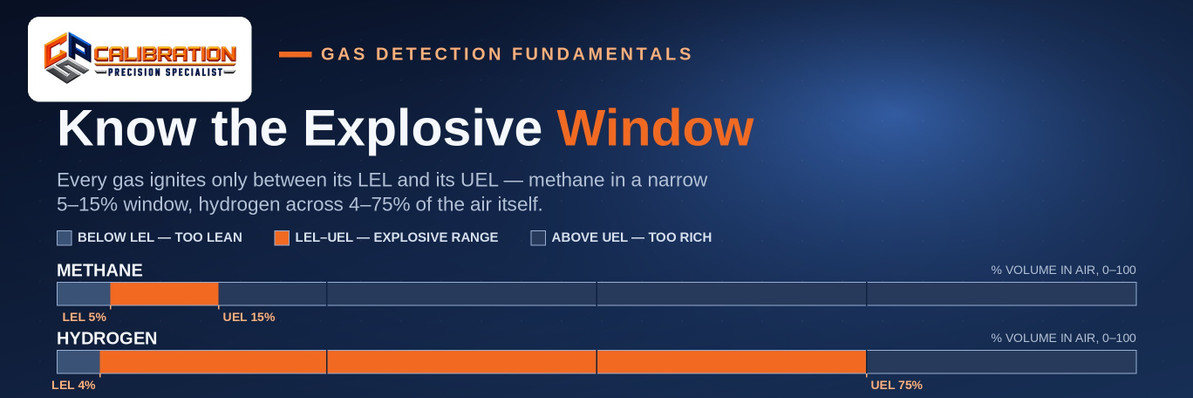
The LEL is the lowest concentration of a gas in air that can explode, and the UEL is the highest: methane burns between 5.0% and 15.0% by volume, hydrogen between 4.0% and 75%, and acetylene from 2.5% all the way to 100%. Because only inside that window can a mixture ignite, gas detectors alarm at 10–20% of the LEL — a small fraction of the way to the bottom edge — while there is still time to get out, ventilate, and re-test.
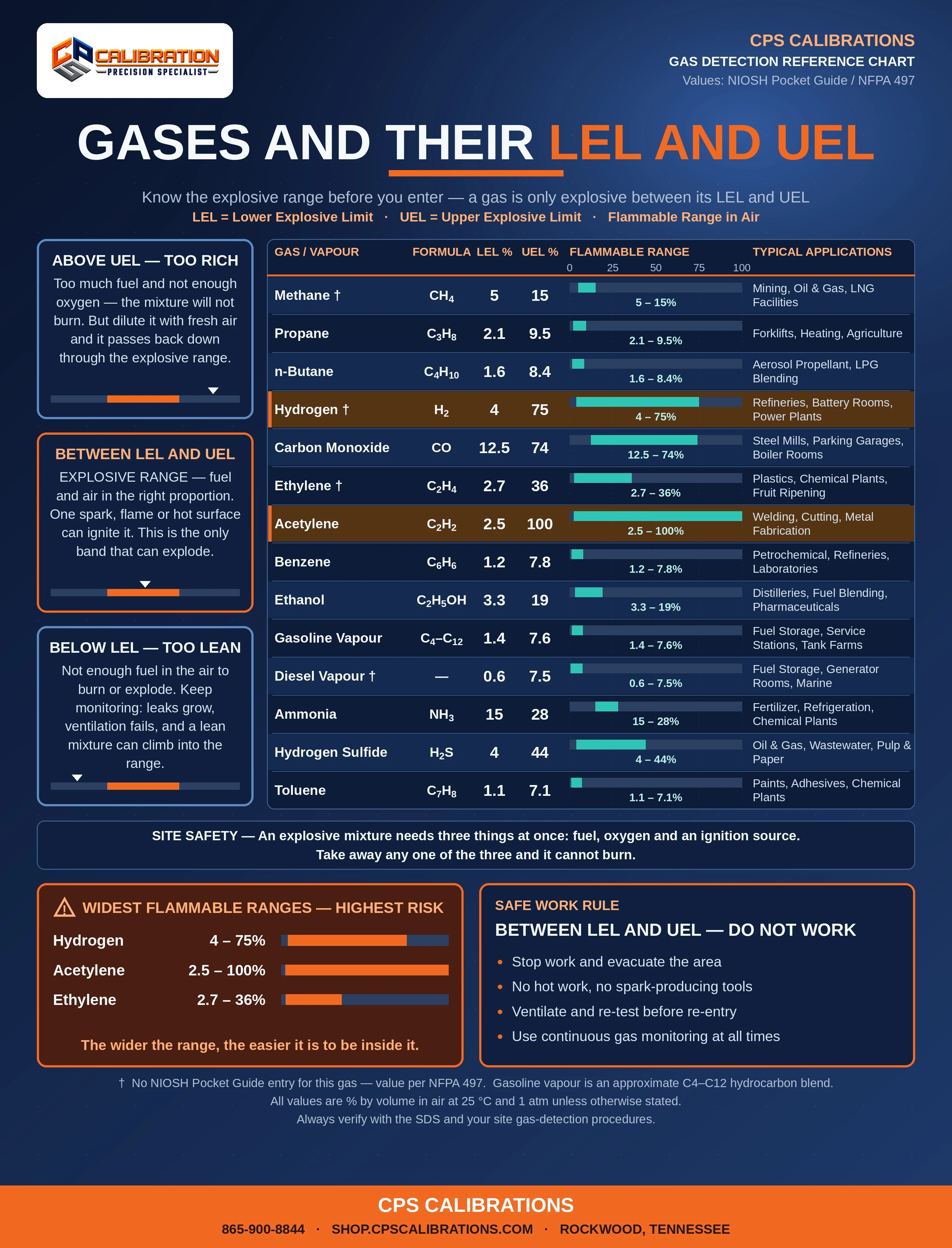
Every combustible-gas reading you will ever take is a position inside — or outside — one of these windows. The meter on your belt does not measure "gas" in the abstract; it measures how far up the climb toward one specific gas's explosive range you already are. That makes the LEL and UEL the two most useful numbers in gas detection, and the gas-by-gas table below the reference worth bookmarking: fourteen gases and vapours, every limit verified against the NIOSH Pocket Guide to Chemical Hazards or NFPA 497, with the alarm math worked out for each one.
What Are the LEL and UEL?
The LEL (Lower Explosive Limit) is the smallest concentration of a gas or vapour in air that can ignite and carry a flame. Below it, the mixture is too lean — there is fuel present, but not enough of it, close enough together, to pass a flame from molecule to molecule. The UEL (Upper Explosive Limit) is the largest concentration that can ignite. Above it, the mixture is too rich — fuel has crowded out so much of the air that there is not enough oxygen in the mix to burn. Between the two limits lies the flammable range (also called the explosive range), the only band of concentrations in which the mixture can explode.
Three clarifications before the table. First, the same two limits are also published as the LFL and UFL — Lower and Upper Flammability Limits. LEL and LFL are the same number under two names; instrument makers say LEL, fire-protection standards often say LFL. Second, the limits are stated in percent by volume in air at normal temperature and pressure — "methane, 5.0%" means five volumes of methane in every hundred volumes of the mixture, in ordinary air with its roughly 21% oxygen. Change the conditions and the window moves: heating a mixture widens its range, and oxygen-enriched air widens it dramatically, which is why published limits are a reference point, not a guarantee about your space. Third, there is no universal window — each gas's chemistry sets its own, and the spread across common gases is enormous, as the table shows. Our earlier explainer on LEL vs. UEL covers the two edges of the range conceptually; this post is the numbers.
The LEL and UEL of 14 Common Gases
Limits below are percent by volume in air. The fourth column converts each gas's LEL into the concentration at which a standard 10% LEL alarm sounds — the number that shows how little gas in the air a combustible alarm actually represents.
| Gas or vapour | LEL (% vol) | UEL (% vol) | 10% LEL alarm = (% vol) |
| Acetylene | 2.5 | 100 | 0.25 |
| Ammonia | 15 | 28 | 1.5 |
| Benzene | 1.2 | 7.8 | 0.12 |
| Butane (n-) | 1.6 | 8.4 | 0.16 |
| Carbon monoxide | 12.5 | 74 | 1.25 |
| Diesel vapour † | 0.6 | 7.5 | 0.06 |
| Ethanol | 3.3 | 19 | 0.33 |
| Ethylene † | 2.7 | 36 | 0.27 |
| Gasoline vapour | 1.4 | 7.6 | 0.14 |
| Hydrogen † | 4.0 | 75 | 0.4 |
| Hydrogen sulfide | 4.0 | 44 | 0.4 |
| Methane † | 5.0 | 15 | 0.5 |
| Propane | 2.1 | 9.5 | 0.21 |
| Toluene | 1.1 | 7.1 | 0.11 |
Values per the NIOSH Pocket Guide to Chemical Hazards (DHHS 2005-149). † The Pocket Guide carries no entry for this gas; value per NFPA 497. Published limits vary slightly from source to source with test method and conditions — for a specific material, its safety data sheet governs.
Read the table for its extremes. Acetylene owns the widest window in the set — 2.5% to a UEL of 100%, a figure that means acetylene can decompose and burn even with no air mixed in at all, which is why it is stored dissolved in acetone inside its cylinder. Hydrogen is nearly as wide, 4.0% to 75%: at almost any leak size, some part of a hydrogen plume is inside its range. At the other end, the solvent and fuel vapours — diesel, gasoline, benzene, toluene — sit in narrow windows under 8%, but their LELs are so low that a 10% LEL alarm can mean as little as 0.06% diesel vapour in the air. And two rows carry a second warning: hydrogen sulfide's IDLH is 100 ppm (0.01% by volume) and carbon monoxide's exposure limits are in the tens of ppm, so for those gases poisoning arrives far below any flammability concern — the ppm toxic alarm, not the LEL channel, is the one that protects you.
Why Does Your Meter Alarm at 10–20% of the LEL?
Because the %LEL scale is built for margin, not for precision about the edge. A combustible channel reads in percent of the LEL: 100% LEL means the concentration has reached the LEL itself — the bottom edge of the explosive range. Alarming there would mean alarming at the exact moment the atmosphere becomes ignitable, with zero room for everything that makes field readings imperfect: sensor tolerance, gas pooled in a low spot or a ceiling void while the meter samples somewhere else, a leak that is still growing, and the time a crew needs to stop work and get out. So alarms are set as a fraction of the LEL — portable meters commonly alarm at 10% LEL, and fixed systems are typically set with a low alarm at 10% of the LEL and a high alarm at 20% — buying a tenfold margin on the low alarm before the mixture can burn.
One caveat rides on every %LEL reading: the percentage is relative to the gas the sensor was calibrated on. A meter spanned on methane reports other gases against methane's response, and most combustibles respond differently — which is why LEL correction factors exist, and why a reading in an unknown or mixed atmosphere should be treated as an approximation that errs toward action, not reassurance.
Why Isn't Above the UEL Safe?
"Too rich to burn" describes one pocket of air, at one moment — never the whole job. A mixture above its UEL cannot stay neatly above it:
- Every rich plume has edges. Gas leaving a leak at 40% by volume dilutes as it spreads, which means somewhere between the source and the clean air the concentration passes down through the entire explosive range. The space a few feet from a "too rich" reading can be squarely in the window.
- Ventilation moves the whole space through the range. Starting a fan, opening a door, or a leak slowing down all dilute a rich atmosphere downward — through the UEL, across the window, and only eventually below the LEL. The trip through the middle is unavoidable, and it happens while people and equipment are present.
- Rich gas displaces air. An atmosphere rich enough to sit above the UEL has pushed out a large share of its oxygen; the same pocket that won't burn can asphyxiate.
- Toxics don't care about the range. Hydrogen sulfide and carbon monoxide are lethal at concentrations far below their LELs; a mixture can be too rich to burn and still poison in minutes.
- A pegged meter is not information. A standard 0–100% LEL channel that slams to full scale and rolls over in rich gas is telling you the concentration is beyond its scale — not how far beyond, and not that conditions are stable.
Acetylene is the standing exception that proves the rule: with a UEL of 100%, there is effectively no "above the range" for it at all. Treat any reading at or beyond the top of the LEL scale as an emergency in progress, not as the far side of one.
How Do You Convert %LEL to Percent Volume?
The conversion is one multiplication, and it is the calculation that makes the table above usable in the field:
% by volume = (%LEL reading × the gas's LEL) ÷ 100
- Methane (LEL 5.0%): 10% LEL = 0.5% by volume · 50% LEL = 2.5% · 100% LEL = 5.0%.
- Hydrogen (LEL 4.0%): 10% LEL = 0.4% by volume · 50% LEL = 2.0% · 100% LEL = 4.0%.
- Propane (LEL 2.1%): 10% LEL = 0.21% by volume · 50% LEL = 1.05% · 100% LEL = 2.1%.
The trap this protects against is reading the display as percent gas: "10% LEL" is not 10% gas in the air — on methane it is one-twentieth of that, and on toluene barely a tenth of one percent. The same conversion runs the other way for ppm work — divide a ppm reading by the LEL expressed in ppm — and our ppm to %LEL and % volume conversion guide works through those numbers in full.
The Work Rule: Between the LEL and UEL, Do Not Work
The limits collapse into one rule a crew can act on without a table: if the atmosphere is between the LEL and the UEL — or climbing toward it — do not work there. Stop the job, keep ignition sources out (no hot work, no non-rated electrics, no striking tools), get people out of the space, ventilate from a safe position, and re-test before anyone goes back in — at the work point and at the levels where the gas actually collects, not just at the door where the air is cleanest. Permits for hot work commonly draw their stop line at 10% LEL for exactly the margin logic above: by the time a reading is anywhere near the window itself, every allowance for error and growth has already been spent. Ventilate and re-test is not the cautious version of the job; it is the job, and the window is why.
Frequently Asked Questions
What is LEL and UEL in gas detection?
The LEL (Lower Explosive Limit) is the lowest concentration of a gas in air that can ignite — below it the mixture is too lean to burn. The UEL (Upper Explosive Limit) is the highest concentration that can ignite — above it the mixture is too rich, having displaced too much air to burn. Between the two is the flammable (explosive) range, the only band where the mixture can explode. Both are stated in percent by volume in air, and gas detectors alarm at 10–20% of the LEL, far below the bottom of the range.
What is the LEL and UEL of methane?
Methane's LEL is 5.0% by volume and its UEL is 15.0% by volume (NFPA 497; the NIOSH Pocket Guide carries no methane entry). A methane mixture below 5.0% is too lean to ignite and above 15.0% too rich. On a methane-calibrated detector, a 10% LEL alarm therefore sounds at 0.5% methane in air, and a 100% LEL reading means the atmosphere has just reached the bottom of the explosive range.
What is the LEL and UEL of hydrogen?
Hydrogen's LEL is 4.0% by volume and its UEL is 75% by volume (NFPA 497) — one of the widest explosive ranges of any common gas, behind only acetylene in the table in this post. Because the range spans most concentrations a leak can produce, some part of a hydrogen release is almost always inside its window, which is why hydrogen alarms are treated as immediately actionable at the 10% LEL setpoint (0.4% by volume).
Why do gas detectors alarm at 10% LEL?
To buy margin. A 10% LEL alarm sounds when the concentration reaches one-tenth of the lowest ignitable concentration — on methane, 0.5% gas by volume against a 5.0% LEL. That tenfold cushion absorbs sensor error, gas that has pooled away from where the meter is sampling, and a leak that is still growing, and it leaves time to stop work and evacuate. Fixed systems commonly use a two-stage version of the same logic: low alarm at 10% of the LEL, high alarm at 20%.
Is a gas above its UEL safe?
No. "Too rich" is a local, temporary condition: the edges of any rich plume dilute down through the explosive range, ventilation or a slowing leak carries the whole atmosphere through the range on its way down, and rich mixtures also displace oxygen and can asphyxiate. Toxic gases such as hydrogen sulfide and carbon monoxide are dangerous far below their LELs regardless of flammability. Acetylene has no safe "above" at all — its UEL is 100%. Treat an over-range reading as an emergency, not an all-clear.
What does 50% LEL mean in percent volume?
It depends on the gas, because %LEL is relative to that gas's LEL. The conversion is % volume = %LEL × LEL ÷ 100. For methane (LEL 5.0%), 50% LEL = 2.5% by volume. For hydrogen (LEL 4.0%), 50% LEL = 2.0% by volume. For propane (LEL 2.1%), 50% LEL = 1.05% by volume. The display never means percent gas directly — 50% LEL is halfway to the bottom of the explosive range, whatever the gas.
What is the difference between LEL/UEL and LFL/UFL?
None in value — they are two names for the same two limits. LEL and UEL stand for Lower and Upper Explosive Limit; LFL and UFL stand for Lower and Upper Flammability Limit. Instrument manufacturers and gas-detection practice use LEL/UEL (and the %LEL display scale), while fire-protection standards such as NFPA documents often print LFL/UFL. A methane LFL of 5.0% and a methane LEL of 5.0% are the same physical threshold.
Which gas has the widest explosive range?
Acetylene, of the common industrial gases: its range runs from an LEL of 2.5% to a UEL of 100% by volume (NIOSH Pocket Guide), meaning it can decompose and burn even without air mixed in. Hydrogen is next at 4.0% to 75% (NFPA 497), followed by carbon monoxide at 12.5% to 74% and hydrogen sulfide at 4.0% to 44% (both NIOSH Pocket Guide). Wide-range gases are dangerous at nearly any leak size because some part of the release is almost always in range.
Can a gas detector measure above the UEL?
A standard combustible channel cannot quantify it. Portable and fixed LEL sensors are scaled 0–100% LEL — built to measure the climb toward the LEL, not concentrations beyond it. In a rich atmosphere a catalytic sensor may peg at full scale, read erratically, or roll over, and it cannot tell you how far above the UEL the mixture sits or whether it is drifting back into range. Readings are also relative to the calibration gas: a methane-spanned meter needs the manufacturer's correction factor to approximate another gas's %LEL.
What should you do if a reading is between the LEL and UEL?
Stop work and get out — an atmosphere between its LEL and UEL can explode on any ignition source. Keep hot work, non-rated electrical equipment, and other ignition sources out of the space, evacuate to clean air, and ventilate from a safe position. Then re-test before re-entry, sampling where the gas collects (high for methane and hydrogen, low for gasoline and solvent vapours) and at the actual work point, and only resume when readings are back down at background with the source controlled.
The Bottom Line
A combustible-gas reading means nothing until it is placed against the right window. The LEL and UEL are gas-specific — 5.0% and 15.0% for methane, 4.0% and 75% for hydrogen, 2.5% and 100% for acetylene — and every part of your meter's behavior follows from them: the %LEL scale, the 10–20% alarm setpoints, and the conversion back to percent volume. Below the LEL a mixture cannot burn; above the UEL it cannot burn yet, and "yet" does all the work in that sentence. Between the two, the rule is the one printed under the chart: do not work — ventilate and re-test. CPS Calibrations in Rockwood, Tennessee calibrates the instruments that make these calls; a meter whose LEL channel is out of span is guessing at the exact number your safety margins are built on.
Need a calibration you can file?
In-house calibration at CPS in Rockwood, Tennessee — $55 for single-gas instruments, $90 for 4- and 5-gas — every channel, as-found and as-left data, full certificate.
See Calibration Servicesor call 865-900-8844
Recent Posts
-

Can You Add a Pump to a SENKO SGT-P or MGT?
Yes — SENKO's SP-Pump101 external sampling pump ($330, part AAA006000) fits the SGT, SGT-P, and MGT, …Nov 12th 2026 -

What Refrigerant Detection Does a Grocery Store Need?
A grocery store needs refrigerant detection in three places: low-mounted carbon dioxide (R-744) sens …Nov 11th 2026 -

What Is LEL and UEL? The Explosive Range, Gas by Gas
The LEL is the lowest concentration of a gas in air that can explode, and the UEL is the highest: me …Nov 10th 2026