
LEL vs. UEL: What's the Difference — and What's the Flammable Range?
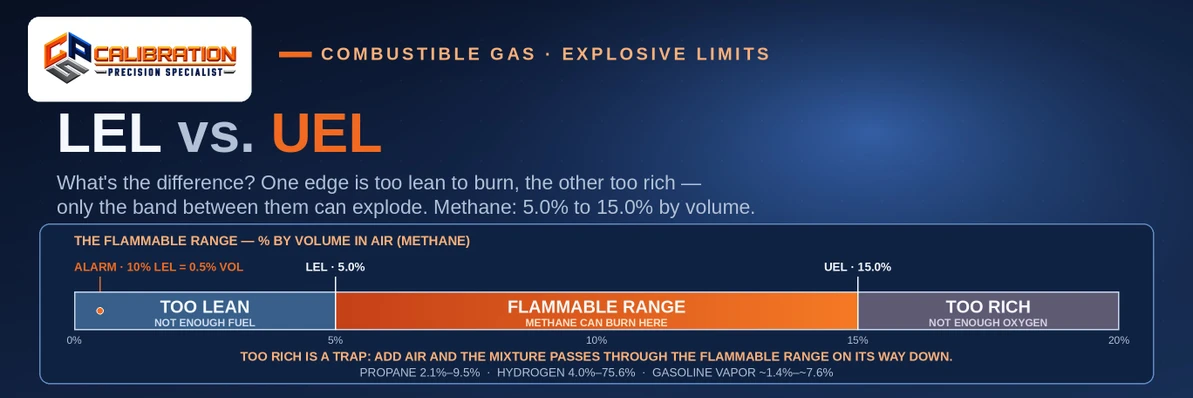
The LEL and the UEL are the two edges of the flammable range: the LEL (Lower Explosive Limit) is the lowest concentration of a gas in air that can ignite — below it the mixture is too lean to burn — and the UEL (Upper Explosive Limit) is the highest, above which the mixture is too rich to burn for lack of oxygen. For methane the range between them runs 5.0% to 15.0% by volume, for propane 2.1% to 9.5%, and for hydrogen 4.0% to 75.6% — and because only inside that band can a mixture explode, gas detectors alarm at 10–20% of the LEL, far below the bottom of the range, while there is still time to act.
Our explainer of what LEL means covers the bottom edge of the range in depth — the %LEL scale, the conversions, the alarm logic. It leaves three questions standing. What sits at the top of the range? What exactly is the "flammable range" printed on every safety data sheet? And if the range has a top, why does no detector on your belt measure toward it? This post answers all three.
What Is the LEL? The Bottom Edge of the Range
The LEL is the leanest mixture of a gas in air that can burn. Fire needs fuel, oxygen, and ignition; below the LEL, the fuel leg of that triangle is simply too weak — a spark in a too-lean mixture releases its energy into air that cannot carry a flame from molecule to molecule, and nothing propagates.
For methane the LEL is 5.0% by volume, and that one figure anchors the %LEL scale your monitor displays: 100% LEL = 5.0% gas = 50,000 ppm, 50% LEL = 2.5% gas, and the standard first alarm at 10% LEL = just 0.5% gas in air. If the conversions between %LEL, % volume, and ppm ever blur together, our breakdown of ppm vs. %LEL vs. percent volume separates the three scales. The framing that matters: the LEL is not a property of your detector — it is the bottom edge of a window that belongs to the gas.
What Is the UEL? The Top Edge of the Range
The UEL is the richest mixture that can burn. Above it, fuel has crowded out so much air that there is not enough oxygen left to sustain a flame — the mirror image of the lean side. Same triangle, different leg missing.
| Gas | LEL (% by volume) | UEL (% by volume) | Flammable range width |
|---|---|---|---|
| Methane | 5.0% | 15.0% | 10.0 points |
| Propane | 2.1% | 9.5% | 7.4 points |
| Hydrogen | 4.0% | 75.6% | 71.6 points |
| Gasoline vapor | ~1.4% | ~7.6% | ~6.2 points |
The methane, propane, and hydrogen figures are the ones from RKI Instruments' published chart, carried in our LEL explainer; the gasoline vapor figures are the standard values quoted on gasoline safety data sheets. Authorities differ slightly from source to source because the limits are measured experimentally, not calculated — treat the second decimal as laboratory territory and the overall picture as settled.
Note the relationship: the UEL is always a multiple of the LEL, never a neighbor — 3× for methane, about 4.5× for propane, nearly 19× for hydrogen. That ratio explains why detectors are built the way they are; hold it for two sections.
What Is the Flammable Range?
The flammable range is the band between the two limits — every concentration of that gas in air, from LEL to UEL, at which the mixture can ignite and a flame can travel through it. Below the band: too lean. Above it: too rich. Inside it: one ignition source away from a fire or an explosion.
The width of the band is a property of the fuel, and it is a fair one-number summary of how forgiving that fuel is. Gasoline vapor's window is narrow — roughly 1.4% to 7.6% — so a gasoline spill has to build a fairly specific mixture before it can burn, and overshooting into too-rich happens quickly near the liquid. Hydrogen's window is enormous: from 4.0% to 75.6%, meaning almost any mixture of hydrogen and air that is neither nearly all air nor nearly all hydrogen sits inside the flammable range, with very little "safe side" on either end — one more reason hydrogen gets the dedicated treatment in our post on why battery rooms need hydrogen detection.
One more precision, because the words get used loosely: the flammable range describes a mixture at a point. Real leaks are not uniform — concentration grades from pure fuel at the source to clean air at the room's edges, which means a single leak normally contains all three regions at once. That fact runs the next two sections.
Can a Mixture Be Too Rich to Burn? Yes — and That's the Trap
Above the UEL, a mixture will not ignite as it sits. It is also one of the most dangerous sentences in gas safety when it gets read as "safe," for three reasons.
The edges are in the range. A rich volume is never uniformly rich everywhere. A tank headspace may sit above the UEL — but at every opening, vent, and leak path, that rich gas mixes with air, and the mixing zone passes through the flammable range. The boundary of a too-rich cloud is, by geometry, a flammable shell.
Dilution walks it down through the range. Ventilate a rich space, open a hatch, let a drained vessel breathe in air as liquid leaves — every path from "too rich" to "safe" passes through "flammable" on the way. The mixture does not jump the band; it transits it. Tank and vessel work is organized around exactly this transit: inerting, purging, and ventilation sequences exist to control how it crosses.
Some fuels barely have a rich side at all. Hydrogen's UEL is 75.6% — to be too rich in hydrogen, the air must be more than three-quarters fuel. And acetylene, per the RKI chart in our LEL explainer, has a UEL of 100%: effectively no too-rich region exists for it at all. "Too rich to burn" is a real physical state for methane or propane in a closed volume — and as a field assumption, it fails exactly where people get hurt.
Why Do Gas Detectors Alarm on the LEL Side?
Because the LEL side is where alarms can still change the outcome. Standard practice sets the first combustible alarm at 10% LEL and a second stage at 20% LEL — for methane, 0.5% and 1.0% gas by volume, one-tenth and one-fifth of the way to an ignitable mixture. At those readings there is no fire risk yet at the sensor: there is a leak, a trend, and time to ventilate, shut down, and evacuate. The 10% figure carries regulatory weight as well — OSHA's confined-space standard, 29 CFR 1910.146, defines a hazardous atmosphere to include flammable gas in excess of 10% of its lower flammable limit, which is why the test sequence in our confined-space entry walkthrough treats a 10% LEL reading as a stop line.
Now imagine the alternative: an alarm philosophy aimed at the top of the range. An alarm that sounds as a mixture approaches the UEL would announce an atmosphere that has already passed through the entire flammable range to get there — burnable for a long stretch of its climb. Alarms exist to fire while the situation is still a leak. The LEL is the edge you approach first from clean air, so the LEL is where the instrumentation lives. The %LEL scale — distance to the bottom edge, as a percentage — is that philosophy built into a display.
Why Does Nobody Instrument the UEL?
Three reasons, and together they explain the design of every combustible gas instrument you own.
The scale doesn't reach. A %LEL sensor is built to measure 0–100% LEL, and 100% LEL is only the bottom of the flammable range. Methane's UEL of 15.0% by volume is 300% LEL. Propane's UEL is roughly 450% LEL. Hydrogen's is about 1,890% LEL. Asking a %LEL instrument to track a mixture toward the UEL is asking a ruler to measure past its own end — past 100% LEL the display pegs at full scale and the honest reading is not a number but a status: over-range, at or beyond ignitable, unmeasured beyond that. The instrument has stopped measuring — which is why our LEL explainer insists an over-range space is unmeasured, not cleared.
The sensor physics degrade exactly there. A catalytic bead sensor — one of the two common LEL technologies compared in our catalytic bead vs. infrared post — works by burning gas on a heated bead, and burning takes oxygen. In a rich, oxygen-starved atmosphere the bead cannot combust the fuel properly, so a catalytic sensor pushed deep into the flammable range and beyond can under-read or behave erratically at precisely the concentrations a UEL instrument would need to be most trustworthy.
By then, the decisions are already made. Measurement toward the UEL does exist — as a % volume job, with instruments configured for it, under controlled procedures: verifying an inerted tank, supervising a purge, confirming a vessel is truly rich (or truly lean) before a state change. That is process verification, done from outside the hazard on a planned timeline. It is not personnel protection, and it never substitutes for the %LEL alarm whose entire purpose is to keep people and atmospheres from entering the range in the first place. If a workspace atmosphere were ever anywhere near UEL concentrations, the correct instruments are legs and a ventilation plan — the monitoring question was settled, badly, long before.
What Makes the Flammable Range Wider or Narrower?
The printed limits — methane 5.0% and 15.0%, and the rest of the table — are measured in ordinary air at ordinary temperatures. Move the conditions and the edges move, always at the level of principle:
- Temperature widens it. Heat a mixture and the range grows: the LEL falls slightly and the UEL rises, because a hot mixture needs less help from a spark to keep a flame alive. Hot processes and hot climates get a somewhat wider range than the book values.
- Pressure nudges it. At ordinary pressures the effect is small; at elevated pressures the range generally widens, mostly at the UEL end.
- Oxygen enrichment blows the top off. The nitrogen in air is the ballast that makes the rich side possible. Enrich the oxygen and the LEL barely moves while the UEL climbs dramatically — fuels keep burning at concentrations that would be far too rich in normal air. That is why oxygen-enriched atmospheres are treated as extreme fire risk.
- Inerting closes it from the top. Run the oxygen lever the other way — dilute with nitrogen or another inert gas — and the UEL falls toward the LEL until the range closes entirely and no mixture of that fuel can burn at any concentration. That closing of the window is the entire working principle of tank inerting.
The practical takeaway: the book range is the narrowest version of the hazard you are likely to meet. Heat and oxygen only make the window bigger.
A Methane Leak, Walked Through the Whole Range
Put the numbers on one event: a flange leaking methane in a compressor room, detector on the wall, concentrations quoted at the detector unless noted. It starts, as it should, at 0% LEL in clean air.
0.5% by volume — 10% LEL. First alarm. The mixture at the detector is one-tenth of ignitable: not burnable, and not close — but methane is arriving and accumulating. Ventilate, shut down the source, treat it as the leak it is. Handled properly, the event ends on this line.
1.0% by volume — 20% LEL. Second-stage alarm. Evacuate, kill ignition sources. Still only one-fifth of the way to the bottom of the flammable range at the detector — and here is the placement caveat that matters: the detector reads its own location. Closer to the flange, the cloud is richer than the wall reading says.
5.0% by volume — 100% LEL. The bottom edge of the flammable range, reached at points near the leak while the far side of the room may still read less. Atmosphere at this concentration ignites: flame can now propagate through any part of the cloud that sits between 5% and 15%.
Between 5% and 15%. Fully inside the range. This is the cloud's working volume — the region that burns if it finds ignition, which is why everything since the first alarm has been about keeping ignition away from it.
Above 15%, at the jet's core. Right at the flange, the escaping stream is richer than 15% — locally too rich to burn. Do not let that comfort anyone: the jet entrains room air as it travels, so its edges grade down through 15% to 5% — a flammable shell wrapped around a rich core — and the shell is where ignition, if it comes, will start.
The way back down. Valve closed, ventilation running: every concentration in the room now falls — and falls through the range, rich core to flammable band to lean to clean. The transit down is the same hazard as the transit up, which is why post-leak ventilation is run with ignition sources controlled until readings are back under the alarm points — not merely falling.
One leak, all three regions, simultaneously. That is the flammable range as it actually exists in the field: not two numbers on a data sheet, but geography.
Frequently Asked Questions
What is the difference between LEL and UEL? The LEL (Lower Explosive Limit) is the lowest concentration of a gas in air that can ignite — below it the mixture is too lean to burn. The UEL (Upper Explosive Limit) is the highest concentration that can ignite — above it the mixture is too rich to burn for lack of oxygen. Only between the two limits can a mixture explode. For methane, the LEL is 5.0% by volume and the UEL is 15.0% by volume.
What is the flammable range of a gas? The flammable range is the band of concentrations between a gas's LEL and its UEL — every mixture inside that band can ignite. Its width depends on the fuel: methane's range spans 10.0 percentage points (5.0% to 15.0% by volume), propane's 7.4 points (2.1% to 9.5%), gasoline vapor's about 6.2 points (~1.4% to ~7.6%), and hydrogen's a very wide 71.6 points (4.0% to 75.6%).
What are the LEL and UEL of methane? Methane's LEL is 5.0% by volume and its UEL is 15.0% by volume. In detector terms, 100% LEL = 5.0% gas = 50,000 ppm; the usual first alarm at 10% LEL sounds at 0.5% gas, and the UEL itself sits at 300% LEL — three times past the top of a standard %LEL instrument's scale.
Can a gas mixture be too rich to burn? Yes — above its UEL a mixture cannot ignite because it lacks oxygen. It is still dangerous: where rich gas mixes with air — at vents, openings, and the edges of a leak plume — the mixture passes through the flammable range, and any ventilation or dilution walks the whole volume down through the range on its way to safe. Acetylene is the standing exception, with a published UEL of 100% — effectively no too-rich region at all.
Why do gas detectors alarm at 10% and 20% LEL instead of near the UEL? Because an alarm's job is to fire while action is still possible. At 10% LEL (0.5% gas by volume for methane) the atmosphere is one-tenth of ignitable — time to ventilate, shut down, and evacuate. An alarm aimed near the UEL would announce an atmosphere that had already passed through the entire flammable range to get there. OSHA's confined-space standard, 29 CFR 1910.146, backs the low setpoint: flammable gas in excess of 10% of its lower flammable limit is a hazardous atmosphere by definition.
What happens when a gas detector reads over 100% LEL? The instrument pegs at full scale: the atmosphere at the sensor is at or beyond the LEL — for methane, at or beyond 5.0% gas by volume — and the detector cannot say how far beyond. An over-range reading is not a measurement of a rich, safe mixture; it is an unmeasured atmosphere known to be at least ignitable. Treat it as an emergency: withdraw, ventilate from a safe position, and do not re-enter on the strength of a pegged display falling back.
What are the LEL and UEL of propane? Propane's LEL is 2.1% by volume and its UEL is 9.5% by volume — a flammable range 7.4 points wide. Propane reaches an ignitable mixture at well under half the concentration methane needs (5.0%), which is why the same %LEL alarm means very different gas concentrations for the two fuels: 10% LEL is 0.21% gas for propane against 0.5% gas for methane.
Why is hydrogen's flammable range so wide? Hydrogen burns across an unusually broad span of mixtures — from 4.0% to 75.6% by volume — because it can sustain a flame in mixtures that are nearly all air and in mixtures that are nearly all fuel. In practical terms, a hydrogen leak has very little "safe side" on either end: a small leak is ignitable, and even a large one only goes too rich above 75.6% hydrogen.
Does temperature or oxygen change the LEL and UEL? Yes. The published limits are measured in normal air at ordinary temperatures. Heating a mixture widens its flammable range — the LEL falls slightly and the UEL rises. Oxygen enrichment widens it far more dramatically, almost entirely at the top: the UEL climbs steeply while the LEL barely moves, which is why oxygen-enriched atmospheres are extreme fire risks. Diluting with an inert gas such as nitrogen does the opposite, pulling the UEL down until the range closes — the principle behind tank inerting.
Why doesn't a gas detector measure up to the UEL? Because the UEL sits far past the end of the %LEL scale: methane's UEL is 300% LEL, propane's about 450% LEL, and hydrogen's about 1,890% LEL, while a combustible instrument measures 0–100% LEL. The detector's purpose is warning before the range is entered, not tracking a mixture through it — and sensor physics agree, since a catalytic bead needs oxygen to burn gas on its surface and can under-read in the oxygen-starved rich end. Measuring rich atmospheres is a separate % volume job done under procedure, for tasks like verifying tank inerting.
The Bottom Line
LEL and UEL are the two edges of one window. Below the LEL a mixture is too lean to burn; above the UEL it is too rich; between them — 5.0% to 15.0% by volume for methane, 2.1% to 9.5% for propane, 4.0% to 75.6% for hydrogen — it can ignite. Detectors alarm at 10–20% of the LEL because that edge is the one you reach first from clean air and the only one where an alarm still buys time; nobody instruments the UEL because a %LEL scale ends at 100% LEL and because an atmosphere anywhere near the UEL has already passed through every concentration that burns. And "too rich" is a state, never a clearance: dilute it, and it comes back through the range to visit you.
Every multi-gas monitor we sell reads its combustible channel on that %LEL scale — the RKI GX-3R at $640 and the SENKO SP-MGT at $485 are the common starting points, and the full lineup is in our portable multi-gas monitors category. If your crew works around flammable gas and the top of the range has never been part of the conversation, that is a training gap worth closing — and if the instruments behind the numbers are due, we calibrate every channel. Call 865-900-8844 or reach us through Contact Us.
CPS Calibrations · 109 S. Front Street, Rockwood, TN 37854 · Portable Gas Detection · Calibration Gas · Calibration Services · Contact Us
Need a calibration you can file?
In-house calibration at CPS in Rockwood, Tennessee — $55 for single-gas instruments, $90 for 4- and 5-gas — every channel, as-found and as-left data, full certificate.
See Calibration Servicesor call 865-900-8844
Recent Posts
-

Can You Add a Pump to a SENKO SGT-P or MGT?
Yes — SENKO's SP-Pump101 external sampling pump ($330, part AAA006000) fits the SGT, SGT-P, and MGT, …Nov 12th 2026 -

What Refrigerant Detection Does a Grocery Store Need?
A grocery store needs refrigerant detection in three places: low-mounted carbon dioxide (R-744) sens …Nov 11th 2026 -

What Is LEL and UEL? The Explosive Range, Gas by Gas
The LEL is the lowest concentration of a gas in air that can explode, and the UEL is the highest: me …Nov 10th 2026