
PPM vs. %LEL vs. % Volume: How Gas Readings Convert
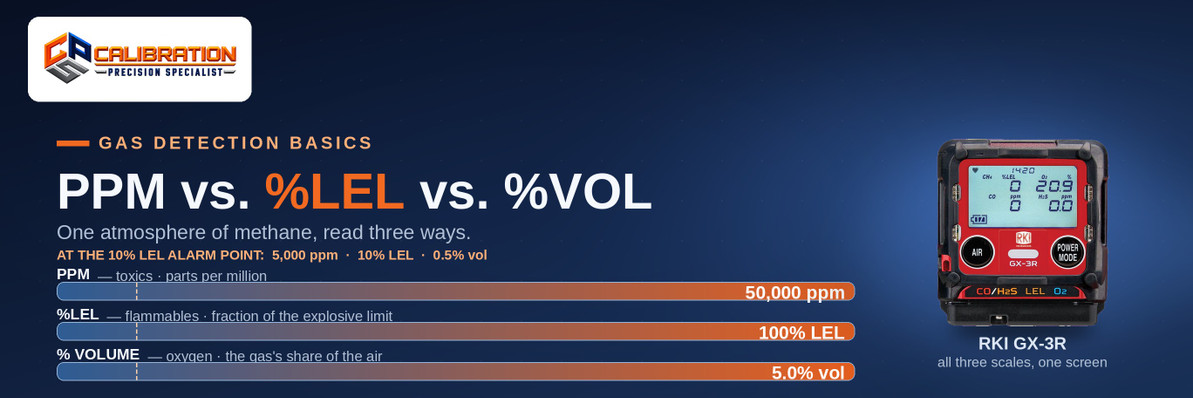
PPM, %LEL, and % volume measure the same air three different ways: ppm counts molecules per million (1% by volume = 10,000 ppm), % volume states the gas's share of the air outright, and %LEL states the reading as a fraction of that gas's Lower Explosive Limit. They are fully interconvertible for any given gas — 100% LEL methane is 5% by volume is 50,000 ppm — while a toxic like hydrogen sulfide is tracked in ppm because its danger zone, the NIOSH 10 ppm ceiling, is just 0.001% by volume.
You will see all three on one instrument. The RKI GX-3R — $640 — shows its combustible channel in %LEL, its oxygen channel in % volume, and its carbon monoxide and hydrogen sulfide channels in ppm, simultaneously. This is not the monitor being indecisive; each channel uses the scale that fits its hazard.
What Do the Three Scales Actually Measure?
- PPM (parts per million) counts how many molecules of the gas sit among a million molecules of air. It is an absolute concentration with very fine resolution.
- % volume states the gas's share of the air as a percentage. It is the same absolute concentration as ppm, at a coarser resolution: 1% by volume is 10,000 ppm, and 100% by volume is the pure gas.
- %LEL is relative to a specific gas: what fraction of that gas's Lower Explosive Limit is present. 100% LEL means exactly the ignitable concentration — a number that is different for every fuel.
The first two convert without knowing anything about the gas. The third needs one fact: the gas's LEL.
How Do You Convert Between PPM and % Volume?
One percent by volume equals 10,000 ppm, always, for every gas. To go from % volume to ppm, multiply by 10,000; to go back, divide. The anchors worth memorizing:
| Reading | In the other scale |
|---|---|
| 1 ppm | 0.0001% by volume |
| 10 ppm (NIOSH H₂S ceiling) | 0.001% by volume |
| 50 ppm (OSHA CO PEL) | 0.005% by volume |
| 1,000 ppm | 0.1% by volume |
| 10,000 ppm | 1% by volume |
| 20.9% O₂ (normal air) | 209,000 ppm |
The 10 ppm and 50 ppm rows explain a practical reality: nobody discusses toxic exposures in % volume, because the meaningful numbers live in the third and fourth decimal place. PPM exists because toxic thresholds are tiny.
How Do You Convert %LEL to PPM and % Volume?
This one needs the gas's LEL from a published chart — for the common fuels, the values used here are methane 5.0%, propane 2.1%, hydrogen 4.0%, pentane 1.5%, and hexane 1.1% by volume. The arithmetic:
1. % volume = %LEL × LEL (% volume) ÷ 100 2. ppm = % volume × 10,000
So 10% LEL methane = 10 × 5.0 ÷ 100 = 0.5% by volume = 5,000 ppm. The same 10% LEL for propane is 0.21% by volume = 2,100 ppm, and for hexane it is 0.11% by volume = 1,100 ppm. One scale reading, three different atmospheres — which is why a detector that only ever showed %LEL without knowing the gas could not tell you the concentration, and why instruments are calibrated to a known reference gas.
| Gas | 10% LEL | 50% LEL | 100% LEL |
|---|---|---|---|
| Methane | 5,000 ppm (0.5% vol) | 25,000 ppm (2.5% vol) | 50,000 ppm (5% vol) |
| Propane | 2,100 ppm (0.21% vol) | 10,500 ppm (1.05% vol) | 21,000 ppm (2.1% vol) |
| Hydrogen | 4,000 ppm (0.4% vol) | 20,000 ppm (2% vol) | 40,000 ppm (4% vol) |
| Pentane | 1,500 ppm (0.15% vol) | 7,500 ppm (0.75% vol) | 15,000 ppm (1.5% vol) |
| Hexane | 1,100 ppm (0.11% vol) | 5,500 ppm (0.55% vol) | 11,000 ppm (1.1% vol) |
Why Are Toxic Gases Measured in PPM?
Because their danger thresholds are minuscule compared with a percent of anything. Hydrogen sulfide's NIOSH ceiling is 10 ppm — 0.001% by volume — and OSHA's ceiling is 20 ppm. Carbon monoxide's OSHA PEL is 50 ppm averaged over 8 hours, NIOSH recommends 35 ppm, and ACGIH's TLV is 25 ppm. On a %LEL scale these gases would be nearly invisible: hydrogen sulfide's LEL is 4.0% by volume (40,000 ppm), so its NIOSH ceiling of 10 ppm is 0.025% LEL — the combustible scale cannot resolve toxic thresholds at all. Toxics get ppm because ppm is the only scale with enough resolution where the harm happens.
Why Are Combustibles Measured in %LEL — and Sometimes % Volume?
Because the combustible hazard is inherently relative. A leak is dangerous when it approaches its own ignitable concentration, and that concentration differs gas to gas, so the detector's scale normalizes the risk: 10% LEL always means a tenfold margin, no matter the fuel. Some instruments also offer a % volume range for combustibles at high concentrations — process vessels and tanks can hold far more than 100% LEL of gas (100% LEL methane is only 5% gas), and past its range a %LEL sensor simply reports over-range, which is "unmeasured," not "safe."
Why Is Oxygen Measured in % Volume?
Because oxygen is a major component of the air, and both of the oxygen hazards that matter are expressed against normal air: deficiency below 19.5% and enrichment above 23.5%, the thresholds in OSHA's confined-space definition. In ppm those would be 195,000 and 235,000 — a normal atmosphere of 20.9% oxygen is 209,000 ppm — numbers nobody wants to read off a meter. % volume keeps the familiar 20.9 on the display, and a drop to 19.5 reads exactly as what it is: visibly short of breathable air. (Confined-space testing order and acceptable ranges are covered in our confined-space testing walkthrough.)
Worked Example: One Atmosphere, Three Readings
Picture a maintenance crew in a below-grade utility room with a natural gas trace leak. The air holds 0.5% methane by volume. Their 4-gas monitor reports three channels:
- LEL channel: 10% LEL — one-tenth of methane's 5.0% LEL; the first alarm sounds here, per the common 10% factory setting.
- O₂ channel: still 20.9% vol — a 0.5% methane leak displaces almost no oxygen, so the oxygen channel says nothing about it.
- If the same 5,000 ppm were carbon monoxide: an instantaneous reading 100 times OSHA's PEL and 25 times the NIOSH ceiling — the ppm scale exists for exactly this distinction.
One atmosphere, three scales, three different stories. Reading any one of them in isolation is how leaks get underestimated: 5,000 ppm is a quiet number until you learn it is 10% of a flammable mixture for methane — or a lethal dose for something else. Which is why calibration gas for these instruments is labeled in the same three scales: our standard 4-gas mix is sold as H₂S 25 ppm / CO 50 ppm / CH₄ 50% LEL / O₂ 12% — one bottle, three measurement conventions, each in the scale its channel reads. (It lives in our calibration gas category.)
The Bottom Line
PPM and % volume are two resolutions of the same absolute concentration — 1% by volume is always 10,000 ppm. %LEL is a different thing: a reading as a fraction of one specific gas's explosive limit, which converts to concentration only when you know that gas's LEL. Toxics live in ppm because their thresholds are thousandths of a percent; combustibles live in %LEL because the risk is the approach to ignition; oxygen lives in % volume because it is measured against the composition of normal air.
If your crew mixes these scales up in conversation — "the H2S was at 10%" when they meant 10 ppm, or "it's only half a percent" of a propane leak — that is a training conversation worth having before the next entry. The instruments that display all three at once are the standard 4-gas monitors: the RKI GX-3R at $640 and the SENKO SP-MGT at $485, both in our portable multi-gas monitors category. And when those monitors are due, we calibrate every channel — call 865-900-8844 or reach us through Contact Us.
Frequently Asked Questions
How many ppm is 1% by volume? 10,000 ppm — for every gas, always. Percent by volume and ppm are the same absolute concentration at two resolutions: multiply % volume by 10,000 to get ppm, or divide ppm by 10,000 to get % volume. 100% by volume (the pure gas) is 1,000,000 ppm.
How do you convert %LEL to ppm? You need the gas's LEL first, because %LEL is relative to a gas-specific limit. Multiply: % volume = %LEL × LEL (% volume) ÷ 100, then ppm = % volume × 10,000. Example: 50% LEL methane = 50 × 5.0 ÷ 100 = 2.5% by volume = 25,000 ppm.
What is 100% LEL in ppm? It depends on the gas: methane 50,000 ppm, propane 21,000 ppm, hydrogen 40,000 ppm, pentane 15,000 ppm, hexane 11,000 ppm. 100% LEL is always the gas's LEL concentration — the one concentration at which its flammable range begins.
Why is oxygen measured in % volume and not ppm? Because the thresholds that matter are fractions of normal air: OSHA defines oxygen-deficient as below 19.5% and oxygen-enriched as above 23.5%. Normal air at 20.9% would be 209,000 ppm — an absurd scale for reading a deficiency. % volume puts the familiar number, 20.9, on the display where a drop is immediately legible.
Why are toxic gases measured in ppm instead of %LEL? Because toxic thresholds sit far below flammable ones. Hydrogen sulfide's NIOSH ceiling is 10 ppm — 0.001% by volume, or 0.025% of its 4.0% LEL. A combustible scale cannot resolve numbers that small, and a gas can be fatally toxic at a fraction of one percent of its LEL. PPM is the scale with enough resolution where the harm happens.
What does 10% LEL mean in ppm? For methane, 5,000 ppm; for propane, 2,100 ppm; for hydrogen, 4,000 ppm; for pentane, 1,500 ppm; for hexane, 1,100 ppm. 10% LEL is one-tenth of each gas's own explosive limit, so the ppm equivalent moves with the gas — the %LEL reading is the constant, the concentration is the variable.
Is ppm the same as mg/m³? No. PPM is a count of molecules; mg/m³ is a mass concentration, so converting between them needs the gas's molecular weight and the reference conditions. The NIOSH Pocket Guide, for example, lists the carbon monoxide conversion as 1 ppm = 1.15 mg/m³. In gas detection work, instruments read ppm, and exposure limits are published in ppm for the same reason.
What does % volume mean on a gas detector? It means the gas's actual share of the air as a percentage: 0.5% volume methane is half a percent of every breathful. It is the absolute counterpart to %LEL's relative scale — on an oxygen channel it is the standard reading (20.9% in normal air), and some instruments offer high-range combustible readings in % volume for process work beyond the %LEL sensor's range.
Can one detector display all three scales at once? Yes — every standard 4-gas monitor does. The combustible channel reads %LEL, the oxygen channel reads % volume, and the carbon monoxide and hydrogen sulfide channels read ppm, all on one screen at once. The RKI GX-3R's display shows exactly that: %LEL 0, O₂ 20.9%, CO 0 ppm, H₂S 0.0 ppm.
What is 20.9% oxygen in ppm? 209,000 ppm. It is a correct conversion and a useless display — which is the point of the three-scale system. Each channel uses the scale whose meaningful numbers are legible: ppm for toxics, %LEL for combustibles, % volume for oxygen.
CPS Calibrations · 109 S. Front Street, Rockwood, TN 37854 · Portable Gas Detection · Calibration Gas · Calibration Services · Contact Us
Need a calibration you can file?
In-house calibration at CPS in Rockwood, Tennessee — $55 for single-gas instruments, $90 for 4- and 5-gas — every channel, as-found and as-left data, full certificate.
See Calibration Servicesor call 865-900-8844
Recent Posts
-

Can You Add a Pump to a SENKO SGT-P or MGT?
Yes — SENKO's SP-Pump101 external sampling pump ($330, part AAA006000) fits the SGT, SGT-P, and MGT, …Nov 12th 2026 -

What Refrigerant Detection Does a Grocery Store Need?
A grocery store needs refrigerant detection in three places: low-mounted carbon dioxide (R-744) sens …Nov 11th 2026 -

What Is LEL and UEL? The Explosive Range, Gas by Gas
The LEL is the lowest concentration of a gas in air that can explode, and the UEL is the highest: me …Nov 10th 2026