
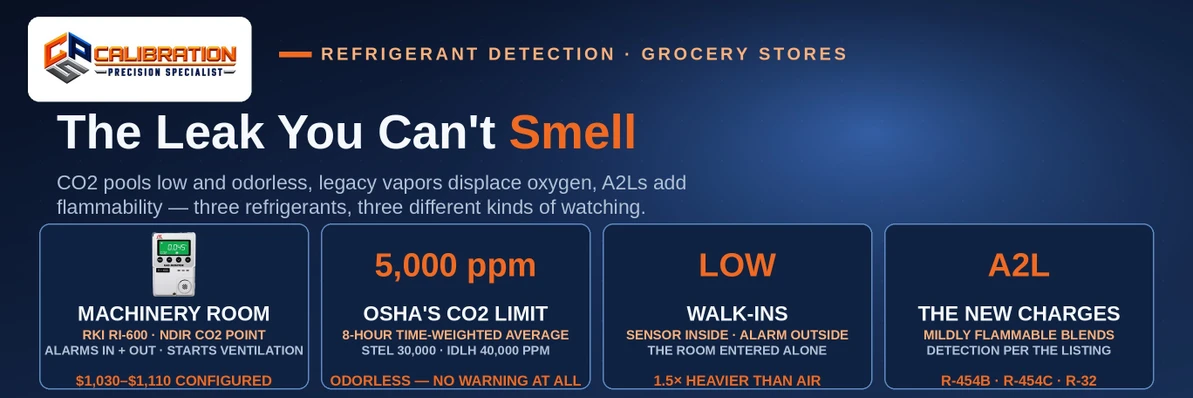
What Refrigerant Detection Does a Grocery Store Need?
A grocery store needs refrigerant detection in three places: low-mounted carbon dioxide (R-744) sensing in the machinery room and inside every walk-in cooler and freezer — CO2 is odorless, about 1.5 times heavier than air, and pools at floor level against an OSHA exposure limit of 5,000 ppm — plus refrigerant-specific detection wherever legacy HFC or new mildly flammable A2L charges can concentrate. Under ASHRAE 15, the machinery-room detector must also alarm inside and outside the room and start the room's ventilation automatically — but the walk-in a stocker enters alone is the space stores most often leave unwatched.
A supermarket is not a warehouse with shelves. The refrigeration plant runs in a machinery room behind the store, the product sits in refrigerated cases on a sales floor full of customers, and between the two are walk-in coolers and freezers that employees enter alone, all day, and pull the door shut behind them. Each of those three spaces leaks differently, collects gas differently, and puts a different person at risk — so each one is watched differently. This post lays out where grocery refrigerant detection belongs and why, refrigerant by refrigerant. It is the retail companion to our cold-storage coverage of where ammonia leaks hide and how halocarbon refrigerants pool low: same physics, different building.
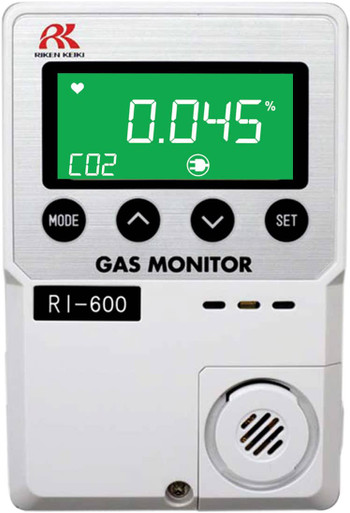
RKI RI-600 Indoor Stand Alone Carbon Dioxide Monitor
Wall-mount NDIR CO2 monitor with two preset alarms, relay contacts, and a 4–20 mA output — the machinery-room and walk-in point.
$1,030–$1,110 configured
See the RI-600Why Are Grocery Stores Changing Refrigerants at All?
Because the old charges are being regulated out from under them. Under the federal AIM Act, production and imports of high-global-warming-potential HFC refrigerants phase down 85% by 2036, and EPA's Technology Transitions program caps the GWP of refrigerants allowed in new equipment. The legacy supermarket charges sit at the top of that scale — R-448A and R-449A, the current rack workhorses, carry GWPs of about 1,387 and 1,397. The refrigerants that fit under the caps are a different set of gases with different hazards: CO2 (R-744, GWP 1), A2L blends such as R-454C (148) and R-454B (466), R-32 (675), and propane (R-290) in small self-contained cases.
One honest complication belongs in any 2026 buying decision: the dates have already moved once. EPA's May 2026 revision of the Technology Transitions rule set an interim GWP limit of 1,400 for supermarket systems and postponed the original 150/300 limits to January 1, 2032, while leaving the 150 limit for self-contained stand-alone units (in force since January 1, 2025) unchanged. State rules can be stricter. So design a new store to the current federal rule, your state's rule, and your authority having jurisdiction — but notice what did not change in the revision: the direction. Every road still ends at CO2, A2Ls, or hydrocarbons, and each of those changes what the store has to detect. A detection plan written for R-404A-era hazards does not automatically cover a CO2 rack or an A2L sales floor.
Three Refrigerants, Three Different Hazards
The reason one detector plan cannot cover a modern grocery store is that its refrigerants fail in three different ways:
| Refrigerant family | Where it runs in a store | Safety class | The hazard that drives detection |
| CO2 (R-744) | Rack systems, cascade and transcritical; the machinery room and every case and walk-in the rack feeds | A1 (non-flammable) | Odorless asphyxiant that pools low; very high operating pressures, so a leak can discharge charge quickly |
| Legacy HFCs (R-404A, R-448A, R-449A) | Existing racks and condensing units still in service everywhere | A1 (non-flammable) | Heavier-than-air vapor that pools low and displaces oxygen; no warning properties |
| A2L blends (R-454B, R-454C, R-32) | New systems built under the GWP caps | A2L (mildly flammable) | Flammability joins the picture: detection and mitigation are set by the system's listed design, not by an exposure limit alone |
| Propane (R-290) | Small self-contained cases and reach-ins | A3 (flammable) | Flammable, but in deliberately small charges in sealed self-contained equipment — a service and siting concern more than a room-monitoring one |
Read the table as a placement map. The CO2 and HFC rows are exposure problems measured in ppm against an occupational limit, and both gases sink — detection belongs low, where the gas collects. The A2L row is a flammability problem measured as a fraction of the gas's flammable limit under the equipment's listing — which is why this post quotes no universal A2L setpoint: the number belongs to the specific refrigerant and the listed system design, exactly as we handled it for refrigerant leak detection in data centers. The R-290 row is mostly a reminder not to over-build: a sealed case with a small charge does not need the monitoring a rack room does.
The Machinery Room: Where ASHRAE 15 Writes the Rules
The machinery room holds the racks — the largest charge in the building, the highest pressures, and the densest cluster of fittings, valves, and relief lines. It is also the one space where the requirement is not a judgment call. ASHRAE 15, the refrigeration safety standard, requires each refrigeration machinery room to contain a refrigerant detector located where a leak would concentrate, and that detector must do three things on alarm: sound an audible alarm, show a visual alarm — both inside and outside the room — and activate the room's mechanical ventilation, with emergency controls located outside the room. Our machinery-room post walks the standard requirement by requirement: what ASHRAE 15 requires.
Three parts of that rule earn their keep in a grocery store specifically. The outside alarm is the one that protects the refrigeration technician: it warns him before he opens the door and steps into the leak, not after. Automatic ventilation starts diluting the room whether or not anyone is present — and grocery machinery rooms sit unoccupied for most of the day, behind a store that never fully empties. And "where a leak would concentrate" decides the mounting height: for CO2 and the HFCs, both heavier than air, the sensor belongs low, near the floor-level pockets where the gas will actually gather, not at eye level where the installer found it convenient.
For a CO2 system, pressure is the multiplier. A transcritical CO2 rack runs around 1,300 psi on its high side — relief settings sit near 1,740 psi — against the few hundred psi of the HFC systems it replaces. High pressure means a fitting failure does not seep; it discharges, and the room's CO2 concentration can climb toward dangerous levels in the time a slow leak would still be a maintenance ticket. That is why CO2 machinery-room detection is specified for early warning, not just for the exposure limit: catch the leak while it is a leak.
Walk-Ins: The Highest-Risk Room in the Store
Ask where a grocery employee is most likely to meet refrigerant, and it is not the machinery room — technicians enter that room expecting hazards. It is the walk-in cooler or freezer: a small, sealed, heavily insulated box, fed by the same rack, entered alone by stockers and department staff who think of it as a pantry, with a door that closes behind them and latches.
Run the physics. A CO2 leak inside a walk-in — at an evaporator coil, a line joint, a door-frame penetration — releases an odorless gas 1.5 times heavier than air into a room with almost no air exchange. The gas pools at the floor and fills the box from the bottom up. The exposure numbers it is filling toward are not abstract: OSHA's CO2 limit is 5,000 ppm as an 8-hour average, NIOSH's short-term limit is 30,000 ppm, and 40,000 ppm is immediately dangerous to life or health. A worker kneeling at a low shelf is breathing the deepest part of that pool, and CO2 gives no smell and no irritation to warn him — the first symptoms are the impairment itself.
The watching that matches the hazard is specific:
- A CO2 point inside the walk-in, mounted low, where the pooled gas reaches it first — not outside the door sampling the corridor.
- An alarm that sounds outside the door as well as inside it, so the next employee does not walk in to check on the first one, and so a leak in an empty walk-in is announced before anyone enters.
- A personal CO2 monitor on the people who work the rooms — the layer that travels with the stocker from walk-in to walk-in and into the below-grade and back-room low spots in between.
That third layer is the one stores skip, and it is inexpensive next to a rack: the SENKO iGas CO2 is a personal NDIR monitor reading 0–50,000 ppm with audible, visual, and vibration alarms, STEL and TWA tracking, and up to about 14 days per charge — $501, worn by the person rather than mounted for the room.
The Sales Floor: Cases, Customers, and the A2L Question
The sales floor is the space detection plans forget, because the charge there is distributed — a little in every case, every island, every reach-in — instead of concentrated in one room. Two things follow from that.
First, the legacy problem: a case or line leak on the floor releases heavier-than-air HFC vapor that pools low, under and behind the cases, in a space occupied by customers who have no training, no monitors, and no reason to expect a hazard. The concentrations a case leak builds in a ventilated sales area are usually a product-loss and service problem before they are an exposure problem — refrigerant is expensive, a slow case leak is inventory quietly leaving the building, and the same detection that watches for safety finds the leak while it is still small. Handheld refrigerant leak detectors are the service tool for pinpointing which case and which joint; fixed points are the watch that says a leak exists at all.
Second, the transition problem: as stores remodel into A2L systems, the sales floor acquires a flammability dimension it never had with A1 refrigerants. A2L blends burn slowly and are hard to ignite — that is what "mildly flammable" means in the ASHRAE classification — but the equipment is listed as a system: charge sizes, case design, and where fitted, leak detection and mitigation all come from that listing and the applicable code, not from a generic rule of thumb. The store's job is to know which refrigerant is in which system, keep the listing's detection and mitigation provisions intact and calibrated, and never let a remodel quietly defeat them. If a contractor proposes value-engineering the detection out of an A2L job, that is the conversation to stop and have in writing.
Which Detector Goes Where?
Matched to the three spaces, the grocery detection kit is smaller than most stores expect:
- Machinery room and walk-ins (CO2): a stand-alone NDIR CO2 point with relays. The RKI RI-600 is the worked example: a wall-mount NDIR monitor with a continuous readout, two preset alarms with an audible tone and a color-changing display, alarm relay contacts, and a 4–20 mA output — the relays and output are what let it do the ASHRAE 15 work of alarming outside the room and starting ventilation, rather than merely beeping in it. Range selection is the decision that matters: it comes in 0–2,000, 0–5,000, and 0–10,000 ppm and 0–2% and 0–5% volume builds ($1,030–$1,110 configured). A walk-in watched against the 5,000 ppm exposure limit wants a ppm-range build that can alarm below and at that limit; percent-range builds suit leak watching where concentrations are expected to run far higher. Buying the percent build for an exposure-alarm job is the classic wrong-range mistake — the alarm points you need sit at the very bottom of its scale.
- People: a personal CO2 monitor for staff who work the walk-ins and back rooms, as above.
- Service: a handheld refrigerant leak detector for pinpointing case and line leaks once a fixed point or a pressure trend says one exists.
- The system around them: alarms that reach a normally attended point, signage at the walk-in doors, and the detection provisions of any A2L listing kept intact. And when a store is planning the fixed side from scratch — sensor placement, controller, ventilation interlocks — that is a fixed-system installation conversation, not a shopping cart.
Whatever the mix, the detectors join the store's calibration discipline like any other gas instrument: NDIR sensors are stable, not immortal, and a CO2 point that has drifted is a number nobody should be making entry decisions on. CPS calibrates fixed and portable gas detection in-house in Rockwood, Tennessee — every channel, as-found and as-left data, full certificate — through our calibration services.
Frequently Asked Questions
What refrigerant detection does a grocery store need?
Detection in three places: the machinery room, inside every walk-in cooler and freezer, and coverage for the sales-floor cases. A CO2 (R-744) store needs low-mounted NDIR CO2 points in the machinery room and walk-ins, because CO2 is odorless and pools at floor level; the machinery-room detector must meet ASHRAE 15 — alarm inside and outside the room and activation of mechanical ventilation. Stores running A2L systems also keep the detection and mitigation provisions of those systems' listings in place, and staff who work the walk-ins should carry personal CO2 monitors.
Does a grocery store with a CO2 refrigeration system need CO2 detectors?
Yes — a CO2 rack system is the strongest case for fixed detection in the store. CO2 is colorless and odorless, about 1.5 times heavier than air, and the system runs at high pressure (around 1,300 psi on the transcritical high side), so a leak can raise a machinery room or walk-in toward OSHA's 5,000 ppm limit quickly with no smell to warn anyone. Fixed CO2 points in the machinery room and inside the walk-ins, alarming inside and outside each space, are the standard answer.
Where should CO2 detectors be placed in a supermarket?
Low — where the gas concentrates. CO2 is about 1.5 times heavier than air, so it sinks and pools at floor level: machinery-room sensors mount low near likely leak sources such as the rack and valve groups, walk-in sensors mount low inside the box, and low pockets, pits, and below-grade back rooms fed by CO2 lines get coverage too. A sensor at eye level in the middle of the room samples the last air the gas reaches, not the first.
What does ASHRAE 15 require for refrigerant detection in a grocery store?
For the machinery room, ASHRAE 15 requires a refrigerant detector located where a refrigerant leak would concentrate. On alarm it must trigger an audible and a visual alarm both inside and outside the room, and it must activate the room's mechanical ventilation; emergency controls are located outside the room. A sensor mounted on the wall but wired to neither an outside alarm nor the ventilation does not meet the standard's intent. The machinery room is the part of a grocery store ASHRAE 15 governs directly; walk-in and sales-floor watching follows from the hazard and local code.
How much CO2 is too much in a grocery store?
OSHA's permissible exposure limit for CO2 is 5,000 ppm as an 8-hour time-weighted average. NIOSH recommends the same 5,000 ppm average, adds a short-term exposure limit of 30,000 ppm, and sets the concentration immediately dangerous to life or health at 40,000 ppm. For scale, normal air holds about 400 ppm — so a detector alarming at the exposure limit is reporting air with more than twelve times the background CO2, and a walk-in leak can carry a room from background toward those limits with no odor at any point on the way.
Why are grocery stores switching to CO2 and A2L refrigerants?
Because federal rules are phasing the old refrigerants down. The AIM Act cuts HFC production and imports 85% by 2036, and EPA's Technology Transitions program caps the GWP of refrigerants in new equipment — the legacy supermarket blends R-448A and R-449A sit near 1,400 GWP, while CO2 (R-744) is GWP 1 and the A2L blends R-454C and R-454B are 148 and 466. EPA's May 2026 revision moved the strictest supermarket limits to 2032 with an interim limit of 1,400, but the direction is unchanged: new stores are being built around CO2, A2Ls, or hydrocarbons, each with its own detection needs.
Are A2L refrigerants flammable?
Yes, mildly — that is the classification. ASHRAE class A2L means lower flammability with a slow burning velocity: these refrigerants (R-454B, R-454C, R-32) are difficult to ignite and do not propagate a flame readily, but they are not non-flammable like the A1 refrigerants (CO2, R-448A) they replace. Because of that, A2L equipment is listed as a system — permitted charge sizes and, where fitted, leak detection and mitigation come from the listing and the applicable code. There is no single universal A2L alarm setpoint; it comes from the specific refrigerant's data and the system's listed design.
Do walk-in coolers and freezers need gas detectors?
In a CO2-refrigerated store, yes — the walk-in is the highest-risk room in the building. It is a small sealed space fed by the rack, entered alone by staff who pull the door shut behind them, and a CO2 leak from a coil or line joint pools at its floor and fills it from the bottom up with an odorless gas. A low CO2 point inside the walk-in with an alarm that also sounds outside the door — plus a personal CO2 monitor on the people working the rooms — is the watching that matches the hazard. Walk-ins on conventional HFC systems present the same pooling physics at lower pressure.
What is the difference between a refrigerant leak detector and a fixed refrigerant monitor?
They do different jobs. A fixed monitor — a wall-mounted point such as an NDIR CO2 monitor — watches a space continuously and alarms when the concentration reaches a set level; it protects people and satisfies machinery-room requirements. A handheld refrigerant leak detector is a service tool a technician carries to find the leak itself, sweeping fittings and joints to pinpoint the source once a fixed alarm, a pressure trend, or a charge loss says one exists. Stores need the fixed watch for protection and the handheld for repair; neither substitutes for the other.
How often should a grocery store's refrigerant detectors be calibrated?
On the detector manufacturer's stated interval, and after any event that gives reason to doubt the reading — a known leak exposure, a failed bump or function check, or an alarm history that does not match the plant's behaviour. NDIR CO2 sensors drift slowly rather than failing outright, which makes scheduled calibration checks easy to postpone and quietly dangerous: the display still shows a number, just not the right one. Keep the fixed points and personal monitors on the same calibration records as the rest of the store's gas instruments, with the as-found and as-left data filed.
The Bottom Line
A grocery store's refrigerant risk is not one hazard in one room — it is an odorless, floor-pooling asphyxiant in the machinery room and walk-ins, a legacy vapor that displaces oxygen under the sales-floor cases, and a new generation of mildly flammable charges arriving with every remodel. The watching splits the same way: ASHRAE 15 detection with inside-and-outside alarms and automatic ventilation in the machinery room, low CO2 points inside every walk-in with personal monitors on the people who enter them, and the A2L listings' detection kept intact on the floor. None of it works on smell, and none of it is the cold-storage plan copied over — it is sized to a building where the public shops a few aisles from the plant. CPS Calibrations in Rockwood, Tennessee supplies and calibrates the instruments that do this watching; a detector that has never been calibrated is a decoration, whatever room it hangs in.
Need a calibration you can file?
In-house calibration at CPS in Rockwood, Tennessee — $55 for single-gas instruments, $90 for 4- and 5-gas — every channel, as-found and as-left data, full certificate.
See Calibration Servicesor call 865-900-8844
Recent Posts
-

Can You Add a Pump to a SENKO SGT-P or MGT?
Yes — SENKO's SP-Pump101 external sampling pump ($330, part AAA006000) fits the SGT, SGT-P, and MGT, …Nov 12th 2026 -

What Refrigerant Detection Does a Grocery Store Need?
A grocery store needs refrigerant detection in three places: low-mounted carbon dioxide (R-744) sens …Nov 11th 2026 -

What Is LEL and UEL? The Explosive Range, Gas by Gas
The LEL is the lowest concentration of a gas in air that can explode, and the UEL is the highest: me …Nov 10th 2026