
Ammonia Detection in Cold Storage and Refrigeration: Where Refrigerant Leaks Hide
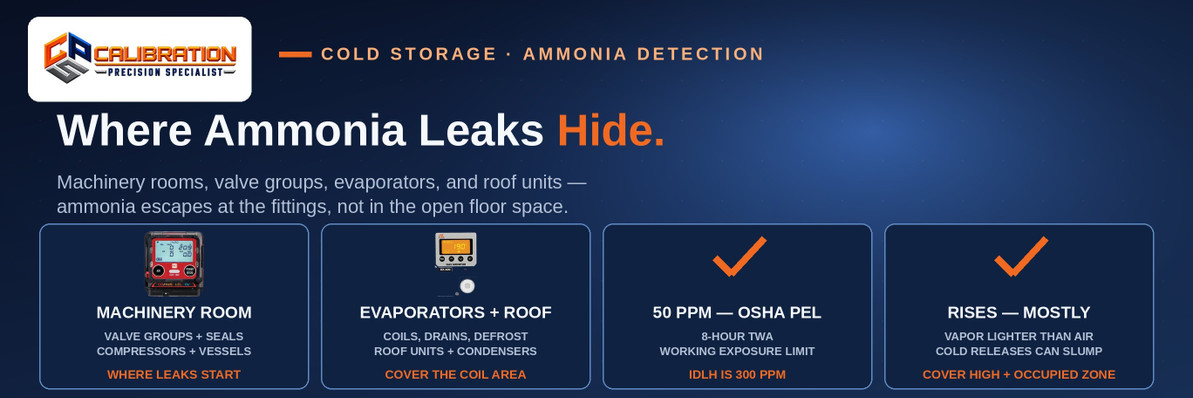
Ammonia detection in cold storage means fixed detectors at the places refrigerant actually escapes — the machinery room, valve groups, evaporators, and roof units — set against the exposure numbers that matter: an OSHA permissible exposure limit of 50 ppm as an 8-hour average and a NIOSH immediately-dangerous level of 300 ppm. Ammonia vapor is lighter than air and rises, so detectors belong above likely leak points, with coverage of the occupied zone as well, because a cold aerosol release can behave differently at first.
Ammonia is the workhorse refrigerant of cold storage for good reasons, and it is also a toxic gas with a sharp, unmistakable smell that fools people into treating their nose as a detector. It is not one. By the time a leak is obvious, the machinery room can already be well past the exposure limit — and the leak itself is almost never in the open floor space where someone would notice it first. This post is the cluster lead for cold storage gas detection: where ammonia leaks hide, what the exposure numbers mean, and where detection belongs. The companion posts cover the detectors cold storage workers carry, controlled-atmosphere oxygen hazards, halocarbon refrigerant leaks, and what ASHRAE 15 requires in the machinery room.
Where Do Ammonia Leaks Hide in a Cold Storage Plant?
At the machinery — not in the middle of the room. Work through a plant in the order leaks actually happen:
| Leak location | Why it leaks | Detection implication |
|---|---|---|
| Machinery room — compressors, valve groups, vessels | Seals, packing, flanges, and valves under constant pressure and vibration; the highest concentration of ammonia piping in the building | Primary fixed detection point; this is also the room ASHRAE 15 addresses |
| Evaporators in cold rooms and freezers | Coils, drain lines, and defrost cycles; damage from forklifts and product handling | Detection or sampling that covers the coil area, not just the door |
| Roof units and condensers | Weather, vibration, and long pipe runs; leaks disperse outdoors but can be drawn into air intakes | Points at the unit, and awareness of where roof air goes |
| Piping runs, risers, and relief headers | Joints and relief events along the route between plant and rooms | Coverage along the run where people work, especially in enclosed chases |
The pattern is simple: follow the fittings. A straight run of sound pipe rarely leaks; a valve that gets operated, a seal that cycles, and a coil that gets hit are where refrigerant gets out.
What Do the Ammonia Exposure Numbers Actually Mean?
Three numbers frame every ammonia detection decision, and they answer different questions:
- 50 ppm — the OSHA PEL. The permissible exposure limit for ammonia is 50 ppm as an 8-hour time-weighted average. This is the working-exposure line: detection and alarming have to happen in a range that lets people act before routine exposure builds past it.
- 300 ppm — the NIOSH IDLH. At 300 ppm ammonia is immediately dangerous to life or health. This is the escape line, not a working line — nobody plans to work in it, and a detector that only alarms near it has failed at its job.
- 15% by volume — the LEL. Ammonia's lower explosive limit is 15% (150,000 ppm). Fire is a real property of ammonia, but at any concentration a person could be standing in, toxicity is the hazard that arrives first by orders of magnitude. Ammonia detection in cold storage is toxic-gas detection.
That spread — 50 to 300 to 150,000 — is why a combustible (%LEL) monitor is the wrong primary instrument for ammonia life safety, and a ppm-range toxic detector is the right one.
Where Should Ammonia Detectors Be Placed?
Above likely leak points — and covering the occupied zone. Both halves matter, and here is why the guidance is deliberately two-part:
Ammonia vapor is lighter than air and rises. Warm ammonia gas released into a room moves up, so a detector above a valve group, compressor, or evaporator coil sees the leak early, and ceiling-level coverage catches what collects overhead.
A cold release does not always start that way. Ammonia flashing out of a cold liquid line can come out as a cold aerosol cloud that is initially denser and can slump or travel at working height before it warms and rises. A plant that detects only at the ceiling can miss the first minutes of exactly the release it most needs to catch.
So the working rule is: a point above each likely leak source, plus coverage of the zone people actually occupy — the machinery-room floor, the door, and the routes workers walk. Placement follows the leak points and the people, not a single height stamped on every wall. A fixed ammonia point such as the PureAire Universal Ammonia Gas Detector ($1,375) covers a machinery-room zone continuously; a personal RKI SC-04 Ammonia monitor ($520) covers the worker who goes looking for the leak. Where oxygen displacement is also a concern — a large charge in a tight room — a stand-alone oxygen point such as the RKI OX-600 ($785) watches the other half of the problem: air below 19.5% oxygen is oxygen-deficient, against a normal of 20.9%.
What Should Happen When the Detector Alarms?
An ammonia alarm has to do more than make noise in an empty room:
- Alarm where people are — and where they are about to enter. Audible and visual alarm in the room and at its entrance, so the warning reaches a worker before he walks in, not after. In the machinery room this is also an ASHRAE 15 requirement — see the machinery-room post for the compliance detail.
- Start ventilation. Detection tied to mechanical ventilation begins diluting the room automatically instead of waiting for someone to decide.
- Reach a staffed point. Cold storage machinery rooms are unstaffed most of the day; an alarm nobody hears is a log entry, not a warning.
If your plant needs the fixed side designed and installed rather than just supplied, that is a defined service: see fixed system installation. And fixed points need calibration on schedule — a fixed head drifts silently, with no wearer to notice — which is routine work for our calibration services.
Frequently Asked Questions
Where do ammonia leaks hide in cold storage?
Ammonia leaks hide at the machinery: compressor seals and valve groups in the machinery room, evaporator coils and drain lines in cold rooms, roof units and condensers, and the joints along piping runs and relief headers. Straight runs of sound pipe rarely leak — fittings, seals, valves that get operated, and coils exposed to forklift traffic are where refrigerant escapes, and detection belongs at those points.
What is the OSHA exposure limit for ammonia?
The OSHA permissible exposure limit (PEL) for ammonia is 50 ppm as an 8-hour time-weighted average. It is the working-exposure line for people in the plant. The NIOSH immediately dangerous to life or health (IDLH) level is far higher at 300 ppm — that is an escape threshold, not a working limit — and ammonia detection and alarming are designed to act in the range around and below the PEL, long before IDLH conditions develop.
Is ammonia flammable?
Yes, but flammability is not the everyday hazard. Ammonia's lower explosive limit is 15% by volume — 150,000 ppm — while its OSHA exposure limit is 50 ppm and its IDLH is 300 ppm. Toxicity arrives thousands of times sooner than flammability at any concentration a person could encounter, which is why ammonia life-safety detection uses ppm-range toxic detectors, not percent-LEL combustible monitors as the primary instrument.
Does ammonia rise or sink?
Ammonia vapor is lighter than air and rises, which is why detectors belong above likely leak points such as valve groups and evaporators. The caution is the cold release: ammonia flashing from a cold liquid line can emerge as a cold aerosol that initially slumps or travels at working height before warming and rising. Good placement therefore covers both — above the leak points and across the occupied zone — rather than relying on a single mounting height.
Where should ammonia detectors be installed in a cold storage facility?
Above each likely leak point — machinery-room valve groups and compressors, evaporator coils, and roof equipment — with additional coverage of the occupied zone: the machinery-room floor, its entrance, and the routes workers walk. Placement follows the leak points and the people. A detector in the middle of an empty room, away from any fitting or coil, is watching the place a leak is least likely to start.
Can you smell ammonia before it is dangerous?
Ammonia has a sharp, pungent odor that most people notice at low concentrations, but smell is not a detection method and this post does not treat it as one. Odor tells you ammonia is present; it cannot tell you whether the air is at 25 ppm or 250 ppm, fatigue dulls it during a shift, and a worker entering from clean air can step into a high concentration at a doorway. Instruments measure; noses do not.
What is the difference between a fixed ammonia detector and a personal ammonia monitor?
A fixed detector watches a place continuously — a machinery room, an evaporator zone — alarms at the room and its entrance, and can start ventilation whether or not anyone is present. A personal monitor, such as the RKI SC-04 Ammonia at $520, watches a person: it travels with the worker doing machinery-room rounds or hunting a leak. Cold storage plants generally need both — the fixed point guards the room, the personal monitor guards the worker who responds to it.
Does a standard 4-gas monitor detect ammonia?
A standard 4-gas monitor reads combustible gas (%LEL), oxygen, carbon monoxide, and hydrogen sulfide — ammonia is not one of its four channels. Configured multi-gas instruments can carry an ammonia sensor as an added channel, and dedicated single-gas ammonia monitors exist for workers whose main exposure is ammonia. Do not assume the 4-gas on a worker's chest is reading ammonia unless its sensor list actually includes an NH3 channel.
What should an ammonia detector alarm do besides sound?
It should warn inside the room and at its entrance — so a worker is warned before entering — activate mechanical ventilation to begin diluting the room, and report to a point that is actually staffed, because machinery rooms sit empty most of the day. In a refrigeration machinery room, the inside-and-outside alarm and the ventilation activation are ASHRAE 15 requirements, not optional extras.
How often do ammonia detectors need calibration?
On the interval the manufacturer specifies for that detector — there is no single number that honestly covers every fixed head and personal monitor, and any source that gives you one for all of them is guessing. What is universal is the failure mode: sensors drift silently, so an uncalibrated point can read low while reporting a room as safe. Put every ammonia point, fixed and personal, on a written calibration schedule based on its manual. CPS calibrates fixed and portable instruments — we calibrate every channel the instrument carries — through our calibration services.
The Bottom Line
Ammonia in cold storage leaks at the machinery — valve groups, compressor seals, evaporators, and roof units — and the numbers are unforgiving: 50 ppm as the working exposure limit, 300 ppm immediately dangerous. Put ppm-range detection above the leak points and across the occupied zone, tie it to alarms inside and outside the room and to ventilation, and give the workers who respond a personal monitor of their own.
Mapping detection for a cold storage plant, or auditing what is already on the walls? Call CPS Calibrations at 865-900-8844 — we supply, install, and calibrate fixed and portable gas detection from Rockwood, Tennessee, and the cold storage series continues with what detectors cold storage workers need.
CPS Calibrations · 109 S. Front Street, Rockwood, TN 37854 · Calibration Services · The CPS Calibration Program
Need a calibration you can file?
In-house calibration at CPS in Rockwood, Tennessee — $55 for single-gas instruments, $90 for 4- and 5-gas — every channel, as-found and as-left data, full certificate.
See Calibration Servicesor call 865-900-8844
Recent Posts
-

Can You Add a Pump to a SENKO SGT-P or MGT?
Yes — SENKO's SP-Pump101 external sampling pump ($330, part AAA006000) fits the SGT, SGT-P, and MGT, …Nov 12th 2026 -

What Refrigerant Detection Does a Grocery Store Need?
A grocery store needs refrigerant detection in three places: low-mounted carbon dioxide (R-744) sens …Nov 11th 2026 -

What Is LEL and UEL? The Explosive Range, Gas by Gas
The LEL is the lowest concentration of a gas in air that can explode, and the UEL is the highest: me …Nov 10th 2026