
The CPS Calibration Program: Every Instrument, Every Date, One Record
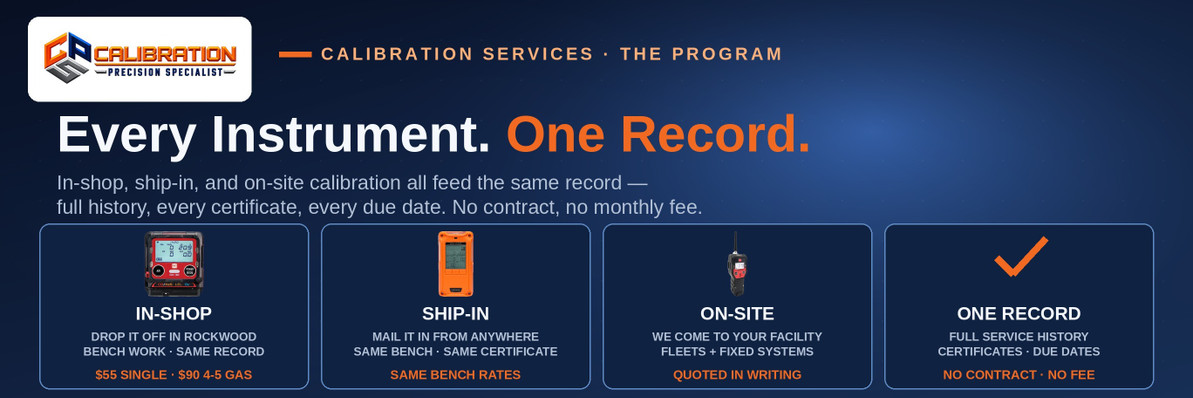
The CPS Calibration Program keeps one record per instrument for every calibration it ever receives: work done in our Rockwood, Tennessee shop, detectors shipped in by mail, and on-site calibrations at your facility all land in the same history — every service event, every certificate, and the next due date in one place. There is no contract and no monthly fee; you pay per calibration ($55 single-gas, $90 for 4- and 5-gas in-house) and the record-keeping comes with the work.
Ask most safety managers where a given detector's calibration history lives and the honest answer is "in three places." The in-shop jobs are on certificates in a binder. The mail-in calibrations live in somebody's email. The on-site visit produced a report that went to whoever signed for it that day. When an auditor, an insurer, or a corporate safety review asks for the record, somebody assembles it by hand — if they can.
The program exists to make that answer one word: here. This post explains what the program is, what the record holds, and how an instrument gets into it.
What Is the CPS Calibration Program?
It is a calibration service organized around the instrument's record instead of the individual job. Every gas detector CPS calibrates gets a record, and every calibration event for that instrument — regardless of how the instrument reached us — is added to it:
- In-shop calibration at our Rockwood, TN bench, for local customers who drop instruments off.
- Ship-in calibration for customers anywhere: mail the instrument in, it goes on the same bench, and it ships back with its certificate.
- On-site calibration at your facility, when the instruments can't come to us.
Most calibration providers treat those as three separate services with three separate paper trails. Here they are three doors into the same room. The calibration services page covers the service itself; the program is what happens to the record afterward — it stays whole.
What Does One Record Per Instrument Actually Include?
| On the record | What it means for you |
|---|---|
| Complete service history | Every calibration event for that serial number, in order, no matter which door it came through |
| The certificate for every job | The actual certificate document, retrievable any time — not a reprint request and a wait |
| As-found / as-left data | Readings on every channel before and after adjustment, on every certificate |
| The gas used, with its CoA | Each certificate names the calibration gas and links the Certificate of Analysis for that cylinder |
| The next due date | Set at every calibration, tracked automatically from that day |
| A reminder before it arrives | An email listing the units coming due — see the due-date reminders post |
The certificate standard deserves one line of its own, because it is where the program is most different: every CPS certificate carries the full breakdown — as-found and as-left readings on every channel, measurement uncertainty, and a clickable Certificate of Analysis link for the gas cylinder used. There is one certificate tier. The complete record is standard, never an upsell. The certificate post walks through a certificate field by field.
How Does an Instrument Get Into the Program?
Through any of the three doors — and it only has to come through once. The first calibration CPS performs on an instrument opens its record; every calibration after that adds to it.
In-shop is the straightforward route for East Tennessee: bring the instrument to 109 S. Front Street in Rockwood, or send it over from the plant. In-house calibration is $55 for a single-gas instrument and $90 for a 4- or 5-gas instrument. The cost breakdown post shows exactly what those rates cover.
Ship-in is the same bench by mail. If there is no calibration provider near you — or yours is booked out for weeks — the instrument travels instead of you. Ship-in work feeds the identical record, and the certificate and history are the same documents an in-shop customer gets.
On-site calibration is for fleets that can't be out of service or can't travel: fixed systems, large portable fleets, instruments spread across a plant. On-site work is priced by written quote, because it carries travel and scheduling that bench work doesn't — the in-house rates above are bench rates, and on-site calibration costs more. What you get for it is convenience and zero downtime, and every instrument serviced still lands in the same record. The honest comparison of the two routes is in our in-house vs. on-site post.
What Happens Between Calibrations?
Two things, and they are the parts of the program customers actually feel day to day.
You get reminded before you're overdue. The record watches due dates automatically. Before an instrument comes due, you get one email listing the units approaching their dates — manufacturer, model, serial number, and due date — so booking happens early, on your schedule, instead of after an auditor finds an expired instrument. Units already scheduled are left off the list. The due-date reminder post explains the cycle in detail.
Your whole history sits behind one link. Every customer gets a single link to their fleet's calibration history — every instrument, every certificate, with per-location views if your instruments live at more than one site. An auditor asks, you send the link. The fleet history post shows what that looks like.
What Does the Program Cost?
The calibrations, and nothing else. In-house rates are $55 for single-gas instruments and $90 for 4- and 5-gas instruments; ship-in work is billed at the same bench rates (shipping is the customer's cost); on-site work is quoted in writing per job. There is no enrollment fee, no monthly fee, no per-record charge, and no contract to sign — the tracking, the reminders, and the fleet link are part of how CPS does calibration, not a subscription layered on top of it.
One honest boundary: the record holds the work CPS performs. Calibrations done by another provider before an instrument came to us live in that provider's paperwork — your CPS record starts complete from your first CPS calibration and never has a gap after it.
Frequently Asked Questions
What is the CPS Calibration Program?
The CPS Calibration Program is CPS Calibrations' calibration service organized around one record per instrument. Every calibration an instrument receives — in our Rockwood, TN shop, shipped in by mail, or performed on-site at your facility — is added to the same record: complete service history, the certificate for every job, as-found and as-left readings on every channel, and the next due date. There is no contract and no monthly fee; you pay per calibration.
Does the CPS Calibration Program require a contract or a monthly fee?
No. There is no contract, no enrollment fee, and no monthly fee. You pay only for calibrations you actually have done — $55 for a single-gas instrument and $90 for a 4- or 5-gas instrument at in-house bench rates, with on-site work quoted in writing. The record-keeping, due-date reminders, and fleet history link are included with the service, not sold as a subscription.
How much does gas detector calibration cost at CPS?
In-house calibration is $55 for a single-gas instrument and $90 for a 4- or 5-gas instrument, at CPS Calibrations in Rockwood, Tennessee. Ship-in (mail-in) calibrations are billed at the same bench rates; you cover shipping. On-site calibration at your facility costs more than bench work and is priced by written quote, since it includes travel and scheduling. Every rate includes the full certificate with as-found and as-left data on every channel.
Can I ship my gas detectors to CPS for calibration?
Yes. Ship-in calibration is one of the three ways instruments enter the program: mail the detector to CPS Calibrations, 109 S. Front Street, Rockwood, TN 37854, and it is calibrated on the same bench, by the same process, as an instrument dropped off in person. Its record, certificate, and due-date tracking are identical either way — the only difference is the trip.
Does on-site calibration feed the same record as in-shop work?
Yes. On-site calibrations performed at your facility are recorded on the same per-instrument record as in-shop and ship-in work — same certificate, same as-found/as-left data, same due-date tracking. An instrument's history at CPS never splits by service type, so a detector calibrated on-site one year and shipped in the next still shows one continuous history.
How will I know when my gas detectors are due for calibration?
CPS tracks the due date set at every calibration and emails you before it arrives. The reminder looks 30 days ahead, goes out on a weekly cycle, and lists each unit coming due — manufacturer, model, description, serial number, and due date — in one email covering your fleet. Units you have already scheduled are excluded, so the list only ever shows what still needs booking.
Can I see my whole fleet's calibration history in one place?
Yes. Every CPS calibration customer has one link to their fleet's calibration history: every instrument, every certificate, and every due date, with per-location views for instruments at multiple sites. It is built for the moment an auditor, insurer, or corporate safety manager asks for proof — you send the link instead of assembling records from binders and email.
What is on a CPS calibration certificate?
The full breakdown, on every certificate: as-found and as-left readings for every channel, the calibration gas used with a clickable Certificate of Analysis link for that exact cylinder, measurement uncertainty, the calibration due date, and the technician who performed the work. There is one certificate tier at CPS — the complete certificate is the standard, never an upgrade you pay extra for.
Do you calibrate gas detector brands you don't sell?
Yes — calibration service coverage is broader than the sales catalog. CPS sells RKI, SENKO, and Crowcon instruments, and the bench also calibrates portable detectors from other major makers that customers already own. What matters for your record is that the instrument comes to CPS: however it arrives, its calibration lands in the same program record as the instruments you bought from us.
How do I get started with the CPS Calibration Program?
Have one instrument calibrated. Call CPS Calibrations at 865-900-8844, bring the instrument to 109 S. Front Street in Rockwood, TN, or ship it in — the first calibration opens the instrument's record, sets its due-date tracking, and puts its certificate in your fleet history. Every calibration after that adds to the same record automatically.
The Bottom Line
One instrument, one record, every door: in-shop, ship-in, and on-site calibrations all feed the same history at CPS — certificates, as-found/as-left data on every channel, and due dates tracked with a reminder before you're overdue — with no contract and no monthly fee, at $55 single-gas and $90 for 4- and 5-gas in-house.
Ready to put your fleet on one record? Call CPS Calibrations at 865-900-8844 or see the calibration services page — the first calibration starts the record.
CPS Calibrations · 109 S. Front Street, Rockwood, TN 37854 · Calibration Services · The CPS Calibration Program
Ready to mail yours in?
Start the ship-in request, pack the meter, and we handle the rest — every channel calibrated as configured, full certificate returned with it.
Start Your Ship-In Requestor call 865-900-8844
Recent Posts
-
Can You Add a Pump to a SENKO SGT-P or MGT?
Yes — SENKO's SP-Pump101 external sampling pump ($330, part AAA006000) fits the SGT, SGT-P, and MGT, …Nov 12th 2026 -

What Refrigerant Detection Does a Grocery Store Need?
A grocery store needs refrigerant detection in three places: low-mounted carbon dioxide (R-744) sens …Nov 11th 2026 -

What Is LEL and UEL? The Explosive Range, Gas by Gas
The LEL is the lowest concentration of a gas in air that can explode, and the UEL is the highest: me …Nov 10th 2026