
What's on a CPS Calibration Certificate?
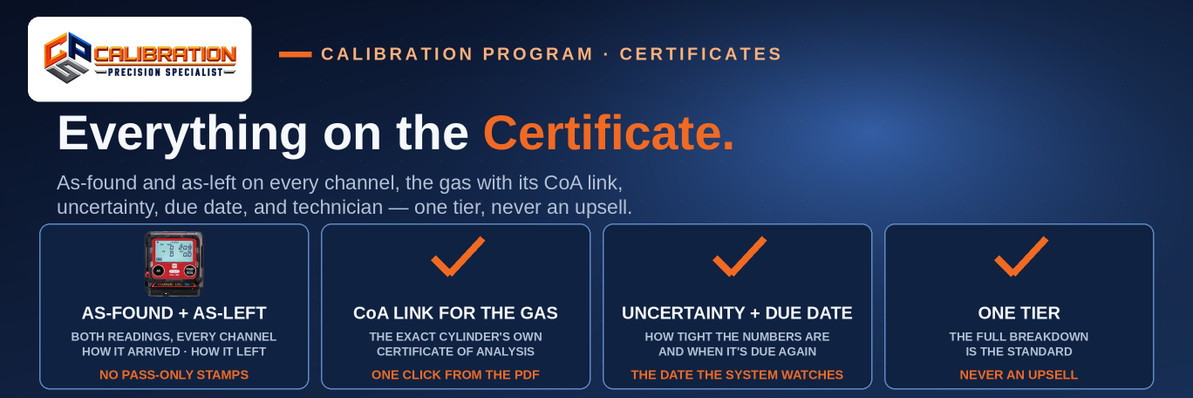
A CPS calibration certificate includes the full breakdown on every job: as-found and as-left readings for every channel, the calibration gas used — with a clickable Certificate of Analysis link for that exact cylinder — measurement uncertainty, the calibration due date, and the technician who performed the work. There is one certificate tier at CPS; the complete record is the standard, never an upsell.
"Calibrated" is a claim. A certificate is the evidence — and certificates vary enormously in how much evidence they actually carry. Some show a pass stamp and an after-adjustment reading. Some show the readings the instrument arrived with, which is where the real information lives. This post lists exactly what a CPS certificate contains, field by field, so you can compare it against whatever is currently in your binder.
What Fields Are on a CPS Calibration Certificate?
| On the certificate | What it tells you |
|---|---|
| Instrument identity | Manufacturer, model, and serial number — the certificate belongs to one specific unit |
| As-found readings, every channel | How each sensor was reading when the instrument arrived, before anything was touched |
| As-left readings, every channel | How each sensor reads after calibration — the state it goes back to work in |
| The calibration gas used | The gas and concentration applied to each channel |
| A clickable Certificate of Analysis link | The CoA for that exact gas cylinder — one click from the certificate to the gas's own documentation |
| Measurement uncertainty | The stated uncertainty of the calibration, so you know how tight the numbers are |
| Calibration due date | When this instrument is due again — the date the reminder system watches |
| The technician | Who performed the work |
No abbreviated version exists. A single-gas clip and a 5-gas pumped instrument get the same treatment, scaled only by how many channels they carry — and we calibrate every channel, every time, and print both sides of the adjustment for each one.
Why Do As-Found Readings Matter So Much?
Because the as-left reading only tells you the instrument is right now. The as-found reading tells you whether it was right then — during the weeks or months it was out working since its last calibration.
- An instrument that arrives reading close to true has been trustworthy all period, and its exposure logs stand.
- An instrument that arrives reading low has been under-reporting — and that fact, documented on the certificate, is what lets a safety manager judge how much weight to give the readings it took.
- A certificate without as-found data erases the question entirely. You know the meter is fine today and nothing about yesterday.
Drift is normal; sensors age. The certificate's job is not to pretend otherwise — it's to measure it, in the open, on every channel, so the history behind your fleet link shows how each instrument is trending over its life, not just that it passed on the day.
How Does the Gas Cylinder's CoA Get onto the Certificate?
A calibration is only as good as the gas it was set with, so the certificate names the gas — and links its paperwork. The flow:
- When a calibration gas cylinder arrives at CPS, we scan the supplier QR code on the bottle. The scan captures the cylinder's Certificate of Analysis.
- The CoA lives on that bottle's record — tied to the cylinder itself, not filed in a drawer.
- When that bottle is used to calibrate your instrument, the certificate carries a clickable CoA link for that exact cylinder — on the PDF, one click, no camera or QR app needed.
So the chain is unbroken and inspectable: this instrument, calibrated with this gas, from this cylinder, whose own analysis is right here. The two posts behind this one explain the gas side in depth: how calibration gas QR codes connect a cylinder to its SDS and CoA, and how to read a calibration gas Certificate of Analysis.
Why Is There Only One Certificate Tier?
Because the alternative never made sense to us. Producing the full breakdown — as-found alongside as-left, the gas linked, the uncertainty stated — takes seconds of extra work once the calibration is done properly. Charging a customer extra for those seconds, or issuing a thin certificate to anyone who didn't pay for the thick one, is charging for the turning of a page.
So there is no basic certificate and no premium certificate. Every instrument calibrated at CPS — in-shop, shipped in, or serviced on-site — gets the complete document, and the price of the calibration doesn't change: $55 for a single-gas instrument, $90 for a 4- or 5-gas instrument in-house, with the certificate standard included in either. The certificate is the product of the work, not an accessory to it.
Frequently Asked Questions
What's on a CPS calibration certificate?
A CPS calibration certificate carries the instrument's manufacturer, model, and serial number; as-found and as-left readings for every channel; the calibration gas used, with a clickable Certificate of Analysis link for that exact cylinder; measurement uncertainty; the calibration due date; and the technician who performed the work. Every field, on every certificate — there is one tier, with the full breakdown standard.
Does a CPS calibration certificate show as-found readings?
Yes — as-found and as-left readings appear on every channel of every certificate. The as-found readings show how the instrument was performing when it arrived, before adjustment; the as-left readings show its state going back into service. Both matter: as-left proves it's right now, as-found tells you how much trust to place in the readings it took since its last calibration.
What is the Certificate of Analysis link on a CPS certificate?
It is a clickable link on the certificate to the Certificate of Analysis (CoA) for the exact calibration gas cylinder used on your instrument. When a gas bottle arrives at CPS, the supplier QR code on it is scanned and the CoA is stored on that bottle's record; when the bottle is used in a calibration, its CoA link is printed on the certificate. One click connects your instrument's calibration to the gas's own certified analysis.
Does the certificate show measurement uncertainty?
Yes. The certificate states the measurement uncertainty of the calibration alongside the readings. Uncertainty quantifies how tight the calibration numbers are — the band within which the true value lies — so a reviewer can judge the readings against your own accuracy requirements instead of taking a bare number on faith.
Is there a more detailed certificate available for an extra fee?
No. CPS issues one certificate tier: the complete breakdown — as-found and as-left on every channel, the gas CoA link, uncertainty, due date, and technician — is on every certificate at no extra charge. The fuller document takes seconds of additional work once a calibration is done properly, and we don't sell it back to you as an upgrade.
Does the certificate show when the next calibration is due?
Yes. Every certificate states the instrument's next calibration due date, and that date is the one CPS's tracking system watches — a reminder email listing the unit goes out 30 days ahead of it. The certificate and the reminder run off the same record, so the date on the document is the date in the system.
Is the technician who did the work named on the certificate?
Yes. The certificate identifies the technician who performed the calibration. Accountability by name matters when a reading is ever questioned: the document shows not just what was done and what gas was used, but who did it — and the instrument's record keeps that certificate permanently as part of its history.
Does every channel really appear on the certificate — even on a 5-gas meter?
Yes. We calibrate every channel, and the certificate shows as-found and as-left readings for each one — LEL, oxygen, hydrogen sulfide, carbon monoxide, and a PID or specialty channel where fitted — not a single summary line. A channel that isn't listed can't be verified; on a CPS certificate, every channel your instrument carries is listed with both readings.
Can I retrieve my certificates later for an audit?
Yes. Certificates live on each instrument's record in the CPS Calibration Program, and your whole fleet's certificates are reachable behind your one fleet history link — every instrument, every certificate, with per-location views. When an auditor or insurer asks for proof, you open the history instead of digging through email and filing cabinets for the original documents.
What does a CPS calibration cost, including the certificate?
In-house calibration is $55 for a single-gas instrument and $90 for a 4- or 5-gas instrument at CPS Calibrations in Rockwood, TN, and the full certificate is included — there is no certificate fee on top. Ship-in calibrations are billed at the same rates; on-site work at your facility is quoted in writing and costs more than bench work.
The Bottom Line
A certificate should prove the calibration, not just announce it. A CPS certificate carries as-found and as-left readings on every channel, the calibration gas with a clickable CoA link for the cylinder used, measurement uncertainty, the due date, and the technician — one tier, full breakdown, on every job, never an upsell.
If the certificates in your binder are thinner than that, the fix is one calibration away: call CPS Calibrations at 865-900-8844 — the work is part of the CPS Calibration Program, and the record starts with the first instrument.
CPS Calibrations · 109 S. Front Street, Rockwood, TN 37854 · Calibration Services · The CPS Calibration Program
Ready to mail yours in?
Start the ship-in request, pack the meter, and we handle the rest — every channel calibrated as configured, full certificate returned with it.
Start Your Ship-In Requestor call 865-900-8844
Recent Posts
-

Can You Add a Pump to a SENKO SGT-P or MGT?
Yes — SENKO's SP-Pump101 external sampling pump ($330, part AAA006000) fits the SGT, SGT-P, and MGT, …Nov 12th 2026 -

What Refrigerant Detection Does a Grocery Store Need?
A grocery store needs refrigerant detection in three places: low-mounted carbon dioxide (R-744) sens …Nov 11th 2026 -

What Is LEL and UEL? The Explosive Range, Gas by Gas
The LEL is the lowest concentration of a gas in air that can explode, and the UEL is the highest: me …Nov 10th 2026