
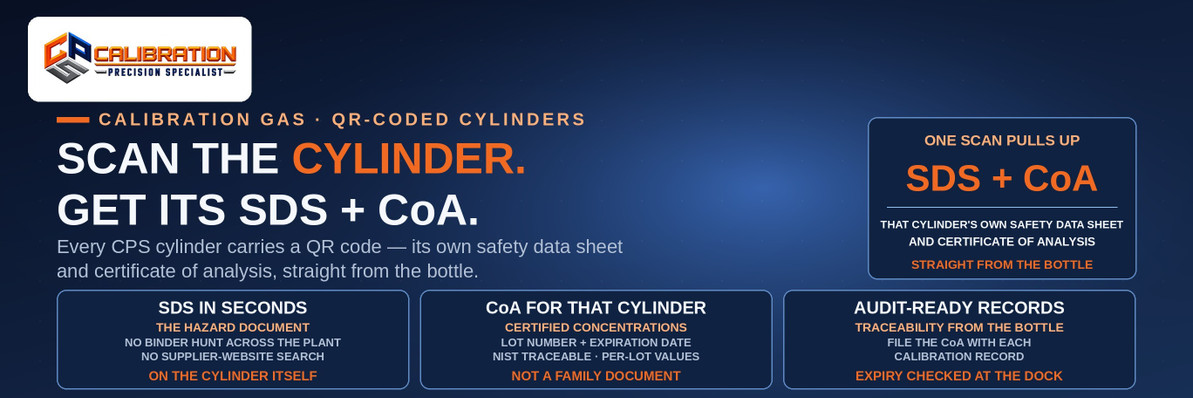
Calibration Gas With QR Codes: Scan the Cylinder for Its SDS and Certificate of Analysis
Every calibration gas cylinder CPS sells carries a QR code on the cylinder: scan it with a smartphone and you pull up that cylinder's own Safety Data Sheet (SDS) and Certificate of Analysis (CoA) — the certified concentrations, lot number, and expiration date for the specific bottle in your hand, not a generic document for the product line. It turns the two documents safety managers need most — at audit time, at receiving, and in the field — into a scan that takes seconds.
Calibration gas is a certified reference, and a certified reference is only as good as its paperwork. The concentrations on the certificate are what your detector was adjusted against; the SDS is the hazard document your safety program is required to keep accessible. Both have traditionally lived somewhere other than the cylinder — a sheet in a shipping box, a PDF on a supplier's website. We put them on the bottle. This post explains what the scan gives you, what each document actually contains, and the four everyday problems it solves.
What Does the QR Code on a CPS Cylinder Actually Pull Up?
Two documents, both specific to the cylinder you scanned:
- The cylinder's Safety Data Sheet (SDS) — the hazard and handling document for that mixture: what's in it, what it can do, how to store, handle, and respond to it.
- The cylinder's Certificate of Analysis (CoA) — the certification for that production lot: the measured concentration of every component, the lot number, the NIST traceability behind the numbers, and the expiration date.
That word — cylinder-specific — is the whole point. Product-family paperwork tells you what a blend is supposed to contain. The CoA behind the QR code states what your cylinder's lot actually measured, and when it stops being certified. (New to the documents themselves? What a calibration gas Certificate of Analysis proves goes line by line, and what calibration gas is covers the mixtures themselves.)
What's Inside the Certificate of Analysis?
A CoA is the cylinder's birth certificate and report card in one page:
| CoA field | Why you care |
|---|---|
| Certified concentration of each component (e.g., H₂S 25 ppm, CO 50 ppm, CH₄ 2.5%) | These are the exact values the detector is adjusted to — if they don't match the instrument's expected span values, the calibration is wrong |
| Lot / batch number | Ties your calibration records to one production lot — the backbone of traceability if a lot is ever questioned |
| NIST traceability | The concentrations were measured against standards chained to the National Institute of Standards and Technology, so the numbers are verifiable, not asserted |
| Expiration date | The date the certification ends — reactive blends run 6–12 months, stable gases roughly 36 |
When a calibration record says "calibrated 3/14 with lot #…", the CoA is the document that proves what was in that lot. With the QR code, it's attached to the cylinder the whole way.
What's Inside the SDS — and When Do You Need It?
The SDS is the safety document: the mixture's hazards, first-aid and exposure information, handling and storage requirements, and disposal guidance. You need it in three ordinary situations:
- Your safety program. OSHA's Hazard Communication standard requires employers to keep a safety data sheet accessible for hazardous chemicals employees work with — and a cylinder containing hydrogen sulfide or carbon monoxide is exactly that.
- An incident or a near-miss. When someone is exposed, the SDS is the document responders and medical staff reach for. Seconds matter; a binder across the plant doesn't help.
- Storage and handling questions. What the cylinder can sit next to, how it should be secured, what to do with a leaker — the SDS answers them (our practical companion is how to store calibration gas).
What Problems Does the Scan Actually Solve?
| The moment | The old way | With the QR code on the cylinder |
|---|---|---|
| An auditor asks for the CoA for the lot used in March | Dig through shipping boxes, email the supplier, wait | Scan any cylinder from that lot — or pull the lot's CoA from the scan and file it with the calibration record |
| EHS needs the SDS for a new mixture | Search the supplier's website by product name and hope the family document matches | Scan the cylinder on the dock; the SDS for that mixture is up |
| A cylinder's lot is questioned or recalled | Reconstruct which instruments were calibrated from which bottle, from memory | Lot number is on the CoA behind the code — traceable from the bottle itself |
| Receiving a new shipment | Check the small print on every label for expiry before shelving | The expiration date is on the CoA the scan pulls up — verify the date before the cylinder goes on the shelf, not after |
The pattern underneath all four: the paperwork used to live in the office, and the cylinder lives in the field. Putting the documents on the cylinder closes that gap — for the technician calibrating off a tailgate, the dock worker receiving a shipment, and the safety manager building an audit file, it's the same document, straight from the bottle.
How It Works in Practice
There is no system to buy into and nothing to install. The code is printed on the cylinder; you scan it with a smartphone or another compatible device, and that cylinder's SDS and CoA open. Save them, print them, or file the CoA with the calibration record for the instruments that cylinder serviced — most shops do the last one, because it makes the next audit a filing exercise instead of a search party. If a code is ever damaged or unreadable, call us at 865-900-8844 with the lot number off the label and we'll get you the documents for that cylinder.
Does Every Calibration Gas Supplier Do This?
No — and it's worth being precise about the difference. The standard handoff in this industry is a paper CoA in the shipping carton and an SDS that lives on the supplier's website under the product name, written for the product family. Family-level documents aren't wrong, but they answer a slightly different question than an auditor, a responder, or a technician is asking. They ask about this cylinder. Cylinder-specific documents — the actual lot, the actual certified values, the actual expiry — are what the QR code delivers.
What the QR Code Doesn't Do
Honest limits, because a QR code is paperwork, not magic:
- It doesn't extend shelf life. Reactive gas still expires on its 6–12 month clock whether or not the CoA is easy to pull up — calibration gas shelf life explains why, and the printed expiry on the label is still the date to check.
- It doesn't replace the label. Gas composition, warnings, and the expiry date are printed on the cylinder itself; the code adds the full documents behind them. How to read a calibration gas label walks the printed side.
- It doesn't calibrate anything. The documents prove the gas; the calibration still has to be done — bump, zero, span — or handed to someone who does it. (CPS calibrates in-house: $55 single-gas, $90 for 4- and 5-gas instruments, ship-in service available — calibration services.)
- It doesn't change disposal. An empty or expired cylinder is still handled as one — see how to dispose of calibration gas cylinders.
Getting Gas With the Code on It
Every calibration gas cylinder CPS sells carries the QR code — single-gas cylinders and multi-gas blends alike, matched to the instrument they'll calibrate. CPS sells gas for every major detector brand — RKI, SENKO, Crowcon, Honeywell/BW, MSA, Industrial Scientific, and more — and the Calibration Gas Finder matches mixtures to specific models. Browse the range under calibration gas, and remember the standing policy: no hazmat fee on calibration gas — CPS absorbs it.
Frequently Asked Questions
What does the QR code on a calibration gas cylinder do?
Scanning the QR code printed on a CPS calibration gas cylinder pulls up that cylinder's own Safety Data Sheet (SDS) and Certificate of Analysis (CoA) on a smartphone or other compatible device — the cylinder-specific safety and certification documents, available at the bottle instead of in a filing cabinet.
Is the Certificate of Analysis from the QR code specific to my cylinder?
Yes. The CoA covers the production lot your cylinder came from: the measured concentration of each component, the lot number, the NIST traceability, and the expiration date. It is not a generic document for the product family — it certifies the gas actually in that cylinder.
What is a Certificate of Analysis for calibration gas?
A Certificate of Analysis is the document that certifies what a calibration gas cylinder contains: each component's measured concentration, the lot number, the traceability of the measurements to NIST standards, and the date the certification expires. It's the proof behind the span values a detector is calibrated against.
What is an SDS, and why do I need one for calibration gas?
An SDS (Safety Data Sheet) documents a chemical mixture's hazards, handling and storage requirements, first aid, and disposal. Calibration gas cylinders contain compressed gases — some toxic, like H₂S and CO — and OSHA's Hazard Communication standard requires SDSs to be accessible where employees work with hazardous chemicals.
Do I need a special app to scan the QR code?
No special CPS system or account is involved. The code is printed on the cylinder — scan it with a smartphone or another compatible device and that cylinder's SDS and CoA open. If a code is ever damaged, call CPS at 865-900-8844 with the lot number from the label and we'll supply the documents.
How does the QR code help during an audit?
Auditors ask two paperwork questions about calibration gas: what were the certified concentrations of the gas used, and where is the SDS? Calibration records tied to a lot number, with that lot's CoA pulled from the cylinder scan, answer the first; the scan answers the second on the spot, from the cylinder itself.
Does the QR code tell me when the gas expires?
The expiration date is part of the certification the scan pulls up, and it's also printed on the cylinder label. Reactive blends expire in about 6–12 months and stable gases in roughly 36 — the date on your cylinder's CoA is the one that governs, and expired gas shouldn't be used for calibration even if the cylinder still has pressure.
Does every CPS calibration gas cylinder have the QR code?
Yes — every calibration gas cylinder CPS sells includes a QR code for access to its cylinder-specific SDS and Certificate of Analysis, across single-gas cylinders and multi-gas blends.
Is there an extra charge for the QR-code documents — or a hazmat fee?
No to both. The QR code and its documents come with the cylinder, and CPS charges no hazmat fee on calibration gas — CPS absorbs the hazmat cost, so it never appears as a line item on your order.
Can I get the SDS and CoA if the cylinder hasn't arrived yet or the code won't scan?
Call CPS at 865-900-8844. With the lot number from the cylinder label (or your order details), we can get you the SDS and CoA for that cylinder — the scan is the fast path, not the only path.
The Bottom Line
A calibration gas cylinder is a certified reference, and a reference is only as good as its paperwork. CPS puts that paperwork on the bottle: scan the QR code on any CPS cylinder and you have its own SDS and Certificate of Analysis — certified concentrations, lot number, NIST traceability, and expiry — in seconds, on the dock, in the field, or in front of an auditor. The gas itself is NIST traceable and matched to your instrument, and we charge no hazmat fee on it. Browse calibration gas, match your instrument in the Calibration Gas Finder, or call 865-900-8844 and we'll spec the right cylinder — paperwork included, because it's printed on it.
Need a calibration you can file?
In-house calibration at CPS in Rockwood, Tennessee — $55 for single-gas instruments, $90 for 4- and 5-gas — every channel, as-found and as-left data, full certificate.
See Calibration Servicesor call 865-900-8844
Recent Posts
-

Can You Add a Pump to a SENKO SGT-P or MGT?
Yes — SENKO's SP-Pump101 external sampling pump ($330, part AAA006000) fits the SGT, SGT-P, and MGT, …Nov 12th 2026 -

What Refrigerant Detection Does a Grocery Store Need?
A grocery store needs refrigerant detection in three places: low-mounted carbon dioxide (R-744) sens …Nov 11th 2026 -

What Is LEL and UEL? The Explosive Range, Gas by Gas
The LEL is the lowest concentration of a gas in air that can explode, and the UEL is the highest: me …Nov 10th 2026