
Calibration Gas Shelf Life: How Long Do Bottles Really Last?
There's a date stamped on every calibration gas cylinder that most people walk right past. It's not a suggestion. That date — usually phrased as "best when used by" followed by a month and year — is the manufacturer's certified window for the gas inside. Past it, the gas doesn't politely stop working. It drifts. Quietly. And a drifting span gas doesn't fail loudly — it teaches your detectors the wrong answer.
So how long do bottles really last? The honest answer is: it depends on what's in them. There are two families of calibration gas, and they age very differently.
What "Shelf Life" Actually Means
Shelf life isn't the date the gas vanishes from the bottle. It's the date the manufacturer will no longer certify the concentration printed on the label. Up to that date, the gas is guaranteed within its stated accuracy — typically ±2% to ±5% of the certified value, depending on the mix. After it, nobody is vouching for the number.
In practice, degradation is a slow drift, not a cliff. A bottle of hydrogen sulfide doesn't read 25 ppm on Monday and zero on Tuesday. It reads a little low, then a little lower, as the reactive molecules adsorb onto the cylinder walls, react with trace moisture, or combine with the valve material. Your bump test still "passes" — against a weaker and weaker standard — until one day the detector's readings can't be trusted and nothing in the procedure told you so. That's the danger of expired gas: it doesn't fail the test, it corrupts the test.
Non-Reactive Gases: ~36 Months
The stable gases — methane, pentane, propane, carbon monoxide, carbon dioxide, oxygen, hydrogen, nitrogen — typically carry a shelf life of around 36 months. These molecules don't react with the cylinder walls, moisture, or each other under normal storage conditions. A pentane 25% LEL mix or an isobutylene 100 ppm bottle you buy this year is good for roughly three years, as long as the cylinder stays sealed and stored sensibly.
Three years sounds generous, and it is — which is exactly why these are the bottles that quietly expire in the back of the cabinet. Nobody tracks the boring, stable bottle. Track it anyway. When you finally pull it out for an annual calibration and find it's 8 months past its date, you get to buy emergency gas and reschedule the work.
Reactive Gases: 6–12 Months
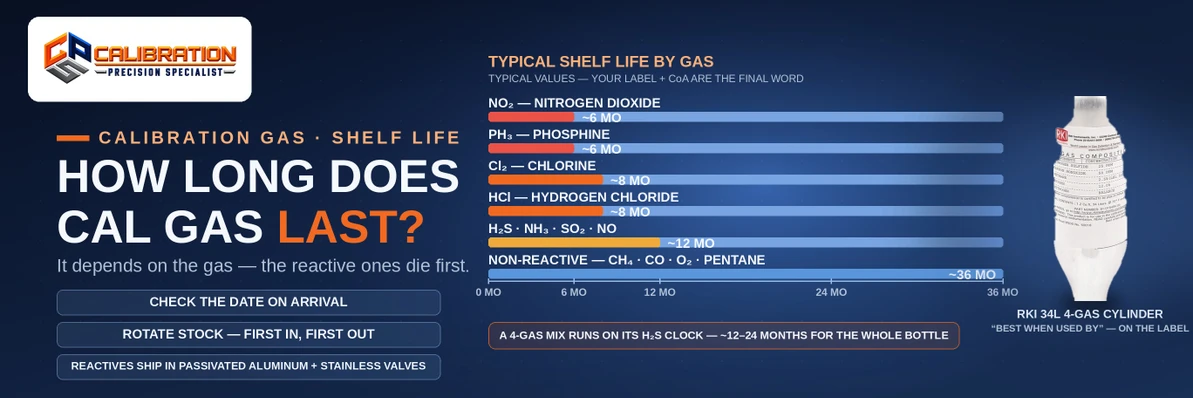
The reactive family — hydrogen sulfide (H₂S), chlorine (Cl₂), nitric oxide (NO), nitrogen dioxide (NO₂), ammonia (NH₃), sulfur dioxide (SO₂), hydrogen chloride (HCl), hydrogen cyanide (HCN), phosphine (PH₃) — is a different story. These gases react with the cylinder walls, trace moisture, and even each other. Their certified shelf lives are short, and they vary by gas:
| Gas | Typical shelf life (34L/58L aluminum) |
|---|---|
| Chlorine (Cl₂) | ~8 months |
| Hydrogen chloride (HCl) | ~8 months |
| Nitrogen dioxide (NO₂) | ~6 months |
| Phosphine (PH₃) | ~6 months |
| Hydrogen sulfide (H₂S) | ~12 months |
| Ammonia (NH₃) | ~12 months |
| Sulfur dioxide (SO₂) | ~12 months |
| Nitric oxide (NO) | ~12 months |
| Silane (SiH₄) | ~12 months |
(These figures align with published RKI shelf-life data for their disposable cylinders — your bottle's label and certificate of analysis are the final word for your specific lot.)
Note the spread: chlorine and HCl get about 8 months, while H₂S and ammonia get about a year. An ammonia 10 ppm bottle you order today needs to be used within roughly 12 months — not "whenever the old one runs out."
Why Reactive Gases Die First
Three things kill a reactive gas inside its cylinder:
Wall adsorption. Gas molecules stick to the interior surface of the cylinder. Rougher internal walls mean more surface area and more loss, which is why reactive gases ship in aluminum cylinders with specially treated (passivated) interiors and stainless steel valves — the treatment minimizes reactivity, but it can't eliminate it.
Moisture. Even trace water vapor inside the cylinder reacts with gases like HCl, Cl₂, and NO₂. Once reacted, the gas is gone — the molecule has become something else entirely.
Concentration effects. A low-concentration mix is more vulnerable: losing the same absolute number of molecules to wall reactions represents a much larger percentage of a 2 ppm mix than a 500 ppm mix. That's why a low-ppm reactive bottle can actually have a shorter certified life than a higher-concentration bottle of the same gas.
The practical takeaway: reactive gases aren't defective, and the short date isn't a scam. It's chemistry. Respect it.
Your 4-Gas Mix Is Only as Fresh as Its H₂S
Here's the one most people miss: a multi-gas mix expires on the schedule of its shortest-lived component. The classic 4-gas mix — LEL (methane), O₂, CO, and H₂S — contains three stable gases and one reactive gas. The methane, oxygen, and CO would happily certify for 3 years. The H₂S gives you roughly 12–24 months. So the whole bottle is dated to the H₂S clock.
This is why buying strategy matters more than brand. A 4-gas calibration mix is the most convenient way to feed a fleet of RKI GX-3R or SENKO SP-MGT monitors — one bottle, one regulator, one procedure — but it's also the bottle you should buy in the size you'll actually finish. A giant cylinder you won't use up before the H₂S fades is money converted into a disposal problem.
What Actually Happens After the Date
Let's be concrete about the failure mode, because "expired" undersells it:
- Your bump tests pass against a drifting standard. A bump test confirms the detector responds to the gas you apply. If that gas is 15% weaker than the label says, the detector "passes" a test that actually verified 15% less response than required. You feel safe. You're less safe.
- Calibrations set the wrong zero and span. A calibration teaches the instrument what the gas concentration is. Teaching it with a weakened gas permanently biases every reading the detector makes until the next calibration — with fresh gas.
- Compliance gaps. If an incident or an OSHA inspection pulls your calibration records and the gas lot was expired, the calibration doesn't count. The paper trail you've been building — the whole reason for data logging and certificates — has a hole in it.
Expired gas doesn't announce itself. The only defenses are the date on the cylinder and a rotation habit.
Buying and Rotation Habits That Actually Work
Buy reactive gases fresh, and buy what you'll use. For H₂S, Cl₂, NH₃, HCl, and other reactives, order the bottle size that matches your burn rate. A 34L cylinder used monthly is a better buy than a 103L cylinder that expires half-full.
Check the date on arrival. Bottles ship with a "best when used by" date and a certificate of analysis showing the manufacture date. If the bottle arrives with 10 months of its 12-month life remaining and you calibrate twice a year, it's already the wrong purchase — send it back or adjust.
Rotate like a grocery store. First in, first out. Put the newest bottles in the back, oldest in front. It sounds trivial; it prevents the most common failure mode we see, which is a reactive bottle quietly aging out behind a fresher one.
Keep bottles sealed until needed. Every connection introduces air and moisture. Don't break the seal "to check" a bottle — check the date and the certificate instead.
Match the gas to the detector fleet. Running RKI and SENKO monitors? Your 4-gas mix should match the channels you're actually spanning (the standard CH₄/O₂/CO/H₂S mix covers both the GX-3R and the SP-MGT), and your single-gas bottles should match any dedicated channels — ammonia, chlorine, SO₂ — in your fixed or portable fleet.
The Calibration Angle
Here's where this connects to our benches: we calibrate every channel with fresh, NIST-traceable gas — and we check the date on our own bottles like it's our job, because it is. Every detector that comes through our lab — gas detection and process instruments alike, temperature, flow, pressure, and gas — gets challenged with gas that's inside its certified life, and the certificate shows the gas lot behind the work. We calibrate every channel, and we prove it on paper.
If you've got a cabinet of cylinders and you're not sure which ones are still good, bring them up the next time you ship us instruments — or call us at 865-900-8844 and we'll help you sort the fresh from the expired. Ship your detectors to our lab or have us come to your facility.
The Bottom Line
Non-reactive gases last about three years. Reactive gases last 6–12 months, and your 4-gas mix inherits the shortest clock in the bottle — the H₂S. Expiration isn't a cliff, it's a drift, and drifting span gas corrupts every bump test and calibration it touches. Buy what you'll use, check the date on arrival, rotate oldest-first, and never let a reactive bottle age out in the back of the cabinet.
Stocking up? Browse calibration gas — single-gas bottles (H₂S, NH₃, Cl₂, SO₂, HCl, HCN and more) and multi-gas mixes — or check the date on the bottles you already own. It's printed right there on the label. Need your fleet verified? Ship your detectors to our lab or have us come to your facility — gas detection and process instruments alike.
Frequently Asked Questions
How long does calibration gas last? Non-reactive gases (methane, pentane, propane, CO, CO₂, O₂) typically last about 36 months. Reactive gases (H₂S, Cl₂, NH₃, HCl, NO₂, SO₂, HCN) typically last 6–12 months depending on the gas. Multi-gas mixes expire on the schedule of their shortest-lived component — for a standard 4-gas mix, that's the H₂S.
Can I use calibration gas after the expiration date? You shouldn't. Past its certified date, the manufacturer no longer guarantees the concentration, and reactive gases measurably drift downward. Calibrating with expired gas biases every reading the detector makes afterward — and in an incident investigation or OSHA inspection, a calibration performed with expired gas may not count.
Why do reactive gases expire faster? Reactive molecules adsorb onto the cylinder walls, react with trace moisture, and in some cases react with the valve material. These losses are proportionally larger in low-concentration mixes, which is why a 2 ppm chlorine bottle can have a shorter certified life than a higher-concentration mix of the same gas. Treated aluminum cylinders and stainless valves slow the process but can't stop it.
Where is the expiration date on a calibration gas cylinder? It's printed on the cylinder label — RKI cylinders, for example, carry a "Best when used by" statement with a month and year — and on the certificate of analysis that ships with the bottle. Check both on arrival: the label tells you the deadline, the certificate tells you the manufacture date and lot.
Does an unopened bottle last longer? Not past its certified date. The certification is based on the chemistry inside the sealed cylinder, so an unopened bottle ages on the same clock. Keeping it sealed does help — every connection introduces air and moisture — but the date on the label still rules.
How do I know if my gas has gone bad before the expiration date? You often can't tell by looking. Warning signs: bump tests that suddenly behave inconsistently across instruments, or calibration adjustments that drift in one direction over successive calibrations. If a bottle was stored hot, connected and left open, or dropped hard enough to suspect valve damage, treat the date with extra skepticism. When in doubt, replace it — a bottle costs far less than a wrong reading.
Recent Posts
-

What Does SIL Mean for Gas Detection?
SIL — Safety Integrity Level — is a rating of a safety function, not of a single detector: under IEC …Oct 21st 2026 -

What Is an Ultrasonic Gas Leak Detector?
An ultrasonic gas leak detector is a fixed detector that finds leaks by listening instead of samplin …Oct 21st 2026 -

Open-Path vs. Point Gas Detectors: What's the Difference?
The difference between an open-path and a point gas detector is what each one measures: an open-path …Oct 21st 2026