
What Is an Ultrasonic Gas Leak Detector?
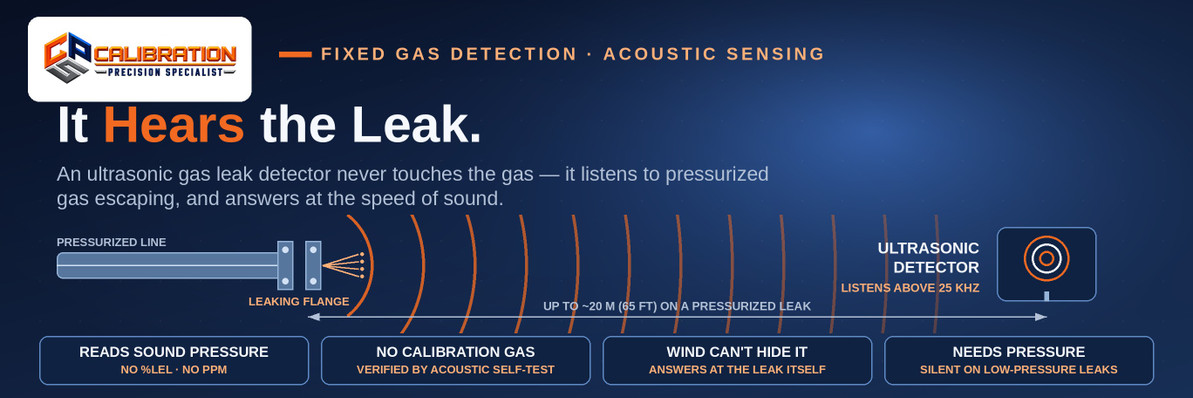
An ultrasonic gas leak detector is a fixed detector that finds leaks by listening instead of sampling: gas escaping under pressure generates broadband noise, and the detector's microphone hears the ultrasonic part of it — above the 25 kHz cutoff these instruments use to shut out ordinary audible sound — and alarms on sound pressure level, not on concentration. It reports no %LEL and no ppm, it is never calibrated with gas, and because it responds to the leak at its source, wind and ventilation cannot carry the evidence away from it the way they can with a measuring detector. Ratings for the class reach a coverage radius of about 20 m (65 ft) for leaks of 0.1 kg/s and larger. The trade is just as plain: a leak that is not pressurized makes little or no ultrasound, and the detector cannot tell you which gas is escaping or how much of it is in the air.
Every other detector in this series works by measurement. A point detector samples the air at its sensor and reports a concentration; an open-path detector measures how much gas sits along a beam. An ultrasonic detector samples nothing and measures nothing. It is the only common fixed technology that detects the event — gas escaping — rather than the result — gas accumulated. That one difference explains everything it is good at, everything it is blind to, and why it shows up as one layer in serious fire and gas systems rather than as a system by itself. This post works through what it hears, how far it hears it, the limits nobody should paper over, and where it fits next to the technologies covered in our guide to how a fixed gas detection system works.
What Does It Actually Hear? A Leak, Not a Cloud
When gas escapes from a pressurized system through a leak — a flange face, a valve stem, a cracked fitting — the flow through the opening is turbulent, and turbulence is noisy. The escaping gas produces a broad wash of sound that spans the audible range and extends well up into ultrasound, the frequencies above human hearing. A fixed ultrasonic detector is built around a microphone and a filter: the filter strips away everything below roughly 25 kHz, which removes the plant's audible roar — voices, alarms, most machinery rumble — and what remains is the band where leak noise lives, roughly 25 to 70 kHz in typical designs.
What the detector reports is a sound pressure level, measured in decibels. That number follows the leak, not the atmosphere: at a given distance, the sound level is directly proportional to the leak rate, and the leak rate is set by the size of the opening and the pressure behind it. A bigger hole or a higher pressure makes a louder leak and a longer reach. This is why ultrasonic detector specifications are written in leak-rate terms — mass per second, at a stated coverage radius — instead of the %LEL and ppm figures every measuring technology uses. The instrument never knows, and never claims to know, how much gas is in the air around it. It knows something is escaping, roughly how fast, and where its microphone is pointed.
Two consequences follow from listening at the source. First, speed: the alarm travels at the speed of sound from the leak, so the detector responds essentially as the leak starts — before any cloud has formed, let alone drifted to a sensor. Second, the sensing element never touches the gas. There is no sensor to poison, saturate, or consume, which is part of why the maintenance story (below) looks so different from a catalytic or electrochemical detector's.
How Is Listening Different From Measuring?
Put the three fixed approaches side by side and the division of labour gets clear. Point and open-path detection are compared in depth in our post on open-path vs. point gas detectors; the ultrasonic column is the odd one out in every row:
| Point detector | Open-path detector | Ultrasonic detector | |
|---|---|---|---|
| Detects | Gas molecules at its sensor | Gas molecules along a beam | The sound of gas escaping |
| Measures | Concentration: %LEL or ppm | Concentration × path: LEL·m | Sound pressure level (dB) — a leak rate proxy, not a concentration |
| What it needs | Gas to physically reach the sensor at alarm concentration | Gas to cross the beam | A pressurized leak making ultrasound within earshot |
| Its blind spot | Gas that never reaches it; clouds diluted below setpoint | Gas that never crosses the beam; a blocked line of sight | Low-pressure and unpressurized leaks; gives no concentration and no gas identity |
| Weather weakness | Wind and ventilation move the cloud away from the sensor | Wind can push the cloud off the beam | Essentially none from wind — but background ultrasonic noise shrinks its range |
That last row is the one that sells the technology, and it deserves its own story.
Why Can't Wind Beat It? The Offshore Test
A measuring detector has a transportation problem: the gas must get from the leak to the sensor, and outdoors the wind is in charge of that journey. Wind dilutes a plume as it carries it, and it can carry it clean past every point detector on the plot while the concentration near the leak is genuinely dangerous. Sound has no such problem. The detector responds to the leak at the source, so changing wind direction, gas dilution, and even the direction the leak is pointing do not enter into it.
This is not a theoretical edge. In a documented field test on a North Sea offshore installation, a test leak — a 3 mm opening at 55 bar, leaking at 0.06 kg/s — was detected by an ultrasonic detector from up to 19 m (about 62 ft) away. During that same test, the gas concentration measured around the leak stayed below 5% LEL, and none of the platform's existing concentration-based gas detectors alarmed at all. Read that again, because it is the whole argument for the technology: a real, substantial pressurized leak, releasing into moving air, that the entire measuring layer was blind to — heard clearly from across the deck. It is also why ultrasonic detectors earned their place first on offshore platforms and outdoor process areas, where wind and ventilation are constants rather than edge cases.
The reach figures are honest ones, with the dependencies attached. Class ratings put coverage at up to about a 20 m (65 ft) radius for leaks of 0.1 kg/s and larger — a substantial leak. A smaller leak, a lower pressure, or a noisier background all pull that radius in, sometimes sharply. Anyone quoting you a single coverage number without asking about your pressures and your background noise is skipping the physics.
What Are the Honest Limits?
The same mechanism that makes the technology fast puts hard edges on it, and a credible specification has to state them:
- No pressure, no sound. The detector hears turbulence, and turbulence needs a pressure difference. A leak from a low-pressure or unpressurized system — a tank vent, a gravity line, a vessel at near-atmospheric pressure — may generate little or no ultrasound and pass unheard. Manufacturer application guidance for the technology treats it as a pressurized-system tool; slow seeps below that threshold are the point detector's job, not this one's.
- It cannot tell you what is leaking, or how bad it is. Escaping sound is escaping sound. The detector hears nitrogen, compressed air, steam, and natural gas with the same ears, and it cannot distinguish them — and since it measures no concentration, its alarm cannot tell you whether the atmosphere is at 5% LEL or 50% LEL. It answers "something is escaping, here, now" and nothing further. Threat assessment still belongs to the measuring layers.
- Background ultrasonic noise is real competition. Plenty of plant equipment makes ultrasound: steam traps, pneumatic actuators, some rotating machinery, electrical discharge. The detector's alarm threshold is set above the site's measured ultrasonic background, and a loud background shrinks the listening range — in very high ultrasonic noise, a small leak can be masked entirely. A background noise survey is part of commissioning one of these, not an optional extra.
- Sound is blocked and absorbed like anything physical. Ultrasound attenuates with distance and is stopped by walls and enclosures; a detector hears its own area, not through the next building. Coverage is a set of overlapping listening zones around likely leak sources — flanges, valves, compressor seals — placed the way our placement guide describes for fixed detectors generally: where fixed gas detectors should be placed.
None of this makes the technology weak. It makes it specific — which is exactly what a layer in a fire and gas system is supposed to be.
Where Does It Earn Its Keep?
The applications share a profile: pressurized gas, outdoors or heavily ventilated, where accumulation-based detection is unreliable:
- Offshore platforms and FPSOs — the technology's birthplace: dense pressurized equipment, constant wind, and no ceiling for gas to collect against.
- Outdoor compressor stations and gas plants — high-pressure gas, open air, leak sources concentrated at flanges, seals, and valve packing.
- Wellheads and production sites — pressurized releases that ignite or disperse before a point detector ever tastes them.
- Anywhere the ventilation is the problem — turbine enclosures with high air-change rates and similar spaces engineered to dilute gas, where dilution defeats a concentration setpoint but does nothing to the sound at the source.
In practice these detectors are almost never the only layer. The standard architecture — spelled out in the layered approach our fixed system overview describes, and in the flame detector vs. gas detector comparison — uses each technology for the moment it owns: ultrasonic hears the leak the second it starts, point detectors measure how bad the cloud is getting, and flame detectors answer if it lights anyway. Ultrasonic detection owns the first seconds of a pressurized release, which is precisely the window the other layers are weakest in.
Does It Need Calibration Gas? No — It Is Verified With Sound
There is no gas sensor, so there is nothing to bump test and nothing to span: no cylinders, no span gas, no calibration schedule of the kind our calibration gas pages exist for. Verification is acoustic. Better designs test themselves — the Gassonic Observer-H, one of the established instruments in this class, runs an integrated acoustic self-test that checks its microphone and electronics every 15 minutes — and the setup work that replaces calibration is the commissioning survey: measure the area's ultrasonic background, set the alarm trigger level above it, and confirm the detector hears a test sound source as expected. That is a genuinely lighter maintenance load than a fleet of point detectors, and it is one of the class's real selling points — but it is maintenance, not magic: a microphone that fails its self-test is a blind layer, and the fault output has to land somewhere a human will act on it, the same discipline as any other detector.
One honest store note, in the open: CPS doesn't list an ultrasonic gas leak detector on the store today. We sell and service the measuring layers — point detectors, controllers, and the flame detectors that complete the stack — and we publish explainers like this one because our customers' fire and gas studies keep putting ultrasonic units in the design. If your study calls for one, talk to us anyway: we can help you sanity-check the layering, the placement logic, and what the rest of the system needs around it, even though the ultrasonic head itself isn't a line we stock.
Frequently Asked Questions
What is an ultrasonic gas leak detector? A fixed detector that finds gas leaks by listening rather than sampling. Gas escaping under pressure makes broadband noise; the detector's microphone hears the ultrasonic part of that noise — above the roughly 25 kHz cutoff it uses to ignore audible sound — and alarms on the sound level. It detects the leak itself, at its source, instead of measuring gas that has accumulated somewhere.
How does an ultrasonic gas leak detector work? A pressurized leak produces turbulent flow, and turbulent flow is loud in ultrasound. The detector filters out sound below about 25 kHz, monitors the ultrasonic band with a microphone, and alarms when the sound pressure level rises above a threshold set over the site's background noise. The sound level it reads is proportional to the leak rate, which is set by the leak's size and the pressure behind it.
Can an ultrasonic gas leak detector measure %LEL or ppm? No. It measures sound pressure level in decibels, not concentration. It cannot tell you whether the air is at 5% LEL or 50% LEL, and its output is not a concentration over a path (LEL·m) either. Judging how dangerous the atmosphere is remains the job of point and open-path detectors; the ultrasonic unit's job is to say a leak has started, immediately.
How far away can an ultrasonic gas leak detector hear a leak? Ratings for the class reach a coverage radius of about 20 m (65 ft) for leaks of 0.1 kg/s and larger. In a documented offshore field test, a 0.06 kg/s leak at 55 bar was detected up to 19 m away. Real range depends on the leak rate, the pressure, and the ultrasonic background noise — smaller leaks and noisier areas hear considerably less far.
Does wind affect an ultrasonic gas leak detector? Wind does not defeat it the way it defeats measuring detectors. The detector responds to the leak at its source, so wind direction, gas dilution, and leak direction don't matter — the sound is generated at the opening whether or not any gas ever reaches a sensor. That is the main reason the technology is used outdoors and offshore, where wind makes accumulation unreliable.
What kinds of leaks will an ultrasonic detector miss? Leaks without pressure behind them. The detector hears turbulence, so a low-pressure or unpressurized release — a tank vent, a gravity line, a vessel near atmospheric pressure — can make little or no ultrasound and go unheard. Very small leaks in a high ultrasonic-noise background can also be masked. Slow, quiet seeps are what point detectors are for.
Can an ultrasonic leak detector tell which gas is leaking? No. Sound is sound: the detector hears natural gas, hydrogen, nitrogen, compressed air, and steam the same way, and it cannot identify any of them. If you need to know what is in the air and how much, you need a measuring detector alongside it — ultrasonic detection is one layer, not the whole system.
Do ultrasonic gas leak detectors need calibration gas? No — there is no gas sensor to calibrate. Nothing is bump tested or spanned. Verification is acoustic: better models run a built-in self-test of the microphone and electronics (one established model checks itself every 15 minutes), and commissioning includes a background-noise survey so the alarm threshold can be set above the site's normal ultrasonic level.
What causes false alarms on an ultrasonic gas leak detector? Other ultrasonic noise. Steam traps, pneumatic equipment, some machinery, and electrical discharge all produce ultrasound, and a source louder than the alarm threshold will trip it. That is why the alarm level is set above a measured background survey — and why a rising background, like a failing steam trap near the detector, can shrink its effective range or cause nuisance trips until the threshold and the noise source are dealt with.
Where are ultrasonic gas leak detectors used? Wherever pressurized gas sits outdoors or in heavy ventilation: offshore platforms, gas plants, compressor stations, wellheads, and ventilated enclosures. They are installed as the fast first layer in a fire and gas system — hearing the leak the moment it starts — with point detectors measuring the cloud and flame detectors standing by if it ignites.
The Bottom Line
An ultrasonic gas leak detector is the one fixed technology that detects the leak instead of its consequences: a microphone, tuned above 25 kHz, that alarms on the sound of pressurized gas escaping and answers before a cloud has even formed. Wind can't hide a leak from it, dilution can't soften it, and there is no sensor to calibrate or poison. In exchange it asks you to accept three honest limits — it only hears pressurized leaks, it reports no concentration and no gas identity, and it competes with the plant's own ultrasonic noise. Specified as the fast layer alongside point detectors and flame detectors, those limits are exactly what the other layers cover. Specified alone, they are holes. Know which job you are buying it for.
Designing a fire and gas system, or trying to work out which layers your site actually needs? Call 865-900-8844 or reach us through Contact Us — we'll talk through the layering before you spend anything. The detectors we do stock live in the RKI flame detector and OTIS flame detector categories, and the system they wire into is covered in our fixed system overview and Calibration Services.
CPS Calibrations · 109 S. Front Street, Rockwood, TN 37854 · Calibration Gas · Calibration Services · Contact Us
Recent Posts
-

PID vs. LEL for VOC Detection: Which Sensor Do You Actually Need?
Use a PID to detect VOCs and an LEL sensor to detect explosive atmospheres — they measure different …Oct 21st 2026 -

Semiconductor (MOS) Gas Sensors: Where They Work and Where They Lie
A semiconductor (MOS) gas sensor measures gas with a heated film of metal oxide — usually tin dioxid …Oct 21st 2026 -

What Do Firefighters Use a Gas Meter For?
Firefighters use a gas meter — usually a 4-gas monitor reading oxygen (O₂), combustible gas as a per …Oct 21st 2026