
What Does SIL Mean for Gas Detection?
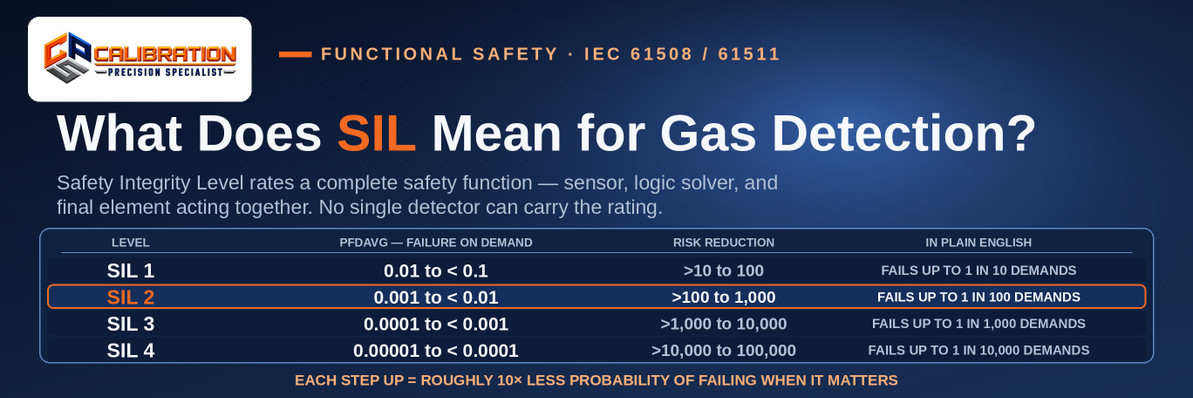
SIL — Safety Integrity Level — is a rating of a safety function, not of a single detector: under IEC 61508, SIL measures how reliably a complete safety loop performs when it is demanded, and a SIL 2 function must hold an average probability of failure on demand (PFDavg) of at least 0.001 but less than 0.01 — it may fail no more than about 1 time in 100 to 1,000 demands, which works out to a risk reduction factor of more than 100 up to 1,000. The rating covers the whole loop acting together — the gas sensor, the logic solver, and the final element, such as a shutdown valve — so a detector sold as "SIL capable" is only one ingredient. The loop earns its SIL in a design calculation, and it keeps that SIL only if the loop is proof tested on the interval the calculation assumed.
Buyers meet SIL as a line in a specification: "gas detection shall be SIL 2." Then they go shopping for a SIL 2 detector, and the confusion starts — because the detector is the one part of the purchase that cannot deliver the rating by itself. This post puts SIL in plain English for gas detection: what the four levels actually promise, why the rating belongs to the loop and not the instrument on the wall, what a "SIL capable" claim on a listing really means (and what paperwork should stand behind it), and why proof testing — not the purchase — is what keeps a SIL rating true. For the hardware underneath all of this, see our guide to how a fixed gas detection system works.
What Does SIL Stand For — and What Is It Actually Rating?
SIL stands for Safety Integrity Level, and it comes from IEC 61508, the international standard for functional safety — the discipline concerned with safety systems that act automatically when something goes wrong. The process-industry version of the same framework is IEC 61511, which governs safety instrumented systems (SIS) in plants like refineries and chemical facilities.
The key definition: SIL rates a safety instrumented function — one specific protective job, such as "on high gas concentration, close the feed valve and start ventilation." Three things follow from that:
- SIL is a number with a unit behind it. Each level is a band of allowable failure probability. It is not a quality grade, a ruggedness rating, or a measure of how accurate the detector is.
- SIL runs 1 to 4. SIL 1 is the lowest band, SIL 4 the highest — each step up demands roughly ten times less probability of failure than the one below it.
- SIL is earned by a loop, on paper and in the field. A function gets its SIL target from a risk assessment, and it holds that SIL only if the installed loop's calculated failure probability lands in the band and the loop is maintained the way the calculation assumed.
Most gas detection is not part of a safety instrumented system at all — it alarms, and people respond. SIL enters the conversation when detection stops being an alarm and becomes an automatic actor: when the gas reading itself must shut down a process, isolate a line, or start ventilation with nobody in the loop, and a risk assessment has credited that action with reducing risk by a stated factor. That is the moment the detector becomes the front end of a safety function, and the rules in this post start to apply.
The SIL Table: What the Four Levels Actually Promise
IEC 61508 defines each SIL as a band of average probability of failure on demand — PFDavg — for functions that sit idle and are demanded occasionally (low-demand mode, the mode that fits gas detection shutdown functions). The risk reduction factor is simply the inverse: how many times smaller the risk becomes with the function in place.
| SIL | PFDavg — average probability of failure on demand | Risk reduction factor | In plain English |
|---|---|---|---|
| SIL 1 | 0.01 to less than 0.1 | More than 10 up to 100 | Fails on up to 1 demand in 10 |
| SIL 2 | 0.001 to less than 0.01 | More than 100 up to 1,000 | Fails on up to 1 demand in 100 |
| SIL 3 | 0.0001 to less than 0.001 | More than 1,000 up to 10,000 | Fails on up to 1 demand in 1,000 |
| SIL 4 | 0.00001 to less than 0.0001 | More than 10,000 up to 100,000 | Fails on up to 1 demand in 10,000 |
Read SIL 2 slowly, because it is the level most often specified for gas detection functions. A SIL 2 function is allowed to fail, on average, somewhere between 1 time in 100 demands and 1 time in 1,000 demands. That is the whole promise — not "it will work," but "its chance of not working, when called on, has been designed, calculated, and maintained to stay inside this band." SIL 4 sits at the top of the scale and is rare outside industries like nuclear and rail; in process plants, SIL 1–3 cover nearly everything, and SIL 2 is the workhorse target.
One caution about the table: it describes low-demand mode. Systems demanded more than about once a year, or running continuously, are measured differently — by dangerous failure rate per hour (PFH) — with their own bands. Gas detection that must act automatically is normally evaluated in low-demand terms, which is why PFDavg is the number to know.
Why SIL Belongs to the Loop, Not the Detector
A safety instrumented function has three subsystems, and the function's failure probability is built from all three:
- The sensor subsystem — in our world, the gas detector or detectors watching the area.
- The logic solver — the safety controller or PLC that reads the signal and decides. How that signal travels is the world of our post on 4–20 mA and Modbus — in a safety loop, the wiring and signal path are part of the calculation, not an afterthought.
- The final element — the valve that closes, the damper that moves, the equipment that actually removes the hazard.
The loop's PFDavg is the sum of what each subsystem contributes, and in most real loops the sensor and the final element dominate the budget — valves stick and sensors drift; the logic solver in the middle usually carries the smallest share. That arithmetic is why "SIL 2 detector" is a category error. Even a flawless detector cannot rescue a loop whose shutdown valve contributes enough failure probability to push the total out of the SIL 2 band, and a mediocre-sensor loop can miss its target no matter how good the controller is. When a vendor tells you a detector "is SIL 2," the accurate translation is: this device has been assessed as suitable for use in functions up to SIL 2, subject to the rest of the loop doing its share. The loop is SIL 2, or nothing is.
What Does "SIL Capable" on a Detector Listing Really Mean?
Because SIL belongs to loops, honest device claims come in a specific dialect. When a fixed gas detector or transmitter is genuinely offered for safety instrumented service, its listing or datasheet should be able to point to:
- A third-party functional safety assessment or certificate — evaluation to IEC 61508 by an independent body (firms such as exida or the TÜV organizations run these programs), not just the manufacturer's own say-so.
- Failure-rate data from an FMEDA (failure modes, effects, and diagnostic analysis) — the dangerous-undetected failure rate and related figures your loop calculation consumes. Without published failure data, nobody can run the PFDavg math, and the claim is decorative.
- A stated systematic capability — IEC 61508 also grades how rigorously the device was designed and built (its systematic capability), which caps how high a SIL function it may serve in, regardless of the math.
- A proof-test procedure in the manual — the manufacturer should tell you exactly how the device is to be tested, end to end, and what that test does and does not cover.
- Defined failure behavior — the device should fail in ways the loop can see: diagnostics that annunciate internal faults and an output that drives to a recognizable fault state, so a dead detector announces itself instead of reading a silent zero.
What to be wary of: the naked phrase "SIL 2 certified" with no certificate, no failure data, and no proof-test procedure behind it. And a store-level note, because it matters when you're comparing listings: a detector can be an excellent, fully approved instrument — FM, CSA, ATEX performance approvals and all — without carrying any SIL assessment at all. Those approvals say it detects gas to a proven standard. They do not make it a component of a safety instrumented function. If your specification calls for SIL, the certificate and the FMEDA data are the deliverables to ask for before the purchase order — from any supplier, on any brand.
Where Does a SIL Target Come From — and How Is It Verified?
The target is set by risk, not by preference. In a hazard analysis (HAZOP) and layers-of-protection analysis (LOPA), engineers work out how bad the event is, how likely it is without this function, and how much risk reduction the function must supply to bring the scenario down to a tolerable level. That required reduction is the SIL: a function that must cut risk by a factor of 500 is a SIL 2 function, because 500 sits inside the SIL 2 band.
Verification then has three legs:
- The probability math — the loop's PFDavg, calculated from each subsystem's failure data and the proof-test interval, must land inside the target band.
- Architectural constraints — IEC 61508/61511 also limit how much credit a single, non-redundant device can claim. One detector with no backup can only carry a function so far, whatever the math says; higher SILs typically demand redundancy or voting arrangements.
- Systematic capability — every device in the loop must be designed and built to a rigor matching the target, which is where the certificates from the previous section do their work.
A function that fails any leg does not meet its SIL — including the leg nobody can see at commissioning, which is the subject of the next section.
Proof Testing: Where SIL Goes to Die
Hidden failures are the enemy the whole framework is built around. A gas detector whose sensor has quietly died, or a shutdown valve that has seized, looks exactly like a healthy one — until the day it is demanded. The PFDavg in the SIL calculation is an average over the interval between proof tests: full, end-to-end tests that exercise the function the way a real demand would, from gas at the sensor (or flame at the detector) through the logic to the final element actually moving. On a simple single-channel loop, the failure probability builds roughly in proportion to half the time since the last proof test — double the interval and you roughly double the average failure probability the loop is carrying. Stretch a SIL 2 loop's proof testing from annual to every three years and you can walk the arithmetic straight out of the SIL 2 band without changing a single component.
Two disciplines follow:
- Calibration is not proof testing. Calibration verifies that a gas detector reads accurately — necessary, and not the same job. A proof test verifies that the whole function works: the detector alarms, the signal arrives, the logic acts, the valve strokes. Our post on testing flame detectors makes the same point in that world — the instrument is proven, end to end, or it isn't proven at all.
- The interval is part of the rating. The SIL calculation assumes a proof-test interval, and the records to match. A SIL claim with no proof-test program behind it is a claim about the day the system was commissioned, quietly expiring ever since.
Do You Need SIL-Rated Gas Detection at All?
Honestly — often, no. Most fixed gas detection in most facilities is an alarm and mitigation layer: it detects, it annunciates, people and procedures respond, and other safeguards (ventilation, procedures, ignition control) share the work. That world is specified by detector performance approvals and area-classification rules, not by SIL, and a well-maintained conventional system is a legitimate, standard design — it is the system described in our fixed gas detection overview, and it protects a great many plants.
SIL becomes the right question when three things line up: the consequence of the scenario is severe, the detection function must act automatically — no operator in the chain — and a risk assessment is formally crediting that action with a quantified risk reduction. Emergency shutdown on high gas, automatic isolation of a feed, interlocked ventilation in a battery or process room: when those functions are credited in a LOPA, they are safety instrumented functions, and they need SIL targets, assessed devices, loop calculations, and proof-test programs. If none of that machinery exists in your plant's safety documentation, asking for a "SIL 2 detector" buys a label, not a function.
Frequently Asked Questions
What does SIL mean in gas detection? SIL — Safety Integrity Level — is a measure, from IEC 61508, of how reliably a safety function performs when it is demanded. In gas detection it applies when a detector's reading automatically triggers a protective action like a shutdown or isolation. Each level is a band of average probability of failure on demand: SIL 2, the level most often specified, allows between 0.001 and less than 0.01 — at most about 1 failure in 100 to 1,000 demands.
What does SIL 2 mean in plain English? It means the safety function has been designed, calculated, and is maintained so that its chance of failing when called on is no worse than roughly 1 in 100 demands, and possibly as good as 1 in 1,000 — a risk reduction factor of more than 100 up to 1,000. It is a promise about the whole loop — sensor, logic solver, and final element together — not a promise about any single instrument.
What is the difference between SIL 2 and SIL 3? One order of magnitude. A SIL 3 function must hold an average probability of failure on demand between 0.0001 and less than 0.001 (risk reduction of more than 1,000 up to 10,000), ten times tighter than SIL 2's band of 0.001 to less than 0.01. Reaching SIL 3 usually means better devices, more diagnostics, and often redundant sensors or final elements — plus proof testing to match — so it costs noticeably more to buy and to maintain.
Can a single gas detector be SIL 2 by itself? No. SIL is a property of a complete safety function — sensor, logic solver, and final element — because the function's failure probability is the sum of all three subsystems' contributions. A detector can be assessed as "SIL capable," meaning its third-party failure data and design rigor make it suitable for use in functions up to that level. Whether your function actually achieves SIL 2 depends on the rest of the loop and its proof-test interval.
What does "SIL capable" mean on a gas detector datasheet? It means the device has been independently assessed to IEC 61508 and the manufacturer publishes the data a loop calculation needs: failure rates from an FMEDA, a systematic capability rating, and a defined proof-test procedure. It is a claim about the device's suitability as a component — not a claim that installing it gives you a SIL-rated system. Treat "SIL certified" claims with no certificate or failure data behind them as marketing.
What is PFDavg? PFDavg is the average probability that a safety function will fail to perform when it is demanded — the "probability of failure on demand, averaged" over the interval between proof tests. It is the number that decides the SIL: 0.001 to less than 0.01 is SIL 2. The average matters because the probability is lowest just after a proof test and grows as hidden failures accumulate, which is why the proof-test interval is an input to the SIL calculation, not an administrative detail.
What is a proof test, and how often should one be done? A proof test is a full, end-to-end test that exercises a safety function the way a real demand would — stimulus at the sensor, signal through the logic, and the final element physically acting — to reveal hidden failures that normal operation and diagnostics cannot see. The interval is not a rule of thumb: it is set by the function's SIL calculation, which assumes a specific interval (commonly a year for many functions) and only stays inside its SIL band if testing actually happens on that schedule.
Is proof testing the same as calibrating a gas detector? No. Calibration verifies measurement accuracy — that the detector reads the right number when gas is applied. A proof test verifies the entire protective function: the detector alarms at the right setpoint, the signal reaches the logic solver, the logic acts, and the final element (valve, shutdown, ventilation) actually operates. A perfectly calibrated detector wired to a seized shutdown valve is a failed safety function with a fresh calibration sticker.
Who decides what SIL a gas detection function needs? Your risk assessment does. Through hazard analysis (HAZOP) and layers-of-protection analysis (LOPA), engineers determine how much risk reduction a scenario requires and assign that as the function's SIL target — a function that must reduce risk by a factor of 500 is a SIL 2 function. The designer then has to prove the installed loop meets the target with failure-probability calculations, the right architecture, and devices of matching systematic capability.
Does my gas detection system need to be SIL rated? Only if a safety function is being formally credited with automatic risk reduction. If your detectors alarm and people respond — the design in most facilities — the system is specified by detector performance approvals and maintained by calibration and functional testing, and SIL does not apply. If gas detection must automatically shut down, isolate, or ventilate, and a risk assessment counts on that action by a stated factor, the function is a safety instrumented function and needs a SIL target, assessed components, and proof testing.
The Bottom Line
SIL is a promise about a loop, expressed as a failure probability. SIL 2 — the band most gas detection specifications reach for — promises a function that fails on demand no more than about 1 time in 100 to 1,000, and that promise is only as real as its three supports: devices with third-party failure data behind them, a loop calculation that lands in the band, and proof tests performed on the interval the calculation assumed. Buy the detector the datasheets justify, by all means — but if the specification says SIL, the deliverables that matter are the certificate, the FMEDA numbers, the loop math, and the test records. Everything else is a sticker.
Spec calls for SIL and you're sorting out what it actually requires of the detectors? That is a conversation worth having before the purchase order — call 865-900-8844 or reach us through Contact Us. For the systems underneath, see our guides to how a fixed gas detection system works and how fixed detectors signal the plant.
CPS Calibrations · 109 S. Front Street, Rockwood, TN 37854 · Calibration Gas · Calibration Services · Contact Us
Recent Posts
-
PID vs. LEL for VOC Detection: Which Sensor Do You Actually Need?
Use a PID to detect VOCs and an LEL sensor to detect explosive atmospheres — they measure different …Oct 21st 2026 -

Semiconductor (MOS) Gas Sensors: Where They Work and Where They Lie
A semiconductor (MOS) gas sensor measures gas with a heated film of metal oxide — usually tin dioxid …Oct 21st 2026 -
What Do Firefighters Use a Gas Meter For?
Firefighters use a gas meter — usually a 4-gas monitor reading oxygen (O₂), combustible gas as a per …Oct 21st 2026