
How to Read a Calibration Gas Cylinder Label: Concentrations, Lot Numbers, and Expiry Dates
A calibration gas cylinder label is the cylinder's identity card: it lists every gas in the mix and its certified concentration, the balance gas, the lot number that ties that cylinder to its Certificate of Analysis, the fill and expiry dates, the cylinder size and connection type, and the hazard markings — and on CPS cylinders, a QR code that pulls up the SDS and COA for that cylinder. Reading the whole label takes about 30 seconds, and it is the check that catches the three errors that quietly ruin calibrations: the wrong mix, expired gas, and the wrong fitting.
Most label reading stops at the product name — "4-gas mix" — and that is where the mistakes start. Two cylinders can both say "4-gas" and carry different concentrations, different balance gases, different expiry dates, and different fittings. This post walks the label field by field, reads a real one end to end, and finishes with the short check to run before any calibration.
The Gas Composition Table: What You're Actually Calibrating With
The heart of the label is the composition table: each component gas named, with its concentration and units.
- Toxic gases are listed in ppm — a typical confined-space mix carries hydrogen sulfide (H₂S) at 25 ppm and carbon monoxide (CO) at 50 ppm.
- Flammable gas is listed as %LEL and/or % volume — methane at 2.5% by volume is the same thing said the second way as 50% LEL.
- Oxygen is listed in % volume — and, as the worked example below shows, it is not always the 20.9% of fresh air.
The critical word is certified. The concentrations printed on the label are the analyzed values for that production lot — the same values stated on the lot's Certificate of Analysis — not round nominal targets. When you program span values into an instrument or a docking station, program the numbers on the cylinder in your hand. Calibrating to the values from memory, from the last cylinder, or from the purchase order is how a fleet ends up precisely, uniformly wrong.
What Is the Balance Gas?
After the active components, the table names the balance gas — the gas that makes up the rest of the mixture, commonly nitrogen or air. It is easy to skip past, but it is not filler:
- The balance determines the background the sensors see during calibration. A mix balanced in nitrogen contains no oxygen beyond what is listed as a component; an air-balanced mix carries oxygen in the balance itself.
- Two mixes with identical component concentrations but different balance gases are different calibration gases, and an instrument's expected readings — especially on the oxygen channel — differ between them.
When you order, the balance gas is part of the specification. When you read the label, it is part of the verification: the mix is only "the right mix" if the balance matches too.
A Worked Example: Reading a Standard 4-Gas Label
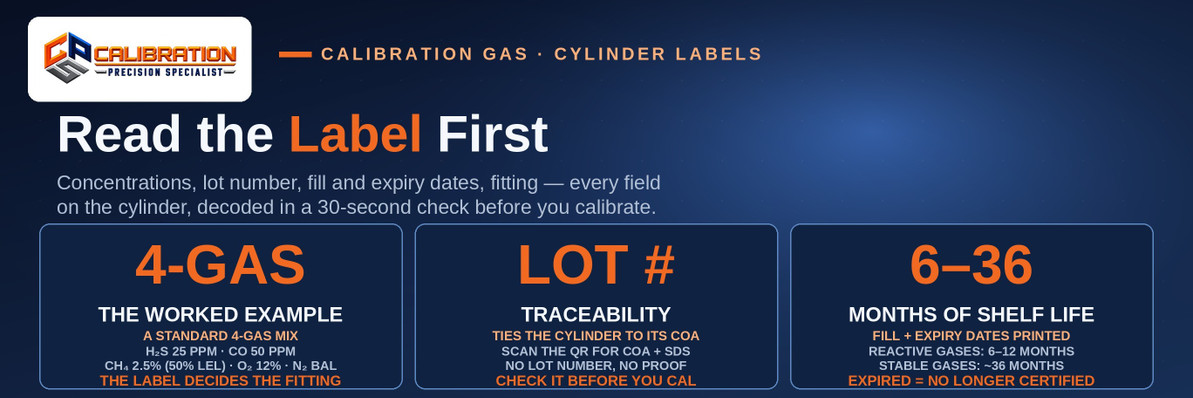
Here is a real label — the RKI 34L 4-gas cylinder in this post's photo — field by field:
| Label field | What this label says | What it means for you |
|---|---|---|
| Component 1 | Hydrogen sulfide — 25 ppm | The H₂S span value to program: 25 ppm |
| Component 2 | Carbon monoxide — 50 ppm | The CO span value: 50 ppm |
| Component 3 | Methane — 2.5% (50% LEL) | The LEL span value, stated both ways: 2.5% vol = 50% LEL |
| Component 4 | Oxygen — 12.0% | The O₂ span value is 12.0%, not 20.9% — with this mix, oxygen is a certified component in a nitrogen balance, so calibrate to what's printed |
| Balance | Nitrogen | The remainder of the mix is N₂; no other oxygen is hiding in the balance |
| Contents | 1.2 cu. ft. — 34 liters | The cylinder size: a 34L cylinder |
| Part number | The manufacturer's part number for this exact mix and size | What to quote when you reorder the identical product |
Two lessons fall out of that example. First, the label outranks your assumptions — anyone who spanned the oxygen channel to 20.9% out of habit calibrated it wrong, and the label said so the whole time. Second, the part number is a shortcut, not a verification: reordering by part number gets you the same product, but each new lot still needs its own label check, because concentrations are certified per lot and expiry dates move with every fill.
The Lot Number: Your Link to the COA
The lot (or batch) number identifies the production batch the cylinder was filled from. It looks like the least interesting field on the label and it is one of the most important:
- It ties the cylinder to its paperwork. The Certificate of Analysis is issued per lot, and the lot number on the COA must match the lot number on your cylinder — that match is what makes the certificate your cylinder's certificate. We explain the document itself in what a certificate of analysis (COA) is.
- It is the reference for every question about that gas. Wrong readings after a gas change, a supplier query, an auditor tracing a calibration — all of them start from the lot number.
- On CPS cylinders, it has a shortcut. The QR code printed on the cylinder pulls up the SDS and the COA for that cylinder with a phone scan — no lot-number lookup required. The mechanics are covered in calibration gas QR codes: SDS and COA from the cylinder.
Fill Date and Expiry Date: The Shelf-Life Fields
Two dates appear on the label: when the lot was filled, and when its certification ends.
- Shelf life depends on chemistry. Reactive gases degrade relatively quickly — a shelf life of about 6–12 months is typical — while stable gases hold for roughly 36 months. A mixture runs on its least stable component's clock, which is why the expiry is printed per cylinder instead of following a universal rule. Our calibration gas shelf life post breaks down which gases sit in which family.
- The expiry date is a hard line. Up to that date, the concentrations on the label are certified. After it, they are not — the gas may still flow, but it is no longer calibration gas in any sense an auditor, or an honest calibration, accepts.
- Check it twice: on arrival and before use. A cylinder delivered with two months of life left changes your reorder timing; a cylinder pulled from the back of the shelf needs its date checked before it goes anywhere near an instrument.
Cylinder Size and Connection: Will It Fit Your Regulator?
The label states the cylinder's contents — CPS calibration gas runs in 17L, 34L, 58L, and 103L sizes, in steel and aluminum — and the connection type the cylinder valve carries.
The connection is the field people discover last and regret most:
- Steel 34L cylinders use a CGA-600 connection; steel 103L cylinders use a C-10. The regulator has to match the cylinder — a regulator built for one will not connect to the other.
- A mismatch is a stopped job, not a workaround. Never force a fitting or improvise an adapter on a calibration gas cylinder. Check the connection on the label against your regulator before the cylinder leaves the shelf; if you're choosing a regulator, our comparison of fixed-flow vs. demand-flow regulators covers which style your instrument needs.
- Size is a logistics field, not just a volume. The 34L that lives in a bump-test kit and the 103L that feeds a docking station are bought on different rhythms — the label's contents line is how you confirm the cylinder in hand is the size the job assumes.
Hazard Diamonds and the UN Number
Calibration gas cylinders also carry transport and hazard markings: hazard diamonds (pictograms) that communicate the mixture's hazard class at a glance, and a UN number identifying the contents for shipping and emergency response.
Read them for what they are — handling information, not calibration information. They tell the person storing, transporting, or responding to the cylinder what they're dealing with; the full hazard detail, first aid, and handling guidance lives in the mixture's SDS. On CPS cylinders, that document is one scan away via the QR code on the cylinder — which is the practical way an SDS gets read in the field instead of residing in a binder.
What to Check on the Label Before You Calibrate
Everything above compresses into a 30-second, three-question check:
- Right mix? Every component concentration — and the balance gas — matches what the instrument expects, and the span values you're about to program are the certified values printed here, not remembered ones.
- In date? Today's date is before the expiry date printed on the cylinder. If it isn't, stop — expired gas is not certified gas, no matter how much is left.
- Right fitting? The connection type matches your regulator (steel 34L = CGA-600; steel 103L = C-10). If it doesn't connect cleanly, it is the wrong pairing.
Add a fourth glance when the paperwork matters: the lot number, matched against the COA — or the QR scan that pulls the COA up directly.
What If the Label Is Expired, Damaged, or Unreadable?
Answer honestly, because the label's whole job is verification:
- Expired: the concentrations are no longer certified, and the cylinder must not be used for calibration or bump testing you intend to rely on. It still has to go somewhere — how to dispose of calibration gas cylinders covers the options for spent and expired cylinders.
- Unreadable or missing: if you cannot read the concentrations, the lot number, or the expiry date, you cannot verify what the cylinder contains — and an unverifiable cylinder is not calibration gas, whatever it used to be. Don't guess a mix from the cylinder's size, color, or shelf position. On CPS cylinders the QR code gives you a second path to the cylinder's SDS and COA; beyond that, treat an unidentifiable cylinder as a supplier question, not a calibration resource.
Neither case is a gray area, and that is the point of the label: the cylinder carries its own proof, and when the proof is gone, so is the basis for trusting the gas.
Frequently Asked Questions
How do you read a calibration gas cylinder label?
Work through it in order: the composition table (each gas and its certified concentration), the balance gas, the lot number, the fill and expiry dates, the cylinder size, and the connection type, then the hazard markings and QR code if present. The whole read takes about 30 seconds, and the concentrations printed there — not the nominal values — are the span values to program into your instrument.
What does "balance gas" mean on a calibration gas label?
It is the gas that makes up the remainder of the mixture after the listed components — commonly nitrogen or air. It matters because it sets the background the sensors see: a nitrogen-balanced mix has no oxygen beyond its listed component, while an air-balanced mix carries oxygen in the balance. Same component concentrations with a different balance are a different calibration gas.
Where is the expiry date on a calibration gas cylinder?
On the cylinder's label, printed alongside the fill date and lot number — the same information carried on the lot's Certificate of Analysis. Shelf life runs from the fill: roughly 6–12 months for reactive gases and about 36 months for stable ones. If you can't find or can't read the date, treat the cylinder as unverified and don't calibrate with it.
What is the lot number on a calibration gas cylinder for?
It identifies the production batch the cylinder was filled from, and it is the key to the cylinder's paperwork: the Certificate of Analysis is issued per lot, and the lot number on the COA must match the one on your cylinder. It's also the reference for supplier questions and audit tracing. On CPS cylinders, the QR code retrieves that lot's COA and SDS directly.
What happens if my calibration gas is expired?
Its concentrations stop being certified. The gas still flows, but reactive components degrade over time — which is exactly what the expiry date bounds — so a calibration performed with expired gas is built on values nobody stands behind. Don't use expired gas for calibration; replace it and dispose of the old cylinder properly.
Can I use a cylinder if the label is unreadable?
Not for calibration. If you can't read the concentrations, lot number, or expiry date, you can't verify what the cylinder contains or whether it's in date — and unverifiable gas isn't calibration gas. Don't guess from size or color. CPS cylinders offer the QR code as a second route to the cylinder's SDS and COA; otherwise, it's a question for your supplier.
How do I know if a calibration gas cylinder fits my regulator?
Check the connection type on the label against your regulator. In the CPS steel line, 34L cylinders use a CGA-600 connection and 103L cylinders use a C-10, and the regulator must match — fittings are not interchangeable and should never be forced or adapted. Confirm the pairing when you order and again when the cylinder reaches the bench.
What do the hazard diamonds on a calibration gas cylinder mean?
They are standardized hazard pictograms communicating the mixture's hazard class — for handling, storage, transport, and emergency response — together with a UN number identifying the contents. They carry safety information, not calibration values; the complete hazard detail is in the mixture's Safety Data Sheet.
What does the QR code on a calibration gas cylinder do?
On CPS calibration gas cylinders, scanning the QR code pulls up that cylinder's Safety Data Sheet (SDS) and Certificate of Analysis (COA) — the hazard document and the lot's certified concentrations — on your phone, at the bench or in the field. It's the fastest way to verify a cylinder's paperwork without tracking down a file or calling the supplier with a lot number.
What should I check on the label before calibrating?
Three things: the mix (every certified concentration and the balance gas match what the instrument expects, and you'll program the printed values), the date (today is before the expiry date), and the fitting (the connection type matches your regulator — CGA-600 on steel 34L, C-10 on steel 103L). If the calibration will be documented, add the lot number matched to the COA, or scan the cylinder's QR code.
The Bottom Line
A calibration gas label is short, standardized, and complete: composition and certified concentrations, balance gas, lot number, fill and expiry dates, size, connection, hazard markings, and — on CPS cylinders — a QR code to the SDS and COA. Everything that can silently ruin a calibration announces itself there first: the unexpected oxygen value, the lot that doesn't match the certificate, the date that passed last month, the fitting that was never going to connect. Thirty seconds of reading before you calibrate is the cheapest quality control in the entire gas detection program.
Need calibration gas your crew can verify at a glance? Call 865-900-8844 or reach us through Contact Us. Browse calibration gas, use the Calibration Gas Finder to match a mix to your instrument, or talk to us about calibration services — and remember, CPS charges no hazmat fee on calibration gas.
CPS Calibrations · 109 S. Front Street, Rockwood, TN 37854 · Calibration Gas · Calibration Services · Contact Us
Need a calibration you can file?
In-house calibration at CPS in Rockwood, Tennessee — $55 for single-gas instruments, $90 for 4- and 5-gas — every channel, as-found and as-left data, full certificate.
See Calibration Servicesor call 865-900-8844
Recent Posts
-
Can You Add a Pump to a SENKO SGT-P or MGT?
Yes — SENKO's SP-Pump101 external sampling pump ($330, part AAA006000) fits the SGT, SGT-P, and MGT, …Nov 12th 2026 -

What Refrigerant Detection Does a Grocery Store Need?
A grocery store needs refrigerant detection in three places: low-mounted carbon dioxide (R-744) sens …Nov 11th 2026 -

What Is LEL and UEL? The Explosive Range, Gas by Gas
The LEL is the lowest concentration of a gas in air that can explode, and the UEL is the highest: me …Nov 10th 2026