
What Is a Certificate of Analysis (COA) for Calibration Gas?
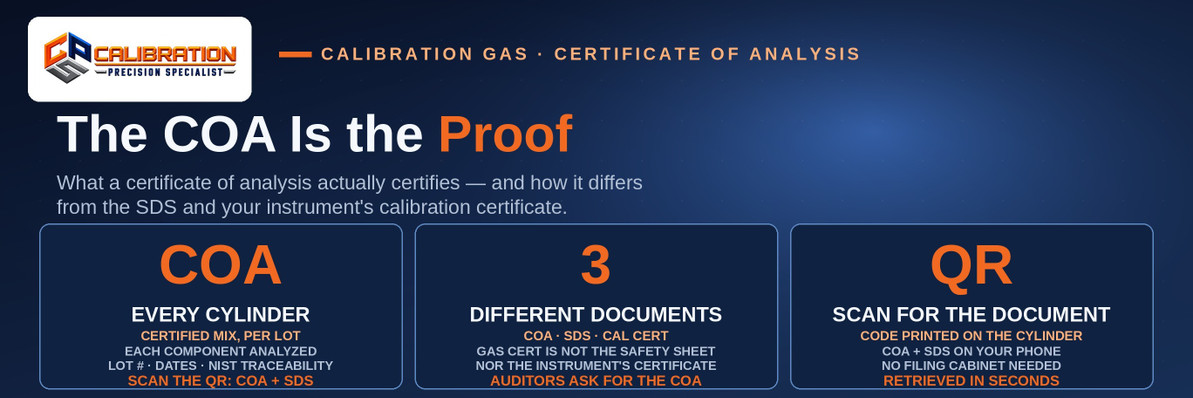
A Certificate of Analysis (COA) for calibration gas is the manufacturer's lot-specific document certifying what is actually inside the cylinder: the analyzed concentration of each gas component, the balance gas, the lot or batch number, the fill and expiry dates, and a statement of traceability to NIST reference standards. It is not the Safety Data Sheet (SDS) — that document covers hazards and handling — and it is not your instrument's calibration certificate, which covers the detector, not the gas. On CPS cylinders, the QR code printed on the cylinder retrieves that lot's COA and SDS with a phone scan.
Every calibration you perform is only as good as the gas you performed it with. If the span gas values are wrong, every detector adjusted against that cylinder is wrong by the same amount — and the COA is the document that proves the values were right. This post covers what a COA is, what it contains, how it differs from the two documents it is constantly confused with, and how to get your hands on one when an auditor asks.
What Is a Certificate of Analysis?
Calibration gas is not filled one cylinder at a time. It is blended and filled in batches — lots — and the manufacturer analyzes the finished mixture to certify what each lot actually contains. The Certificate of Analysis is the record of that analysis, issued per lot, not per product.
That "per lot" detail matters more than it sounds:
- Two cylinders with the same part number can carry different COAs. Buy the same 4-gas mix twice, months apart, and the two shipments belong to different lots. Each lot was analyzed separately, and each has its own certificate.
- The COA states certified values, not nominal ones. A mix sold as "25 ppm H₂S" is certified to the concentration the analysis actually measured for that lot. Those certified values are what is printed on the cylinder label — and they are the values that should be entered in the instrument or docking station when you calibrate. (Our field-by-field guide to how to read a calibration gas label walks through where each value sits.)
- The COA is the paper end of the traceability chain. CPS sells its gas as NIST-traceable, and the COA is the document that evidences that chain for the lot in your hand — the link between your cylinder and the national reference standards the blend was measured against. We unpack the traceability claim itself in what NIST-traceable calibration gas means.
If you are new to the product itself, start with what calibration gas is — this post is about the document that stands behind it.
What Does a Calibration Gas COA Contain?
Formats vary by manufacturer, but a calibration gas COA carries the same core fields:
| COA field | What it tells you |
|---|---|
| Lot / batch number | The identity of the production batch this certificate covers. It must match the lot number printed on your cylinder — if it doesn't, you are holding the wrong lot's paperwork. |
| Certified concentration of each component | The analyzed value for every gas in the mix — each toxic gas in ppm, flammables in %LEL or % volume, oxygen in % volume. These are the numbers your calibration is set to. |
| Balance gas | The gas that makes up the remainder of the mixture — commonly nitrogen or air. It is part of the certified recipe, not a filler detail. |
| Fill date | When the lot was filled. Together with the expiry date, it defines the cylinder's certified life. |
| Expiry date | The date the certification runs out. After it, the concentrations are no longer certified and the gas must not be used for calibration. |
| Traceability statement | The declaration that the lot's concentrations are traceable to NIST reference standards — the reason the gas can serve as the reference your instruments are adjusted against. |
Read together, those six fields answer the only questions that matter about a span gas: what is it, how much of each gas is in it, which batch did it come from, and until when can I trust it?
COA vs. SDS vs. Calibration Certificate: Three Different Documents
Most of the confusion around the COA is really confusion between three documents that all travel in the same world:
| Document | Covers | The question it answers | Where it comes from |
|---|---|---|---|
| Certificate of Analysis (COA) | The gas in a specific lot | "What exactly is in this cylinder, and how do we know?" | The gas manufacturer, per production lot |
| Safety Data Sheet (SDS) | The hazards of the mixture | "What can this gas do to people, and how do we handle, store, and ship it safely?" | The gas manufacturer, per product mixture |
| Calibration certificate | The instrument that was calibrated | "What did this detector read before and after calibration, and was it within tolerance?" | Whoever performed the calibration — your shop or your service provider |
Three documents, three different subjects: the gas, the hazard, and the instrument. None of them substitutes for another. An SDS says nothing about whether the H₂S in the cylinder is really 25 ppm. A calibration certificate says the detector was adjusted — but the quality of that adjustment rests entirely on the gas used, which is the COA's territory. We go deep on the third document in what a calibration certificate actually proves; this post stays on the gas document.
The practical failure mode is simple: an auditor asks for the COA for the gas used in a round of calibrations, and what comes out of the file is the SDS — similar-looking, gas-related, and useless for the question asked. Knowing which document is which is most of the battle.
Why Do Auditors and Safety Managers Ask for the COA?
Because a calibration program is an evidence chain, and the COA is one of its links:
Instrument → calibration event → gas lot → NIST. When a safety manager documents that a detector was calibrated on a given date, the next question is with what. The calibration record names the gas; the gas lot's COA proves the concentrations in that lot were certified and traceable. Without the COA, the chain ends at "we used a cylinder that said 25 ppm on it."
The COA also earns its keep outside audits:
- Troubleshooting drift. If several detectors start reading off shortly after a gas change, comparing the old and new lots' certificates is an early diagnostic step — did the certified values change between lots?
- Receiving checks. Matching the COA's lot number and values against the cylinder label on arrival confirms you received the mix you ordered, with the shelf life you expected.
- Program documentation. Sites that must demonstrate their calibration program to regulators, customers, or insurers keep COAs with their calibration records for exactly the traceability reason above.
How Do You Get the COA for Your Cylinder?
The traditional route is paper: a copy ships with the gas or gets filed in the office, and retrieving it later means finding the file — or contacting the supplier with the lot number from the cylinder label and waiting for a copy to come back.
CPS cylinders remove that step. Every CPS calibration gas cylinder carries a QR code you can scan to get the SDS and the Certificate of Analysis for that cylinder — the lot's own documents, pulled up on a phone at the bench, in the field, or in front of an auditor. We wrote up how the codes work in calibration gas QR codes: SDS and COA from the cylinder. When you buy calibration gas from CPS, the paperwork problem is solved at the cylinder, not in a filing cabinet — and CPS charges no hazmat fee on calibration gas, so the delivered price is the price you see.
One habit is still worth keeping regardless of how you retrieve it: when the COA comes up, confirm the lot number on the certificate matches the lot number on the cylinder in front of you. A COA for the wrong lot proves nothing about your gas.
Does a COA Expire With the Gas?
Yes — the certificate and the shelf life are the same clock. A COA certifies the lot's concentrations until the expiry date printed on the COA and the cylinder. Past that date, the concentrations are no longer certified: reactive gases such as H₂S degrade on a 6–12 month scale, while stable gases hold for roughly 36 months, which is why calibration gas shelf life differs so much by mixture. Expired gas must not be used for calibration — a detector spanned against concentrations nobody certifies anymore has a calibration in name only. When a cylinder passes its date, our guide to how to dispose of calibration gas cylinders covers the end-of-life options.
Frequently Asked Questions
What is a certificate of analysis for calibration gas?
It is the gas manufacturer's lot-specific document certifying what is inside a batch of calibration gas: the analyzed concentration of each component, the balance gas, the lot number, the fill and expiry dates, and a statement of traceability to NIST reference standards. One COA covers one production lot — a different shipment of the same mix carries a different certificate.
What information does a calibration gas COA include?
Six core fields: the lot or batch number, the certified concentration of every gas component, the balance gas, the fill date, the expiry date, and the traceability statement. The lot number on the COA must match the lot number printed on your cylinder; if it doesn't, you're looking at a different lot's certificate.
Is a COA the same thing as an SDS?
No. The COA certifies the gas — the measured concentrations in that lot. The SDS (Safety Data Sheet) covers the hazards of the mixture: health effects, handling, storage, first aid, and transport. An SDS contains no certified concentration values and cannot substitute for a COA when someone asks what your calibration gas actually contained.
Is a COA the same as a calibration certificate?
No — they certify different things. The COA covers the gas used; a calibration certificate covers the instrument that was calibrated, recording what the detector read and how it was adjusted. A complete calibration record needs both sides: the instrument's certificate for the work performed, and the gas lot's COA proving the reference it was adjusted against.
Why do I need a COA for calibration gas?
Because it is the evidence that your span gas was what it claimed to be. Auditors, safety managers, and customers tracing a calibration will ask which gas lot was used and for that lot's COA, which ties the concentrations back to NIST reference standards. It also lets you verify on delivery that the mix and values you received match what you ordered.
How do I get the COA for a cylinder I already have?
Start with the lot number printed on the cylinder label — the COA is filed under the lot, not the part number. With CPS gas you don't have to chase it: scan the QR code on the cylinder and it pulls up the SDS and the Certificate of Analysis for that cylinder. For other suppliers, the COA typically shipped with the gas or can be re-issued by the supplier against the lot number.
What does NIST traceable mean on a calibration gas COA?
It means the lot's certified concentrations were measured against reference standards traceable to the National Institute of Standards and Technology — an unbroken comparison chain back to national standards. That is what qualifies the gas to be the reference your instruments are adjusted against, and the COA's traceability statement is where that claim is made for your specific lot.
Is a COA still valid after the calibration gas expires?
No. The COA certifies the lot's concentrations until the expiry date printed on the certificate and the cylinder. Reactive gases typically hold certification for 6–12 months and stable gases for about 36 months. After the expiry date the concentrations are no longer certified, and the gas must not be used for calibration.
Can I calibrate a gas detector without the COA?
Physically, yes — the cylinder will flow and the instrument will span. But the calibration is only as defensible as your proof of what was in the gas. Without the lot's COA you cannot show the concentrations were certified or traceable, which is exactly what an audit, an incident investigation, or a customer review will ask for. Treat a missing COA as a documentation gap to close, not a step to skip.
How long should I keep calibration gas COAs?
At least as long as you keep the calibration records for the instruments that gas was used on — the COA is the supporting evidence for those records, and an auditor tracing a past calibration will ask for the gas lot's certificate. There is no single retention period that fits every site; follow your calibration program's and your industry's documentation requirements, and when in doubt, keep the COA for the life of the lot plus the life of the records it supports.
The Bottom Line
The Certificate of Analysis is the calibration gas document: per lot, it certifies each component's concentration, the balance gas, the fill and expiry dates, and the NIST traceability that makes the gas a valid reference. It is not the SDS (hazards) and not the calibration certificate (the instrument) — and producing the wrong one is the classic way a good calibration program looks undocumented. Keep the lot number matched to the certificate, respect the expiry date on both, and the paper side of calibration stops being a scramble. CPS makes the retrieval part disappear: the QR code on every CPS cylinder pulls up that cylinder's SDS and COA on the spot.
Need calibration gas with the paperwork a scan away? Call 865-900-8844 or reach us through Contact Us. Browse calibration gas and the Calibration Gas Finder to match a mix to your instrument, see our calibration services for the instrument side — and remember CPS charges no hazmat fee on calibration gas.
CPS Calibrations · 109 S. Front Street, Rockwood, TN 37854 · Calibration Gas · Calibration Services · Contact Us
Need a calibration you can file?
In-house calibration at CPS in Rockwood, Tennessee — $55 for single-gas instruments, $90 for 4- and 5-gas — every channel, as-found and as-left data, full certificate.
See Calibration Servicesor call 865-900-8844
Recent Posts
-

Can You Add a Pump to a SENKO SGT-P or MGT?
Yes — SENKO's SP-Pump101 external sampling pump ($330, part AAA006000) fits the SGT, SGT-P, and MGT, …Nov 12th 2026 -

What Refrigerant Detection Does a Grocery Store Need?
A grocery store needs refrigerant detection in three places: low-mounted carbon dioxide (R-744) sens …Nov 11th 2026 -

What Is LEL and UEL? The Explosive Range, Gas by Gas
The LEL is the lowest concentration of a gas in air that can explode, and the UEL is the highest: me …Nov 10th 2026