
NIST-Traceable Calibration Gas: What Traceability Means and Why It Matters
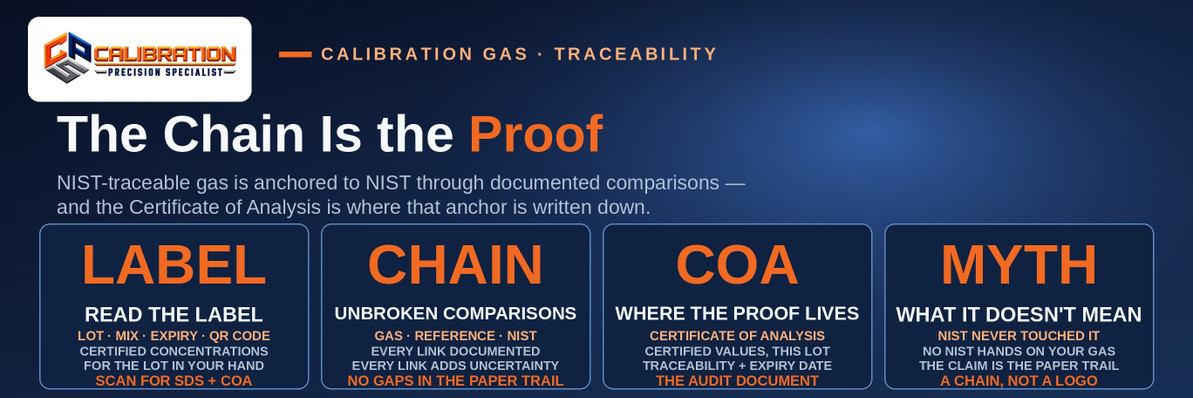
NIST-traceable calibration gas is gas whose certified concentrations are tied to reference materials maintained by NIST — the National Institute of Standards and Technology — through a documented, unbroken chain of comparisons, with every link in that chain carrying a stated uncertainty. NIST never filled, blended, or certified the bottle in your hand; what makes the claim real is the paper trail behind it, and that trail lives on the lot's Certificate of Analysis — the document you can pull up on a CPS cylinder by scanning the QR code printed on the cylinder.
Nearly every calibration gas listing on the internet carries the words "NIST traceable," usually in the same breath as the price. Two cylinders can wear those words with completely different evidence behind them. This post walks through what the chain actually is, what it does not claim, why it decides audits and investigations, and the checks that separate a documented chain from a marketing adjective.
What Traceability Actually Is: A Chain, Not a Stamp
You cannot check a gas concentration by looking at the cylinder. The number on the label — 25 ppm H₂S, 50 ppm CO, 50% LEL methane — is a claim, and traceability is how that claim gets anchored to something outside the seller's own say-so:
- The blend was measured against a reference. The producer analyzed the finished mix by comparing it to a reference gas standard of known concentration.
- That reference was measured against a higher one. Reference standards are themselves certified by comparison, level by level, up a hierarchy.
- The top of the chain is NIST. The comparisons ultimately anchor to reference materials and measurement standards maintained by NIST, including its Standard Reference Materials (SRMs).
- Every link is documented, and every link adds uncertainty. No comparison is perfect, so each step contributes a small, stated uncertainty to the final value. The certified concentration on your certificate is the end of that accounting — a value plus the documented path it took to get there.
Think of it as a chain of custody, except what is being preserved is a number. A chain with more links is not a weaker chain; a chain with an undocumented link is no chain at all. If a producer cannot show you the document for your lot, the word "traceable" is doing marketing work, not measurement work.
| Term | What it means | Where you see it |
|---|---|---|
| Traceability | The documented, unbroken chain of comparisons linking this lot's values back to NIST references | The traceability statement on the lot's Certificate of Analysis |
| Certified concentration | The value the producer certifies for each component in that specific lot | The results table on the COA — not just the cylinder label |
| Uncertainty | How far the true value may sit from the certified value, built up link by link through the chain | Stated alongside the certified values on the COA |
| Lot / batch number | The specific production batch the certificate covers | The cylinder label and the COA — and the two must match |
What NIST-Traceable Does Not Mean
Three misunderstandings do most of the damage:
- NIST did not make or certify your gas. NIST maintains the reference materials and primary standards at the top of the chain. Commercial producers blend the gas, analyze it, and document their chain up to those references. "Traceable to NIST" and "certified by NIST" are different claims, and only the first one is on offer.
- The words alone prove nothing. A label, a listing, or a salesperson saying "traceable" is a claim awaiting its document. The Certificate of Analysis for the actual lot is the evidence; without it, you are taking the chain on faith.
- Traceability does not stop the clock. The chain documents what the gas was when it was certified. Reactive components still degrade in the cylinder — shelf life runs about 6–12 months for reactive gases and roughly 36 months for stable mixes — and every cylinder carries an expiry. An expired bottle has a documented past and an unusable present; our post on calibration gas shelf life walks through the timelines gas by gas.
- It is not a tightest-tolerance contest. Traceability documents the anchor and the uncertainty; it does not, by itself, promise the narrowest blend tolerance on the market. Compare the certified values and the stated uncertainty on the COA rather than comparing adjectives on listings.
Why Traceability Decides Audits and Incident Investigations
A calibration is itself a claim: this detector read low, we exposed it to a standard of known concentration, and we adjusted it until it read true. The gas is the standard in that sentence. If the standard's values cannot be proven, the calibration cannot be proven either — no matter how carefully the work was done.
That is why the question surfaces in two predictable places:
- Audits and compliance reviews. Safety audits, customer qualification reviews, and internal program checks converge on the same request: show the certificate for the gas you calibrated with. Detector manufacturers specify calibrating with certified gas of known concentration; the lot COA is how you demonstrate the gas in the cabinet met that requirement on the dates in your calibration log.
- Incident investigations. After an exposure, a failed alarm, or a near-miss, investigators reconstruct whether the instruments were reading truthfully in the days before. Calibration records answer when and who; the lot COA answers against what. A complete file closes the question. A missing certificate leaves it open — and an open question about whether the detector was right tends to be resolved against the program, not for it.
Nobody asks about traceability on a good day. It gets asked on the worst day, when "we're pretty sure the gas was fine" is not an answer anyone accepts.
Where the Evidence Lives: The Lot's Certificate of Analysis
The Certificate of Analysis (COA) is the one document that carries the whole claim: the lot or batch identity, each component's certified concentration, the traceability statement connecting those values to their reference chain, and the expiry date. It is the audit document, the investigation document, and the buying document in one page. Our companion post takes the COA apart line by line: what a calibration gas Certificate of Analysis proves.
Two delivery details matter as much as the document itself:
- Cylinder-specific beats generic. A COA downloaded from a supplier's document library may describe a different lot than the bottle in your hand. CPS gas listings state it plainly — cylinder-specific SDS & COA via QR code — because every CPS cylinder carries a QR code that opens the Safety Data Sheet and Certificate of Analysis for that cylinder. Scan it at the bench and you are reading your lot's documents, not a representative sample of somebody else's.
- File it while the cylinder is in service. Scan and save the COA when a cylinder arrives, and keep it with the calibration records for the instruments that cylinder was used on. Cylinders get emptied and returned; the record is what survives, and the record is the part an auditor asks for.
One distinction worth keeping straight: the SDS is the safety document — hazards, handling, storage, first aid. The COA is the measurement document — certified values, chain, expiry. The QR code on a CPS cylinder gets you both, because a complete cylinder file needs both.
Buying Checks: How to Verify Traceability Before You Pay
- Ask where the COA lives before you order. "Certificates available on request" with no clear path is a warning sign. You want the lot's COA in hand with the gas — on CPS cylinders it is one QR scan away, no request queue involved.
- Match the lot. When the cylinder arrives, confirm the lot number on its label matches the COA you file. A certificate for a different lot certifies a different batch of gas.
- Read the traceability statement, not the adjective. It should connect the lot's certified values to NIST references — the chain, named — rather than just repeating the word "traceable."
- Check the expiry against the work ahead. Reactive mixes carry the short clocks (6–12 months); stable mixes run about 36 months. Buy the freshest lots for reactive gas, and never calibrate on an expired cylinder no matter how clean its paperwork is.
- Confirm the mix itself is right for the instrument. Traceability cannot rescue the wrong span gas. Match the mix to your detector first — the Calibration Gas Finder looks it up by instrument, and our guide to how to choose calibration gas covers the decision end to end.
- Make sure the regulator matches the cylinder, too. The best-documented gas in the world does not flow through the wrong fitting — CPS steel cylinders split between CGA-600 and C-10 by size, and CGA-600 vs C-10 is the two-minute check that prevents the most common ordering mistake we see.
And one buying fact that needs no document at all: CPS charges no hazmat fee on calibration gas — we absorb it. Documentation should not cost extra, and at CPS neither does the freight classification.
New to the subject entirely? Start with what calibration gas is and come back here when the word "traceable" starts appearing in quotes.
Frequently Asked Questions
What does NIST-traceable calibration gas mean?
It means the gas's certified concentrations are linked to reference materials maintained by NIST (the National Institute of Standards and Technology) through a documented, unbroken chain of comparisons: the blend was measured against a reference standard, that standard against a higher one, and so on up to NIST's references. Every link is documented and contributes a stated uncertainty to the final certified values, which are printed on the lot's Certificate of Analysis.
Does NIST make or certify calibration gas?
No. NIST maintains the reference materials and primary measurement standards at the top of the chain; it does not blend, fill, or certify commercial calibration gas cylinders. A commercial producer makes the gas, analyzes it against its reference standards, and documents the chain back to NIST. "Traceable to NIST" is the accurate claim — "certified by NIST" is not something a gas supplier can sell you.
Is NIST-traceable gas more accurate than other calibration gas?
Traceability by itself is a documentation claim, not an accuracy contest: it proves what the certified values are anchored to and how the uncertainty accumulated along the chain. Two traceable gases can carry different tolerances and uncertainties, which is why the numbers that matter are the certified concentrations and the stated uncertainty on the lot's COA — not the adjective on the listing.
What is a Certificate of Analysis (COA) for calibration gas?
The COA is the lot-specific document that carries the traceability claim: it identifies the production lot, lists each component's certified concentration, states the traceability chain those values rest on, and gives the expiry date. It is the document an auditor asks for and the document that makes a calibration defensible later. If a supplier cannot produce the COA for the lot you received, the traceability claim for that cylinder is unverifiable.
How do I get the COA for my calibration gas cylinder?
On CPS cylinders, scan the QR code printed on the cylinder — it opens that cylinder's own Safety Data Sheet and Certificate of Analysis, specific to the lot in your hand rather than a generic document from a library. Do it when the cylinder arrives and file the COA with your calibration records. With other suppliers, request the COA for your lot number at order time and confirm the lot on the certificate matches the lot on the cylinder label.
Why do auditors ask for calibration gas certificates?
Because a calibration is only as provable as the standard it was performed against. Your calibration log shows when an instrument was calibrated and by whom; the gas cylinder's COA shows what it was calibrated against — certified concentrations anchored to NIST through a documented chain. Without the certificate, the standard behind every calibration in the log is an assertion, and audits, customer reviews, and incident investigations all treat it that way.
Does NIST-traceable calibration gas expire?
Yes. Traceability documents what the gas was when certified; it does not freeze the chemistry. Reactive gases such as H₂S, SO₂, chlorine, and ammonia carry shelf lives of roughly 6–12 months, while stable mixes run about 36 months, and each cylinder is marked with its own expiry. Calibrating with expired gas means calibrating against concentrations nobody will certify anymore — the chain is only evidence while the gas is in date.
What is the difference between the SDS and the COA?
The SDS (Safety Data Sheet) is the safety document: the gas's hazards, handling and storage requirements, exposure controls, and first aid. The COA (Certificate of Analysis) is the measurement document: the lot's certified concentrations, their traceability chain, and the expiry. You need both — the SDS to handle the cylinder safely, the COA to prove what was in it. CPS cylinders carry a QR code that opens both documents for that specific cylinder.
Can I calibrate a gas detector with gas that isn't NIST-traceable?
The instrument will respond and the adjustment will happen — the mechanics work with any gas. What you lose is the proof: without a documented chain behind the gas's concentrations, you cannot demonstrate what standard the calibration rested on, and detector manufacturers specify calibrating with certified gas of known concentration. For a bump test in a pinch it may tell you the sensors are alive; for a calibration you intend to defend in an audit or an investigation, untraceable gas leaves the record hollow.
How can I tell if my calibration gas is really traceable?
Ask for the Certificate of Analysis for your specific lot and read three things: the lot number (it must match the cylinder label), the certified concentration for each component, and the traceability statement connecting those values to NIST references. Then check the expiry date — an in-date, lot-matched COA is what "really traceable" looks like in practice. On CPS cylinders all of it is one QR scan away, printed on the cylinder itself.
The Bottom Line
Traceability is not a grade of gas and it is not a stamp from NIST — it is a chain of documented comparisons, and the Certificate of Analysis is the link of that chain you are actually handed. Buy gas whose lot certificate you can produce on demand, file it with your calibration records, and respect the expiry date, because the day the paperwork matters is the day nobody accepts a substitute for it. On CPS cylinders the whole file — SDS and lot COA — rides on the bottle as a QR code, which is where it should have been all along.
Need calibration gas with the documentation already attached — or instruments calibrated against documented gas? Call 865-900-8844 or reach us through Contact Us. Browse calibration gas, see what gas detector calibration costs — CPS in-house calibration runs $55 for single-gas and $90 for 4- and 5-gas instruments — or send the fleet in through our calibration services.
CPS Calibrations · 109 S. Front Street, Rockwood, TN 37854 · Calibration Gas · Calibration Services · Contact Us
Need a calibration you can file?
In-house calibration at CPS in Rockwood, Tennessee — $55 for single-gas instruments, $90 for 4- and 5-gas — every channel, as-found and as-left data, full certificate.
See Calibration Servicesor call 865-900-8844
Recent Posts
-

Can You Add a Pump to a SENKO SGT-P or MGT?
Yes — SENKO's SP-Pump101 external sampling pump ($330, part AAA006000) fits the SGT, SGT-P, and MGT, …Nov 12th 2026 -

What Refrigerant Detection Does a Grocery Store Need?
A grocery store needs refrigerant detection in three places: low-mounted carbon dioxide (R-744) sens …Nov 11th 2026 -

What Is LEL and UEL? The Explosive Range, Gas by Gas
The LEL is the lowest concentration of a gas in air that can explode, and the UEL is the highest: me …Nov 10th 2026